

• info@mentalhealthbilling.us
Mental Health Billing logo header

Category: ICD

F20.0 ICD-10 Code Diagnosis, Documentation & Billing

F20.0 ICD-10 Code: Diagnosis, Documentation, and Reimbursement Guide

The F20.0 ICD-10 code reports paranoid schizophrenia, and it sits at an awkward intersection in American medicine. The manual that most United States clinicians use to make the diagnosis, the DSM-5,

Read More
F14.20 Diagnosis Code Symptoms, Documentation, and Billing Guidelines

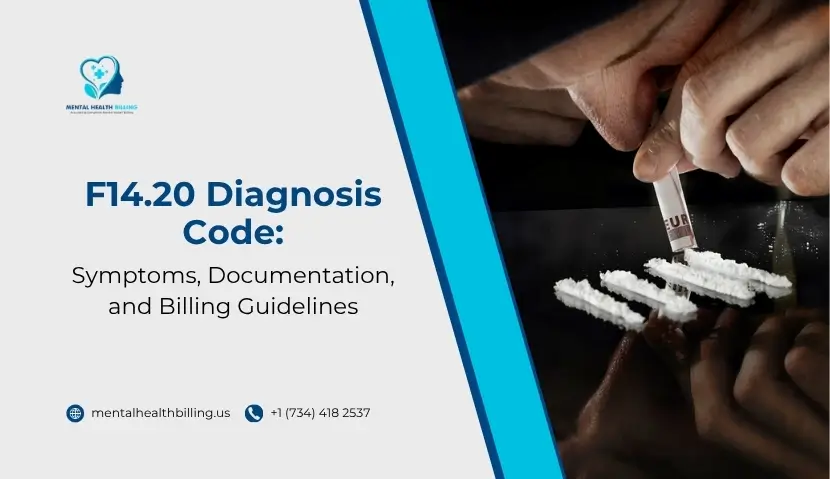
F14.20 Diagnosis Code: Symptoms, Documentation, and Billing Guidelines

Accurate behavioral health coding can mean the difference between a clean claim and a months-long appeal. For providers treating patients with cocaine addiction, F14.20 sits at the center of that accuracy.

Read More
F12.20 Diagnosis Code Meaning, Description, and Clinical Guidelines.jpg

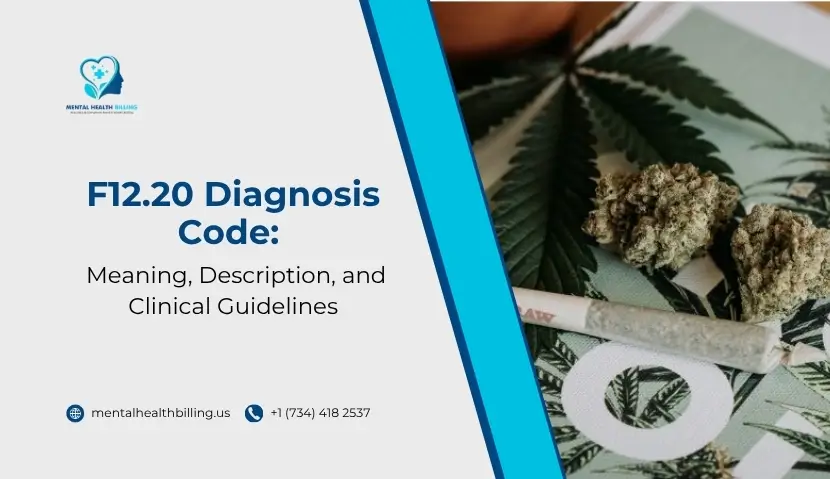
F12.20 Diagnosis Code: Meaning, Description, and Clinical Guidelines

F12.20 is the ICD-10-CM code for cannabis dependence, uncomplicated. It lives inside category F12, the block the National Center for Health Statistics and the Centers for Medicare and Medicaid Services use

Read More
F11.20 Diagnosis Code Billing Guidelines and Documentation Requirements

F11.20 Diagnosis Code: Billing Guidelines and Documentation Requirements

The F11.20 diagnosis code represents “Opioid dependence, uncomplicated” in the ICD-10-CM classification system. Healthcare providers and medical billers use this specific alphanumeric string to classify patients with moderate to severe opioid

Read More
F10.20 ICD-10 Code Symptoms, Clinical Criteria, and Billing Guidelines.jpg

F10.20 ICD-10 Code: Symptoms, Clinical Criteria, and Billing Guidelines

Accurate medical coding ensures appropriate patient care and predictable reimbursement cycles. Healthcare providers use the F10.20 ICD-10 code to classify alcohol dependence, uncomplicated. This specific alphanumeric string belongs to Chapter 5

Read More
F91.3 Diagnosis Code Explained Symptoms, Documentation, and Billing Guidelines .jpg

F91.3 Diagnosis Code Explained: Symptoms, Documentation, and Billing Guidelines

A clinician writes “oppositional defiant disorder” in a progress note. The biller then has to translate that phrase into a single code: F91.3. That translation looks straightforward until a claim comes

Read More
F90.1 Diagnosis Code Symptoms, Billing & Documentation

F90.1 Diagnosis Code Explained: Symptoms, Billing and Documentation Guide

Medical billers and healthcare providers encounter the F90.1 diagnosis code when processing claims for specific behavioral health conditions. The ICD-10-CM manual defines F90.1 as Attention-deficit hyperactivity disorder, predominantly hyperactive type. Accurate

Read More
F90.0 Diagnosis Code Explained ADHD Predominantly Inattentive Type

F90.0 Diagnosis Code Explained: ADHD Predominantly Inattentive Type

The Centers for Disease Control and Prevention reports that millions of children and adults carry an attention-deficit hyperactivity disorder diagnosis. The ICD-10-CM manual provides specific alphanumeric codes to classify this neurodevelopmental

Read More
F43.23 Diagnosis Code Explained Symptoms, Documentation, and Billing Guidelines

F43.23 Diagnosis Code Explained: Symptoms, Documentation, and Billing Guidelines

ICD-10 code F43.23 classifies Adjustment Disorder with Mixed Anxiety and Depressed Mood. The Diagnostic and Statistical Manual of Mental Disorders, Fifth Edition, Text Revision (DSM-5-TR) categorizes this condition under trauma and

Read More
F43.0 Acute Stress Reaction Billing, Coding, and Clinical Documentation Explained

F43.0 Acute Stress Reaction: Billing, Coding, and Clinical Documentation Explained

The ICD-10-CM code F43.0 designates an acute stress reaction. Medical coders and healthcare providers frequently encounter this diagnosis in emergency departments, primary care clinics, and outpatient psychiatric facilities. Accurate application of

Read More