



SAMHSA’s 2024 National Survey on Drug Use and Health, released in July 2025, found that 23.4% of U.S. adults (61.5 million people) had a mental illness in the past year, and that 52.1% of them received any treatment. Practices that treat these patients in the exam room have to bill the work accurately, and PCP mental health billing rests on three families of codes: screening, same-day psychotherapy, and monthly care management. Each has its own time rules, documentation requirements, and payer traps.
PCP mental health billing: three code families
Screening codes pay for a scored instrument. Therapy delivered by the billing practitioner during an E/M visit falls under the add-on psychotherapy codes. Monthly work done mostly by clinical staff between visits belongs to the care management codes.
| Family | Codes | What is paid for | Time rule |
|---|---|---|---|
| Screening | 96127, G0444 | A scored instrument such as the PHQ-9; Medicare’s annual depression screen | None for 96127; up to 15 minutes for G0444 |
| Same-day psychotherapy | 90833, 90836, 90838 | Psychotherapy by the billing practitioner, added to an E/M | 16 to 37, 38 to 52, or 53+ minutes |
| Monthly care management | 99484, 99492, 99493, 99494, G2214 | Staff time under the practitioner’s direction | 20 minutes; 70, 60, and each added 30; 30 |
Screening codes: 96127 and G0444
CPT 96127 is reported per standardized instrument, so a PHQ-9 and a GAD-7 given at one visit count as two units, subject to the payer’s daily limit. If a significant, separately identifiable E/M service happens the same day, many payers expect modifier 25 on the E/M line. Z13.31 fits a patient screened without a known diagnosis. A patient already treated for depression is being monitored, so the claim carries that diagnosis instead.
Medicare handles depression screening through its own pathway. National Coverage Determination 210.9, effective October 14, 2011, covers one annual screening in a primary care setting with staff-assisted depression care supports, meaning clinical staff who can report results to the physician and help arrange treatment or referral. The code is G0444, and 11 full months must pass after the month of the last screening before the next one is payable. The deductible and coinsurance are waived. The American Medical Association’s Ed Hub notes that CMS does not require the minutes to be documented.
Psychotherapy add-on codes with an E/M visit
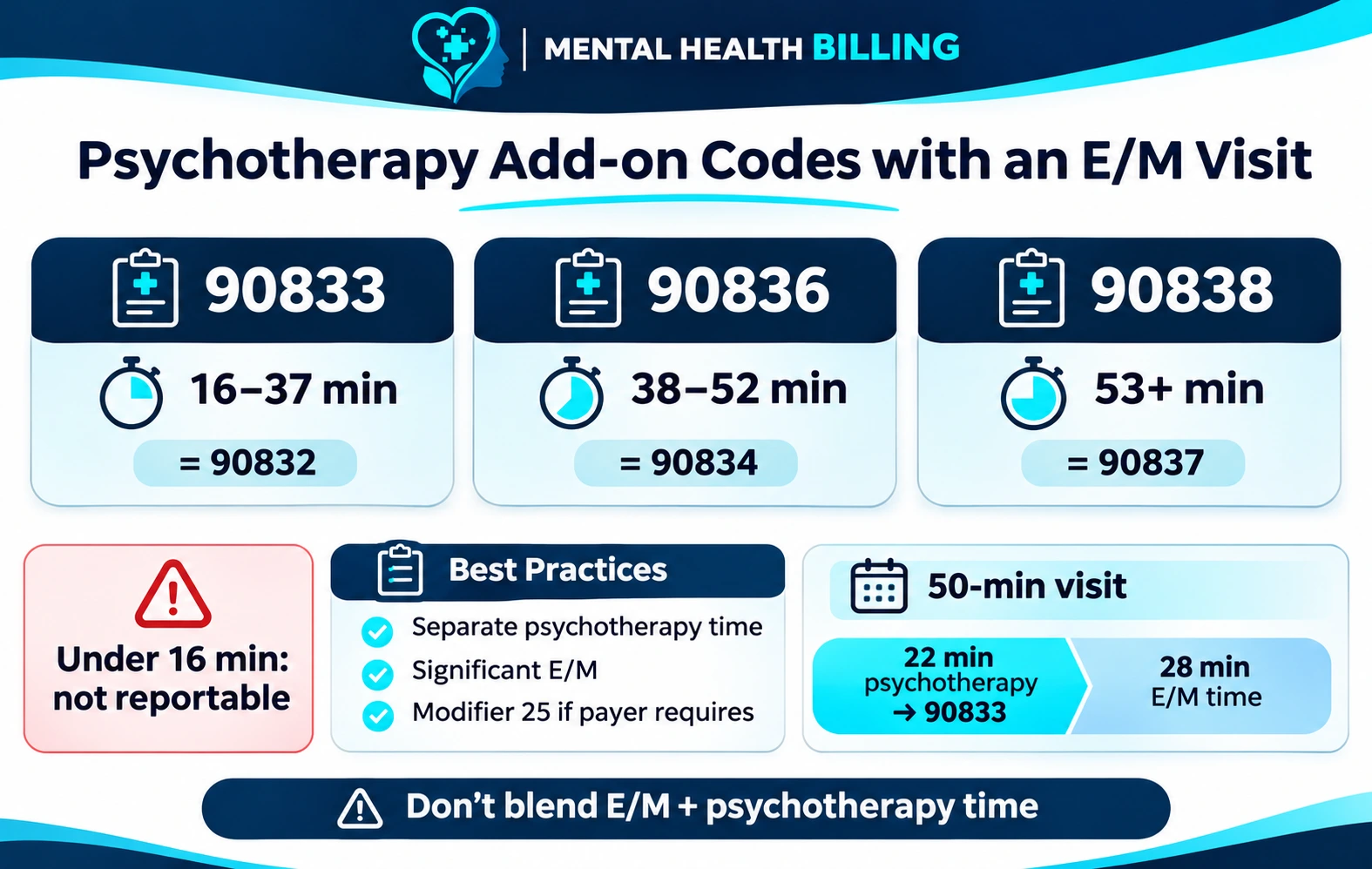
A PCP who provides psychotherapy during the same visit reports an E/M code plus one add-on, chosen by psychotherapy minutes.
| Add-on code | Psychotherapy time | Stand-alone equivalent |
|---|---|---|
| 90833 | 16 to 37 minutes | 90832 |
| 90836 | 38 to 52 minutes | 90834 |
| 90838 | 53 minutes or more | 90837 |
Sessions under 16 minutes are not reportable, and the E/M must be significant and separately identifiable, according to Medicare contractor First Coast Service Options. Blended time is the common failure. The American Academy of Family Physicians’ Family Practice Management blog, citing a CMS quarterly newsletter, describes a claim for 99213 plus 90836 supported by one 45-minute entry. The contractor treated the payment as an overpayment and recouped it.
Here is how the arithmetic works. A visit runs 50 minutes, and the note documents 22 minutes of psychotherapy. Those 22 minutes support 90833. Only the remaining 28 minutes can count toward an E/M level chosen by time, which misses the 30 minutes required for 99214 and supports 99213 (20 minutes). Choosing the E/M level by medical decision making avoids the subtraction, but the psychotherapy minutes still need their own line in the note. Some payers also require modifier 25 on the E/M; confirm each plan’s policy.
Behavioral health integration codes for monthly care management
These codes pay for work between visits. Medicare’s booklet Behavioral Health Integration Services (MLN909432, April 2025) sets the structure.
Psychiatric collaborative care (CoCM) uses a team of three: the billing practitioner, a behavioral health care manager, and a psychiatric consultant who usually works remotely and is not expected to see the patient. CPT 99492 requires 70 minutes of care manager time in the first month, 99493 requires 60 minutes in later months, and 99494 adds each extra 30 minutes. Under the CPT time rule, American Psychiatric Association guidance says 99492 can be billed at 36 minutes and 99493 at 31. General BHI (99484) needs 20 minutes of clinical staff time and no psychiatric consultant. G2214 covers 30 minutes of care manager time in a month that misses the CPT thresholds, such as one interrupted by a hospitalization. Clinical psychologists and clinical social workers report G0323 for 20 minutes of their own time.
CMS also lists the billing practitioner time assumed behind each code: 30 minutes for 99492, 26 for 99493, 13 per 99494 increment, and 15 for 99484.
Three conditions apply before the first claim. New patients, and patients not seen in the prior year, need an initiating visit. Verbal consent must be documented, and the patient must be told that cost sharing applies. Psychotherapy minutes and administrative or clerical minutes cannot count toward care management time.
The clinical case rests on the IMPACT trial, published in JAMA in 2002 across 18 primary care clinics in five states. At 12 months, nearly half of collaborative care patients had at least a 50% reduction in depressive symptoms, against 19% under usual care, according to the University of Washington AIMS Center, which counts more than 90 randomized trials since.
2026 advanced primary care management add-ons
For 2026, CMS added HCPCS G0568, G0569, and G0570. MLN Matters article MM14315 (December 2025) describes them as optional add-ons to the advanced primary care management codes G0556 through G0558, billed by the same practitioner in the same month and meant to be comparable to CoCM and general BHI services. They carry no time requirement and do not replace 99492 through 99494.
Documentation that holds up in a records request
First Coast Service Options states that the record must show the length of the psychotherapy encounter, and it identifies missing face-to-face time as a concern in CERT data. The same discipline applies across all three families:
- Psychotherapy add-ons: total psychotherapy minutes, written apart from E/M time, with the intervention and the patient’s response.
- Screening: the instrument name, the score, and the plan the score produced.
- Care management: the initiating visit date, documented consent, a time log by staff member, and for CoCM, evidence of the weekly caseload review with the psychiatric consultant.
- Diagnosis: the condition the note supports, which may differ from the screening code on the same claim.
Reimbursement in 2026 and what changes in 2027
Medicare’s 2026 conversion factors are $33.4009 for most clinicians and $33.5675 for qualifying advanced APM participants, increases of 3.26% and 3.77% over 2025, according to the CY 2026 final rule CMS released on October 31, 2025. Both include a one-year 2.5% increase under Public Law 119-21 that expires after December 31, 2026. The CY 2027 proposed rule (July 14, 2026) set the factors at $32.8409 and $33.1693, drops of 1.68% and 1.19%. CMS has since issued the final 2027 rule, so load the finalized factors, not the proposed ones.
The 2026 efficiency adjustment trimmed work RVUs by 2.5% for non-time-based services, and Holland & Knight’s November 12, 2025 analysis confirms that time-based codes were excluded. Payment for each code still varies by locality, so pull figures from the CMS Physician Fee Schedule Look-Up Tool for your Medicare Administrative Contractor.
Medicare telehealth flexibilities run through December 31, 2027 after Congress extended them on February 3, 2026, according to the American College of Physicians, and the in-person visit requirement for Medicare tele-mental health does not take effect before January 1, 2028.
Commercial plans pay by contract, and many carve out mental health. KFF Health News reported in June 2022 that insurers began adopting behavioral health carve-outs in the 1980s, and that a medical plan can deny a claim as a behavioral health service while the carve-out vendor denies the same claim as a physical health one. Peter Liepmann, a California family physician, told the outlet he had at one point reported depression as fatigue to get paid. That workaround separates the claim from the record. Confirm in writing, plan by plan, whether mental health is carved out and whether the practice is credentialed with the vendor before billing a psychotherapy add-on or 99484.
What a clean PCP mental health billing claim contains
A screening claim shows one unit per scored instrument. A psychotherapy add-on shows at least 16 minutes, recorded apart from the E/M time. A care management claim shows an initiating visit within the prior year, documented consent, and a staff log that reaches 20, 70, or 60 minutes as the code requires. For 2026 dates of service, CoCM still bills under 99492 through 99494, G0568 through G0570 sit on top of APCM, and the Medicare conversion factor is $33.4009 for most clinicians. Dates of service from January 1, 2027 fall under the finalized 2027 factors.