01
Clinical criteria and required timelines
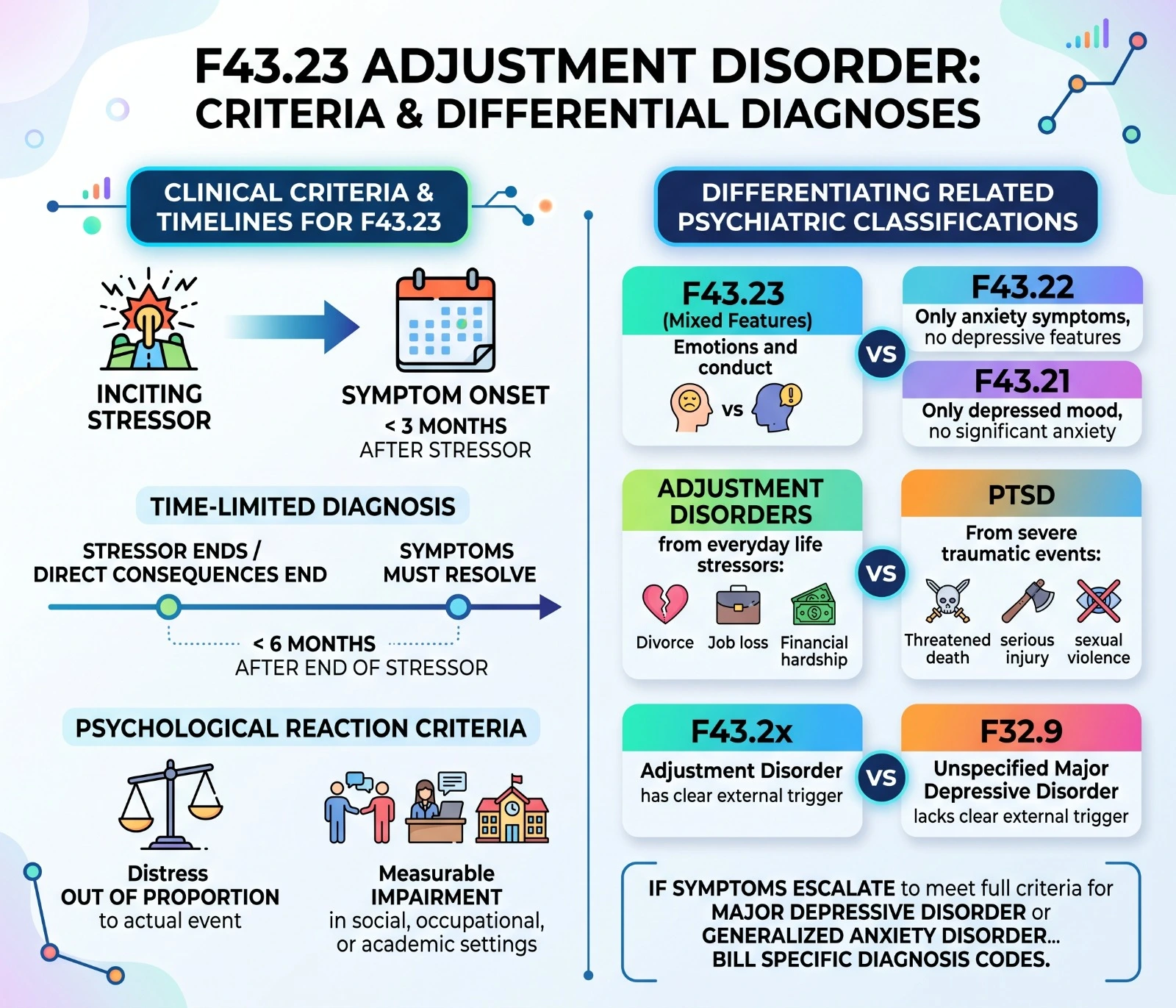
To bill F43.23, the patient's symptom onset must follow a strict timeline.
The symptoms must appear within three months of the inciting stressor.
Within Three Months
The symptoms must appear within three months of the inciting stressor.
Six-Month Limitation
Once the stressor or its direct consequences end, the patient's symptoms
must resolve within six months.
The diagnosis is intentionally time-limited. Once the stressor or its direct consequences
end, the patient's symptoms must resolve within six months. The psychological reaction
must also cause distress that is entirely out of proportion to the actual event, or it
must lead to measurable impairment in social, occupational, or academic settings.
02
Differentiating related psychiatric classifications
Medical coders and providers must differentiate this code from similar psychiatric
classifications to prevent claim denials.
| Code / Condition |
Key Distinction |
| F43.22 |
Applies only when anxiety symptoms are present without depressive features. |
| F43.21 |
Applies strictly to a depressed mood without significant anxiety. |
| F32.9 |
Applies to an unspecified major depressive disorder lacking a clear external trigger. |
| PTSD |
PTSD stems from exposure to a severe traumatic event involving actual or threatened
death, serious injury, or sexual violence.
|
Providers must also distinguish adjustment disorders from Post-Traumatic Stress Disorder (PTSD).
PTSD stems from exposure to a severe traumatic event involving actual or threatened death,
serious injury, or sexual violence. Adjustment disorders originate from everyday life stressors,
such as a divorce, job loss, or sudden financial hardship.
If a patient's symptoms escalate to meet the full criteria for a Major Depressive Disorder or
Generalized Anxiety Disorder, the provider must bill those specific diagnosis codes.
03
Epidemiology and high-risk populations
A 2024 report published by Blueprint AI provides specific data on the prevalence of adjustment
disorders across different demographic groups. The condition affects an estimated 2% to 8% of
the general global population.
General Population
The condition affects an estimated 2% to 8% of the general global population.
Pediatric Populations
Among pediatric populations, the prevalence of adjustment disorders ranges from
14% to 34.4%.
Medical Patients
Medical patients also represent a high-risk group. Up to 19% of oncology patients
develop an adjustment disorder following a cancer diagnosis.
DSM-5 Structure
Prior to the release of the DSM-5, adjustment disorders existed in an isolated
diagnostic category.
A 2016 article published in Psychiatric News explained how the American Psychiatric
Association moved the condition into the broader group of trauma and stress-related disorders.
This structural change forces clinicians to establish a direct causal link between an external
event and the patient's psychological response.
04
Standardized documentation requirements
Insurance auditors frequently target adjustment disorder claims due to vague clinical
documentation. Progress notes for F43.23 must accomplish specific tasks.
According to a 2026 guide published by the Clinical Docs Library, therapists must anchor
every session note directly to the specific stressor. Vague phrases such as "life stress"
or "multiple stressors" fail to meet the standard for this diagnostic code.
When formatting documentation templates in an Electronic Health Record (EHR) system,
clinical administrators frequently use H2 and H3 HTML formatting tags to visually separate
the patient's subjective narrative from the provider's objective clinical measurements.
This hierarchical structure reduces auditor confusion and ensures all mandatory billing
elements are captured.
A compliant progress note requires four specific elements:
1
Stressor identification
The clinical note must name the specific event (a recent job termination,
a medical diagnosis, a breakup) and record the exact date it occurred.
2
Symptom measurement
Providers must track subjective symptoms using standardized evaluation tools.
Administering the PHQ-9 for depression and the GAD-7 for anxiety provides
objective data proving symptom severity. The note must list specific symptoms,
such as tearfulness, sleep changes, and excessive worry.
3
Functional impairment
Documentation must list exact areas of daily life disrupted by the symptoms.
The provider should record if the patient missed three days of work, stopped
attending college classes, or withdrew from family interactions.
4
Coping skill progression
The treatment narrative must prove the provider is teaching the patient specific
coping mechanisms. Notes should demonstrate that the patient is learning and
applying these skills to manage the specific stress response.
05
Contrasting clinical note examples
The difference between a denied claim and a paid claim often comes down to specific phrasing.
Non-compliant note
"The patient is feeling stressed about life and seems sad today. We discussed their
feelings. The patient will return next week."
This example fails because it lacks a specific stressor, timeline, objective measurements,
and functional impairment details.
Compliant note
"The patient reports daily crying spells and severe anxiety regarding the sudden loss
of their engineering job on October 1st. Symptoms began within two weeks of the termination.
The patient scored a 14 on the PHQ-9 and a 12 on the GAD-7. The patient has missed two
mortgage payments due to avoidance behaviors regarding their job search, causing severe
functional impairment. Today's session focused on cognitive restructuring to challenge
negative beliefs about their employability."
This example explicitly justifies the use of F43.23 by fulfilling every DSM-5-TR requirement.
06
Treatment planning and clinical interventions
Clinical interventions for adjustment disorders focus on short-term problem-solving.
Cognitive Behavioral Therapy (CBT) is widely used to help patients identify and challenge
negative thought patterns regarding the specific stressor. Providers also utilize mindfulness
techniques, progressive muscle relaxation, and supportive therapy to reduce acute physical
anxiety symptoms.
Because F43.23 implies a temporary condition, the treatment plan requires specific,
time-bound goals.
A 2026 case study document published on Scribd outlines standard CBT goals for an adjustment
disorder triggered by a job loss. The clinical goals include:
-
Reducing subjective feelings of sadness and anxiety to a 2 on a 10-point scale
within 12 therapy sessions.
-
Processing the emotional loss associated with the specific life change.
-
Developing a concrete, structured plan to resolve the stressor
(e.g., networking with three people per week).
-
Re-establishing personal identity through non-work-related activities.
07
Billing guidelines and CPT code pairing
Medical billers pair F43.23 alongside standard psychiatric CPT codes. Mental health
professionals, including psychiatrists, psychologists, licensed clinical social workers,
and licensed professional counselors, are qualified to use this diagnosis code.
The most common CPT codes billed with F43.23 are time-based individual psychotherapy codes.
The specific code depends on the exact length of the therapy session.
90791
Psychiatric Diagnostic Evaluation — used for the initial intake.
90832
Psychotherapy, 30 minutes. The session must last between
16 and 37 minutes.
90834
Psychotherapy, 45 minutes. The session must last between
38 and 52 minutes.
90837
Psychotherapy, 60 minutes. The session must last 53 minutes
or longer.
Providers may also use add-on codes, such as 90833, for psychotherapy sessions conducted
alongside an Evaluation and Management (E/M) service.
08
2025 Medicare reimbursement rates
Reimbursement amounts vary heavily based on the patient's insurance type, geographic location,
and provider credentials. Private insurance companies typically reimburse between $100 and
$150 per session for therapy billed under this diagnosis code. Medicaid rates average
approximately $75 per session.
According to a 2025 report published by 24/7 Medical Billing Services, Medicare updated
its reimbursement schedule for mental health services.
| CPT Code |
Service Description |
2025 Estimated Medicare Rate |
| 90791 |
Psychiatric Diagnostic Evaluation |
$166.91 |
| 90832 |
Individual Psychotherapy (30 minutes) |
$78.93 |
| 90834 |
Individual Psychotherapy (45 minutes) |
$104.16 |
| 90837 |
Individual Psychotherapy (60 minutes) |
$154.29 |
Telehealth Services
Telehealth services also apply to this diagnosis. Data from a 2025 Cloud RCM Solutions
report indicates that Medicare reimburses CPT code 99443 (Telehealth psychotherapy,
30 minutes or more) at a rate of $75.00.
09
Compliance risks and billing denials
Billing for adjustment disorders carries specific audit risks. Failing to update the
diagnosis code is the most frequent cause for denied claims.
If the identifiable stressor has ended and six months have passed, the F43.23 diagnosis
is no longer medically valid. Providers must reassess the patient at the six-month mark.
If psychological symptoms persist beyond this window, the billing provider must take one
of two actions. They must either discharge the patient if the symptoms have resolved,
or they must change the diagnosis to a chronic condition, such as Generalized Anxiety
Disorder, supported by a clear clinical rationale.
Documentation Matters
Neglecting follow-up documentation will trigger insurance audits. Copying and pasting
the exact same symptoms across multiple weekly sessions suggests that the provider is
not actively tracking the patient's recovery. If a patient's situation evolves, the
medical record must reflect these changes to justify continued insurance coverage.
Furthermore, overlooking a patient's past medical history leads to misdiagnosis. If a
patient has a documented, long-standing history of severe anxiety prior to the new stressor,
the provider must evaluate whether an exacerbation of a chronic anxiety disorder is a more
accurate primary diagnosis than a temporary adjustment disorder.
Summary of requirements
ICD-10 code F43.23 requires strict documentation of a specific, recent stressor that
triggers both anxious and depressive symptoms. The symptoms must begin within three months
of the event and resolve within six months of the stressor ending. Providers must explicitly
track functional impairment and symptom reduction using standardized measurements.
Accurate medical billing pairs this diagnosis with time-based psychotherapy CPT codes,
yielding a 2025 Medicare reimbursement rate of $104.16 for a standard 45-minute therapy
session. Updating the diagnosis after six months prevents insurance audits and ensures
accurate patient records.