


F90.1 Diagnosis Code Explained: Symptoms, Billing and Documentation Guide
Medical billers and healthcare providers encounter the F90.1 diagnosis code when processing claims for specific behavioral health conditions. The ICD-10-CM manual defines F90.1 as Attention-deficit hyperactivity disorder, predominantly hyperactive type. Accurate application of this code requires understanding the clinical criteria separating it from other ADHD classifications. This guide examines the specific symptoms, documentation standards, and billing protocols required to properly submit claims using F90.1.
Clinical definition of the F90.1 diagnosis code
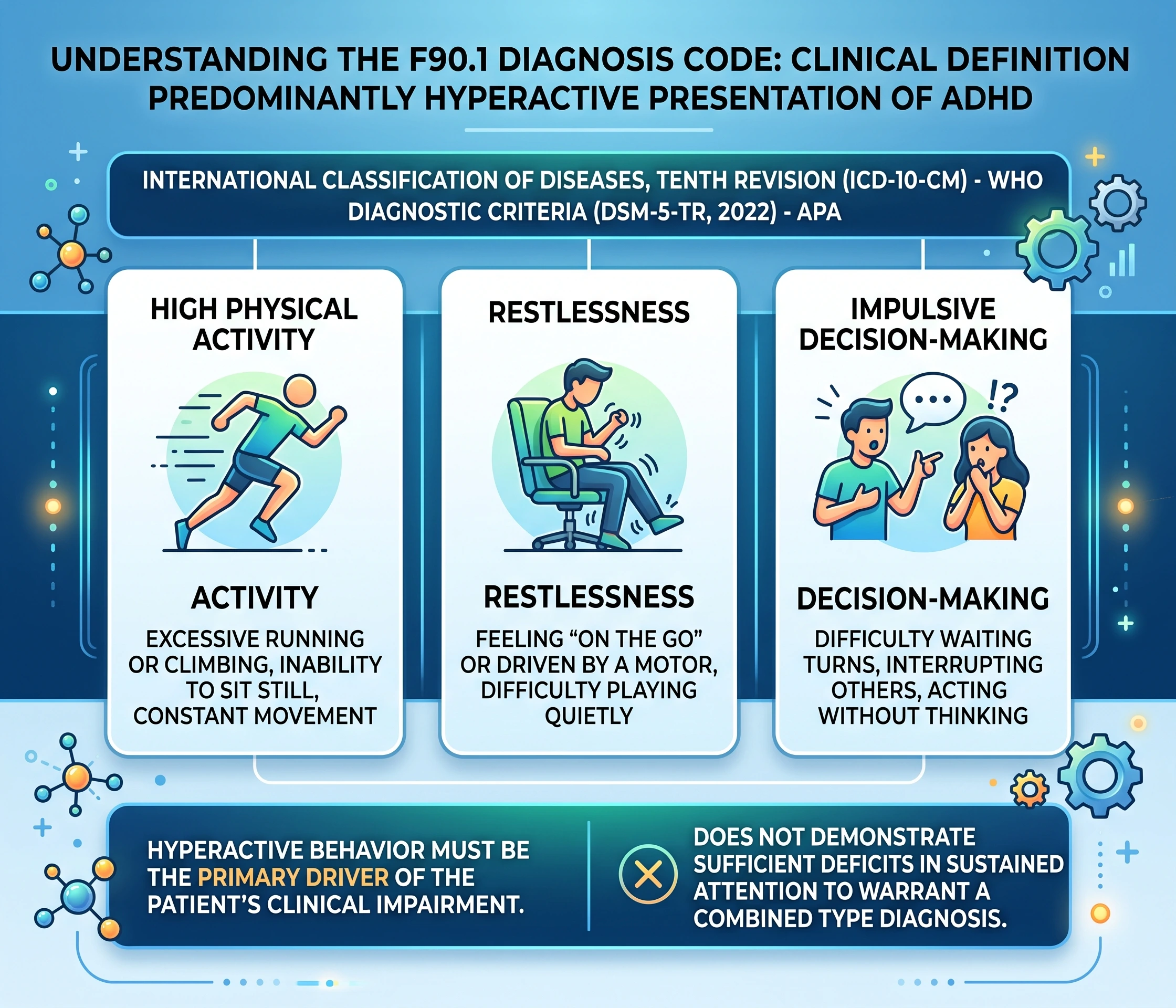
The World Health Organization maintains the International Classification of Diseases, Tenth Revision, Clinical Modification (ICD-10-CM). Within this framework, the F90 category covers hyperkinetic disorders. F90.1 applies exclusively to the predominantly hyperactive presentation of ADHD.
The American Psychiatric Association outlines the diagnostic criteria for this condition in the Diagnostic and Statistical Manual of Mental Disorders, Fifth Edition, Text Revision (DSM-5-TR), published in 2022. Patients assigned the F90.1 code exhibit high levels of physical activity, restlessness, and impulsive decision-making.
They do not demonstrate sufficient deficits in sustained attention to warrant a combined type diagnosis. The hyperactive behavior must be the primary driver of the patient’s clinical impairment.
Historical context of ADHD diagnostic coding
The healthcare industry in the United States transitioned from ICD-9 to ICD-10 on October 1, 2015. This regulatory change significantly altered how medical coders reported behavioral health conditions. Under the previous ICD-9 system, providers used code 314.01 to indicate attention deficit disorder with hyperactivity.
The ICD-10 implementation introduced a higher level of granularity. The F90 category forced providers to classify the exact nature of the disorder based on updated psychiatric standards. This transition required clinical staff to adopt more precise documentation habits.
A provider who continued to write generic “ADHD” notes after 2015 caused their billing department to rely heavily on the F90.9 unspecified code. Insurance payers track the utilization of unspecified codes. Medical practices that report high volumes of F90.9 often face targeted chart reviews from insurance networks.
Recognizing F90.1 symptoms in clinical settings
Physicians must document specific behavioral patterns to meet the criteria for F90.1. The DSM-5-TR requires the presence of six or more hyperactive-impulsive symptoms for children up to age 16. Individuals aged 17 and older must present at least five symptoms.
These behaviors must persist for a minimum of six months.
Providers should document evidence of the following behaviors to support the diagnosis:
- Fidgeting with hands or feet, or squirming in seats.
- Leaving a seat in situations where remaining seated is expected.
- Running or climbing in inappropriate situations.
- Experiencing subjective feelings of intense restlessness (primarily in adolescents and adults).
- Inability to play or engage in leisure activities quietly.
- Acting as if driven by a motor.
- Talking excessively during inappropriate times.
- Blurting out answers before questions have been completed.
- Experiencing difficulty waiting for a turn in lines or games.
- Interrupting or intruding on others during conversations.
Symptoms must be present in two or more environments. A child who only exhibits hyperactivity at school does not meet the diagnostic criteria for F90.1. Providers typically gather data from parents, teachers, and direct clinical observation to confirm the presence of symptoms across multiple settings.
Distinguishing F90.1 from other ADHD classifications
Medical coders frequently encounter provider notes that state “ADHD” without further clarification. Using the correct code requires matching the clinical documentation to the exact presentation type.
|
ICD-10-CM Code |
Description |
Clinical Documentation Requirement |
|
F90.0 |
Attention-deficit hyperactivity disorder, predominantly inattentive type |
Symptoms focus on distractibility, lack of focus, and poor organization. |
|
F90.1 |
Attention-deficit hyperactivity disorder, predominantly hyperactive type |
Symptoms focus on excessive movement, impulsivity, and restlessness. |
|
F90.2 |
Attention-deficit hyperactivity disorder, combined type |
Patient meets full criteria for both inattentive and hyperactive presentations. |
|
F90.9 |
Attention-deficit hyperactivity disorder, unspecified type |
Provider notes confirm ADHD but fail to identify the specific presentation. |
Documentation requirements for the F90.1 diagnosis code
Auditors from insurance companies regularly review patient charts to ensure the assigned diagnosis codes match the clinical documentation. To support an F90.1 diagnosis, the medical record must establish a clear history of hyperactive and impulsive behaviors.
The American Academy of Pediatrics published clinical practice guidelines in 2019 regarding the assessment of ADHD. These guidelines dictate that primary care clinicians should initiate an evaluation for any child aged 4 to 18 who presents with academic or behavioral problems and symptoms of hyperactivity.
A complete chart note for F90.1 contains several specific elements. The provider must document the age of onset. DSM-5-TR criteria mandate that several hyperactive-impulsive symptoms must be present before age 12.
The notes must detail the specific settings where symptoms occur, such as home, school, or work. The provider should also include scores from validated measurement tools, such as the Vanderbilt Assessment Scales or the Conners rating scales.
Coders cannot assume a specific type of ADHD based on prescribed medications. Even if a provider prescribes a stimulant medication commonly used to treat hyperactivity, the coder cannot assign F90.1 unless the provider explicitly writes “predominantly hyperactive type” or lists the specific hyperactive symptoms in the assessment and plan section of the encounter note.
Documenting pharmacological management for F90.1
Patients diagnosed with the F90.1 diagnosis code frequently receive prescriptions for central nervous system stimulants. Medical coders must look for specific details when a provider bills for pharmacological management. The medical record must identify the specific medication, the current dosage, and the frequency of administration.
Providers must also record the patient’s physiological response to the medication. Stimulant medications affect a patient’s cardiovascular system and appetite. A compliant medical chart for an F90.1 follow-up visit will include the patient’s blood pressure, heart rate, and weight.
The provider should note any adverse side effects, such as insomnia or decreased appetite. Documenting these physical parameters justifies the medical necessity of the ongoing office visits and supports the assigned Evaluation and Management (E&M) code.
Billing guidelines and CPT code pairings
Reimbursement depends on pairing the F90.1 diagnosis code with appropriate Current Procedural Terminology (CPT) codes. Healthcare providers evaluate and manage patients with hyperactive ADHD through various service types.
Psychiatric diagnostic evaluations often occur during the initial assessment. Providers bill CPT code 90791 for evaluations that do not include medical services. When a physician or psychiatric nurse practitioner performs a medical evaluation alongside the behavioral assessment, they use CPT code 90792.
Ongoing treatment typically involves E&M codes ranging from 99202 to 99215. The selection of the exact E&M code depends on the complexity of the medical decision-making or the total time spent with the patient on the date of the encounter.
Managing F90.1 frequently involves prescribing controlled substances. The Centers for Medicare & Medicaid Services (CMS) require providers to document the medical necessity of these prescriptions. Chart notes must detail medication efficacy, side effects, dosage adjustments, and patient compliance. If a provider bills a high-level E&M code (such as 99214 or 99215) for a routine medication refill without documenting a complex medical decision or extended time, insurance payers often downcode the claim.
Managing F90.1 in telehealth environments
The expansion of digital healthcare has changed how providers diagnose and treat behavioral health conditions. Billing for F90.1 via telehealth requires specific modifiers and place of service (POS) indicators.
Commercial payers and federal programs maintain different rules for telehealth reimbursement. Providers conducting synchronous audiovisual appointments typically append modifier 95 to the CPT code. The POS code tells the insurance company where the patient was located during the visit. POS 10 indicates the patient was in their home during the telehealth encounter. POS 02 indicates the patient was located outside of their home (such as a separate medical clinic) during the telehealth service.
Evaluating hyperactive symptoms through a video screen presents clinical challenges. Providers must document their observations of the patient’s behavior during the digital encounter. If the patient fidgets, leaves the camera view frequently, or interrupts the provider, these physical actions support the F90.1 diagnosis.
Common reasons for F90.1 claim denials
Medical billing staff spend significant time appealing denied claims related to behavioral health codes. Several specific errors lead to claim rejections for F90.1.
Insurance companies frequently deny claims when the diagnosis code lacks specificity. If a provider’s documentation only supports F90.9 (unspecified type), but the biller submits F90.1, the payer will deny the claim upon chart review.
Another common reason for denial involves missing prior authorizations. Many commercial insurance plans require prior authorization for psychological testing or extended psychiatric evaluations. Billers must verify benefits and secure authorization before the patient arrives for the appointment.
Denials also occur when primary care providers fail to use appropriate screening codes. Providers administering standard ADHD questionnaires should bill CPT code 96127 (Brief emotional/behavioral assessment). If this code is billed without the corresponding documentation of the instrument used and the patient’s numerical score, the payer will refuse reimbursement.
Coding accuracy and patient history
Accurate medical coding impacts more than immediate financial reimbursement. The F90.1 code becomes a permanent part of the patient’s medical history. When a patient transitions from a pediatrician to an adult care provider, the historical diagnosis codes inform the new provider about the patient’s specific presentation.
Adults with F90.1 present differently than children. While a child might run around a classroom, an adult with predominantly hyperactive ADHD might experience internal restlessness, talk excessively during meetings, or make impulsive financial decisions. Providers must adjust their documentation to reflect age-appropriate symptoms while still meeting the criteria for F90.1.
Incorrectly labeling a patient with F90.2 (combined type) when they solely exhibit hyperactive symptoms creates a false medical narrative. Accurate coding ensures continuity of care and protects the provider during compliance audits.
Verifying clinical compliance for F90.1
Medical practices should conduct regular internal audits of their behavioral health claims. Billers and coders should select a random sample of claims submitted with the F90.1 diagnosis code and compare them against the provider’s notes.
The auditor should look for explicit mentions of hyperactivity or impulsivity. They should verify that the symptom duration exceeds six months. The auditor must also check that the provider documented the impact of these symptoms on the patient’s daily life.
If a practice discovers a pattern of providers using F90.1 without sufficient supporting details, the coding department should provide targeted education to the clinical staff regarding DSM-5-TR requirements.
Final review of F90.1 documentation standards
Proper utilization of the F90.1 diagnosis code requires strict alignment between clinical observations and coding guidelines. Medical billers rely on providers to document specific hyperactive and impulsive behaviors that persist for at least six months and impact multiple areas of a patient’s life. By recording precise symptoms, utilizing validated rating scales, and detailing pharmacological treatment plans, healthcare organizations secure accurate reimbursement and maintain factual clinical histories.