


F91.3 Diagnosis Code Explained: Symptoms, Documentation, and Billing Guidelines
A clinician writes “oppositional defiant disorder” in a progress note. The biller then has to translate that phrase into a single code: F91.3. That translation looks straightforward until a claim comes back denied for insufficient specificity, or an auditor flags a chart where the diagnosis doesn’t match the documented severity.
The F91.3 diagnosis code appears constantly in pediatric and adolescent behavioral health billing, and it carries more nuance than four characters would suggest. This guide covers what the code represents, the DSM-5-TR criteria a provider needs to document to support it, and the billing details that keep F91.3 claims from bouncing back.
What is the F91.3 diagnosis code?
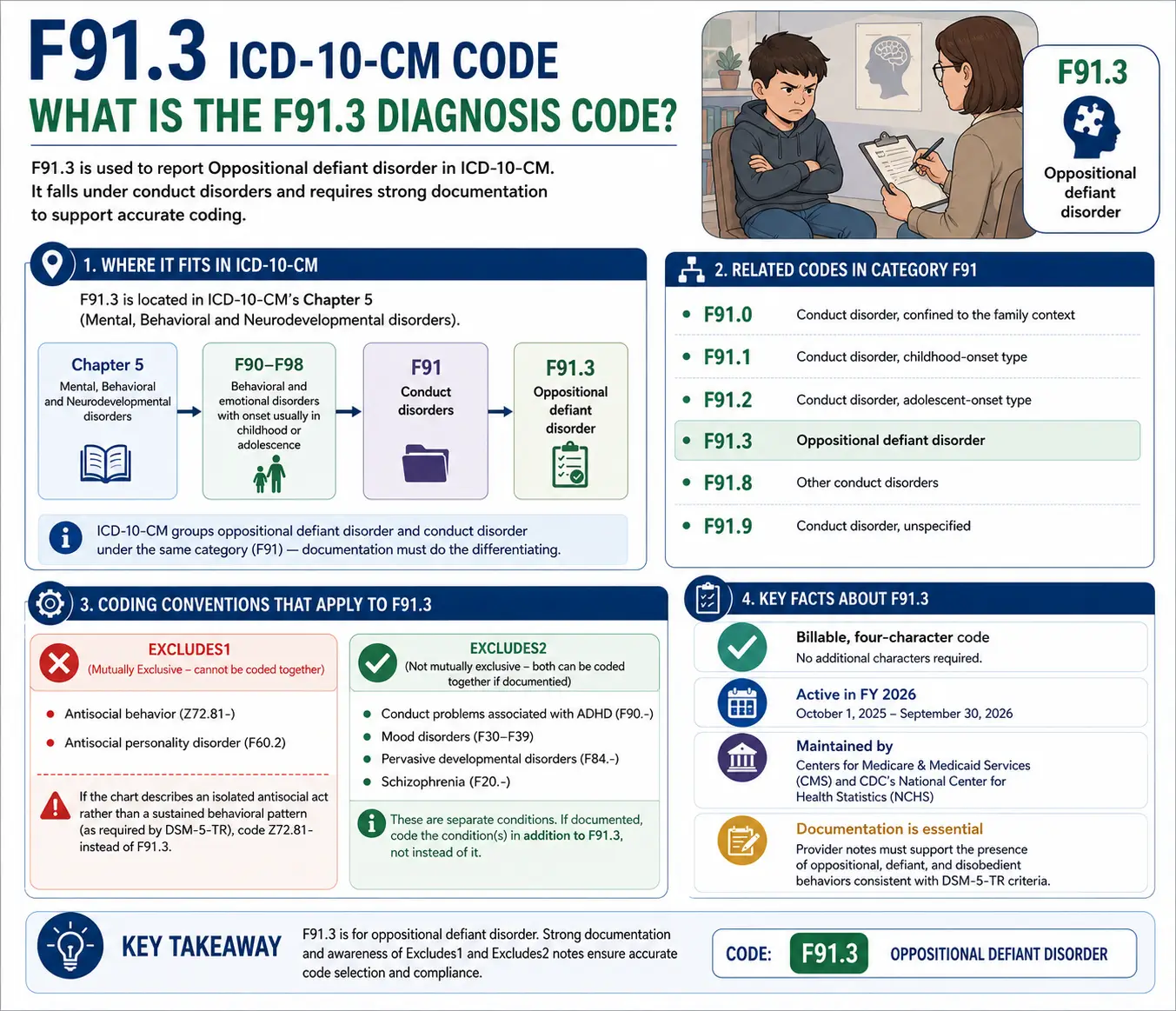
F91.3 sits in ICD-10-CM’s Chapter 5 (Mental, Behavioral and Neurodevelopmental disorders), inside the F90 to F98 block covering behavioral and emotional disorders that usually begin in childhood or adolescence. More specifically, it belongs to category F91, Conduct disorders, alongside F91.0 (confined to the family context), F91.1 (childhood-onset type), F91.2 (adolescent-onset type), F91.8 (other conduct disorders), and F91.9 (unspecified).
That placement confuses coders at first glance. DSM-5-TR treats oppositional defiant disorder and conduct disorder as separate diagnoses with separate criteria sets. ICD-10-CM groups them under one category regardless. When a chart references both terms, the code structure will not do the differentiating work; the documentation has to.
F91.3 is a billable, four-character code, active in the fiscal year 2026 code set (October 1, 2025 through September 30, 2026), maintained jointly by the Centers for Medicare & Medicaid Services and the CDC’s National Center for Health Statistics.
Two coding conventions apply directly to F91.3:
- Excludes1 (mutually exclusive, cannot be coded together): antisocial behavior (Z72.81-) and antisocial personality disorder (F60.2). If a chart describes an isolated antisocial act rather than the sustained behavioral pattern DSM-5-TR requires, Z72.81- fits better than F91.3.
- Excludes2 (a separate condition, but both can be coded together if both are documented): conduct problems associated with ADHD (F90.-), mood disorders (F30-F39), pervasive developmental disorders (F84.-), and schizophrenia (F20.-).
The Excludes2 note is the one that trips people up. Rather than forbidding F91.3, it flags the excluded condition as a distinct diagnosis. If the provider has documented that condition, it needs its own code alongside F91.3, not instead of it.
Understanding oppositional defiant disorder
The three symptom categories
DSM-5-TR organizes ODD symptoms into three groups: angry or irritable mood, argumentative or defiant behavior, and vindictiveness. A diagnosis requires at least four symptoms from any combination of these categories, sustained for six months, according to the American Psychiatric Association’s DSM-5-TR criteria, as summarized in a 2024 clinical review by Mars, Aggarwal, and Marwaha on the NCBI Bookshelf (StatPearls). The behaviors must occur with at least one person who is not a sibling, which rules out ordinary sibling conflict as a diagnostic basis.
The eight specific behaviors that show up in psychiatric evaluations are:
- Frequently loses temper
- Is often touchy or easily annoyed
- Is often angry or resentful
- Often argues with authority figures, or with adults if the patient is older
- Often actively defies or refuses to comply with rules or requests
- Often deliberately annoys others
- Often blames others for their own mistakes or misbehavior
- Has been spiteful or vindictive at least twice within the past six months
Duration, frequency, and severity specifiers
Six months is the floor for duration, but the frequency threshold shifts with age. Children younger than 5 need to display the behavior on more than half the days over that six-month span. Patients 5 and older need to show it at least once a week for six months, per DSM-5-TR guidance. The behavior also has to produce genuine distress or measurable disruption to schooling, family functioning, or peer relationships. That functional-impairment requirement separates ODD from the ordinary defiance most children display at some point.
DSM-5-TR also grades severity by how many settings the symptoms cross: mild means one setting, moderate means at least two, and severe means three or more. Here is a detail that catches billers off guard: ICD-10-CM has no separate codes for mild, moderate, or severe ODD. F91.3 covers all three. Severity has to live in the clinical narrative, not in the code itself.
How common is oppositional defiant disorder
Prevalence estimates vary by population and screening method, typical for a diagnosis assessed through parent and teacher report rather than a lab test. The American Psychiatric Association cites an average prevalence around 3.3%, with individual studies ranging from 1% to 11%. The American Academy of Child and Adolescent Psychiatry’s Facts for Families guide gives a wider range, 1% to 16% of school-age children and adolescents. A 2009 meta-analysis conducted for the Institute of Medicine, published by the National Academies Press, put childhood ODD prevalence at 2.8%, with a 95% confidence interval of 2.1% to 3.7%.
Comorbidity is where the numbers get more useful for coders. A 2025 systematic review and meta-analysis in Clinical Psychology Review, led by Urdur Njardvik and colleagues at the University of Iceland, pooled 121 studies covering nearly 40,000 children and adolescents diagnosed with ADHD. Oppositional defiant disorder was the single most common co-occurring condition, present in 34.7% of that population, ahead of general behavior disorders (30.7%) and anxiety disorders (18.4%). That comorbidity rate is a large part of why F91.3 so often shows up on the same claim as an F90 code.
Documentation requirements for F91.3
What the note needs to establish
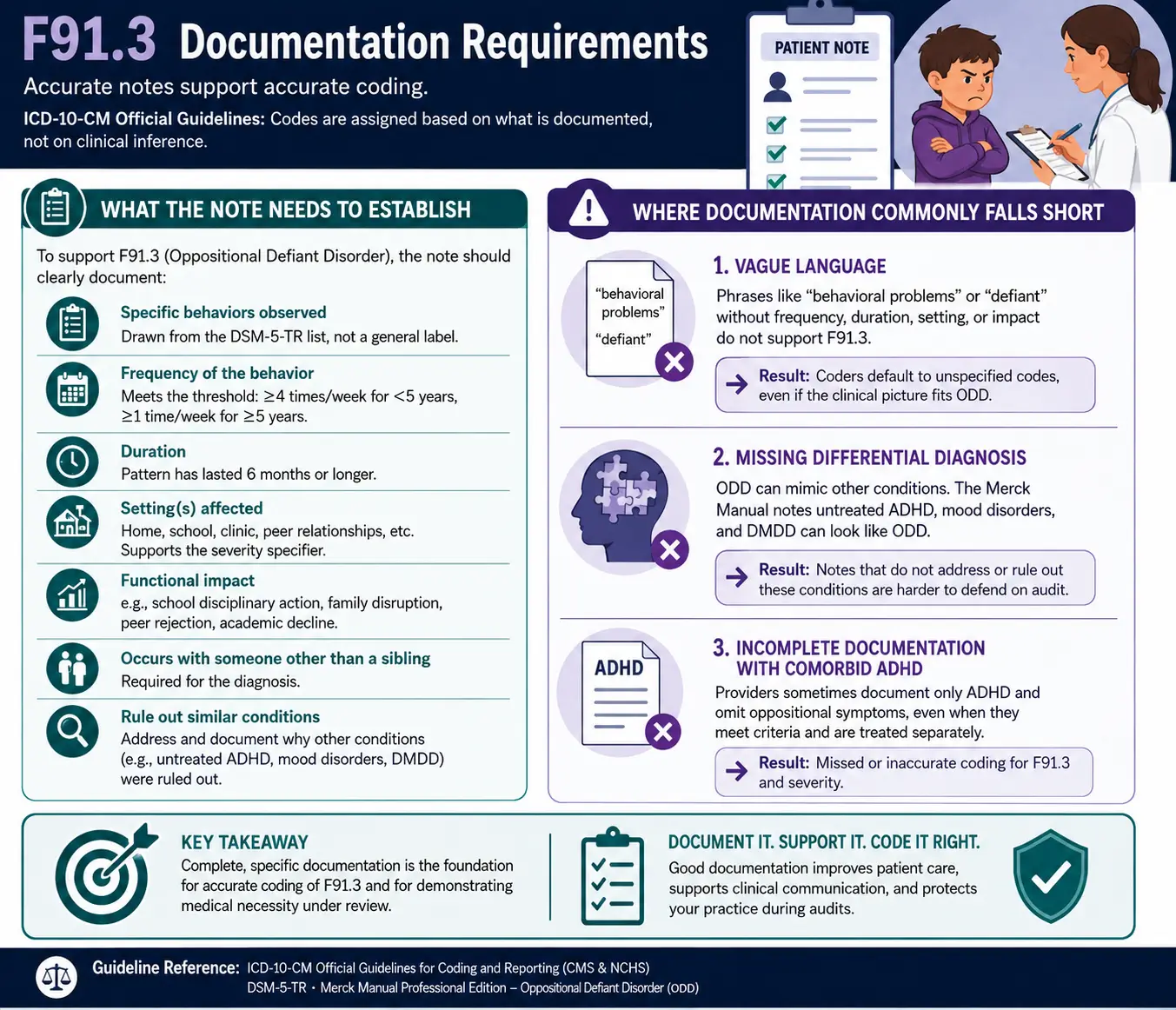
A note that reads “patient is oppositional” will not support F91.3 under audit, regardless of how experienced the clinician is. The ICD-10-CM Official Guidelines for Coding and Reporting, maintained jointly by CMS and the CDC’s National Center for Health Statistics, place the burden of specificity on the medical record: codes get assigned based on what is documented, not on clinical inference. For F91.3, the note should capture:
- The specific behaviors observed, drawn from the DSM-5-TR list rather than a general label
- Frequency of the behavior, since the threshold differs for patients under 5 versus older children
- Duration, confirming the pattern has lasted six months or longer
- The setting or settings affected (home, school, clinic, peer relationships), which supports the severity specifier
- Functional impact, such as school disciplinary action, family disruption, or peer rejection
- Confirmation that the behavior occurs with someone other than a sibling
- A rule-out of conditions that present similarly, including untreated ADHD, mood disorders, and disruptive mood dysregulation disorder
Where documentation commonly falls short
The most frequent gap involves vague language rather than absent information. Phrases like “behavioral problems” or “defiant,” written without frequency, duration, or setting, give a coder nothing to anchor a specific code to, and they invite a default to an unspecified code even when the clinical picture actually supports F91.3. A second gap involves the differential diagnosis. The Merck Manual’s clinical guidance on pediatric ODD specifically calls out untreated ADHD and mood disorders as conditions that mimic ODD symptoms; a note that never addresses why those were ruled out is harder to defend on review. A third gap shows up with comorbid ADHD: providers sometimes document only the more familiar ADHD diagnosis and leave the oppositional symptoms unrecorded, even when those symptoms are frequent enough to meet criteria and are being treated separately.
Billing guidelines for F91.3
CPT codes commonly reported alongside F91.3
F91.3 rarely stands alone on a claim. As a diagnosis code, it has to be paired with a procedure code describing the service rendered. The codes that show up most often in ODD treatment include:
- 90791: psychiatric diagnostic evaluation without medical services, typically the code for the visit where F91.3 is first established
- 90792: the same evaluation with medical services, used only by prescribers
- 90832, 90834, 90837: individual psychotherapy, billed by time (roughly 30, 45, and 60 minutes or longer)
- 90846: family psychotherapy without the patient present, commonly used for parent management training, a first-line intervention for ODD
- 90847: family psychotherapy with the patient present, which under CPT’s time rule requires at least 26 minutes of service to report, according to the American Academy of Child and Adolescent Psychiatry’s CPT coding training materials
- 96127: a brief behavioral or emotional screening instrument, reported per instrument rather than by time
The interactive complexity add-on code, +90785, can be appended to 90791, 90792, the individual psychotherapy codes, 90847, and 90853, but not to 90846 or the crisis psychotherapy codes 90839 and 90840.
Medical necessity and common denial triggers
The Centers for Medicare & Medicaid Services’ Medicare Coverage Database, in Local Coverage Article A57480, specifies that 90846 and 90847 should not be reported for sessions that amount to taking a family history or delivering standard evaluation and management counseling; those services belong under the appropriate E/M code instead. Billing a family therapy code for what was actually a diagnostic intake is a common source of denials.
Beyond code selection, the FY2026 ICD-10-CM guidelines push against unspecified coding across the board, and industry billing analyses have linked rising denial rates to claims that lean on vague or default diagnosis codes rather than the most specific one the documentation supports. For F91.3, that means confirming the note supports the full diagnosis rather than defaulting to F91.9 (conduct disorder, unspecified) when ODD criteria are actually met, and it means not using F91.3 when the documented behavior has crossed into rights-violating conduct that belongs under F91.1 or F91.2.
Telehealth visits follow the same CPT codes as in-person sessions. The claim needs a telehealth modifier (95 or GT, depending on payer) and Place of Service code 02 instead of 11 to reflect the remote setting.
F91.3 compared with related codes
Coders confuse F91.3 with its neighbors often enough that a side-by-side is worth keeping on hand.
|
Code |
Condition |
Core clinical feature |
Onset detail that matters for coding |
|
F91.3 |
Oppositional defiant disorder |
Angry or irritable mood, argumentativeness, and vindictiveness, without violating others’ basic rights |
No onset-age split within the code; severity lives in the note |
|
F91.1 |
Conduct disorder, childhood-onset type |
Repeated violation of others’ rights or major age-appropriate norms (aggression, destruction, deceit, theft) |
At least one characteristic behavior documented before age 10 |
|
F91.2 |
Conduct disorder, adolescent-onset type |
Same conduct disorder behaviors as F91.1 |
No characteristic behavior before age 10 |
|
F91.9 |
Conduct disorder, unspecified |
Conduct disorder documented, onset history not yet established |
Use only until onset timing is confirmed, then move to F91.1 or F91.2 |
|
F90.- |
Attention-deficit hyperactivity disorder |
Inattention and/or hyperactivity-impulsivity |
Several symptoms present before age 12; codes alongside F91.3 when both are documented |
The line between F91.3 and conduct disorder comes down to what the behavior actually does. ODD is emotional and relational: temper, arguing, blame-shifting, spite. Conduct disorder crosses into behavior that harms people, animals, or property, or breaks significant rules and laws. A chart describing a teenager who argues constantly and refuses instructions supports F91.3. A chart describing theft, physical aggression, or property destruction points toward F91.1 or F91.2, and possibly both a conduct disorder code and F91.3 if both presentations are documented.
A practical coding scenario
Consider a hypothetical case that resembles what shows up in an outpatient behavioral health chart regularly. A 9-year-old is referred after the school reports repeated defiance toward teachers. The evaluation documents temper outbursts three to four times a week for the past eight months, arguing with both parents and teachers, deliberate rule-breaking at home and school, and a pattern of blaming siblings for the child’s own misbehavior. No theft, aggression toward people or animals, or property destruction appears anywhere in the record. The child also has an existing ADHD diagnosis, well controlled on stimulant medication, and the evaluating clinician notes that the oppositional symptoms persist independent of ADHD symptom control.
That documentation supports F91.3, coded alongside the existing F90 code for ADHD, since the Excludes2 note allows both when each is separately documented. It does not support F91.1 or F91.2, since nothing in the note describes rights-violating behavior. The specificity in the note (frequency, duration, settings, and a comorbidity discussion) is what would let this code withstand a payer audit, not the diagnosis label by itself.
Getting the F91.3 diagnosis code right
Coding F91.3 accurately comes down to matching documentation to a specific, criteria-based diagnosis rather than memorizing a four-character string. DSM-5-TR gives providers a clear structure: three symptom categories, a four-symptom threshold, a six-month duration, and a severity grade based on how many settings are affected. Coders and billers who understand that structure can recognize when a chart genuinely supports F91.3, when it actually points toward conduct disorder instead, and when a comorbid diagnosis like ADHD needs its own code alongside it.
None of this replaces clinical judgment; the documentation always has to reflect what the clinician actually observed. But a well-documented chart paired with a correctly applied F91.3 code tends to move through claims processing without the delays that vague documentation invites.