


F12.20 Diagnosis Code: Meaning, Description, and Clinical Guidelines
F12.20 is the ICD-10-CM code for cannabis dependence, uncomplicated. It lives inside category F12, the block the National Center for Health Statistics and the Centers for Medicare and Medicaid Services use for mental and behavioral disorders tied to cannabinoid use. Anyone who bills for behavioral health services, or anyone studying to become a certified coder, runs into this code often enough that a shaky grasp of it turns into denied claims and rework. This piece breaks down what F12.20 actually documents, how it differs from the codes coders regularly confuse it with, and what recent federal cannabis policy changes mean for documentation going forward.
What the code actually represents
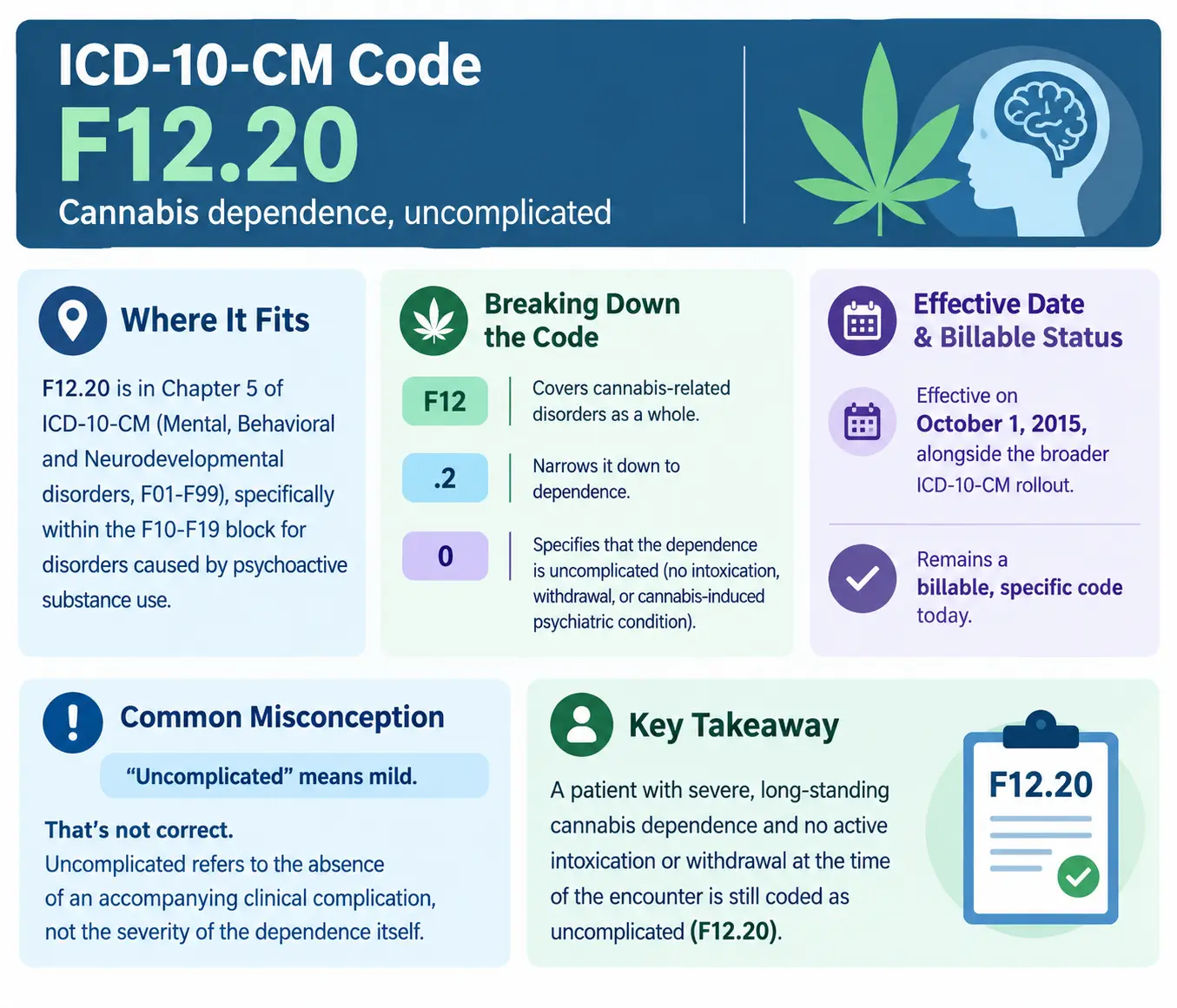
F12.20 sits within Chapter 5 of ICD-10-CM (Mental, Behavioral and Neurodevelopmental disorders, F01-F99), specifically inside the F10-F19 block for disorders caused by psychoactive substance use. F12 covers cannabis-related disorders as a whole; the .2 after the decimal narrows that down to dependence, and the trailing 0 specifies that the dependence is uncomplicated, meaning there is no documented intoxication, withdrawal, or cannabis-induced psychiatric condition layered on top. The code became effective on October 1, 2015, alongside the broader ICD-10-CM rollout, and it remains a billable, specific code today.
Coders sometimes assume “uncomplicated” means mild. It doesn’t. Uncomplicated refers to the absence of an accompanying clinical complication, not the severity of the dependence itself. A patient with severe, long-standing cannabis dependence and no active intoxication or withdrawal at the time of the encounter is still coded as uncomplicated.
Dependence, abuse, and use: where the confusion starts
The terminology gap between clinical documentation and billing codes causes most of the errors coders make with F12.20. The DSM-5, published by the American Psychiatric Association, eliminated the separate categories of substance abuse and substance dependence in 2013. In their place, it created a single diagnosis, cannabis use disorder, rated by severity based on how many of eleven diagnostic criteria a patient meets: two or three criteria for mild, four or five for moderate, and six or more for severe, according to the DSM-5 criteria summarized in Counselor Magazine.
ICD-10-CM never made that switch. It still separates cannabis-related conditions into use, abuse, and dependence categories, a structure closer to ICD-9 and the older DSM-IV. The generally accepted crosswalk, described by the Association of Clinical Documentation Integrity Specialists, treats mild use disorder as equivalent to abuse and moderate or severe use disorder as equivalent to dependence. So when a psychiatrist documents “moderate cannabis use disorder,” the coder should typically land on F12.20, not F12.10 (cannabis abuse) or F12.90 (unspecified cannabis use).
The official ICD-10-CM Guidelines for Coding and Reporting add a rule that resolves a related problem: when a provider’s documentation references use, abuse, and dependence of the same substance during the same encounter, coders should assign only one code, based on the highest term in that hierarchy. Dependence outranks abuse, and abuse outranks use. If a chart says the patient has a history of cannabis use and current cannabis dependence, only the dependence code gets reported.
The F12.2 code family
F12.20 is one member of a larger set of dependence codes under F12.2, each covering a different clinical picture:
- F12.21 – Cannabis dependence, in remission. Assigning this one requires the provider’s own clinical judgment, per the ICD-10-CM guidelines; a coder cannot infer remission status from lab results or gaps in visits alone.
- F12.22 and its subcodes – Cannabis dependence with intoxication, including uncomplicated intoxication (F12.220), intoxication with delirium, and intoxication with perceptual disturbance.
- F12.23 – Cannabis dependence with withdrawal.
Two exclusion notes matter here. F12.20 carries an Excludes1 note against cannabis abuse (F12.1-) and cannabis use, unspecified (F12.9-), meaning those codes should never be reported alongside F12.20 for the same substance and encounter, since ICD-10-CM treats them as mutually exclusive severity levels of the same condition. There’s also an Excludes2 note against cannabis poisoning (T40.7-), which is not mutually exclusive; a patient can have both cannabis dependence and a documented poisoning event, and both codes can be reported together when clinically supported.
How often this diagnosis actually comes up
Cannabis use disorder is not a rare finding in a chart. According to the 2025 National Survey on Drug Use and Health, released by the Substance Abuse and Mental Health Services Administration, an estimated 20.6 million Americans aged 12 and older met diagnostic criteria for cannabis use disorder that year, surpassing the 19.8 million who met criteria for nicotine dependence from cigarettes. Alcohol use disorder still topped both, affecting an estimated 27.9 million people. The same survey put past-year cannabis use at 61.6 million people, making it the most widely used federally illicit substance in the country.
The trend among adolescents is worth flagging separately. NSDUH data tracked by recovery-treatment researchers shows cannabis use disorder among 12- to 17-year-olds rose from 2.7% in 2014 to 4.7% in 2024, a 74% increase, moving from roughly 667,000 affected teens to about 1.2 million. For pediatric and adolescent behavioral health practices, that shift alone is a reason to expect more F12.2x coding, not less.
Getting the documentation and billing right
A few habits separate accurate F12.20 coding from guesswork:
- Don’t default to an unspecified code (F12.90 or F12.9-) just because the chart is thin. Official guidance limits unspecified psychoactive substance use codes to cases where the substance use is tied to a documented physical, mental, or behavioral disorder and no more specific term is available. If the provider actually documented dependence, F12.20 or a more specific F12.2x code is required.
- Watch for DSM-5 severity language without a matching ICD-10-CM term. If a note says “severe cannabis use disorder” but never uses the word dependence, a coding query to the provider is often the safer move than assuming the crosswalk applies automatically.
- Check for intoxication, withdrawal, or an induced psychiatric condition before finalizing F12.20. Any of those push the code to a more specific F12.2x subcategory instead.
- Remember the risk-adjustment angle. Substance use disorder diagnoses, cannabis dependence among them, feed into the CMS-HCC model that Medicare Advantage plans use to set payment. CMS finished the three-year phase-in of Version 28 of that model for payment year 2026, and the restructured behavioral health categories generally carry less risk weight than they did under the prior version. Practices that lean heavily on behavioral health diagnoses should expect the documentation to matter more, not less, for accurate reimbursement under the current model.
Why the regulatory backdrop is worth watching
Cannabis’s federal legal status is shifting in ways that touch documentation practices even though they don’t change the coding rules themselves. On April 22, 2026, the Drug Enforcement Administration issued a final order moving two narrow categories of marijuana, FDA-approved drug products and marijuana covered by a qualifying state medical license, from Schedule I to Schedule III of the Controlled Substances Act. Recreational marijuana and unlicensed cannabis remain in Schedule I. The DEA has scheduled an administrative hearing beginning June 29, 2026, to consider whether marijuana should be rescheduled more broadly.
None of that changes how F12.20 is defined or assigned; ICD-10-CM’s diagnostic criteria are independent of a substance’s scheduling status. What it does change is the clinical and administrative context coders will increasingly see in charts, more documented medical marijuana licenses, more state-authorized dispensing records, and potentially more nuanced conversations between prescribers and patients about dependence risk as access expands. Coders who understand both the clinical code and the policy environment around it are better positioned to catch documentation gaps before a claim goes out the door.
A quick scenario
A 34-year-old patient tells their primary care provider they’ve been smoking cannabis daily for three years, have tried to cut back twice without success, and have missed work because of it. The provider documents “moderate cannabis use disorder” in the assessment and notes no current intoxication or withdrawal symptoms. Applying the DSM-5 to ICD-10-CM crosswalk, moderate use disorder maps to dependence, and the absence of intoxication or withdrawal keeps it uncomplicated. The correct code is F12.20. If that same patient showed up glassy-eyed and reporting recent use within the hour, the picture would shift toward F12.220, cannabis dependence with intoxication, uncomplicated, instead.
Getting to that answer consistently comes down to reading past the DSM-5 language providers actually chart in and translating it correctly into the ICD-10-CM hierarchy every time, not just when the documentation happens to match up neatly.