


F90.2 Diagnosis Code: Documentation and Billing Guidelines
The ICD-10-CM manual designates F90.2 as the specific alphanumeric classification for attention-deficit hyperactivity disorder, combined type. Medical coders and healthcare providers apply this code when a patient’s medical record documents a sustained pattern of both inattentive and hyperactive-impulsive behaviors.
Managing claims for behavioral health services requires strict adherence to payer policies and federal regulations. Clinics maintaining compliance with F90.2 diagnosis code: documentation and billing guidelines reduce their claim denial rates and survive payer audits. Accurate coding communicates the exact clinical scenario to the insurance company and justifies the medical necessity of the treatment provided.
Understanding the ICD-10-CM structure for F90 codes
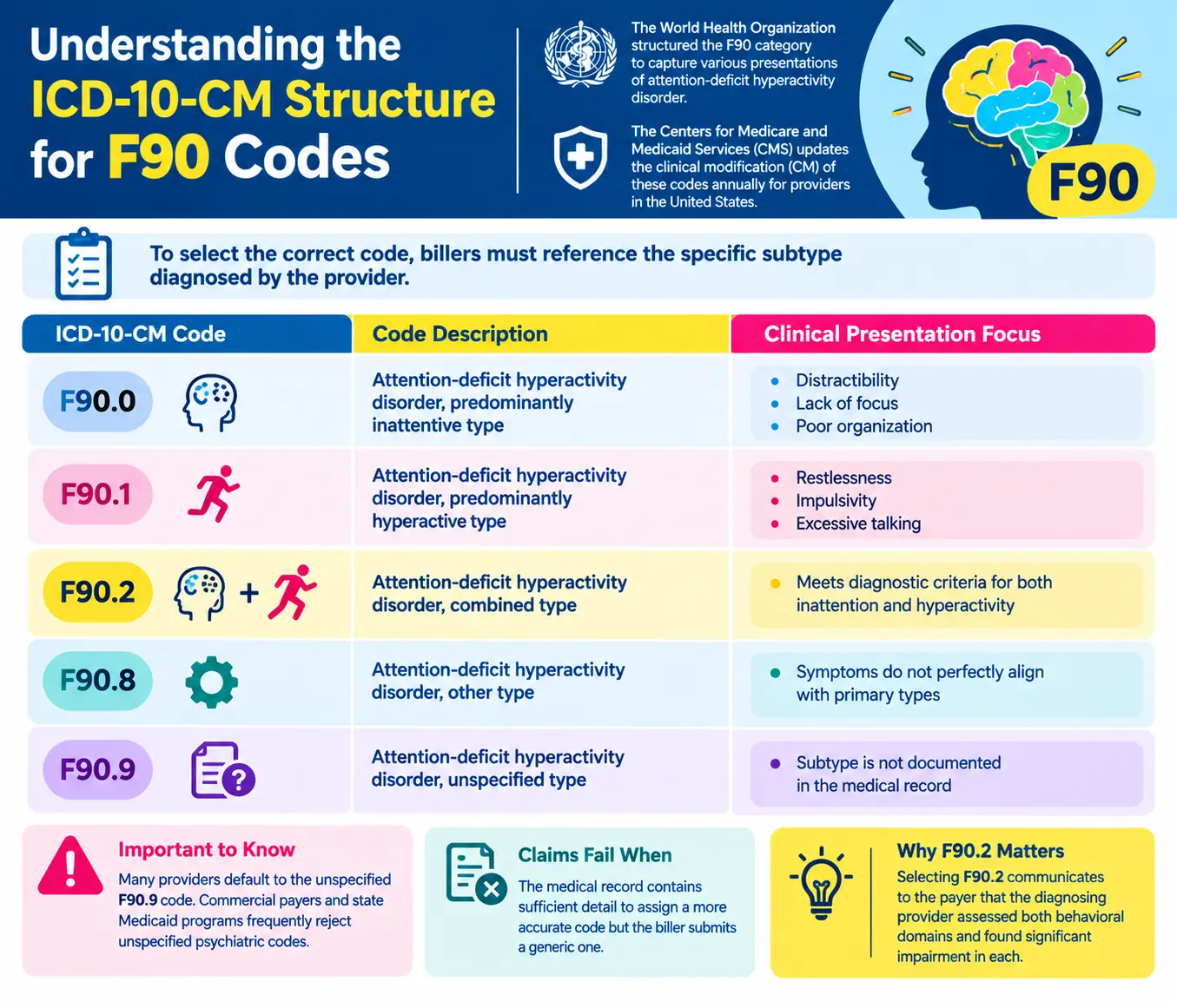
The World Health Organization structured the F90 category to capture various presentations of attention-deficit hyperactivity disorder. The Centers for Medicare and Medicaid Services (CMS) updates the clinical modification (CM) of these codes annually for providers in the United States.
To select the correct code, billers must reference the specific subtype diagnosed by the provider.
|
ICD-10-CM Code |
Code Description |
Clinical Presentation Focus |
|
F90.0 |
Attention-deficit hyperactivity disorder, predominantly inattentive type |
Distractibility, lack of focus, poor organization |
|
F90.1 |
Attention-deficit hyperactivity disorder, predominantly hyperactive type |
Restlessness, impulsivity, excessive talking |
|
F90.2 |
Attention-deficit hyperactivity disorder, combined type |
Meets diagnostic criteria for both inattention and hyperactivity |
|
F90.8 |
Attention-deficit hyperactivity disorder, other type |
Symptoms do not perfectly align with primary types |
|
F90.9 |
Attention-deficit hyperactivity disorder, unspecified type |
Subtype is not documented in the medical record |
Many providers default to the unspecified F90.9 code. Commercial payers and state Medicaid programs frequently reject unspecified psychiatric codes. Claims fail when the medical record contains sufficient detail to assign a more accurate code but the biller submits a generic one. Selecting F90.2 communicates to the payer that the diagnosing provider assessed both behavioral domains and found significant impairment in each.
Clinical documentation requirements for the combined type
The F90.2 diagnosis relies directly on the criteria established by the American Psychiatric Association. According to the Diagnostic and Statistical Manual of Mental Disorders, Fifth Edition, Text Revision (DSM-5-TR) published in 2022, a combined type diagnosis requires the provider to document specific symptom thresholds.
Children up to age 16 must exhibit six or more symptoms of inattention and six or more symptoms of hyperactivity or impulsivity. Adolescents aged 17 and older, along with adults, must demonstrate at least five symptoms in both categories. These behaviors must persist for at least six months.
To support the F90.2 code, the chart must detail specific inattention symptoms. These include failing to give close attention to details, difficulty sustaining attention in tasks, seeming not to listen when spoken to directly, failing to follow through on instructions, and difficulty organizing tasks. The provider must also document hyperactivity symptoms. These include fidgeting with hands or feet, leaving a seat in situations when remaining seated is expected, running about in inappropriate situations, talking excessively, and interrupting others.
Medical records must state that these symptoms presented before the patient reached age 12. The provider must also verify that the behaviors manifest in two or more settings. A chart note stating a child struggles with focus at school fails to support F90.2 if it lacks information about the child’s behavior at home.
Auditors look for specific behavioral examples. A compliant chart note describes how the impairment presents in the patient’s daily life. The provider might document that an adult patient misses workplace deadlines, frequently loses personal items, and interrupts colleagues during professional meetings. This exact detail justifies the diagnosis.
F90.2 diagnosis code: documentation and billing guidelines
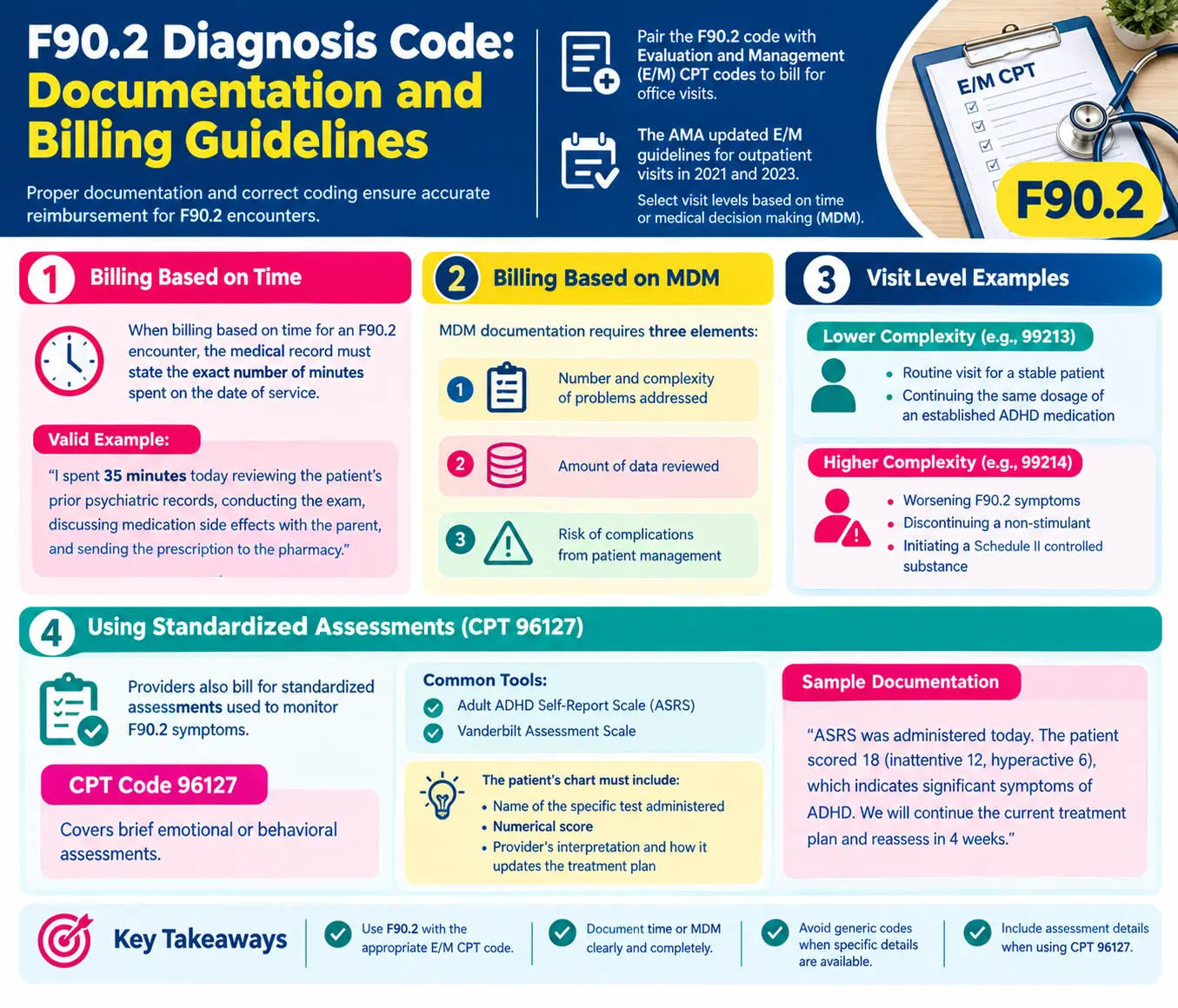
Healthcare facilities pair the F90.2 code with Evaluation and Management (E/M) Current Procedural Terminology (CPT) codes to bill for office visits. The American Medical Association (AMA) updated E/M guidelines for outpatient visits in 2021 and 2023. Providers now select visit levels based on either total time spent on the date of the encounter or the complexity of medical decision making (MDM).
When a provider bills based on time for an F90.2 encounter, the medical record must explicitly state the exact number of minutes spent on the date of service. A valid entry reads, “I spent 35 minutes today reviewing the patient’s prior psychiatric records, conducting the exam, discussing medication side effects with the parent, and sending the prescription to the pharmacy.”
Billing based on MDM requires the provider to document three elements. These include the number and complexity of problems addressed, the amount of data reviewed, and the risk of complications from patient management. A routine visit for a stable patient continuing the same dosage of an established ADHD medication usually qualifies for a lower complexity CPT code, such as 99213.
If the patient presents with worsening F90.2 symptoms and the provider decides to discontinue a non-stimulant and initiate a Schedule II controlled substance, the risk increases. The documentation of this medication change justifies a higher code, such as 99214.
Providers also bill for standardized assessments used to monitor F90.2 symptoms. CPT code 96127 covers brief emotional or behavioral assessments. Clinics apply this code when administering tools like the Adult ADHD Self-Report Scale (ASRS) or the Vanderbilt Assessment Scale. The patient’s chart must include the name of the specific test administered, the numerical score, and how the provider interpreted the results to update the clinical treatment plan.
Navigating comorbidities and ICD-10 coding conventions
Patients with an F90.2 diagnosis frequently present with co-occurring conditions. A 2024 data brief published by the Centers for Disease Control and Prevention (CDC) indicates that a majority of children diagnosed with ADHD also carry diagnoses for behavioral problems, anxiety, or depression.
Medical billers must apply ICD-10-CM sequencing rules when multiple conditions exist. The primary diagnosis code reflects the main reason for the clinical encounter. If a patient presents primarily for a medication check regarding their combined type ADHD, F90.2 belongs in the primary position on the CMS-1500 claim form. If the provider addresses the patient’s generalized anxiety disorder (F41.1) during the same visit, the biller adds that code in the secondary position.
Billers must verify Excludes1 and Excludes2 notes in the tabular list. An Excludes1 note means the two conditions cannot be billed together. An Excludes2 note indicates that the condition excluded is not part of the condition represented by the code, meaning a patient may have both conditions at the same time.
Category F90 carries Excludes2 notes for mood disorders (F30 through F39) and anxiety disorders (F40 through F41.9). This specific classification confirms providers can document and bill F90.2 alongside these distinct psychiatric conditions when clinical evidence supports both diagnoses.
HEDIS quality measures and revenue cycle impact
Accurate F90.2 documentation directly affects clinical quality reporting metrics. The National Committee for Quality Assurance (NCQA) establishes the Healthcare Effectiveness Data and Information Set (HEDIS). Commercial insurance payers and state Medicaid programs use HEDIS measures to evaluate provider performance and calculate reimbursement rates.
One specific metric is the Follow-Up Care for Children Prescribed ADHD Medication (ADD) measure. This metric evaluates patients aged 6 to 12. The NCQA requires a newly prescribed patient to complete an initiation phase visit within 30 days of the medication dispensing date. The continuation and maintenance phase requires two additional follow-up visits within the subsequent nine months.
Clinics must coordinate their scheduling systems with their medical billers to capture these specific dates of service. Failing to bill F90.2 accurately during the strict follow-up window results in missed HEDIS targets. Health maintenance organizations (HMOs) penalize clinics that fail to meet these follow-up thresholds. These penalties result in reduced end-of-year incentive payments and lower tier rankings within provider networks.
Overcoming common F90.2 claim denials
Insurance companies deny F90.2 claims for predictable, preventable reasons. Identifying these specific patterns allows billing departments to secure appropriate reimbursement.
Many compliance audits fail due to cloned chart notes. Electronic health record (EHR) software allows providers to copy text from a previous visit into the current day’s note. The Office of Inspector General (OIG) identifies this practice as a major compliance violation. If the F90.2 documentation reads exactly the same for three consecutive months, Medicare auditors determine the notes lack medical necessity for the follow-up encounters. Each note must detail the patient’s current symptom status on that exact date.
Place of service (POS) errors also trigger denials. Following the expansion of telehealth, many psychiatrists and primary care physicians manage F90.2 patients via secure video connections. Billing for a virtual visit requires the correct POS code (typically 02 or 10) and specific modifiers (such as 95 or GQ) depending on the individual payer contract. Applying a standard office POS code (11) to a telehealth encounter constitutes a false claim.
Telehealth billing for F90.2 also intersects with federal prescribing laws. The Drug Enforcement Administration (DEA) regulates the prescription of Schedule II stimulants frequently used to treat combined type ADHD. Providers billing F90.2 via telemedicine must document their compliance with current DEA requirements regarding in-person medical evaluations.
Prior authorization processes heavily depend on precise diagnosis coding. Pharmacy benefit managers (PBMs) require the exact F90.2 code when reviewing requests for amphetamine salts or methylphenidate products. If the clinic submits a prescription with a generic F90.9 code, the PBM will reject the authorization. This delays the patient’s access to prescribed pharmacotherapy and generates uncompensated administrative work for the clinical staff.
Best practices for medical coding compliance
Healthcare organizations protect their revenue by establishing internal chart audit procedures. Routine review of claims containing the F90.2 diagnosis code ensures providers consistently document symptom duration, dual-setting impairment, and accurate E/M levels.
Compliance teams verify that every F90.2 diagnosis links directly to an active treatment plan. The documentation must list the currently prescribed medications, behavioral therapies recommended, and a specific timeline for the next clinical evaluation. Precise, factual charting protects the practice during post-payment reviews and proves the provider delivered medically necessary care.