


F43.10 Diagnosis Code Explained: Symptoms, Criteria, and Coding Rules
Medical coders apply the F43.10 diagnosis code to represent post-traumatic stress disorder when clinical records lack details about the condition's duration. This ICD-10-CM designation serves as a placeholder for unspecified PTSD. Accurate use of this code requires providers and medical billing professionals to navigate the differences between clinical diagnostic standards and federal reporting guidelines.
Translating behavioral health assessments into billable codes demands precision. Coders must sequence related factors, follow strict exclusion protocols, and recognize when to query a physician for additional documentation.
What is the F43.10 diagnosis code?
The ICD-10-CM manual categorizes mental and behavioral health conditions within Chapter 5. The structural hierarchy narrows down from broad categories to specific clinical presentations. F43.10 sits within the block designated for anxiety, dissociative, and stress-related disorders.
The subcategory F43.1 covers post-traumatic stress disorder specifically. The zero at the end of F43.10 designates the unspecified nature of the diagnosis.
Coders select from three distinct options within this subcategory based on symptom duration. The F43.11 code identifies acute presentations. The F43.12 code indicates a chronic condition. According to the Centers for Medicare & Medicaid Services (CMS), billing professionals must default to the F43.10 unspecified code if the attending provider fails to state whether the disorder is acute or chronic in the official medical record.
DSM-5-TR clinical criteria and symptoms
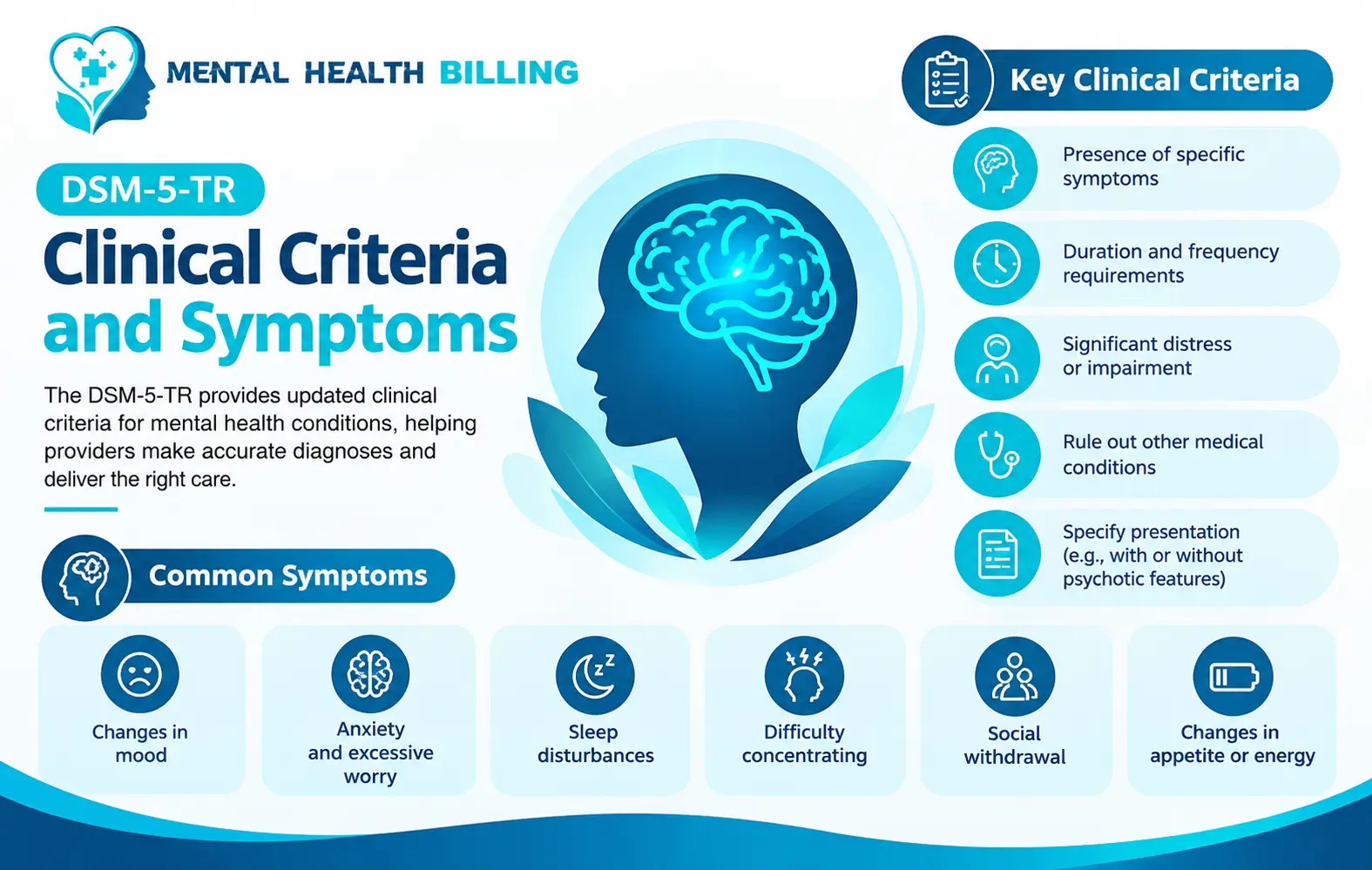
While the ICD-10-CM manual dictates billing procedures, psychiatric diagnosis relies on the American Psychiatric Association's framework. The Diagnostic and Statistical Manual of Mental Disorders, Fifth Edition, Text Revision (DSM-5-TR) establishes the current criteria for identifying PTSD.
Diagnosis requires exposure to actual or threatened death, severe injury, or sexual violence. A person might experience the trauma directly or witness it happening to others. Learning about a violent or accidental trauma involving a close friend or family member also meets the exposure criteria. Furthermore, professionals repeatedly exposed to aversive details of traumatic events, such as first responders, qualify under these guidelines.
Symptoms must persist for more than 30 days to warrant a PTSD diagnosis. Conditions resolving within the first month typically map to acute stress disorder. Patients with PTSD demonstrate specific behaviors categorized into four symptom clusters.
Intrusion symptoms
Individuals frequently suffer from unprompted, distressing recollections of the trauma. This cluster encompasses severe nightmares and dissociative reactions. During a flashback, the patient may lose awareness of their current surroundings and behave as though the traumatic event is happening again.
Avoidance behaviors
Patients actively alter their routines to escape trauma-related stimuli. Internal avoidance involves suppressing memories, thoughts, or physical sensations tied to the event. External avoidance manifests as staying away from specific locations, avoiding certain conversations, or withdrawing from people who trigger recollections of the incident.
Negative alterations in cognition and mood
Trauma can severely distort a patient's emotional state and thought processes. Some individuals block out critical details of the traumatic event entirely. Others develop pervasive, distorted beliefs regarding their own safety or the trustworthiness of others. A noticeable detachment from loved ones and a marked inability to experience joy or satisfaction fall under this diagnostic cluster.
Alterations in arousal and reactivity
The final cluster involves heightened neurological reactivity. Patients may exhibit sudden anger, reckless behavior, or extreme hypervigilance. They frequently report severe insomnia and an exaggerated startle response to loud noises or sudden movements.
The documentation disconnect between DSM-5 and ICD-10
A structural misalignment between diagnostic manuals and billing systems causes the high utilization of the F43.10 code.
Older iterations of the diagnostic manual, specifically the DSM-IV, categorized PTSD using strict timeframes. Symptoms lasting less than three months received an acute label. Symptoms persisting beyond three months received a chronic label.
The publication of the DSM-5 eliminated these time-based specifiers. The updated psychiatric guidelines introduced new specifiers to identify cases involving delayed expression or dissociative symptoms. The concept of acute versus chronic disappeared from the clinical diagnostic standard.
However, the ICD-10-CM billing system still operates on the older, duration-based framework. F43.11 and F43.12 require explicit acute or chronic terminology. Physicians diagnosing patients today use current DSM-5-TR guidelines, which do not prompt them to record the duration in those specific terms. Consequently, a physician might write a perfectly accurate clinical note that forces a medical coder to assign the F43.10 unspecified code. Coders cannot calculate the duration from past visits to assign a specific code; the exact word must appear in the current encounter note.
ICD-10-CM coding rules for F43.10
Accurate medical billing requires strict adherence to the instructional notes located in the tabular list of the ICD-10-CM manual. These rules prevent contradictory reporting and ensure claims contain necessary context.
Excludes1 guidelines
The ICD-10-CM system utilizes Excludes1 notes to indicate conditions that cannot coexist on the same claim. F43.10 carries an Excludes1 restriction for acute stress reaction, billed as F43.0. A medical coder must never submit both codes for the same date of service, as the guidelines deem it clinically impossible for a patient to suffer from an acute stress reaction and post-traumatic stress disorder simultaneously.
External cause codes
Billing manuals direct coders to use Chapter 20 external cause codes in conjunction with F43.10. These secondary codes explain the exact nature of the traumatic event. Public health organizations rely on this data for statistical tracking, and insurance companies use it to determine primary liability in accident cases. Common external event codes include categories for transport accidents (V00-V99), intentional self-harm (X71-X83), and physical assaults (X92-Y09).
Z codes for social determinants of health
Social determinants of health heavily influence psychiatric care. Coders append Z codes to the F43.10 primary diagnosis to provide payers with a complete picture of the patient's circumstances. Common additions include Z56.82 for military deployment, Z65.4 for victims of terrorism or crime, and Z62.810 to indicate a history of childhood physical or sexual abuse.
Documentation requirements for healthcare providers
Insurance payers scrutinize claims containing unspecified diagnosis codes. Automated adjudication systems often flag F43.10 when providers use it repeatedly for the same patient over an extended period.
Medicare Administrative Contractors and commercial health plans expect providers to report conditions to the highest degree of specificity supported by the clinical record. If an auditor examines a chart where a patient has undergone trauma-focused cognitive behavioral therapy for three years, a claim containing F43.10 appears deficient. The clinical reality indicates a chronic condition, but the paperwork lacks the necessary keyword.
Hospitals and large practices rely on clinical documentation improvement (CDI) teams to bridge this gap. CDI specialists audit charts prior to billing. When they see a PTSD diagnosis without a duration specifier, they send a formal query to the attending physician. The physician can then amend the record to specify whether the presentation is acute or chronic. Updating electronic health record templates to prompt physicians for this specific detail significantly reduces a practice's reliance on unspecified codes.
Billing and reimbursement impacts
Claims processing systems link diagnosis codes directly to medical necessity requirements. Payers assess the submitted ICD-10-CM codes against published local and national coverage determinations before issuing payment.
Certain behavioral health plans enforce limits on the number of psychotherapy sessions covered under an unspecified diagnosis. Insurance companies generally expect unspecified or acute conditions to either resolve or develop into chronic conditions requiring long-term management. Submitting F43.10 for a patient seen weekly for a year may trigger a medical records request or a claim denial.
Reporting F43.12 for a chronic condition demonstrates that the provider is actively managing a long-term illness. This specific coding supports the medical necessity of extended psychiatric interventions, ongoing medication management, and specialized therapeutic modalities.
Coding scenarios for F43.10
Examining how these rules apply to daily medical coding illustrates the limitations and proper usage of the unspecified code.
Scenario 1: Insufficient documentation
A psychiatrist evaluates a patient and records the following note: "The patient returns today for PTSD management. They report ongoing insomnia and avoidance of driving. Continuing current dosage of Paroxetine."
The medical coder processing this chart sees a clear diagnosis of PTSD and a list of active symptoms. However, the psychiatrist omitted any mention of how long the patient has suffered from the condition. Because the exact words "acute" or "chronic" are missing from this specific date of service, the coder cannot assign a specific code. The coder applies F43.10.
Scenario 2: Specific documentation
A clinical psychologist documents a therapy session with the following assessment: "Patient presents for weekly trauma therapy. The chronic PTSD developed following a severe industrial accident two years ago. We focused today on cognitive restructuring regarding workplace safety."
The coder identifies the explicit use of the word "chronic." This specific documentation allows the coder to bypass the unspecified code entirely. The coder assigns F43.12 for chronic post-traumatic stress disorder, followed by the appropriate external cause code indicating an industrial accident.
Summary of F43.10 application
The F43.10 code provides a necessary option for medical coders when physician documentation lacks the detail required by the ICD-10-CM manual. Relying on this code ensures claims can be submitted when records are incomplete, but it does not represent the highest standard of medical billing. Physicians who adapt their charting habits to include duration specifiers eliminate the need for unspecified coding. Precise documentation that supports specific acute or chronic codes minimizes payer scrutiny, reduces audit liability, and ensures the patient's medical history is accurately recorded.