



CPT Code 99205 Billing Guide for Physicians and Medical Practices
CPT code 99205 sits at the top of the new patient office visit series, and it is one of the most closely watched codes a practice submits. It pays more than any other new patient evaluation and management (E/M) code in an outpatient setting, roughly $236.81 under Medicare’s 2026 non-facility schedule. That reimbursement is precisely why payers scrutinize it. When the documentation matches the work, the payment reflects the clinical effort. When it does not, the claim becomes a downcoding target or an audit flag. This guide covers what 99205 requires, what it pays in 2026, and the specific places practices tend to lose money on it.
What CPT code 99205 covers
The code describes an office or other outpatient visit for the evaluation and management of a new patient at the highest complexity level. It is the Level 5 code in the new patient family, which runs 99202 through 99205. There is nothing above it in that category for outpatient work.
The American Medical Association maintains the CPT code set, and it defines a new patient as someone who has not received professional services from the physician, or another physician of the same specialty in the same group practice, within the prior three years. If a three-year lookback turns up no qualifying encounter, the visit is new. The established patient equivalent of 99205 is 99215, which follows the same high-complexity or 60-minute logic.
Patients who genuinely warrant 99205 tend to arrive with layered problems. Multiple chronic conditions in poor control, an undifferentiated presentation that needs an extensive workup, or a condition that threatens life or bodily function without treatment. In behavioral health, the code is reserved for the most involved initial evaluations, such as a patient with several psychiatric diagnoses and active safety concerns.
How the 2021 coding changes reshaped 99205
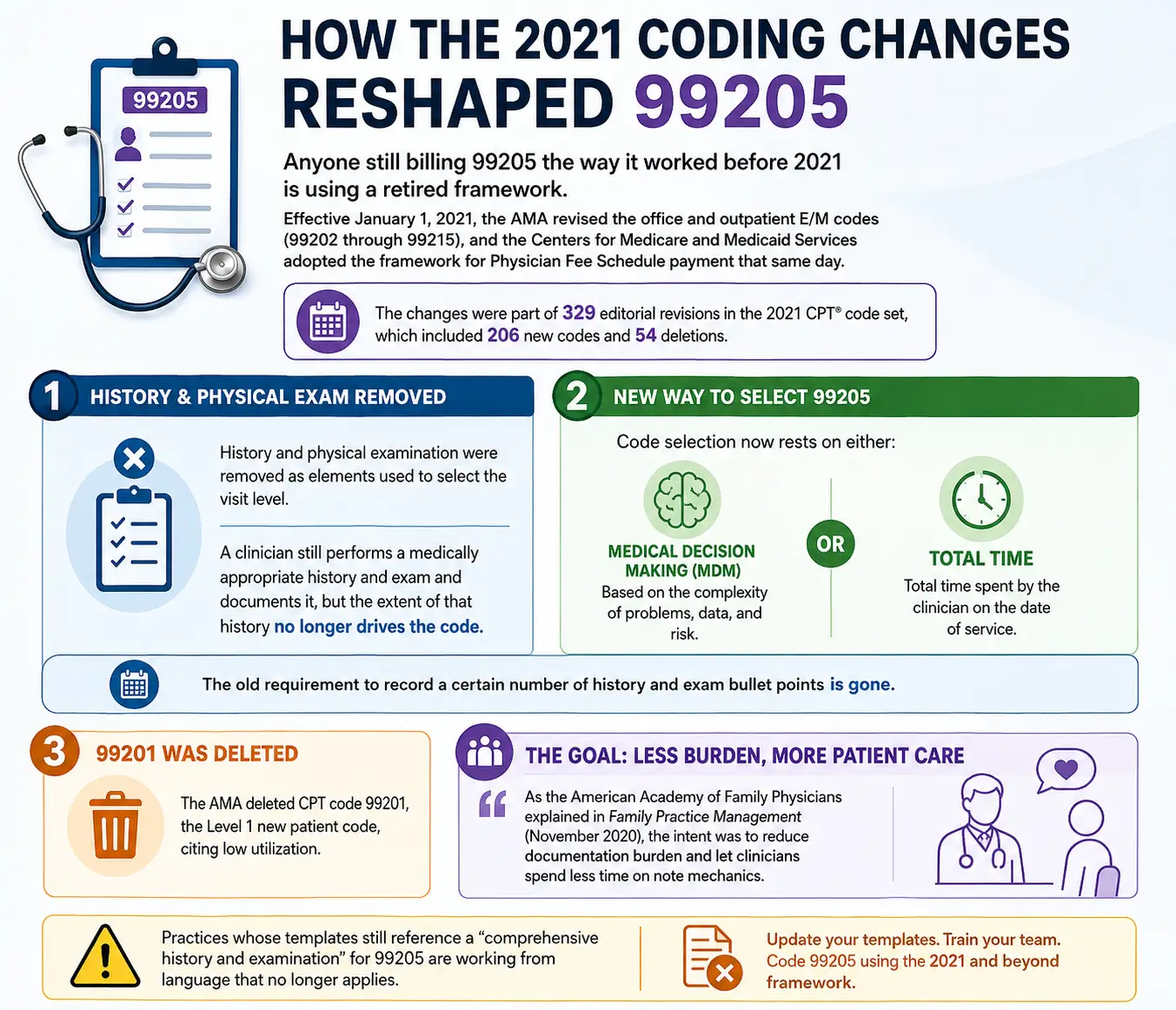
Anyone still billing 99205 the way it worked before 2021 is using a retired framework. Effective January 1, 2021, the AMA revised the office and outpatient E/M codes (99202 through 99215), and the Centers for Medicare and Medicaid Services adopted the framework for Physician Fee Schedule payment that same day. The changes were part of 329 editorial revisions in the 2021 CPT code set, which included 206 new codes and 54 deletions.
Two shifts matter most for this code. First, history and physical examination were removed as elements used to select the visit level. A clinician still performs a medically appropriate history and exam and documents it, but the extent of that history no longer drives the code. Second, code selection now rests on either medical decision making or total time on the date of service. The old requirement to record a certain number of history and exam bullet points is gone.
The AMA also deleted CPT code 99201, the Level 1 new patient code, citing low utilization. As the American Academy of Family Physicians explained in Family Practice Management in November 2020, the intent was to reduce documentation burden and let clinicians spend less time on note mechanics. Practices whose templates still reference a “comprehensive history and examination” for 99205 are working from language that no longer applies.
The two ways to qualify for 99205
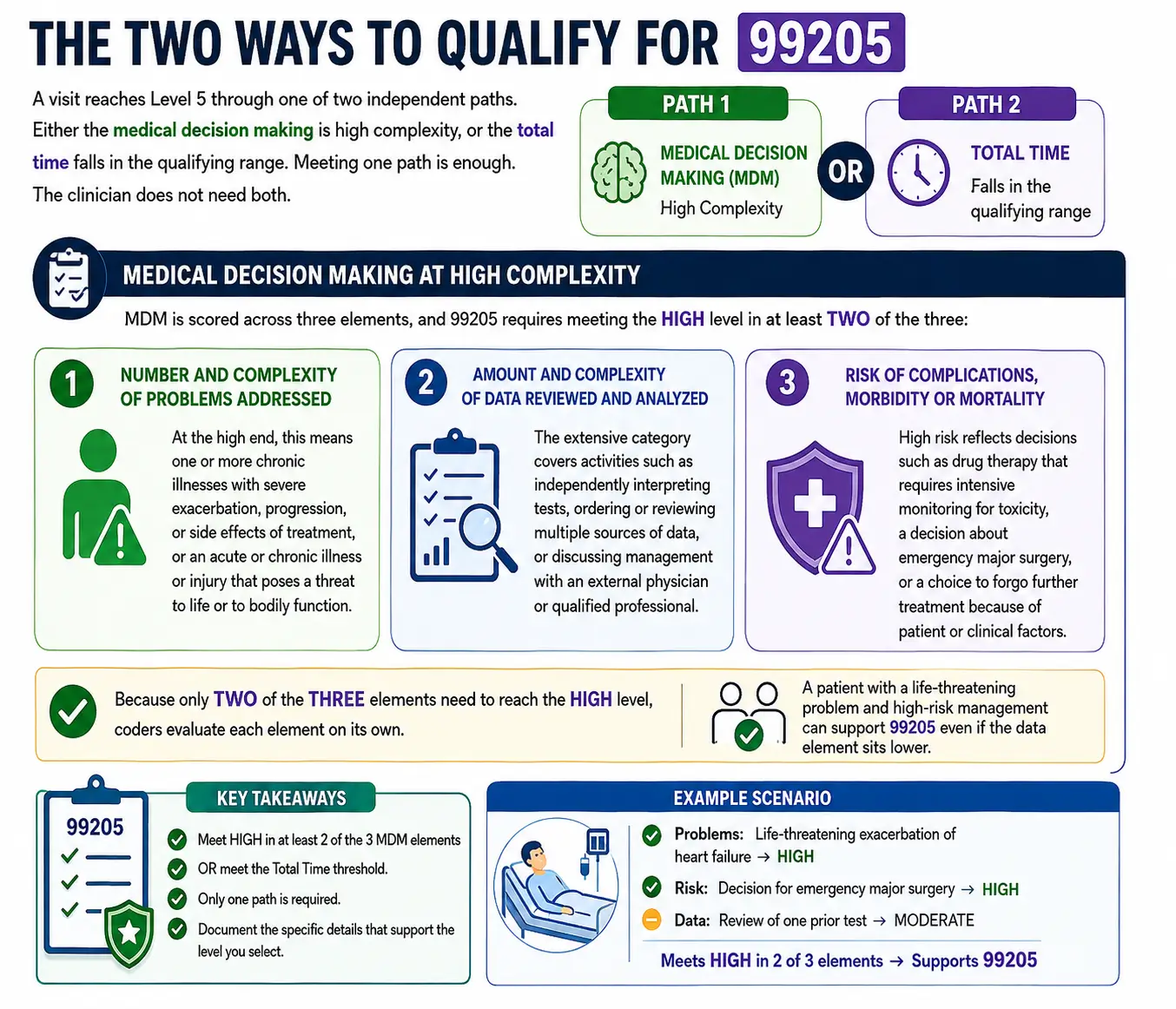
A visit reaches Level 5 through one of two independent paths. Either the medical decision making is high complexity, or the total time falls in the qualifying range. Meeting one path is enough. The clinician does not need both.
Medical decision making at high complexity
Medical decision making (MDM) is scored across three elements, and 99205 requires meeting the high level in at least two of the three:
- Number and complexity of problems addressed. At the high end, this means one or more chronic illnesses with severe exacerbation, progression, or side effects of treatment, or an acute or chronic illness or injury that poses a threat to life or to bodily function.
- Amount and complexity of data reviewed and analyzed. The extensive category covers activities such as independently interpreting tests, ordering or reviewing multiple sources of data, or discussing management with an external physician or qualified professional.
- Risk of complications, morbidity, or mortality. High risk reflects decisions such as drug therapy that requires intensive monitoring for toxicity, a decision about emergency major surgery, or a choice to forgo further treatment because of patient or clinical factors.
Because only two of the three elements need to reach the high level, coders evaluate each element on its own. A patient with a life-threatening problem and high-risk management can support 99205 even if the data element sits lower.
Total time on the date of the encounter
The time path uses 60 to 74 minutes of total time personally spent by the reporting clinician on the calendar date of the visit. CMS phrases its threshold as 60 minutes met or exceeded. Countable time includes the work the physician or qualified professional does that day tied to this specific patient: reviewing records before the visit, the face-to-face encounter, ordering tests, documenting in the chart, and coordinating care. Time spent by clinical staff does not count toward the clinician’s total, and time on activities unrelated to the encounter, such as general reading, is excluded.
If a practice codes by time, the note needs to state the total minutes and describe what filled that time. A bare statement of “60 minutes” without supporting activity is thin, and it is the kind of entry that automated review programs flag.
What 99205 pays in 2026
Medicare payment runs through the Resource-Based Relative Value Scale, which assigns each code three relative value unit (RVU) components: work, practice expense, and malpractice. The work RVU for 99205 is 3.17, more than three times the 0.93 work RVU for 99202, which is the reason systematic undercoding from Level 5 to a lower level quietly drains revenue.
The practice expense component changes by setting, which is why the total differs between office and hospital.
|
Setting |
Work RVU |
Total RVU |
2026 Medicare payment |
|
Non-facility (office) |
3.17 |
7.09 |
about $236.81 |
|
Facility (hospital outpatient) |
3.17 |
4.80 |
about $160.32 |
The work RVU holds steady across both settings because the physician’s cognitive effort does not change based on location. What drops in the facility setting is practice expense, since the hospital absorbs overhead like rent, equipment, and staff. The non-facility practice expense RVU is 3.15; in the facility it falls to 1.06.
Two figures in the payment math changed for 2026. In the CY 2026 Physician Fee Schedule final rule (CMS-1832-F), CMS finalized two separate conversion factors for the first time in the program’s history. Clinicians who are not qualifying alternative payment model participants use $33.4009, while qualifying participants use $33.5675. Participation status now determines the exact rate. CMS also increased non-facility practice expense RVUs by about 4 percent and reduced facility indirect practice expense by about 7 percent, which nudged office-based payments up slightly and facility payments down.
Two practical notes. Every figure above is a national average before geographic adjustment; the Geographic Practice Cost Index can move the final payment by more than $60 per encounter between low-cost and high-cost regions, so the CMS Physician Fee Schedule lookup tool gives the number that applies to a specific ZIP code. And nurse practitioners and physician assistants may bill 99205 independently under Medicare at 85 percent of the physician fee schedule rate.
Prolonged services and the 99417 versus G2212 trap
When a Level 5 new patient visit runs long and the practice codes by time, a prolonged service add-on may apply. This is one of the most frequently mis-billed areas in E/M, and the reason is a rule difference between the AMA and CMS.
Commercial payers generally follow the AMA, which uses CPT code 99417 for prolonged office and outpatient E/M services. The AMA counts from the minimum threshold plus 15 minutes, so the first unit of 99417 becomes reportable at 75 minutes of total time. Medicare disagreed with billing prolonged time that early and created its own code, HCPCS G2212, which is reportable only when the maximum time of the Level 5 code (74 minutes) is exceeded by at least 15 minutes. For Medicare, the first unit of G2212 does not trigger until 89 minutes.
That gap produces real denials. Consider an 80-minute new patient visit coded by time:
- For a commercial payer: report 99205 plus one unit of 99417, because total time reached the minimum threshold plus 15 minutes.
- For Medicare: report 99205 alone, because the visit did not reach 89 minutes and 99417 is not payable to Medicare.
Billing G2212 to a commercial plan, or 99417 to Medicare, is a wrong-code submission rather than a medical necessity dispute, which means a clinical appeal will not overturn it. Two more guardrails apply. Prolonged add-ons may be used only when the base code was selected by time, not by MDM. And they are billed in whole 15-minute units, so partial increments are not reported. The CMS Physician Fee Schedule fact sheet on office and outpatient E/M visits lays out the G2212 reporting table in full.
Modifiers that apply to 99205
A handful of modifiers come up regularly with this code.
Modifier 25 identifies a significant, separately identifiable E/M service performed on the same day as a procedure. If a clinician bills 99205 alongside a minor procedure, Modifier 25 signals that the visit stands on its own. The documentation has to support two distinct services, and payers that run automated review read what is written rather than what was intended.
Modifier 95 marks a synchronous telehealth visit delivered by real-time audio and video. CMS kept 99205 on its 2026 list of telehealth services, so Medicare continues to cover new patient telehealth visits this year. Some commercial payers still accept the older Modifier GT as an alternative to 95, so it is worth confirming which one each contract expects before the claim goes out.
Where practices lose money on 99205
The revenue problems with this code split into two directions, and both are avoidable.
Undercoding is the quieter one. A clinician does the work of a Level 5 visit, documents it as a Level 4, and leaves money on the table on every complex new patient. Across a panel with dozens of such patients a year, the difference between 99204 and 99205 compounds into a meaningful gap. Overcoding is the louder problem, because a 99205 that the record cannot support invites downcoding, recoupment, or an audit.
Automated review has raised the stakes. Effective October 1, 2025, Cigna launched a program called Evaluation and Management Coding Accuracy (R49). Under it, professional claims using 99204, 99205, 99214, 99215, 99244, and 99245 may be reviewed and adjusted down one level when the documentation does not meet AMA E/M guidelines. The process is algorithmic, so a claim can be downcoded before a person ever reads the note. The program continues into 2026. Code 99205 is also among the E/M codes that Recovery Audit Contractors review for documentation adequacy, given its position as the highest-paid code in the new patient range.
Three habits protect the claim:
- State the basis for the code explicitly. If the visit was coded by time, record total minutes and describe the activities. If it was coded by MDM, make the two qualifying elements visible in the note rather than implied.
- Retire outdated template language. Any reference to a required “comprehensive history and examination” reflects pre-2021 rules and can undercut a time-based or MDM-based selection.
- Keep Modifier 25 documentation clean whenever a procedure shares the day, since that is a common downcoding trigger under automated review.
CPT code 99205 rewards accurate documentation and punishes vague notes. The requirements are settled: high-complexity medical decision making across two of three elements, or 60 to 74 minutes of the clinician’s time on the date of service. The 2026 Medicare payment lands near $236.81 in the office and $160.32 in a facility, built on a total RVU of 7.09 and a work RVU of 3.17, and adjusted by the dual conversion factors CMS finalized for the year. The prolonged service rules diverge by payer, with commercial plans using 99417 at 75 minutes and Medicare using G2212 at 89. A practice that codes to the record, keeps its templates current, and watches the payer-specific thresholds will collect what the work is worth and hold up under review.