


Understanding F31.0 Diagnosis Code for Bipolar I Disorder (Hypomanic Episode)
Medical coders and healthcare providers encounter specific documentation challenges when recording behavioral health conditions. The F31.0 diagnosis code for Bipolar I disorder (hypomanic episode) requires exact clinical text to satisfy both diagnostic criteria and insurance payer mandates. This code specifically identifies a patient with a confirmed history of Bipolar I disorder who is currently experiencing a hypomanic episode. Accurate assignment depends on the provider’s ability to clearly distinguish the current presentation from full mania while maintaining the historical diagnosis of a previous manic episode within the medical record.
The International Classification of Diseases, Tenth Revision, Clinical Modification (ICD-10-CM) places this code in Chapter 5, which covers mental, behavioral, and neurodevelopmental disorders. Category F31 categorizes bipolar disorder based on the current clinical episode. F31.0 requires coders to verify two distinct timelines in the patient chart: a past occurrence of mania and a present occurrence of hypomania.
Clinical criteria for the F31.0 diagnosis code
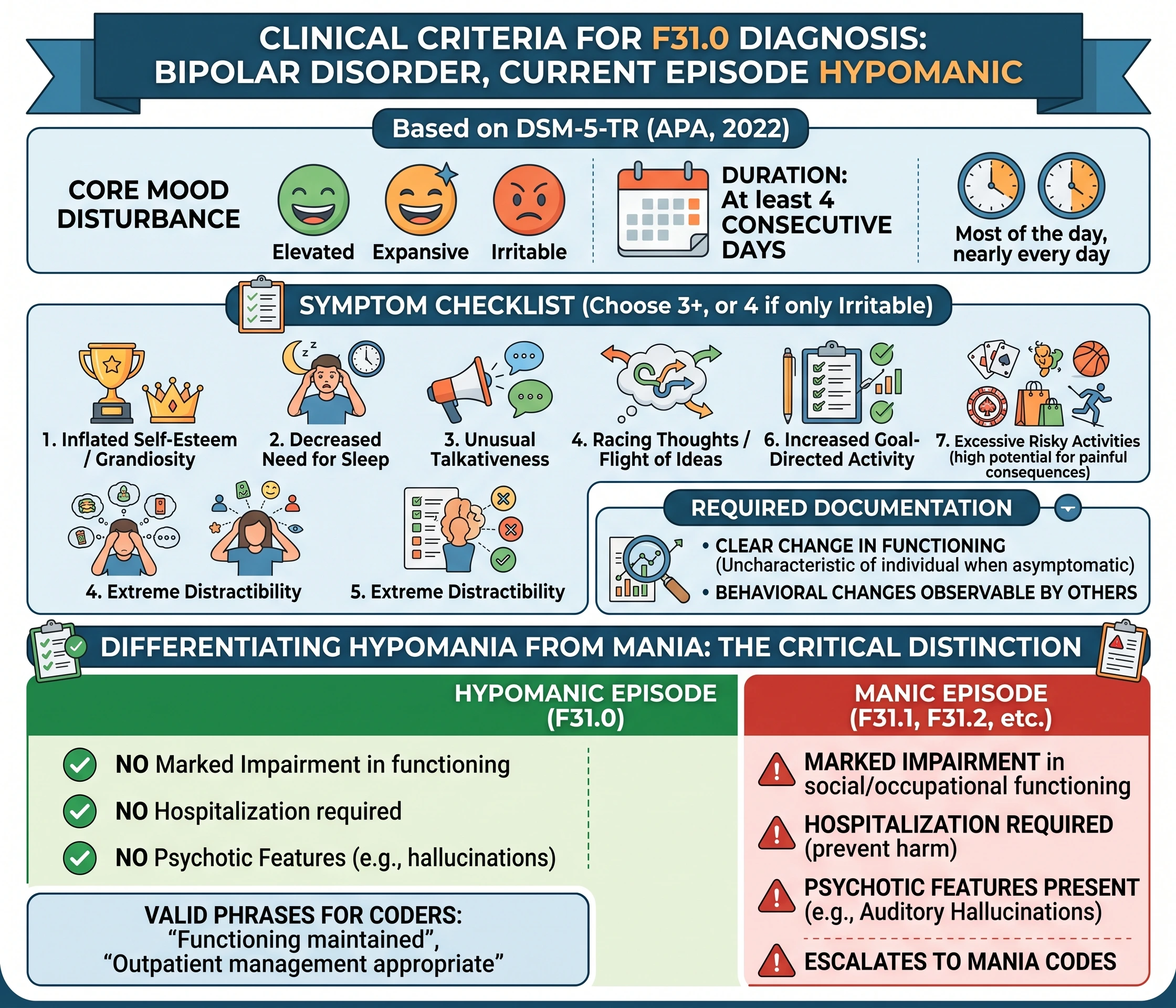
To support an F31.0 claim, the physician or psychiatric provider must document symptoms that align with established psychiatric guidelines. The Diagnostic and Statistical Manual of Mental Disorders, Fifth Edition, Text Revision (DSM-5-TR), published by the American Psychiatric Association in 2022, defines a hypomanic episode as a distinct period of abnormally and persistently elevated, expansive, or irritable mood. This mood disturbance must last for at least four consecutive days and be present for most of the day, nearly every day.
During this period, the patient must exhibit three or more specific symptoms. If the patient’s mood is only irritable rather than elevated, the requirement increases to four symptoms. These clinical indicators include inflated self-esteem or grandiosity, a decreased need for sleep, unusual talkativeness, racing thoughts or flight of ideas, extreme distractibility, increased goal-directed activity, and excessive involvement in activities that have a high potential for painful consequences.
Providers must explicitly state in the medical record that the current episode represents a clear change in functioning that is uncharacteristic of the individual when asymptomatic. The behavioral changes must be observable by others.
Differentiating hypomania from mania in documentation
The most critical distinction for the F31.0 code is the absence of severe impairment. A full manic episode causes marked impairment in social or occupational functioning, requires hospitalization to prevent harm to self or others, or includes psychotic features. A hypomanic episode does not cause marked impairment, does not require hospitalization, and never involves psychosis.
When a provider notes that a patient is experiencing auditory hallucinations during an elevated mood state, the F31.0 code becomes clinically invalid. Psychotic features automatically escalate the current episode to mania, requiring a different code from the F31.1 or F31.2 subcategories. Medical billers must look for specific phrases in the assessment, such as “functioning maintained” or “outpatient management appropriate,” to validate the assignment of a hypomanic episode code.
Documentation requirements for medical billers and coders
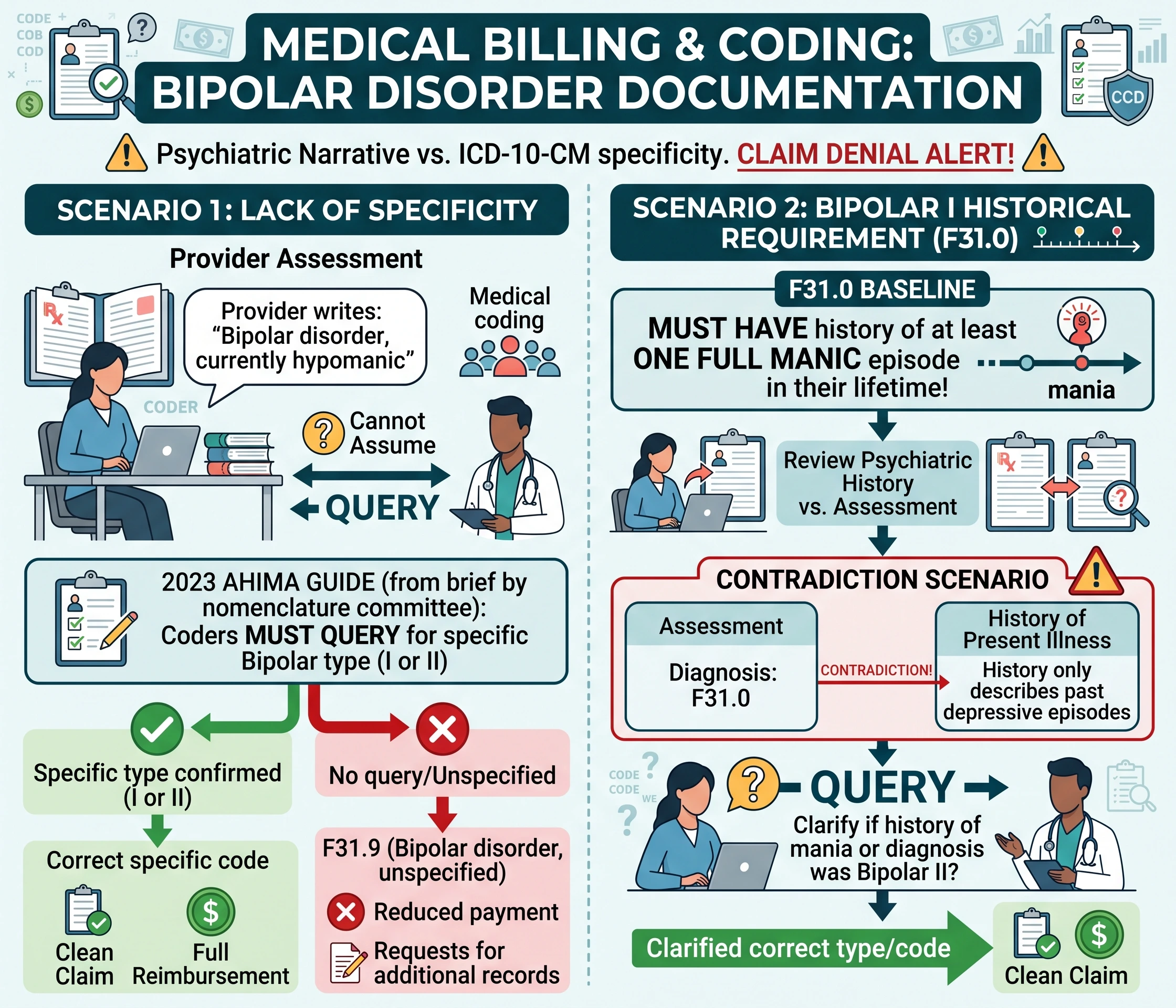
Translating a psychiatric evaluation into a clean insurance claim requires alignment between the clinical narrative and the ICD-10-CM tabular list. A frequent cause of claim denial in behavioral health billing is the lack of specificity in the provider’s assessment.
If a psychiatrist documents “Bipolar disorder, currently hypomanic,” the coder cannot assume the patient has Bipolar I disorder. The patient could have Bipolar II disorder, which is defined by a history of major depressive episodes and hypomanic episodes. According to a 2023 coding practice brief published by the American Health Information Management Association (AHIMA), authored by their coding nomenclature committee, coders must query the attending provider when the documentation lacks the specific bipolar type. Assigning the unspecified code F31.9 (Bipolar disorder, unspecified) frequently results in reduced reimbursement or requests for additional medical records from Medicare and commercial payers.
Establishing the Bipolar I baseline
The F31.0 code contains an inherent historical requirement. The patient must have experienced at least one full manic episode in their lifetime. Without a documented history of mania, a diagnosis of Bipolar I disorder cannot be sustained.
Coders reviewing an initial psychiatric evaluation for a new patient must ensure the provider has documented the patient’s psychiatric history. If the provider lists F31.0 in the assessment but the history of present illness only describes past depressive episodes, the documentation contradicts the diagnosis code. In these instances, the coder must send a query to clarify whether the patient actually has a history of mania or if the provider intended to diagnose Bipolar II disorder.
Common coding errors and claim denials associated with F31.0
Behavioral health claims undergo strict scrutiny by insurance companies to verify medical necessity. Claims submitted with F31.0 frequently face audits when the documentation fails to detail the specific duration of the symptoms. Writing “patient is energetic” does not satisfy the four-day duration requirement for a hypomanic episode.
Another common error involves billing F31.0 alongside inappropriate secondary codes. Billing a code for a current severe major depressive episode concurrently with F31.0 contradicts the definition of a single current episode type, unless the provider explicitly documents a mixed episode.
|
Diagnostic feature |
F31.0 (Bipolar I, current episode hypomanic) |
F31.81 (Bipolar II disorder) |
|
Current episode |
Hypomanic |
Hypomanic or depressed |
|
History of mania |
Required (at least one lifetime episode) |
Never occurred |
|
History of major depression |
Common, but not required for diagnosis |
Required (at least one lifetime episode) |
|
Psychotic features in history |
Possible (during past manic episodes) |
Never occurred during elevated mood states |
This comparison isolates why precise language in the provider’s progress note directly affects code selection. A vague note leads to coding delays and increases the administrative burden on the medical billing department.
Specific coding scenarios for outpatient settings
Clinical scenarios illustrate the practical application of this diagnosis code. Consider a 35-year-old patient who presents to an outpatient psychiatric clinic. The patient has been a patient of the practice for five years and has a documented history of a severe manic episode that required hospitalization in 2021.
During the current visit, the psychiatrist notes that for the past five days, the patient has been sleeping only three hours a night, speaking rapidly, and starting multiple home renovation projects. The patient continues to go to work and has not exhibited any delusional thinking. The provider prescribes a medication adjustment and recommends a follow-up appointment in two weeks.
The coder reviews this chart and correctly assigns F31.0. The history of mania confirms Bipolar I. The current symptoms match the DSM-5-TR criteria for hypomania. The duration exceeds four days. The lack of hospitalization and the ability to maintain employment confirm the episode is hypomanic rather than manic.
Conversely, if the same patient presented with these symptoms but told the provider that God was commanding the home renovation projects, the presence of delusions (a psychotic feature) would upgrade the episode to mania. The coder would then assign F31.2 (Bipolar disorder, current episode manic severe with psychotic features).
Navigating CMS and insurance payer guidelines
The Centers for Medicare & Medicaid Services (CMS) regulates the reimbursement of outpatient mental health services through specific Local Coverage Determinations (LCDs). CMS requires documentation of the exact duration of the psychiatric episode and the specific symptoms observed during the clinical interview.
According to a 2024 behavioral health audit report published by the Office of Inspector General (OIG), federal auditors frequently monitor claims to identify patterns of upcoding or insufficient documentation. Upcoding occurs when a provider bills for a more severe diagnosis, such as severe mania, without the clinical evidence to support it. To substantiate an F31.0 claim, the progress note must include a detailed mental status examination (MSE). The MSE should describe the patient’s appearance, behavior, speech rate, mood, affect, thought process, and judgment.
A treatment plan that directly addresses the hypomanic symptoms must accompany the diagnosis. If the provider bills F31.0 but the treatment plan only focuses on managing anxiety or insomnia without addressing the underlying bipolar disorder, the payer may deny the claim for lacking medical necessity. The documentation must clearly link the psychiatric intervention to the hypomanic state.
Pharmacological management and code verification
Medical coders also use the medication list as a secondary check for diagnosis accuracy. Patients with an F31.0 diagnosis typically take mood-stabilizing medications. The medical record often includes prescriptions for lithium, valproate, lamotrigine, or atypical antipsychotics used for mood stabilization.
If a coder encounters an F31.0 diagnosis on a chart where the patient is only prescribed standard antidepressants without a mood stabilizer, this discrepancy requires an immediate chart review. Standard antidepressants can trigger hypomanic episodes in bipolar patients. The standard of care usually involves a mood stabilizer. Recognizing these pharmacological patterns helps coders identify potential documentation errors before claims go to clearinghouses.
Social determinants of health and supplementary Z codes
Behavioral health conditions frequently intersect with a patient’s socioeconomic environment. According to the 2024 ICD-10-CM Official Guidelines for Coding and Reporting published by the Centers for Disease Control and Prevention (CDC), coders should report Social Determinants of Health (SDOH) using Z codes (Z55-Z65).
Hypomania does not cause the severe impairment seen in full mania. It can still create specific friction in a patient’s life. Increased goal-directed activity and impulsivity frequently lead to workplace conflicts, financial stress from impulsive spending, or relationship strain. If the provider documents that the patient’s current hypomanic episode has resulted in a recent job loss or extreme financial distress, the coder should append the appropriate Z codes. Relevant options include Z56.0 (Unemployment, unspecified) or Z59.8 (Other problems related to housing and economic circumstances).
Documenting these secondary factors provides a complete clinical picture to the payer. Commercial insurance companies use this data to determine risk adjustment factors and allocate resources for case management programs.
The relationship between DSM-5-TR and ICD-10-CM for F31.0
Psychiatrists and psychologists formulate diagnoses using the DSM-5-TR. Medical billers process claims using the ICD-10-CM. The transition between these two systems operates smoothly for most mood disorders, but F31.0 requires attention to the “current episode” modifier.
The clinical reality of bipolar disorder is episodic. A patient will not remain in a hypomanic state indefinitely. When a patient returns for a follow-up appointment three months later, and the mood-stabilizing medication has resolved the hypomanic symptoms, the provider should not continue to report F31.0.
If the patient is euthymic (experiencing a normal, tranquil mental state), the provider must update the documentation to reflect remission. The coder should then assign F31.70 (Bipolar disorder, currently in remission, most recent episode unspecified), F31.73 (Bipolar disorder, in partial remission, most recent episode manic), or F31.74 (Bipolar disorder, in full remission, most recent episode manic). Continuing to bill F31.0 for months after the symptoms have subsided constitutes a documentation error and creates a compliance risk during payer audits.
Understanding the application of the F31.0 diagnosis code for Bipolar I disorder (hypomanic episode) ensures healthcare organizations receive appropriate reimbursement while maintaining clean clinical records. Medical billers and coders must verify the historical presence of a manic episode and the current presentation of hypomanic symptoms within the physician’s assessment. Clear communication between the coding department and the clinical staff prevents claim denials, satisfies insurance requirements, and produces a medical record that accurately reflects the patient’s psychiatric condition.