


How can I find out what health insurance I have? A guide for patients, providers, and billing staff
Front desk staff hear a version of this question several times a shift: “I think I have insurance, but I’m not sure who it’s with.” Sometimes the patient lost their card. Sometimes they just started a new job and haven’t received one yet. In some cases, a patient’s insurance coverage expired months earlier without their knowledge. Whatever the reason, the answer to how can I find out what health insurance I have almost always comes from one of a handful of sources, and knowing which one applies to a given patient saves a registration desk real time.
This piece, put together as a training reference for Mental Health Billing’s front-office and coding staff, walks through those sources in the order most people should check them, then covers the side of the process that billing teams and medical billing students actually work with: the electronic transactions, standards, and data that confirm coverage before a claim ever goes out the door.
Start with what’s already in your hands
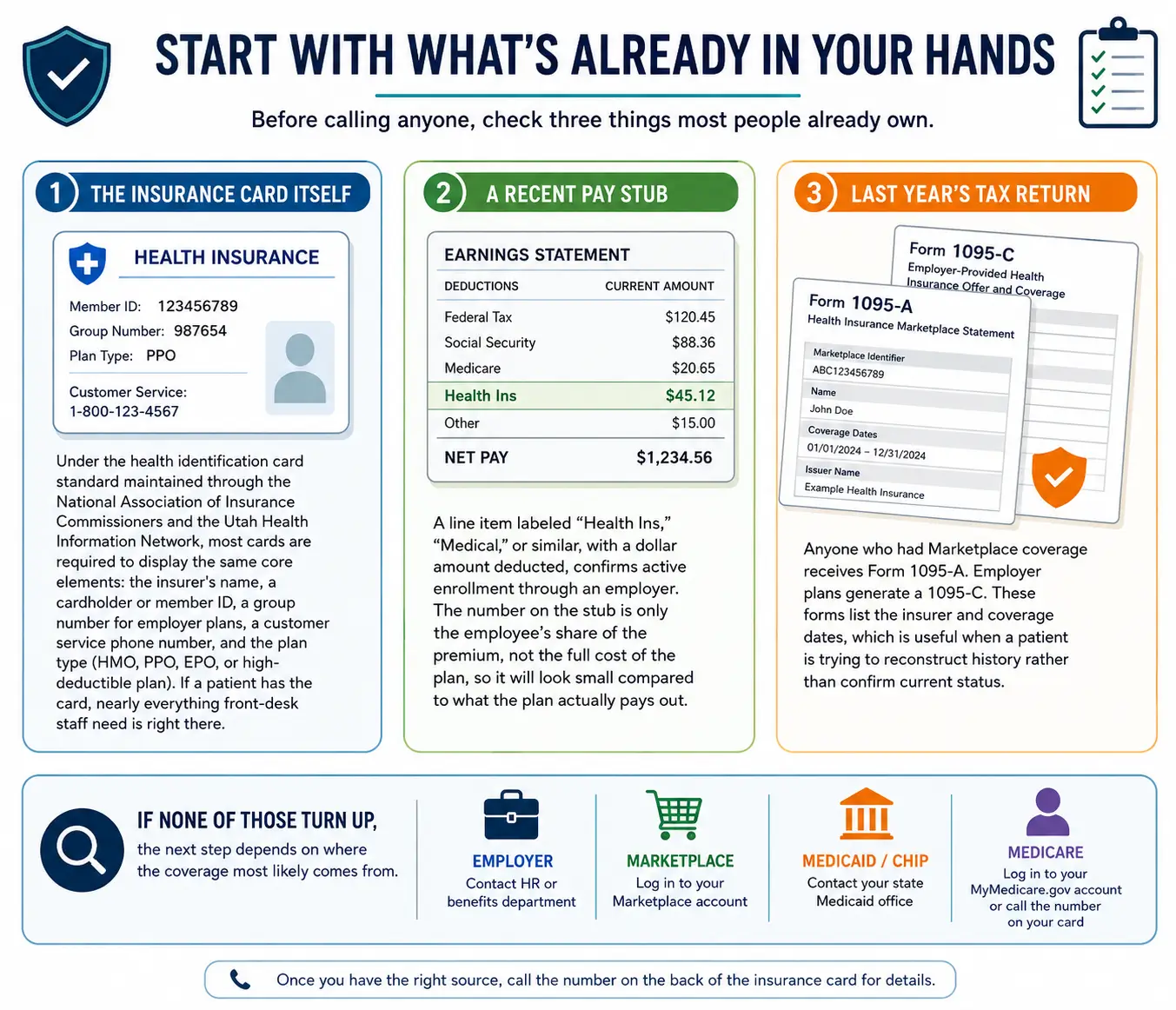
Before calling anyone, check three things most people already own.
A few of these deserve more detail, because the verification path is not always obvious.
Marketplace coverage. The Affordable Care Act directed the Department of Health and Human Services to build a mechanism for consumers to identify coverage options, which became HealthCare.gov. In states that run their own exchange, such as Washington Healthplanfinder or GetCoveredNJ, the same idea applies: log into the account created at enrollment, and the plan name, carrier, and premium history are all visible.
TRICARE. Active-duty service members, military retirees, and their families are enrolled through the Defense Enrollment Eligibility Reporting System, known as DEERS. Coverage status can be checked through milConnect, and the DEERS Support Office phone line runs during business hours Eastern time. Outdated DEERS records are a common reason claims get held up, since the system, not the insurance card, is the source of truth for eligibility.
VA health care. Veterans enrolled in VA health care manage benefits through My HealtheVet on VA.gov. A separate general information line, MyVA411, handles broader questions that fall outside health benefits specifically.
Some states offer more than basic provider login portals by maintaining public network verification tools. For example, New York’s Provider & Health Plan Look-Up Tool allows users to search by health insurance plan to find participating providers or search by provider to see which insurance plans they accept. After a patient’s insurance coverage has been verified, these state-run resources provide a reliable way to confirm whether the provider is in-network.
- The insurance card itself. Under the health identification card standard maintained through the National Association of Insurance Commissioners and the Utah Health Information Network, most cards are required to display the same core elements: the insurer’s name, a cardholder or member ID, a group number for employer plans, a customer service phone number, and the plan type (HMO, PPO, EPO, or high-deductible plan). If a patient has the card, nearly everything front-desk staff need is right there.
- A recent pay stub. A line item labeled “Health Ins,” “Medical,” or similar, with a dollar amount deducted, confirms active enrollment through an employer. The number on the stub is only the employee’s share of the premium, not the full cost of the plan, so it will look small compared to what the plan actually pays out.
- Last year’s tax return. Anyone who had Marketplace coverage receives Form 1095-A. Employer plans generate a 1095-C. These forms list the insurer and coverage dates, which is useful when a patient is trying to reconstruct history rather than confirm current status.
Match the situation to the right source
Coverage in the United States comes from a short list of channels, and each one has its own lookup method. The table below is the order a registration desk typically works through.| Coverage source | Fastest way to confirm it | Who to contact |
| Employer group plan | Call HR or benefits administration; check payroll deductions | Employer’s benefits office |
| ACA Marketplace (individual/family) | Log into the state or federal exchange account | HealthCare.gov or the state-based exchange |
| Medicaid or CHIP | Check the state Medicaid portal or card | State Medicaid agency |
| Medicare | Log into an account at Medicare.gov | 1-800-MEDICARE (1-800-633-4227) |
| TRICARE | Log into milConnect | DEERS Support Office, (800) 538-9552 |
| VA health benefits | Log into My HealtheVet | VA health benefits hotline, 877-222-8387 |
If nothing turns up
Working through every channel above and coming up empty usually means one of two things: the person is currently uninsured, or coverage exists somewhere the search hasn’t reached yet, most often a spouse’s employer plan or a parent’s plan for a dependent under 26. Before concluding someone is uninsured, it’s worth checking whether they’re listed as a dependent on someone else’s policy, since dependents rarely receive their own card. If the person is genuinely uninsured, enrollment windows matter. Marketplace plans are generally available only during the annual Open Enrollment Period, which runs November 1 through January 15 in most states, according to HealthCare.gov. Outside that window, a Special Enrollment Period opens for 60 days after a qualifying life event such as losing job-based coverage, getting married, having a baby, or moving to a new coverage area. Losing Medicaid or CHIP specifically extends that window to 90 days.How billing offices verify the same coverage electronically
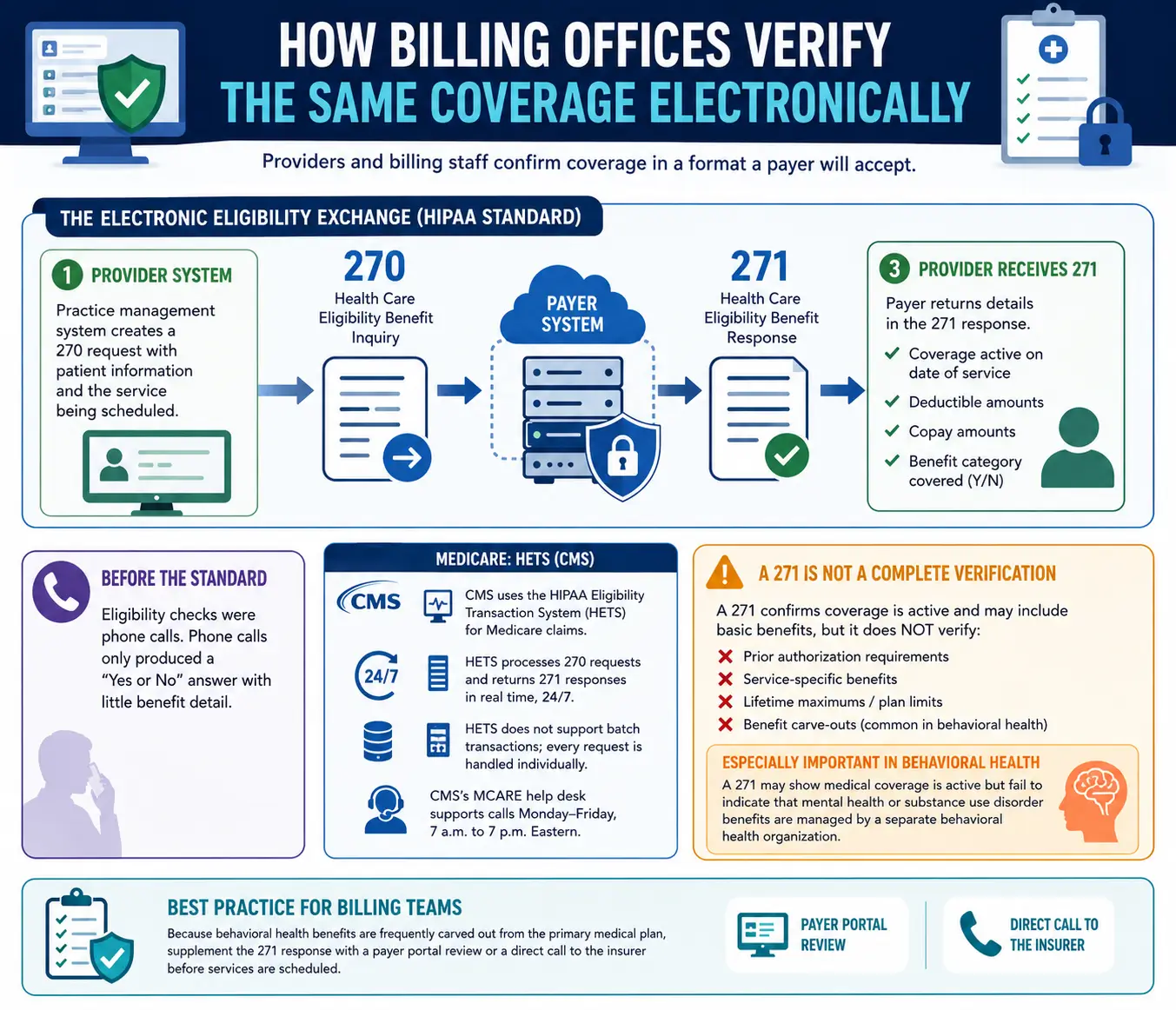
Everything above describes how a patient finds their own coverage. Providers and billing staff need to confirm the same information in a format a payer will accept, and that process runs on a different rail entirely.
Under HIPAA’s transaction and code set rules, eligibility verification between a provider and a payer uses a standardized pair of electronic transactions: the 270 (Health Care Eligibility Benefit Inquiry) and the 271 (Health Care Eligibility Benefit Response). The provider’s practice management system builds a 270 request containing the patient’s identifying information and the service being scheduled. The payer’s system returns a 271 with the requested details: whether coverage is active on the date of service, deductible and copay amounts, and whether the specific benefit category is covered at all.
Before this standard existed, eligibility checks were phone calls, and phone calls only produced a yes-or-no answer with little benefit detail. The Centers for Medicare & Medicaid Services runs its own version of this exchange for Medicare claims through the HIPAA Eligibility Transaction System, or HETS, which processes 270 requests and returns 271 responses in real time, 24 hours a day. HETS does not support batch transactions; every request is handled individually, and CMS’s MCARE help desk staffs support calls Monday through Friday, 7 a.m. to 7 p.m. Eastern.
A 271 eligibility response should not be treated as a complete insurance verification. It confirms that coverage is active and may include basic benefit information, but it usually does not verify prior authorization requirements, service-specific benefits, or lifetime maximums. This limitation is especially important in behavioral health. For example, a 271 may show that a patient’s medical coverage is active while failing to indicate that mental health or substance use disorder benefits are managed by a separate behavioral health organization. That distinction determines where claims for services such as outpatient therapy, intensive outpatient programs (IOPs), or partial hospitalization programs (PHPs) must be submitted. Because behavioral health benefits are frequently carved out from the primary medical plan, billing teams should supplement the 271 response with a payer portal review or a direct call to the insurer before services are scheduled.