



Integrating mental health care into primary medical settings requires accurate reporting to ensure practices receive appropriate reimbursement. The 99484 CPT code allows healthcare organizations to bill for time spent managing and coordinating behavioral health care. According to the Centers for Medicare and Medicaid Services (CMS) Medicare Learning Network publication on Behavioral Health Integration, these services address a clear clinical need. Primary care practitioners often manage psychiatric conditions, and care management codes compensate them for the continuous monitoring required outside of standard face-to-face appointments.
Understanding the 99484 CPT code explained in this guide helps medical billers, coders, and providers maintain compliance. Accurate billing prevents denied claims and protects practices during standard payer audits.
What is the 99484 CPT code?
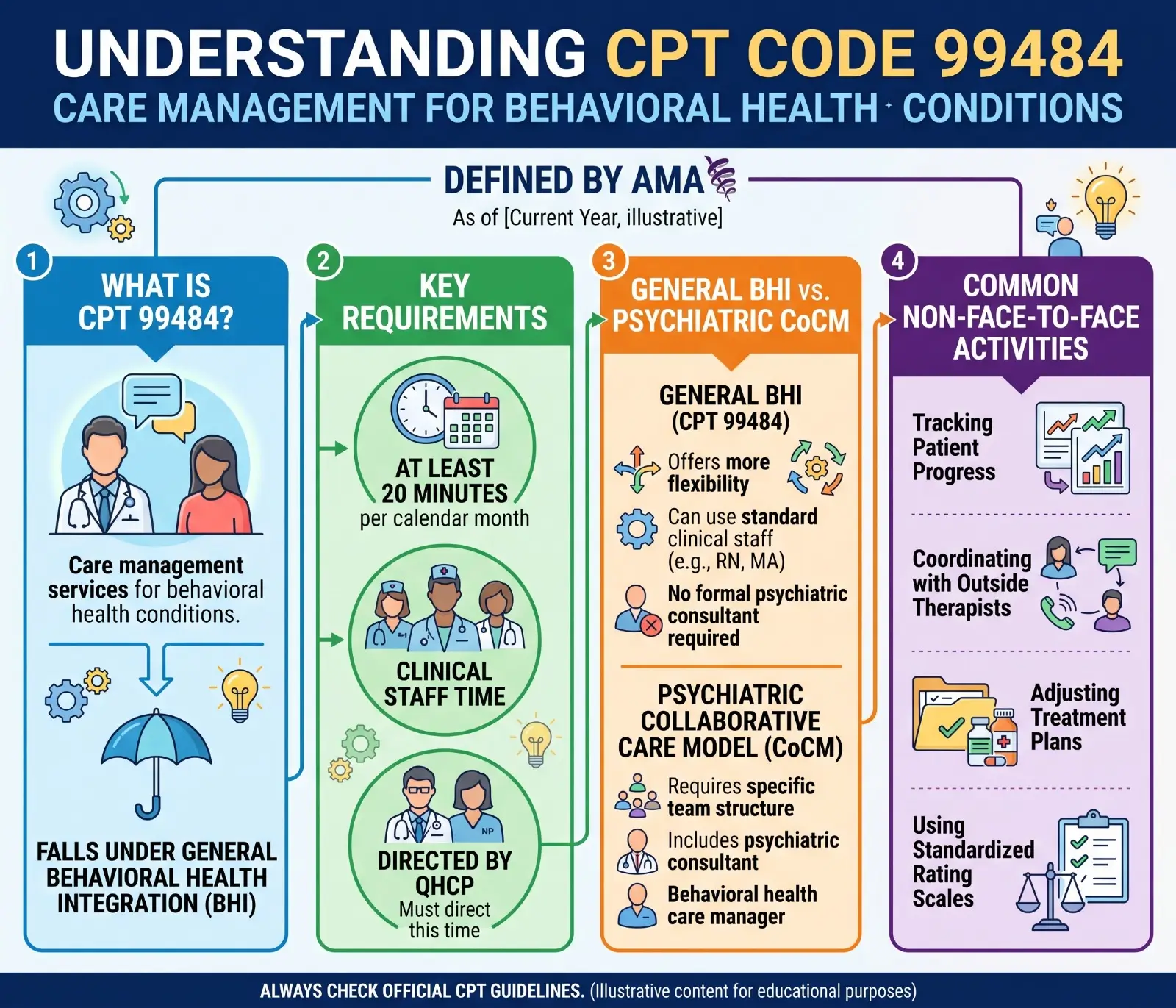
The American Medical Association (AMA) defines CPT code 99484 as care management services for behavioral health conditions. It requires at least 20 minutes of clinical staff time per calendar month. A physician or other qualified healthcare professional must direct this time.
This code falls under the umbrella of General Behavioral Health Integration (BHI). It differs from the Psychiatric Collaborative Care Model (CoCM). CoCM requires a specific team structure including a psychiatric consultant and a behavioral health care manager. General BHI offers more flexibility. A practice can bill 99484 using standard clinical staff, such as medical assistants or registered nurses, working under the direction of the billing practitioner. No formal psychiatric consultant is required.
Practices use this code to report non-face-to-face services. These activities include tracking patient progress, coordinating with outside therapists, and adjusting treatment plans based on standardized rating scales.
Provider and patient eligibility
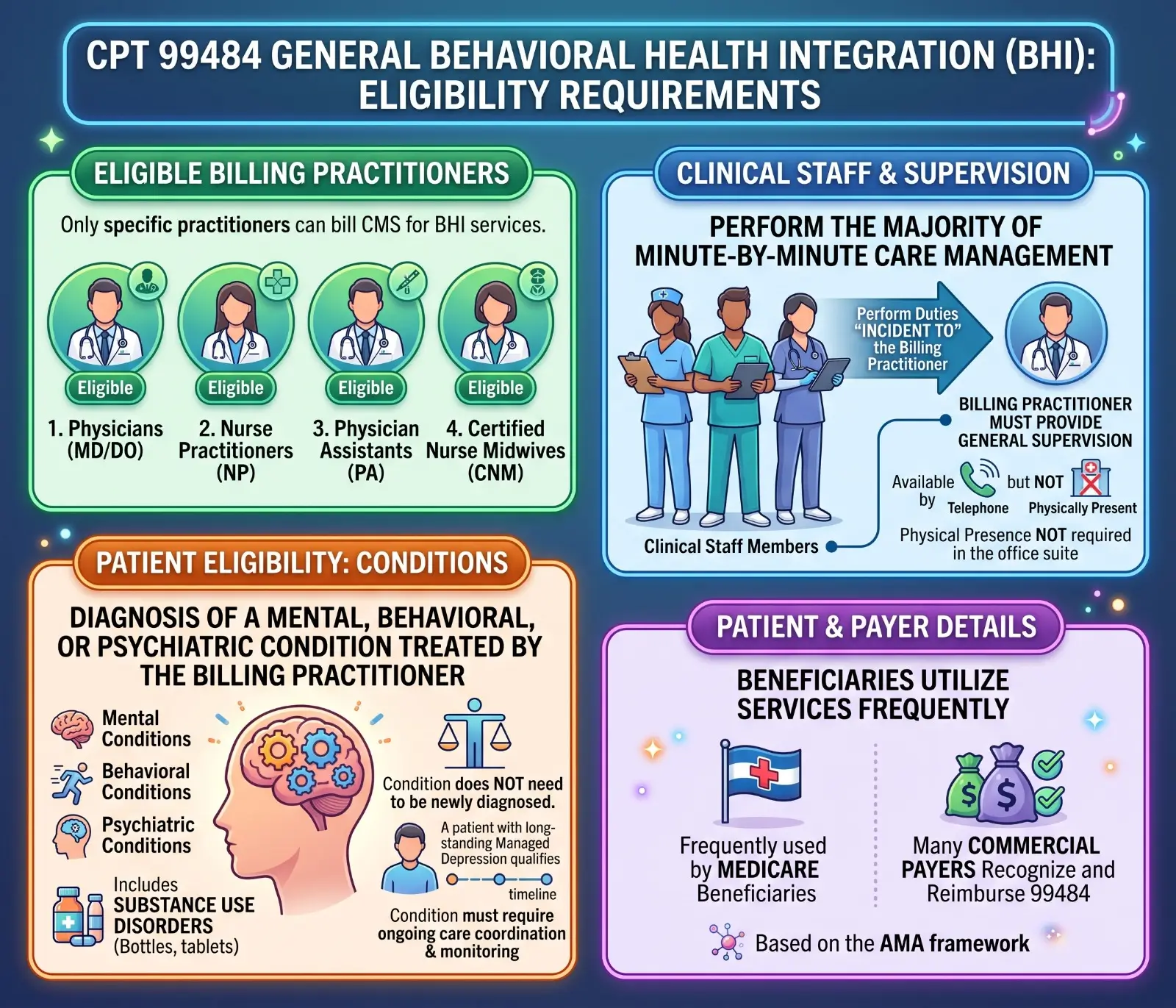
Not all practitioners can bill for BHI services. CMS restricts the primary billing of 99484 to specific provider types.
Eligible billing practitioners include:
- Physicians (MD or DO)
- Nurse Practitioners (NPs)
- Physician Assistants (PAs)
- Certified Nurse Midwives (CNMs)
Clinical staff members provide the majority of the minute-by-minute care management. They perform these duties "incident to" the billing practitioner. The billing practitioner must provide general supervision. General supervision means the physician must be available by telephone, but they do not need to be physically present in the same office suite when the clinical staff performs the service.
Patient eligibility requires a diagnosis of any mental, behavioral, or psychiatric condition being treated by the billing practitioner. This includes substance use disorders. The condition does not need to be newly diagnosed. A patient with long-standing, managed depression qualifies for BHI services if the condition requires ongoing care coordination and monitoring. Medicare beneficiaries frequently utilize these services, but many commercial payers also recognize and reimburse 99484 based on the AMA framework.
Core clinical components of general BHI
Billing the 99484 CPT code requires the practice to deliver specific clinical elements during the calendar month. Simply talking to a patient on the phone for 20 minutes does not satisfy the code requirements.
The clinical staff must perform an initial assessment. This involves administering validated rating scales. For a patient with depression, the staff might use the Patient Health Questionnaire-9 (PHQ-9). For anxiety, they might administer the Generalized Anxiety Disorder-7 (GAD-7) scale. The practitioner uses the results to establish a baseline and measure treatment efficacy over time.
Practitioners must also create and maintain a behavioral health care plan. This document outlines the patient's specific treatment goals, current medications, and planned psychological interventions. The clinical staff reviews this plan regularly and updates it based on the patient's progress.
Facilitating and coordinating treatment forms the bulk of the tracked time. Clinical staff might call the patient to discuss medication side effects, contact a local community mental health center to arrange counseling, or consult with the supervising physician to adjust a prescription. The practice must also ensure the patient has a continuous relationship with a designated care team member.
Billing rules and time requirements for 99484 CPT code
Medical coders must strictly adhere to time and frequency rules when submitting claims for care management. CPT 99484 is a time-based code. The practice must accumulate exactly 20 minutes or more of clinical staff time within a single calendar month.
If the staff logs 18 minutes in November, the practice cannot bill the code for November. Time does not roll over. On December 1, the time clock resets to zero.
Only one practitioner can bill 99484 per patient per calendar month. If a patient sees two different primary care physicians in different practices, only the practice managing the behavioral health care plan should bill the BHI service.
An initiating visit is mandatory for new patients or established patients who have not been seen within the last year. Before a practice can begin billing monthly care management, the provider must conduct a comprehensive Evaluation and Management (E/M) visit, an Annual Wellness Visit (AWV), or an Initial Preventive Physical Examination (IPPE). The provider discusses the BHI program during this visit and establishes the initial diagnosis.
Patient consent is a strict regulatory requirement. Because Medicare Part B and commercial insurance plans apply standard copayments and deductibles to 99484, patients will incur out-of-pocket costs for these non-face-to-face services. The billing practitioner must explain the service, inform the patient of potential cost-sharing, and notify them that only one practitioner can provide the service at a time. The patient may stop the service at any time. The practice must document this verbal or written consent in the electronic health record (EHR).
Comparing General BHI (99484) to CoCM (99492)
Medical billers frequently confuse General BHI with the Psychiatric Collaborative Care Model. The CMS Medicare Claims Processing Manual separates these tracks based on personnel and time minimums.
| Feature | General BHI (99484) | CoCM Initial Month (99492) |
|---|---|---|
| Time Requirement | 20 minutes per calendar month | 70 minutes per calendar month |
| Team Structure | Billing provider and clinical staff | Provider, Behavioral Health Care Manager, and Psychiatric Consultant |
| Registry Requirement | Not explicitly required | Must use a patient tracking registry |
| Consultation | General supervision by billing provider | Regular case reviews with psychiatric consultant |
Practices without the resources to contract an external psychiatric consultant rely on 99484 to provide structured care coordination.
Common mistakes when billing for BHI services
Auditors frequently identify recurring errors in behavioral health integration billing. Correcting these mistakes prevents recoupment demands from insurance carriers.
Double counting time
Many patients receiving BHI also qualify for Chronic Care Management (CCM) reported with CPT 99490. Medicare allows practices to bill both 99484 and 99490 in the same month for the same patient. The strict rule is that time cannot overlap. If a practice bills 99484 (20 minutes) and 99490 (20 minutes), the EHR must show a total of 40 distinct minutes of care management. The documentation must clearly delineate which minutes applied to the behavioral health condition and which applied to the other chronic medical conditions.
Counting administrative tasks as clinical time
Not all non-face-to-face time counts toward the 20-minute threshold. Clerical tasks do not qualify. If a receptionist spends five minutes leaving a voicemail to remind a patient about an upcoming appointment, that time is administrative. Clinical time includes activities requiring medical judgment, assessing symptoms, discussing medication compliance, or educating the patient on coping strategies.
Missing care plan documentation
A valid claim requires a documented care plan. Auditors deny claims when they review a chart and find only a list of phone call timestamps. The record must contain a localized care plan detailing the behavioral health diagnosis, the specific interventions planned, and the expected outcomes. If the plan remains static for six months with no notes regarding patient progress or medication adjustments, payers may determine the service lacks medical necessity.
Failing to document consent
Consent documentation is a frequent audit target. If a practice bills 99484 for six consecutive months, the auditor will look for the initial consent obtained prior to the first billing cycle. If the EHR lacks a sentence confirming the patient agreed to the service and understood the financial implications, the payer will likely retract payment for all subsequent months.
Financial considerations and workflow implementation
Reimbursement rates for CPT 99484 fluctuate based on geographic location and annual CMS adjustments to the Physician Fee Schedule conversion factor. Historically, the national average Medicare reimbursement for 99484 hovers between $40 and $50 per patient per month.
Generating revenue through this code requires a highly organized workflow. Successful medical practices designate specific clinical staff members to manage the BHI patient panel.
A practical clinical workflow follows a predictable sequence. During the first week of the month, the designated nurse reviews the registry of BHI patients. The nurse identifies patients due for follow-up calls. During the second week, the nurse contacts patients to administer PHQ-9 questionnaires over the phone and asks about adherence to newly prescribed antidepressants. The nurse logs eight minutes for a specific patient.
During the third week, the patient calls the clinic reporting mild nausea from the medication. The nurse spends six minutes consulting with the primary care physician and calling the patient back to advise taking the medication with food. During the final week, the nurse spends six minutes updating the care plan in the EHR and forwarding a referral to an outpatient counseling center. The system logs 20 total minutes. The billing department submits CPT 99484 at the end of the month.
Practices must train their clinical staff on exact timekeeping procedures within their specific EHR system. Many modern EHRs include built-in timers connected to the patient chart. Staff must use these tools accurately, ensuring they clock out of the timer if they switch to a different patient's chart or step away to handle an unrelated task.
Consistent compliance requires routine internal audits. Practice managers should randomly select five claims for 99484 each quarter. The manager should verify the presence of the initiating visit, the documented patient consent, the 20 minutes of strictly clinical time, and the updated behavioral health care plan. Addressing documentation gaps internally prevents larger financial liabilities when external commercial or federal auditors request records. Accurate reporting reflects the actual work clinical staff perform to support patients managing mental health conditions.