


F41.9 ICD-10 Code Explained: Anxiety Disorder Unspecified — A Complete Clinical Guide
F41.9 is the ICD-10-CM code for anxiety disorder, unspecified, and it belongs to a small family of codes that coders reach for far more often than most clinicians assume. The code shows up constantly in emergency department charts, primary care intake notes, and telehealth visits where a patient reports anxiety but a formal workup hasn’t happened yet. For students learning medical billing and coding, and for providers who sign off on the note that determines what gets billed, F41.9 raises a practical question: when does “unspecified” reflect honest clinical uncertainty, and when does it just mean the documentation fell short?
This guide walks through where F41.9 sits inside ICD-10-CM, how it lines up with DSM-5-TR terminology, and the billing consequences that follow depending on how it’s used.
What F41.9 actually covers
F41.9, listed under the heading “Anxiety disorder, unspecified,” includes the inclusion term Anxiety NOS (not otherwise specified). It is a billable, specific code in the ICD-10-CM tabular list, meaning claims can be submitted with it on its own without a secondary qualifier. The code sits inside category F41, “Other anxiety disorders,” within the F40-F48 block, “Anxiety, dissociative, stress-related, somatoform and other nonpsychotic mental disorders,” in Chapter 5 of ICD-10-CM (Mental, Behavioral and Neurodevelopmental Disorders).
That placement matters for coders because F41 is a mixed category. It holds both highly specific diagnoses, like panic disorder, and this catch-all unspecified option, side by side.
Where F41.9 sits inside the F41 family
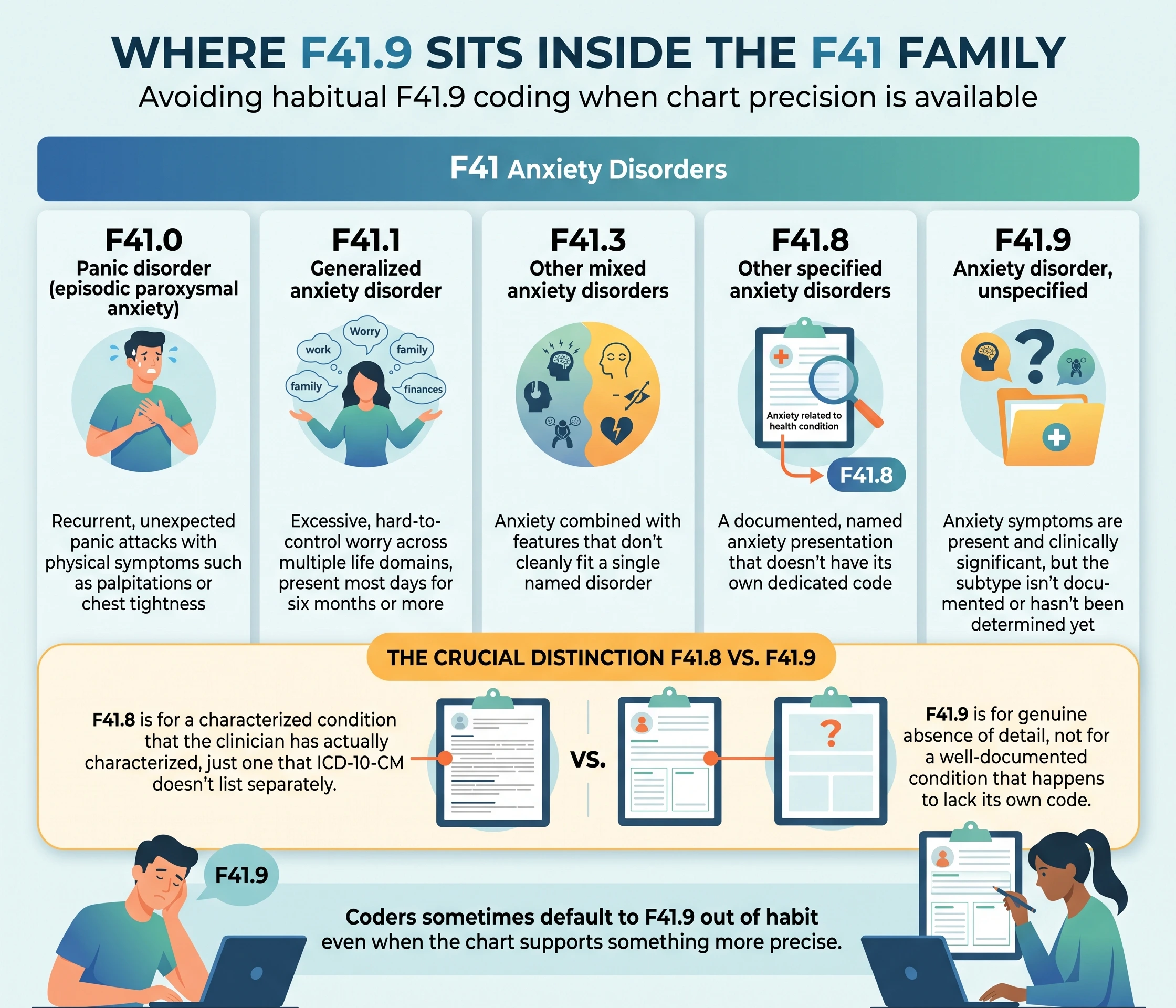
Coders sometimes default to F41.9 out of habit even when the chart supports something more precise. The table below lays out the full F41 category so the distinctions are easier to hold onto.
|
Code |
Description |
Typical clinical picture |
|
F41.0 |
Panic disorder (episodic paroxysmal anxiety) |
Recurrent, unexpected panic attacks with physical symptoms such as palpitations or chest tightness |
|
F41.1 |
Generalized anxiety disorder |
Excessive, hard-to-control worry across multiple life domains, present most days for six months or more |
|
F41.3 |
Other mixed anxiety disorders |
Anxiety combined with features that don’t cleanly fit a single named disorder |
|
F41.8 |
Other specified anxiety disorders |
A documented, named anxiety presentation that doesn’t have its own dedicated code |
|
F41.9 |
Anxiety disorder, unspecified |
Anxiety symptoms are present and clinically significant, but the subtype isn’t documented or hasn’t been determined yet |
The distinction between F41.8 and F41.9 trips up a lot of students. F41.8 is for a condition the clinician has actually characterized, just one that ICD-10-CM doesn’t list separately. F41.9 is for genuine absence of detail, not for a well-documented condition that happens to lack its own code.
How F41.9 lines up with DSM-5-TR
Billing coders working alongside behavioral health providers benefit from knowing the DSM crosswalk. F41.9 corresponds most closely to DSM-5-TR’s “Unspecified Anxiety Disorder” (300.00), a category the American Psychiatric Association reserves for anxiety symptoms that cause clinically significant distress or impairment without meeting full criteria for a named disorder, or where there isn’t enough information yet to be more specific. The two systems are asking a related but distinct question: DSM-5-TR is a diagnostic framework built for clinical decision-making, while ICD-10-CM is the classification system tied to reimbursement and public health reporting. A clinician can land on “unspecified anxiety disorder” under DSM-5-TR criteria and a coder will translate that directly to F41.9 on the claim.
When F41.9 is the right code, and when it isn’t
F41.9 is appropriate in a narrower set of situations than its frequency in claims data would suggest:
- Initial evaluations. A patient reports anxiety symptoms on intake, and the provider documents a plan for further assessment without yet meeting criteria for a specific subtype.
- Emergency and urgent care encounters. Anxiety symptoms are clinically significant, but a full diagnostic workup isn’t realistic in that setting.
- Follow-up visits with vague documentation. The problem list says “anxiety,” notes describe ongoing symptoms or medication management, and the provider never names a specific subtype.
It is not appropriate when the note already supports a more specific diagnosis. If a patient meets criteria for generalized anxiety disorder, or if the chart clearly describes recurrent panic attacks, coding F41.9 instead of F41.1 or F41.0 under-codes the encounter. Per section I.A.9.b of the ICD-10-CM Official Guidelines for Coding and Reporting, codes titled “unspecified” are meant for situations where the medical record genuinely lacks the detail needed to assign something more precise, not as a default when a coder hasn’t read the full note.
A practical scenario
A 34-year-old presents to primary care reporting several months of persistent worry about work, finances, and family, along with muscle tension and trouble sleeping. If the provider documents that these symptoms occur more days than not and meet the six-month duration threshold, F41.1 (generalized anxiety disorder) is the accurate code. If instead the note says only “patient endorses anxiety, will reassess at next visit,” F41.9 is the honest reflection of what’s known so far.
Documentation that supports F41.9
Auditors reviewing behavioral health claims look for a specific gap: does the note actually withhold the level of detail the unspecified code implies? Documentation that supports legitimate use of F41.9 typically includes a stated intention to evaluate further, symptom descriptions that don’t yet map onto a named subtype, and a visit type (intake, emergency, urgent care) where incomplete workup is expected. Documentation that undermines it includes duration and frequency details that already satisfy criteria for GAD or panic disorder, since that data should have produced a more specific code.
F41.9 and reimbursement
One detail billing students often miss: F41.9 does not map to a Hierarchical Condition Category under the CMS-HCC risk adjustment models used for Medicare Advantage payment, whether version 24 or the newer version 28, nor under the ACA/HHS commercial risk adjustment model. That means the code carries a risk adjustment factor of zero. For practices tracking risk-adjusted revenue, assigning F41.9 instead of a more specific, documented anxiety diagnosis doesn’t just under-represent the patient’s condition clinically, it also leaves potential risk-adjustment value uncaptured where a more specific code might apply differently under a given payer’s methodology. This is one more argument, separate from documentation accuracy, for pushing toward specificity whenever the chart supports it.
The CMS grace period that tolerated broad, unspecified ICD-10-CM coding for Medicare physician claims ended on October 1, 2016. Since then, unspecified codes remain acceptable when documentation genuinely supports them, but payers increasingly track patterns of unspecified coding by provider and flag outliers for review.
Codes to avoid confusing with F41.9
ICD-10-CM’s Excludes2 note under F41 lists anxiety appearing in the context of other conditions that should be coded separately: acute stress reaction (F43.0), transient adjustment reaction (F43.2), neurasthenia (F48.8), psychophysiologic disorders (F45.-), and separation anxiety (F93.0). An Excludes2 note means these conditions can coexist with F41.9 in the same patient, but if the anxiety symptoms are specifically part of one of these other diagnoses, that code, not F41.9, should be used to describe them.
Why this code appears so often
Anxiety disorders are common enough that unspecified presentations show up constantly in general medical settings. According to the National Institute of Mental Health, drawing on data from the National Comorbidity Survey Replication, an estimated 19.1% of U.S. adults experienced some form of anxiety disorder in the past year, and 31.1% experience one at some point in their lives. Past-year prevalence was higher among women (23.4%) than men (14.3%). Given how often anxiety surfaces as a secondary complaint during visits for unrelated primary concerns, it’s unsurprising that providers frequently note the symptom without immediately pursuing a full diagnostic workup, which is exactly the scenario F41.9 exists to capture.
Common errors that trigger denials or audits
Three patterns recur in claims review: coders defaulting to F41.9 without reading the full note for subtype detail, providers using “anxiety” as shorthand in a problem list across multiple visits without ever documenting a specific diagnosis, and F41.9 being paired with treatment (a specific anti-anxiety medication regimen, for example) that implies a level of diagnostic certainty the code itself doesn’t reflect. None of these are catastrophic on their own, but a pattern of unspecified anxiety coding across a provider’s panel is the kind of signal that prompts a payer to request records.
Getting F41.9 right comes down to a single habit: read the note for what it actually documents, not what the presenting complaint suggests it might be. When the record supports panic disorder, generalized anxiety disorder, or another named subtype, code to that level. When it genuinely doesn’t, F41.9 is the accurate, defensible choice, and using it correctly protects both the integrity of the patient’s chart and the practice’s standing with payers.