



The Z71.89 diagnosis code classifies patient encounters for "Other specified counseling." The World Health Organization and the Centers for Medicare and Medicaid Services (CMS) designate Z codes for occasions when circumstances other than a disease or injury prompt a clinical encounter. Medical coders and healthcare providers use Z71.89 to document preventive advice, risk factor reduction, and targeted medical counseling that lacks a more specific classification in the ICD-10-CM manual.
What is the Z71.89 diagnosis code?
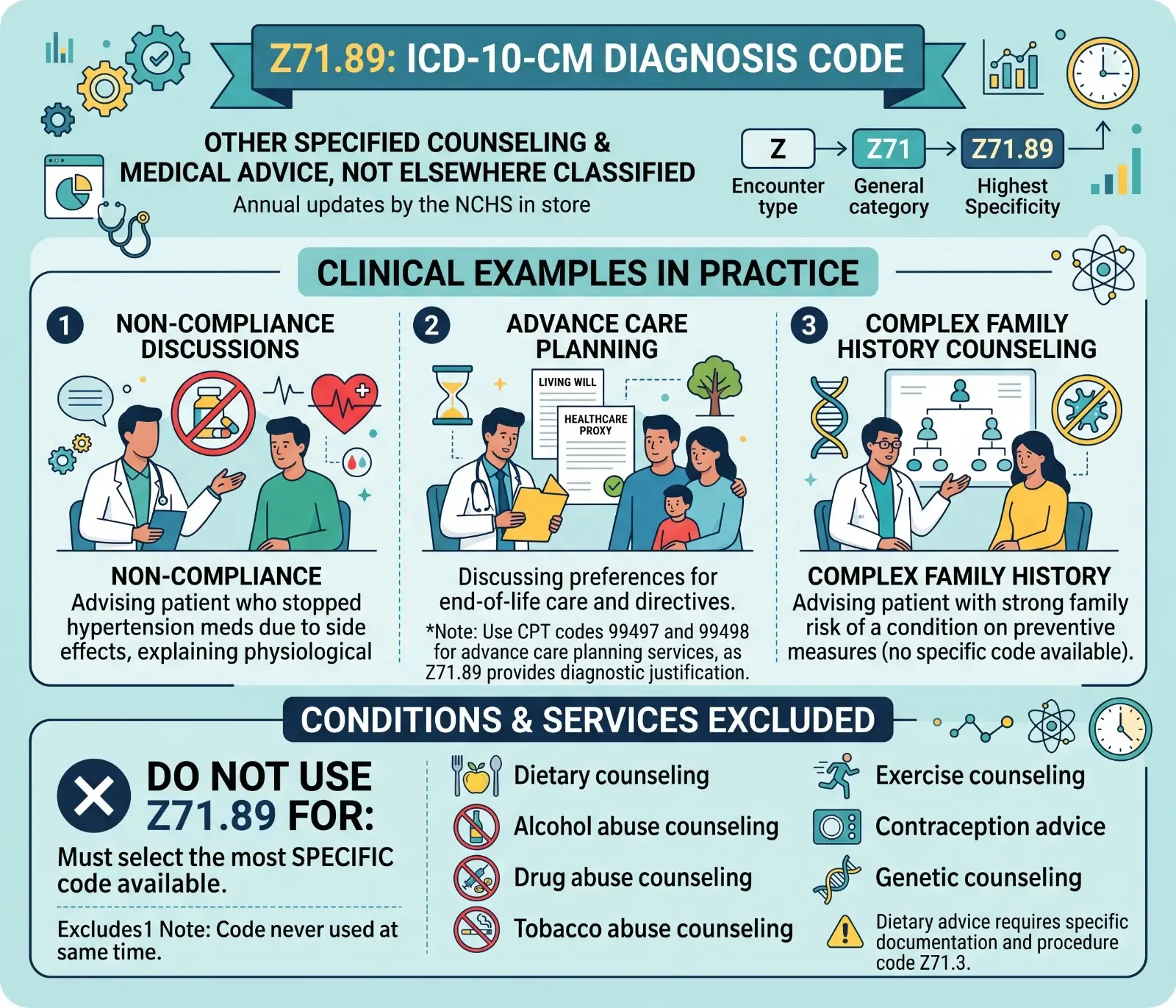
The ICD-10-CM manual organizes diagnoses into chapters based on body systems and encounter types. Z codes exist within Chapter 21, which covers factors influencing health status and contact with health services.
Category Z71 applies to persons encountering health services for other counseling and medical advice not elsewhere classified. The hierarchy of this specific code breaks down into three levels. The letter Z identifies the encounter type. The numbers 71 specify the general counseling category. The decimals .89 indicate the highest level of specificity available, denoting "other specified" counseling rather than an unspecified encounter.
The National Center for Health Statistics updates these classifications annually. Under the current official guidelines, providers use Z71.89 when they deliver detailed, subject-specific advice to a patient, and no other code accurately describes the topic discussed.
Clinical examples of Z71.89 in practice
Coders apply Z71.89 to a variety of clinical scenarios. A provider must spend measurable time advising the patient to justify the use of this code.
One common application involves non-compliance discussions. A patient might stop taking prescribed hypertension medication due to perceived side effects. The physician spends 15 minutes explaining the physiological risks of untreated high blood pressure and counseling the patient on alternative treatment options. The primary diagnosis remains hypertension, but Z71.89 documents the specific counseling intervention.
Advance care planning also falls under this category in specific contexts. A physician may spend time discussing living wills, healthcare proxies, and end-of-life care preferences with a patient and their family. While specific Current Procedural Terminology (CPT) codes govern the billing of advance care planning, Z71.89 provides the diagnostic justification for the service.
Another example is counseling for complex family histories. A patient with a strong family history of a specific autoimmune disorder may schedule a visit strictly to discuss preventive measures. If the ICD-10-CM index lacks a dedicated genetic or familial risk counseling code for that exact condition, the provider uses Z71.89 to capture the service.
Conditions and services excluded from Z71.89
Medical coding requires providers to select the most specific code available. Z71.89 acts as a catch-all category, meaning coders cannot use it if a dedicated code already exists for the counseling topic.
The ICD-10-CM manual includes specific exclusions. Coders refer to these as Excludes1 notes. An Excludes1 note means the excluded code should never be used at the same time as the primary code. You cannot bill Z71.89 for the following services:
- Z71.3: Dietary counseling and surveillance
- Z71.41: Alcohol abuse counseling and surveillance
- Z71.51: Drug abuse counseling and surveillance
- Z71.6: Tobacco abuse counseling
- Z71.82: Exercise counseling
- Z30.09: Encounter for other general counseling and advice on contraception
- Z31.5: Encounter for genetic counseling
If a physician spends 20 minutes discussing weight management and a diabetic diet, the coder must assign Z71.3. Submitting Z71.89 for dietary advice constitutes a coding error and often results in a claim denial.
Z71.89 diagnosis code billing insights and guidelines
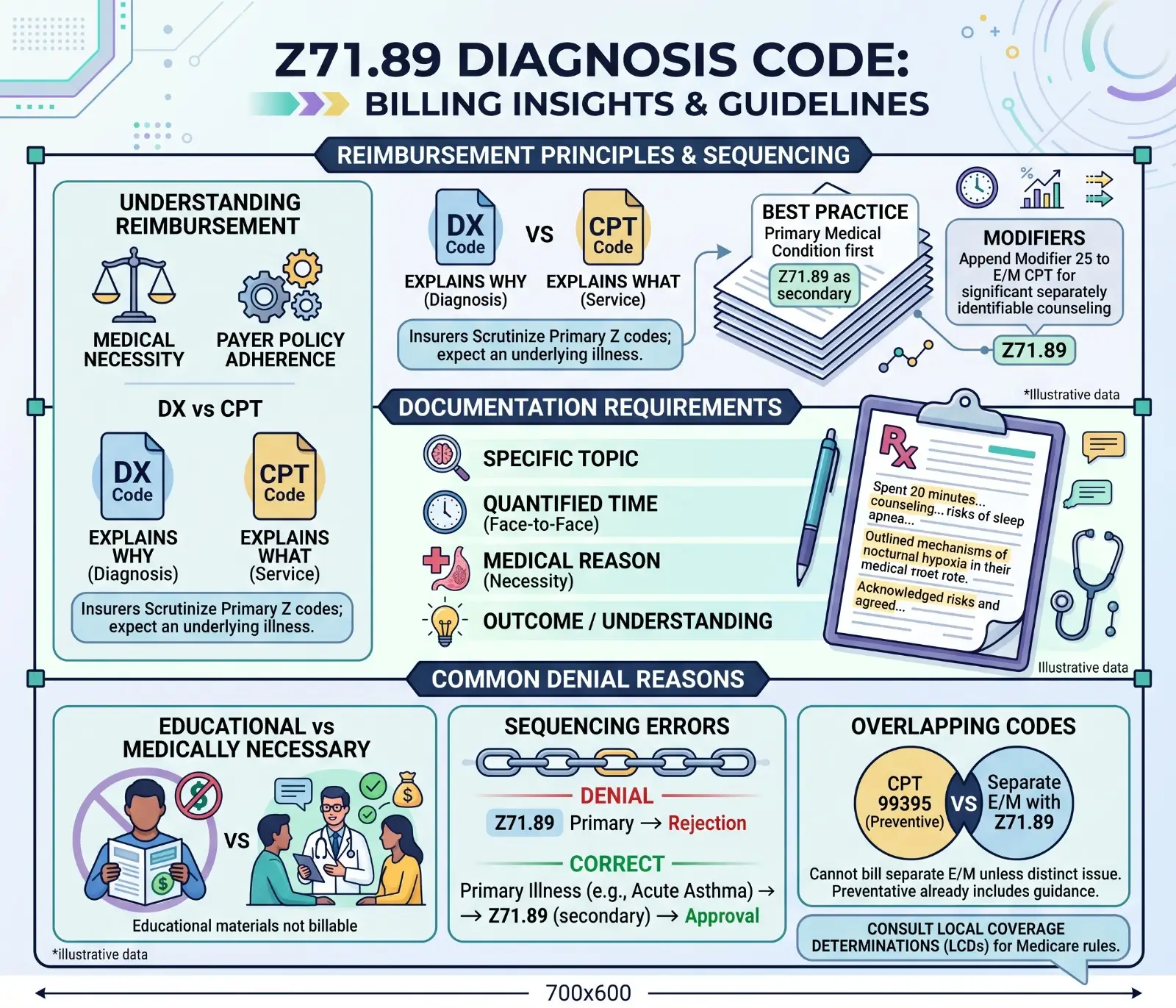
Securing reimbursement for counseling services requires strict adherence to payer policies. Health insurance companies evaluate claims based on medical necessity. When a provider submits a claim, the diagnosis code explains why the service was necessary, and the CPT code explains what service was performed.
According to the ICD-10-CM Official Guidelines for Coding and Reporting (Section I.C.21), Z codes may function as either a first-listed (principal) diagnosis or a secondary diagnosis. Commercial payers and Medicare Administrative Contractors heavily scrutinize Z codes submitted as the primary reason for a visit. Insurers expect to see an underlying illness or symptom prompting the encounter.
When a provider bills Z71.89 as the primary code, payers frequently deny the claim for lacking medical necessity. To prevent this, coders typically sequence the patient's primary medical condition first. Z71.89 follows as a secondary code to explain the extended time spent on education and advice.
Modifiers also dictate how these claims process. Providers often perform counseling during a standard Evaluation and Management (E/M) visit. If the counseling requires significant, separately identifiable time beyond the standard exam, coders append Modifier 25 to the E/M CPT code. The Z71.89 diagnosis code then links directly to that modified E/M service.
Documentation requirements for Z71.89
Auditors evaluate medical records to ensure billed codes match the clinical documentation. The Office of Inspector General and Medicare Recovery Audit Contractors regularly review E/M claims based on time and counseling components.
Writing "counseled patient" in the chart fails to meet auditing standards. For a counseling session to qualify for billing under Z71.89, the clinical note must include specific data points.
The provider must state the exact topic of the discussion. The documentation must quantify the time spent face-to-face with the patient discussing this topic. The note needs to outline the medical reason the intervention was necessary. The provider must record the outcome of the conversation or the patient's level of understanding.
A compliant chart note provides explicit details. A physician might write, "Spent 20 minutes face-to-face with the patient discussing the long-term cardiovascular risks of unmanaged sleep apnea. Outlined the physiological mechanisms of nocturnal hypoxia. Patient acknowledged the risks and agreed to schedule a CPAP titration study." This note specifies the time, topic, medical necessity, and outcome.
Common denial reasons for Z71.89 claims
Medical billing departments frequently process appeals for Z code denials. Understanding why payers reject these claims helps practices avoid initial errors.
Insurers reject claims when they determine the counseling was educational rather than medically necessary. Educational material handed to a patient does not constitute a billable counseling encounter. The provider must actively engage the patient in a clinical discussion.
Sequencing errors trigger automated denials in many claims processing systems. If a patient presents with an acute asthma exacerbation and the provider also counsels them on trigger avoidance, the asthma diagnosis must appear first on the CMS-1500 claim form. Placing Z71.89 in the primary position suggests the patient only came in for advice, contradicting the treatment of the acute attack.
Overlapping procedural codes cause additional rejections. Providers cannot bill a comprehensive preventive medicine service (such as CPT 99395) and add a separate E/M code for Z71.89 counseling unless the counseling addresses a completely separate, distinct clinical issue. Preventive medicine CPT codes already include anticipatory guidance and standard health counseling in their relative value units.
Practices consult Local Coverage Determinations published by regional Medicare contractors to verify specific billing rules. These documents outline exactly which primary diagnosis codes establish medical necessity for supplementary counseling services in different geographic jurisdictions.
Comparing Z71.89 to related codes
Medical coders navigate multiple similar codes within the Z71 category. Selecting the correct code depends entirely on the provider's documentation.
| Code | Description | Primary Clinical Use Case |
|---|---|---|
| Z71.0 | Person encountering health services to consult on behalf of another person | A parent consults a physician about a child's condition without the child present. |
| Z71.1 | Person with feared health complaint in whom no diagnosis is made | A patient fears they have a disease, but testing rules out the condition, and counseling is provided. |
| Z71.81 | Spiritual or psychiatric counseling | A patient receives pastoral care or specific psychiatric guidance during an encounter. |
| Z71.82 | Exercise counseling | A provider details a specific physical therapy or exercise regimen for joint health. |
| Z71.89 | Other specified counseling | The provider issues medical advice that does not fit any of the specialized categories above. |
| Z71.9 | Counseling, unspecified | The chart documentation lacks the detail required to assign a more specific counseling code. |
Coders avoid Z71.9 whenever possible. Unspecified codes signal to payers that the clinical documentation is incomplete, which increases the likelihood of an audit or claim denial.
Maintaining accuracy in medical coding and billing
Accurate medical coding relies on specificity. The Z71.89 diagnosis code serves a distinct function in healthcare administration by capturing patient education and medical advice that falls outside standard categories. Relying on this code as a default entry for all counseling leads to compliance risks if a more specific alternative exists in the manual. Healthcare providers secure appropriate reimbursement and maintain accurate clinical records by documenting the exact nature of the advice, the measurable time spent, and the underlying medical context requiring the intervention.