


Mental health medical billing companies typically charge between 5% and 10% of net collections. Most private therapy practices pay a median rate of 6% to 8% for full-service revenue cycle management.
These fees apply strictly to the revenue the billing service successfully collects from insurance payers and patients. The total cost fluctuates based on the size of the practice, the volume of monthly claims, and the complexity of the payer mix. Practices heavily reliant on state Medicaid programs often negotiate different rates than those processing commercial insurance claims.
Understanding exactly what percentage mental health medical billing companies charge requires looking at the specific services included in that rate. Some agencies provide end-to-end services including coding, claim submission, denial management, and patient invoicing. Others charge a lower base percentage but add individual fees for credentialing and follow-up work.
Average percentage rates based on practice size
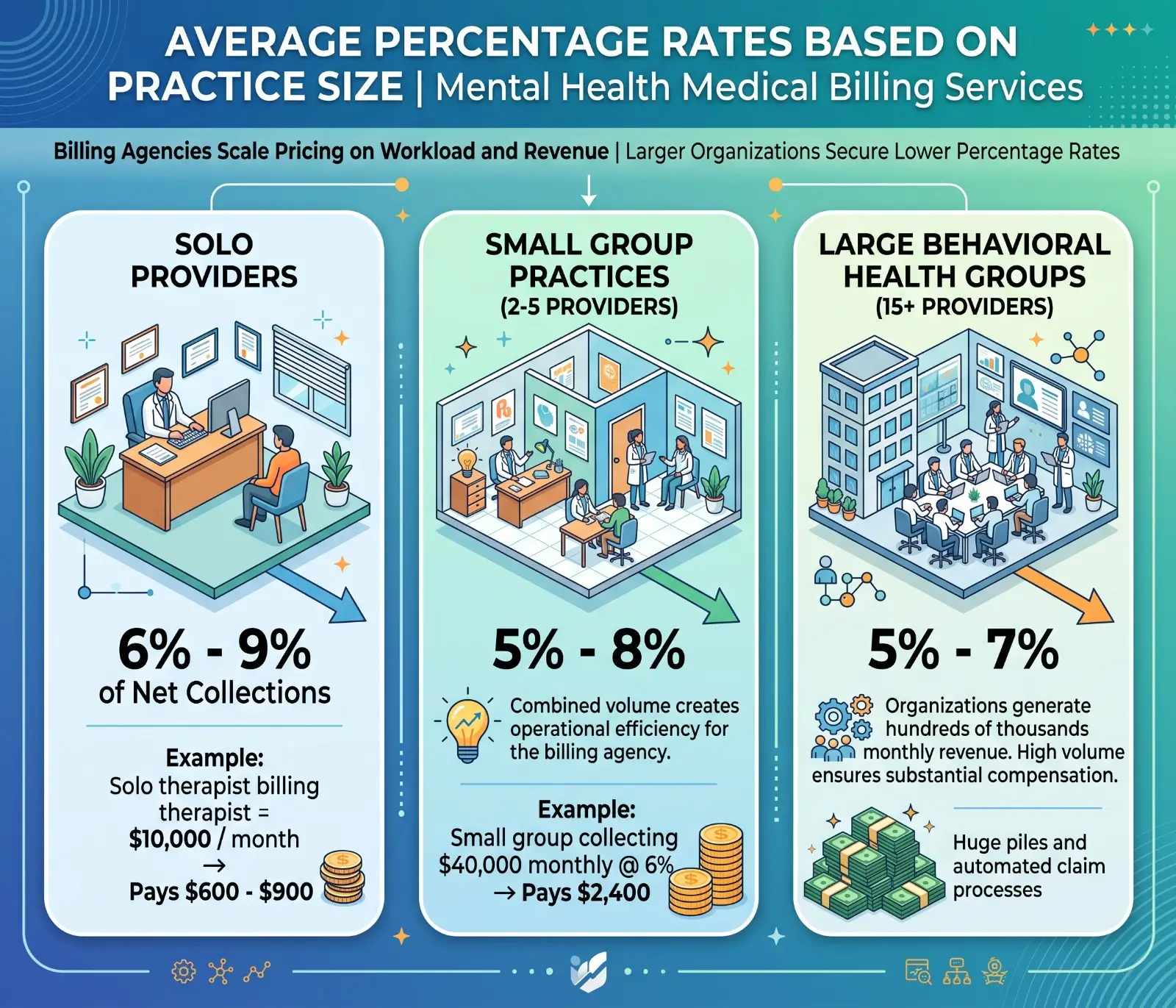
Billing agencies scale their pricing based on the anticipated workload and the expected revenue of the client. Larger organizations secure lower percentage rates because their high claim volume guarantees a larger absolute payout for the billing company.
Solo providers typically pay between 6% and 9% of their net collections. A solo therapist billing $10,000 a month will usually pay $600 to $900 for outsourced billing services.
Small group practices with two to five providers generally pay between 5% and 8%. The combined volume of multiple providers creates operational efficiency for the billing agency. If a small group collects $40,000 monthly at a 6% rate, the billing fee equals $2,400.
Large behavioral health groups with fifteen or more providers frequently secure rates between 5% and 7%. These organizations often generate hundreds of thousands of dollars in monthly revenue. At these volumes, even a 5% fee provides substantial compensation to the billing agency.
Why behavioral health billing rates differ from general medicine
Mental health billing carries a heavier administrative burden than standard medical billing. This increased difficulty directly influences the percentage rates agencies charge.
The American Medical Association's 2025 Prior Authorization Physician Survey reported that behavioral health claim denial rates run at 15% to 20%. This is roughly double the 5% to 10% average denial rate seen in standard medical and surgical claims. Billing agencies must allocate more staff time to appeal denied mental health claims, which justifies their percentage fees.
Time-based coding adds another layer of complexity. General medical visits rely heavily on standard Evaluation and Management codes based on medical decision-making. Mental health providers bill based on strict time increments. Using Current Procedural Terminology code 90837 requires a full 60-minute session. If a session runs for 45 minutes, the provider must use code 90834. Insurers frequently audit these time-based codes and demand detailed progress notes to prove medical necessity.
Regulatory changes also force billing companies to update their software and retrain their staff. Effective January 1, 2026, the specific Collaborative Care Management codes 99492, 99493, and 99494 were replaced by G0568, G0569, and G0570. Furthermore, Licensed Professional Counselors and Licensed Marriage and Family Therapists became eligible Medicare providers in 2024. They are reimbursed at 75% of the standard Physician Fee Schedule. Managing these specialized payer rules requires dedicated behavioral health coders.
How the percentage of collections model functions
The percentage of collections model bases the billing fee entirely on the money actually deposited into the practice's bank account. Billing companies do not charge a percentage based on the billed amount.
Providers often set their billed rates higher than the contracted rates agreed upon with insurance companies. A therapist might bill $200 for a session, but the insurance company's contracted allowable rate might be $150. If the billing company charges a 7% fee, they calculate that fee based on the $150 they collected. The cost to the practice for that specific claim is $10.50.
This model forces the billing company to pursue every unpaid claim. If a claim is denied and abandoned, the billing company earns nothing for the time spent submitting it.
Consider a small clinic collecting $50,000 in a month. If they handle billing internally and achieve an 82% net collection rate, they lose $9,000 to denied or ignored claims. If an outsourced agency charges 7% but improves the collection rate to 95%, the clinic collects $57,000. After paying the $3,990 billing fee, the clinic retains $53,010. The outsourced service pays for itself by capturing revenue that would otherwise be lost.
Alternative pricing structures for therapy practices
While the percentage model is the most common, some agencies offer flat-rate or per-claim pricing structures. These alternatives appeal to specific types of practices.
| Pricing Model | Average Cost Range | Best Suited For | Primary Financial Risk |
|---|---|---|---|
| Percentage of Collections | 5% to 10% of net revenue | Practices with variable volume or high denial rates | Costs scale up directly as practice revenue grows |
| Per-Claim Fee | $2 to $8 per submitted claim | Low-volume practices or cash-pay heavy clinics | Practice pays the fee even if the claim is denied |
| Flat Monthly Fee | $500 to $3,000 per provider | Large organizations with highly predictable volume | Practice overpays during slow months or vacations |
The per-claim model charges a set dollar amount every time a claim leaves the software system. This typically ranges from $2 to $8 per claim for full-service processing. A solo therapist submitting 40 claims a month at $5 per claim pays exactly $200. This is highly predictable. The danger of this model is that billing agencies have little financial incentive to fight denials. They already collected their fee when the claim was originally sent.
Flat monthly fees provide absolute predictability. A practice pays exactly $1,000 per provider every month regardless of how many patients they see. This works well for established psychiatrists who work full schedules year-round. It works poorly for therapists who take extended summer vacations or experience seasonal patient drop-offs.
Additional fees beyond the base percentage
When calculating what percentage mental health medical billing companies charge, practice owners must read the contract to identify additional line-item fees. A company advertising an unusually low 4% rate will often make up the difference through hidden surcharges.
Credentialing is the most common additional expense. According to a 2026 pricing report by Credex Healthcare, credentialing a single provider costs between $200 and $500 per insurance payer panel. Some premium billing agencies include this service in their base percentage. Others bill it as a separate hourly rate or flat fee.
Patient statements also incur extra charges. If a patient owes a $30 copay, the billing company must generate and mail a statement. Agencies typically charge $0.50 to $2.00 per physical statement mailed. If the agency handles patient collection calls, they may charge $50 to $100 per hour for that specific service.
Contract termination fees and automatic renewal clauses can trap practices in unfavorable agreements. Standard industry contracts require 60 to 90 days of written notice prior to cancellation. Practices should refuse contracts that charge denied claim resubmission fees. A reputable agency will include basic denial recovery in their primary percentage fee.
In-house staff costs compared to outsourced percentages
Practice owners frequently attempt to keep billing in-house to avoid paying 7% of their gross revenue to an outside vendor. This decision requires a realistic look at 2026 labor data.
According to a 2026 cost comparison report by Advanced Data Systems Corporation, the base salary for an experienced medical biller in the United States ranges from $55,000 to $70,000. Once payroll taxes, health insurance benefits, paid time off, and software licensing fees are factored in, the fully loaded cost of a single in-house biller falls between $90,000 and $120,000 annually.
For a behavioral health practice generating $1 million in annual revenue, an in-house biller costs roughly 10% to 12% of the total revenue. Outsourcing that same volume at a 7% rate costs $70,000 annually.
Beyond direct financial costs, in-house billing drains clinical time. A 2026 time-tracking analysis published by Physitrack found that physical and occupational therapists spend up to 49% of their workday on administrative tasks. Mental health providers face similar burdens. Every hour a licensed therapist spends on the phone with Blue Cross Blue Shield arguing about a modifier code is an hour they cannot bill for a clinical session.
Outsourced agencies also maintain lower first-pass denial rates. The Healthcare Financial Management Association notes that top-quartile billing operations maintain a denial rate below 5%. Internal staff at small therapy practices often lack the time to track every updated payer policy, which leads to higher initial denial rates and delayed cash flow.
Conclusion
Determining exactly what percentage mental health medical billing companies charge depends on the exact scope of work negotiated in the service agreement. The standard market rate in 2026 remains firmly between 5% and 10%, with solo providers paying slightly more than large clinical groups.
Practice owners should evaluate these fees against the verified costs of hiring internal staff and the revenue lost to unworked denials. A billing company charging 8% but delivering a 98% clean claim rate will generate more net income for a clinic than a discount agency charging 4% while abandoning difficult claims. Providers must demand clear contracts that specify exactly how credentialing, patient statements, and denial appeals are priced before handing over control of their revenue cycle.