


Z63.0 Diagnosis Code: Definition, Billing Guidelines, and Documentation Tips
Few codes create as much confusion per character as Z63.0. It is four characters long, it has been valid since the first day of ICD-10-CM, and it describes something clinicians encounter in almost every practice setting. It also sits in a part of the code set where the reporting rules and the payment rules point in different directions, which is why relationship-focused claims get denied so often.
What follows covers what the code classifies, the exclusion notes that generate edits, the sequencing rule most people miss, what Medicare contractors say about family and couples work, and the documentation habits that keep a Z63.0 claim intact under review.
What the Z63.0 diagnosis code means in ICD-10-CM
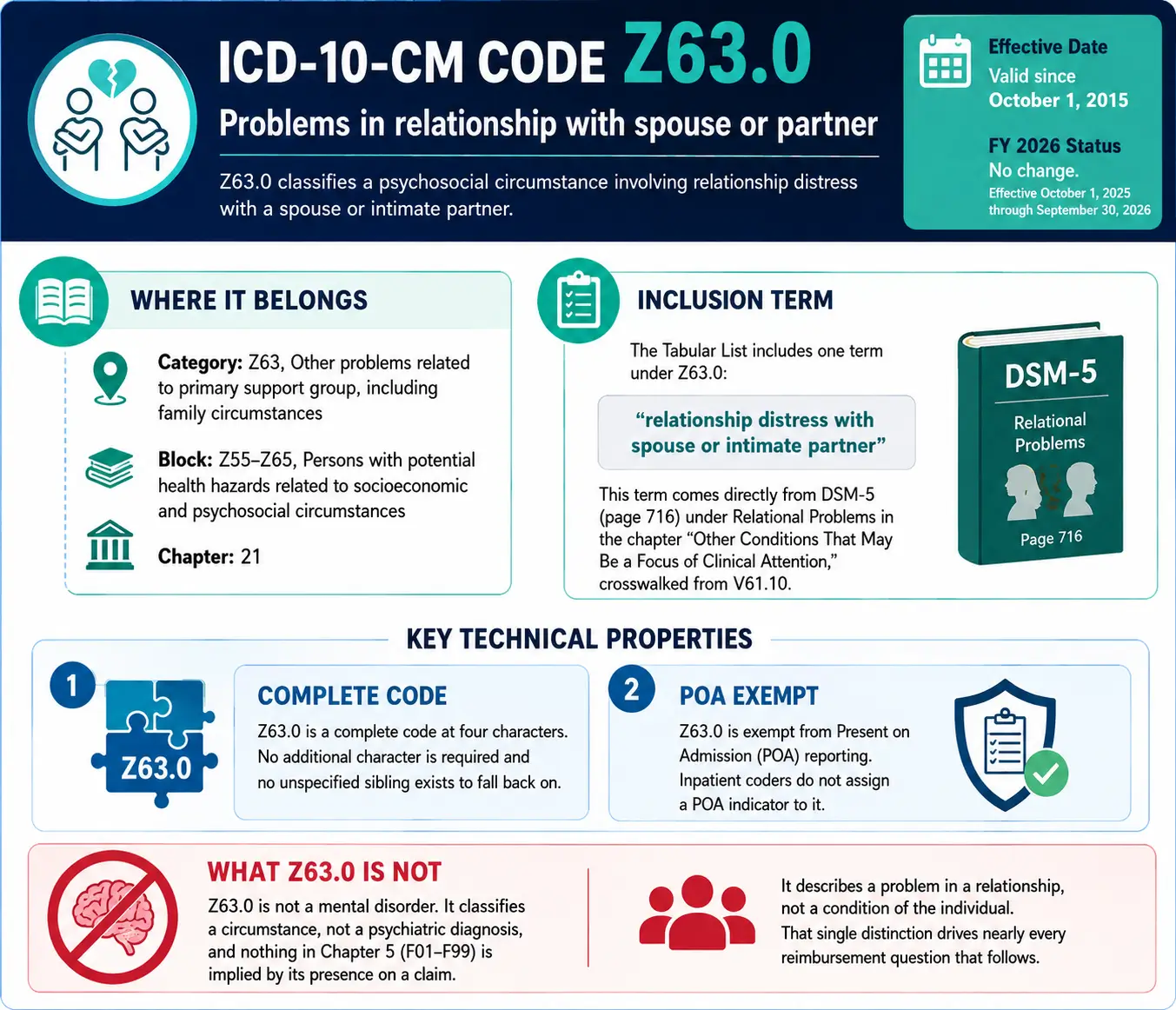
Z63.0 is titled Problems in relationship with spouse or partner. It belongs to category Z63, Other problems related to primary support group, including family circumstances, within the block Z55-Z65, Persons with potential health hazards related to socioeconomic and psychosocial circumstances, in Chapter 21. It became valid when ICD-10-CM took effect on October 1, 2015, and the FY 2026 code set (effective October 1, 2025 through September 30, 2026) made no change to it.
The Tabular List carries one inclusion term under the code: relationship distress with spouse or intimate partner. That language comes directly from DSM-5, where the same entry appears on page 716 under Relational Problems in the chapter “Other Conditions That May Be a Focus of Clinical Attention,” crosswalked from V61.10. A therapist who writes “relationship distress with intimate partner” and a coder who assigns Z63.0 are describing the same clinical situation in two vocabularies.
Two technical properties matter for daily work. Z63.0 is a complete code at four characters, so no additional character is required and no unspecified sibling exists to fall back on. It is also exempt from present on admission (POA) reporting, so inpatient coders do not assign a POA indicator to it.
One thing Z63.0 is not: a mental disorder. It classifies a circumstance, not a psychiatric diagnosis, and nothing in Chapter 5 (F01-F99) is implied by its presence on a claim. That single distinction drives nearly every reimbursement question that follows.
The Excludes notes that cause the most trouble
Z63.0 carries an Excludes1 note with two entries: counseling for spousal or partner abuse problems (Z69.1-) and counseling related to sexual attitude, behavior, and orientation (Z70.-). Excludes1 is the pure exclusion. The two codes are mutually exclusive and should not appear together for the same encounter.
The practical consequence is significant. Once the encounter addresses intimate partner violence rather than conflict, the abuse codes take over: Z69.11 for mental health services for the victim of spousal or partner abuse, Z69.12 for the perpetrator, with confirmed or suspected adult abuse reported from T74.- or T76.- and the appropriate 7th character. Assigning Z63.0 alongside Z69.11 because “both apply” is a coding error, and it blurs a distinction that matters for safety planning.
The Excludes2 note sits one level up, at category Z63, and covers maltreatment syndrome (T74.-, T76.-) plus parent-child problems, problems related to negative life events in childhood, and problems related to upbringing (all Z62.-). Excludes2 works in the opposite direction. The excluded condition is not part of Z63, but a patient can have both, and both codes may be reported when documentation supports each one. A patient in partner conflict who is also in a parent-child relational problem can carry Z63.0 and Z62.820 on the same encounter.
Where Z63.0 sits in category Z63
The category separates relationship quality from absence, loss, separation, caregiving burden, and household stress, so choosing between Z63.0 and its neighbors is usually a documentation question.
|
Code |
Description |
Typical trigger in the record |
|
Z63.0 |
Problems in relationship with spouse or partner |
Conflict, distress, or discord in an intact intimate relationship |
|
Z63.1 |
Problems in relationship with in-laws |
Extended-family conflict, not partner conflict |
|
Z63.31 |
Military deployment leading to the absence of a family member. |
Partner or family member currently deployed |
|
Z63.32 |
Other absence of family member |
Non-deployment absence (incarceration, work abroad, hospitalization) |
|
Z63.4 |
Disappearance and death of family member |
Bereavement, missing family member |
|
Z63.5 |
Disruption of family by separation and divorce |
Couple living apart, separation, divorce in process |
|
Z63.6 |
Dependent relative needing care at home |
Caregiver strain documented as the issue |
|
Z63.71 |
Family stress related to the return of a family member from military deployment. |
Reintegration stress after deployment |
|
Z63.72 |
Alcoholism and drug addiction in family |
Substance use in a family member affecting the patient |
|
Z63.79 |
Other stressful life events affecting the family or household |
Specified household stressor with no dedicated code |
|
Z63.8 |
Other specified issues involving the primary support group |
Documented support-group problem outside the above |
|
Z63.9 |
Problem related to primary support group, unspecified |
Documentation names no specific issue |
A couple experiencing separation should be assigned Z63.5, not Z63.0. Likewise, when a patient is experiencing distress because a spouse or family member is deployed for military service, the appropriate code is Z63.31. Reviewing the entire Z63 category before selecting a code helps ensure the most accurate code assignment and reduces the risk of common coding errors.
Billing guidelines for Z63.0
Rule one: report it as a secondary diagnosis
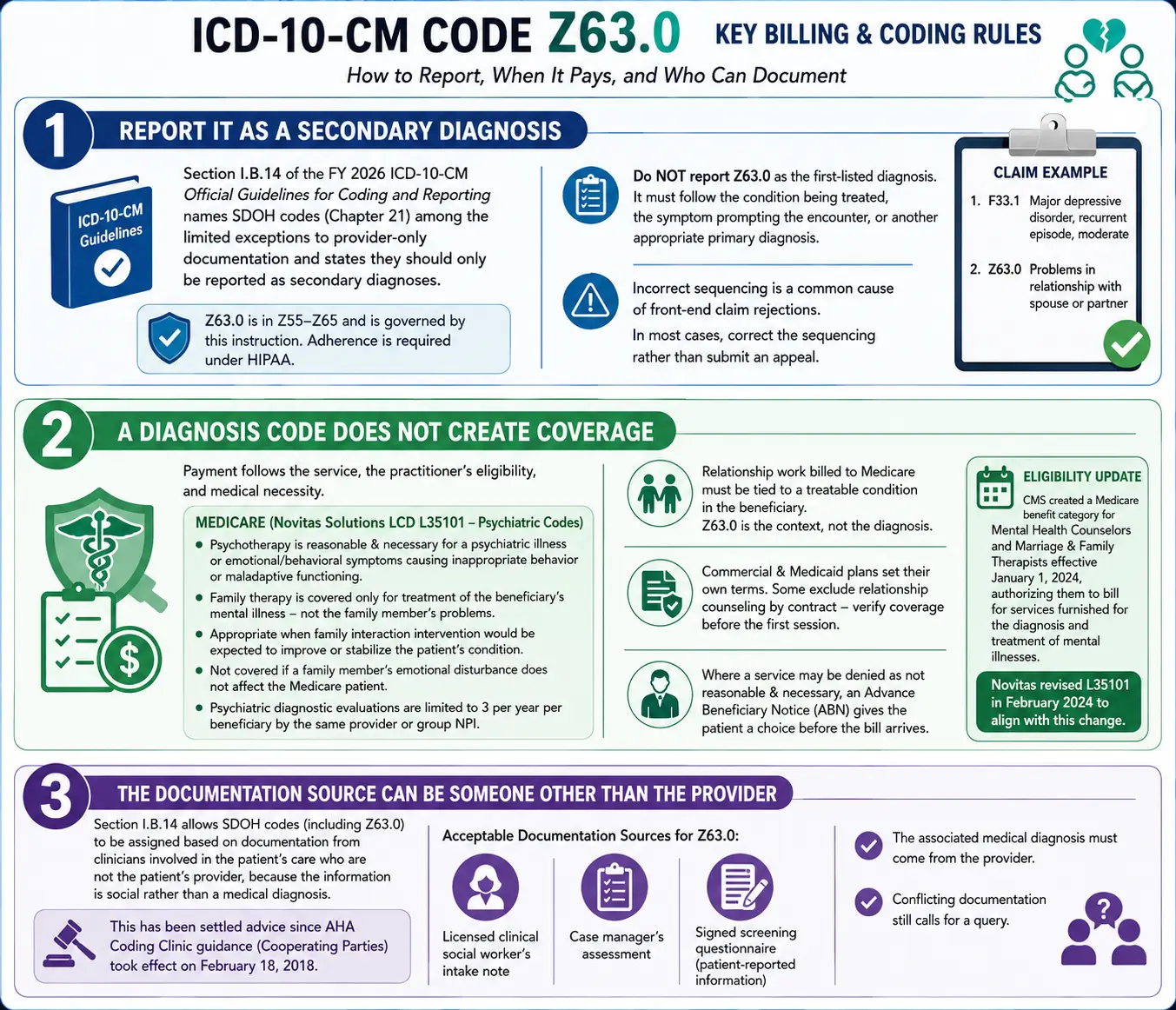
Section I.B.14 of the FY 2026 ICD-10-CM Official Guidelines for Coding and Reporting names social determinants of health classified to Chapter 21 among the limited exceptions to provider-only documentation, and then states that codes for social determinants of health should only be reported as secondary diagnoses. Z63.0 falls inside Z55-Z65 and is governed by that instruction. Adherence to these guidelines is required under HIPAA, so this is not a payer preference that varies by contract.
Z63.0 should not be reported as the first-listed diagnosis on a claim. Instead, it must follow the condition being treated, the symptom that prompted the encounter, or another appropriate primary diagnosis. Placing Z63.0 in the primary position is a common cause of front-end claim rejections. In most cases, the solution is to correct the diagnosis sequencing rather than submit an appeal.
Rule two: a diagnosis code does not create coverage
Payment follows the service, the practitioner’s eligibility, and medical necessity. Novitas Solutions, the Medicare Administrative Contractor for Jurisdictions H and L, spells this out in LCD L35101, Psychiatric Codes, whose current version is effective for services on or after January 1, 2024. The policy states that psychotherapy is medically reasonable and necessary when the patient has a psychiatric illness or is demonstrating emotional or behavioral symptoms sufficient to cause inappropriate behavior or maladaptive functioning.
On family and couples work the LCD is more specific. Family therapy is considered medically reasonable and necessary only for treatment of the Medicare beneficiary’s mental illness and not the family member’s problems. It is appropriate when intervention in family interactions would be expected to improve or stabilize the patient’s emotional or behavioral disturbance. The limitations section adds that an emotional disturbance in a family member which does not affect the Medicare patient’s status is not covered under that patient’s benefits. The same LCD caps psychiatric diagnostic evaluations at three per year per beneficiary by the same provider or group NPI.
Read those provisions together and the pattern is clear. Relationship work billed to Medicare has to be tied to a treatable condition in the beneficiary, and Z63.0 is the context around that condition rather than a substitute for it. Commercial and Medicaid plans set their own terms, and some exclude relationship counseling by contract regardless of coding, which is worth verifying before the first session rather than after the third denial. Where a service may be denied as not reasonable and necessary, an Advance Beneficiary Notice gives the patient a decision to make before the bill arrives.
One eligibility change reshaped this area recently. CMS created a Medicare benefit category for mental health counselors and marriage and family therapists effective January 1, 2024, authorizing them to bill for services furnished for the diagnosis and treatment of mental illnesses. Novitas revised L35101 in February 2024 specifically to align with that change. Practices that stopped asking about Medicare enrollment for these disciplines before 2024 should ask again.
Rule three: the documentation source can be someone other than the provider
Social determinants of health codes are among the short list of exceptions in Section I.B.14 where code assignment may be based on medical record documentation from clinicians involved in the patient’s care who are not the patient’s provider, because the information is social rather than a medical diagnosis. Patient-reported information signed off by a clinician also supports assignment. This has been settled advice since AHA Coding Clinic guidance approved by the Cooperating Parties took effect on February 18, 2018.
So a licensed clinical social worker’s intake note, a case manager’s assessment, or a signed screening questionnaire can support Z63.0. The associated medical diagnosis still has to come from the provider, and conflicting documentation still calls for a query.
What the claims data says about how Z63.0 is used
The most detailed public numbers come from CMS Office of Minority Health Data Highlight No. 24, published in September 2021 by Maksut, Hodge, Van, Razmi, and Khau, covering 2019 Medicare fee-for-service claims. Among 33.1 million continuously enrolled beneficiaries, 1.59% had a claim carrying any Z55-Z65 code, up from 1.31% in 2016. Those 1,262,563 claims represented 0.11% of all fee-for-service claims that year.
Z63.0 ranked fifth among all social determinant Z codes, behind homelessness (Z59.0), disappearance and death of a family member (Z63.4), problems related to living alone (Z60.2), and problems related to living in a residential institution (Z59.3).
The demographic split inside that Z63.0 population is striking. Beneficiaries whose original reason for Medicare entitlement was disability made up 22.1% of the fee-for-service population but 45.1% of those with a Z63.0 claim. Beneficiaries dually eligible for Medicare and full Medicaid benefits were 14.3% of the population and 19.9% of the Z63.0 group. Across all Z codes, five provider types generated roughly two-thirds of the volume: family practice physicians (15%), internal medicine physicians (14%), nurse practitioners (14%), psychiatrists (13%), and licensed clinical social workers (12%).
The report names the reason those numbers stay low without hedging: Z code claims are not generally used for payment purposes, so there is no financial incentive to report them.
That gap is not permanent. In the FY 2024 IPPS final rule, CMS changed the severity designation of the three homelessness codes (Z59.00, Z59.01, Z59.02) from NonCC to CC for discharges on or after October 1, 2023, which can raise payment for affected inpatient stays. Z63.0 was not part of that change. Separately, HCPCS code G0136, established in the CY 2024 Physician Fee Schedule final rule and effective January 1, 2024, pays for administering a standardized, evidence-based social determinants of health risk assessment, 5 to 15 minutes, not more often than every six months, furnished in conjunction with certain evaluation and management or behavioral health services. Any need identified during that assessment must be documented in the medical record. The payment attaches to the assessment work, not to the Z code that results from it.
Documentation tips that hold up under review
- Name the patient and the relationship. In couples work, one person is the patient of record. The note should make clear whose chart it is and whose condition is being treated.
- Clearly document how the relationship issue affects the patient’s clinical condition. For example, stating that partner conflict is interfering with medication adherence and sleep, contributing to the patient’s recurrent depressive episode provides support for reporting both diagnoses. In contrast, a vague statement such as “marital issues discussed” does not establish medical necessity or justify either code.
- Do not use Z63.0 as a soft label for abuse. If the record describes coercion, threats, or violence, the Excludes1 note applies and the abuse codes are the correct assignment.
- Record who documented what. If the social risk came from a social worker’s note or a signed patient questionnaire, say so. That trail is what makes the non-provider documentation exception usable.
- Watch the intake template. Screening tools that auto-populate a problem list can carry Z63.0 forward for years after the issue resolved. Reassess it like any other diagnosis.
- Document the elements the LCD asks for. Type of service, content of the session, therapeutic techniques applied, time spent, and the identity of the person performing the service.
Consider a straightforward outpatient example. A patient with an established generalized anxiety disorder diagnosis attends a session with a partner present because escalating household conflict is undermining the treatment plan. First-listed diagnosis: F41.1. Secondary: Z63.0. Service: the appropriate psychotherapy code supported by time and content. The note explains how working on the interaction is expected to stabilize the patient’s symptoms. That sequence tells a reviewer what was treated, why the partner was in the room, and which condition justified the encounter.
Coded that way, Z63.0 adds information a reviewer can use and a population health team can count. Coded as a stand-alone reason for a visit, it does neither. The distance between those two outcomes is about three lines of documentation and one sequencing decision.