


What is the H0031 CPT code? Description, billing, and reimbursement explained
A biller preparing a Medicaid claim for a new-patient mental health assessment will often reach for H0031, then pause at a familiar question: is this a CPT code? Search engines are full of the phrase “H0031 CPT Code,” so the confusion is understandable. The accurate answer is that H0031 is not a CPT code at all. It belongs to a related but separate system called HCPCS Level II.
That distinction is not just trivia. It shapes which payers accept the code, which providers may report it, and how the claim gets priced. This article explains what H0031 represents, why people search for it as a CPT code, who can bill it, and how reimbursement and documentation work in practice. Because most rules attached to H0031 come from state Medicaid programs rather than a single national policy, the guidance below points out where requirements shift from one payer to the next.
One more point from CMS is worth keeping in mind: the existence of a HCPCS code does not by itself determine coverage or payment. A valid code and a payable claim are two different things.
What is the H0031 code?
H0031 is a HCPCS Level II code maintained by the Centers for Medicare & Medicaid Services (CMS). Its official long descriptor is “Mental health assessment, by non-physician,” and its short descriptor is “Mh health assess by non-md.” CMS places the code in the “Mental Health Programs and Medication Administration Training” category, the H0031 through H0040 block within the larger behavioral health H-code series. The code was added to the system on January 1, 2003, and it remains a valid HCPCS code for 2026. The service it identifies is an assessment of a person’s mental health performed by a qualified clinician who is not a physician. In everyday terms, it is the intake or evaluation step that precedes a treatment plan, when the provider is a behavioral health professional rather than an MD or DO. People type “H0031 CPT Code” into search engines for a simple reason. CPT codes and HCPCS Level II codes travel together on the same claim forms and sit in the same billing software fields, so many practitioners use “CPT” loosely to mean any procedure code. On a CMS-1500 claim, both types of code go in the same procedure column, which reinforces the habit. The phrasing reflects how people search, even though it is not technically correct.H0031 CPT code description
In plain language, H0031 covers a non-physician mental health assessment: a structured clinical evaluation used to identify a person’s psychiatric concerns, functional difficulties, and psychosocial needs, and to lay the groundwork for an individualized treatment plan. The national descriptor from CMS is deliberately short. It names the service (“mental health assessment”) and one condition (“by non-physician”), and nothing else. It does not spell out a fixed time increment, a required setting, or a mandatory list of clinical steps. Those details come from individual payers and state Medicaid manuals, which is why coverage policies describe the same code somewhat differently from one jurisdiction to the next. Because the base descriptor is broad, it is worth being careful about assumptions. Some vendor references describe H0031 as billed “per 15 minutes.” That framing exists in certain state or payer setups, but it is not part of the official CMS descriptor, and other programs pay the code as a flat per-assessment service instead. Treat any time unit as a payer-specific rule to verify, not a national feature of the code.Is H0031 a CPT code or an HCPCS code?
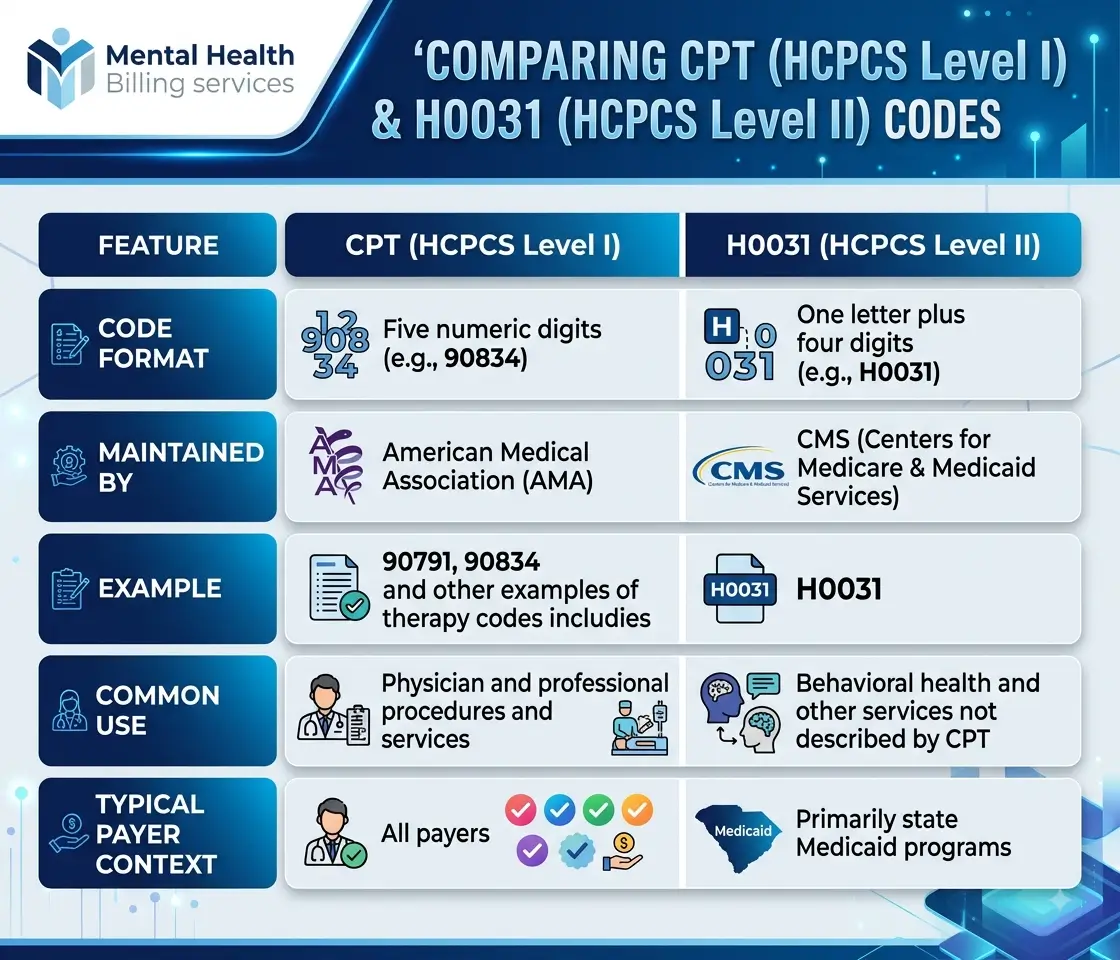
Both CPT and HCPCS Level II codes actually live under one umbrella. According to CMS, the Healthcare Common Procedure Coding System is divided into two subsystems. Level I is the CPT code set, developed, maintained, and copyrighted by the American Medical Association (AMA). Level II is the alphanumeric code set maintained by CMS for items and services that CPT does not describe. Under authority delegated through HIPAA, the AMA maintains Level I and CMS maintains Level II. So H0031 is a HCPCS Level II code. Calling it a “CPT code” mixes up the two levels. One quick tell is the format: CPT codes are five numeric digits, while HCPCS Level II codes start with a letter followed by four digits, as H0031 does.
One more point from CMS is worth keeping in mind: the existence of a HCPCS code does not by itself determine coverage or payment. A valid code and a payable claim are two different things.
When is H0031 used?
H0031 is reported for the assessment stage of behavioral health care, most often in community mental health and outpatient settings that bill Medicaid. It typically represents the clinical work of gathering a person’s mental health history, evaluating current symptoms and functioning, screening for risk, and forming the basis of a treatment plan when a non-physician clinician performs that work. State Medicaid programs frequently attach specific service definitions to the code through modifiers. Florida’s Medicaid Community Behavioral Health Fee Schedule, for example, uses H0031 for both an “in-depth assessment” and a “bio-psychosocial evaluation,” distinguishing them with different modifiers. A hypothetical illustration (labeled hypothetical because it is not drawn from a real record): a licensed clinical social worker meets a new client at an outpatient clinic, completes a full mental health intake including a mental status examination and risk screening, and documents findings that will drive the treatment plan. In a state that recognizes H0031 for this service, that assessment may be reported under the code with the appropriate modifier. Whether it is payable, and at what rate, depends on the state and plan.Who can bill H0031?
The descriptor limits the code to services delivered “by non-physician” clinicians, and eligible provider types commonly named in state Medicaid guidance include psychologists, licensed clinical social workers (LCSWs), licensed professional counselors (LPCs), and licensed marriage and family therapists (LMFTs). Some states also allow qualified mental health professionals who meet defined training or supervision standards. That said, eligibility is not uniform, and it would be a mistake to assume every behavioral health provider can bill H0031 everywhere. Whether a specific clinician may report the code depends on several factors that vary by jurisdiction:- Provider type and license. The state Medicaid program defines which credentials qualify.
- Enrollment. The provider usually must be enrolled in the relevant Medicaid program or contracted with the managed care plan.
- Credentialing. Some payers require the provider to be credentialed with the specific plan before claims are accepted.
- State-specific rules. A provider category that qualifies in one state may not qualify in another.
H0031 billing requirements
Practical billing details for H0031 are set mostly at the payer and state level, so the items below are considerations to verify rather than fixed national rules.- Claim submission. For professional claims, H0031 is reported on the CMS-1500 (or its electronic equivalent) with the date of service and rendering provider information.
- Units. Some programs pay per assessment, and others structure the code in timed units. Confirm how your payer counts a unit before submitting.
- Modifiers. State Medicaid programs often require credential-level modifiers. In HCPCS, HN indicates a bachelor’s degree level, HO a master’s degree level, and HP a doctoral level, while TS designates a follow-up service. Florida, for instance, distinguishes new-patient and established-patient assessments using HO and TS.
- Place of service. Community and outpatient settings are typical, and telehealth delivery is allowed by some states when documented appropriately.
- Diagnosis coding. Claims generally need a supporting behavioral health diagnosis consistent with the payer’s coverage policy.
- Prior authorization and frequency limits. Some payers limit how often H0031 may be reported, and some require authorization. These limits are payer-specific.
H0031 reimbursement
There is no single nationwide payment amount for H0031. CMS assigns the code a pricing status indicating it is not separately priced under Medicare Part B, which is consistent with H-codes being Medicaid-oriented. As a result, what a provider is paid depends on the specific fee schedule or contract that governs the claim. Reimbursement is shaped by factors including the state Medicaid fee schedule, the managed care or commercial plan involved, the provider’s contract, geographic location, provider credential level, service authorization, and the quality of claim documentation. A real example shows how state-specific this is. The Florida Medicaid Community Behavioral Health Fee Schedule (2025), tied to coverage policy 59G-4.028, lists H0031 at different maximum fees depending on the modifier and service: an in-depth assessment for a new patient (modifier HO) at $126.11 per assessment, an in-depth assessment for an established patient (modifier TS) at $100.88 per assessment, and a bio-psychosocial evaluation (modifier HN) at $57.28 per assessment. Florida also limits Medicaid to one in-depth assessment per recipient per state fiscal year and specifies that it is not reimbursable on the same day as a biopsychosocial evaluation for the same person. Those Florida figures apply to Florida Medicaid on that fee schedule. They should not be treated as the rate anywhere else. For your own claims, check the current fee schedule for the exact payer, state, and effective date that apply.Documentation requirements for H0031
Solid documentation is what turns a valid code into a payable and audit-ready claim. State Medicaid auditors tend to look for specific clinical content in the record, not simply the presence of a note. Elements that payer and state guidance commonly expect include:- Date of service and the setting where the assessment occurred
- The presenting problem and relevant mental health history
- A mental status examination and evaluation of current symptoms and functioning
- Risk assessment findings
- The clinical purpose of the assessment and its link to treatment planning
- The rendering provider’s identity and credentials
- Patient identifying information
- Support for medical necessity
Common H0031 billing mistakes
Several recurring errors lead to denials or takebacks:- Treating H0031 as a CPT code. Beyond the terminology, this can lead to using the wrong reference tables or missing HCPCS-specific modifier rules.
- Skipping the payer policy check. Because rules are set at the state and plan level, billing from memory or from another state’s manual invites denials.
- Provider eligibility errors. Reporting the code for a provider type the payer does not recognize, or before the provider is enrolled and credentialed, results in rejected claims.
- Missing documentation. Absent elements such as a mental status exam or provider credentials are among the most cited reasons H0031 claims are denied.
- Incorrect units. Billing timed units where the payer pays per assessment, or the reverse, creates mismatches.
- Wrong or missing modifiers. Using a master’s-level credential modifier when the provider is doctoral level, or omitting a required credential modifier, can trigger downcoding or denial.
- Ignoring frequency and authorization limits. Reporting the code more often than the payer allows, or without required authorization, leads to non-payment.
- Assuming one state’s reimbursement applies everywhere. A rate or limit from one Medicaid program says nothing about another.