


CPT code for couples therapy: 2026 billing codes, insurance & reimbursement guide
The CPT code for couples therapy is most often 90847, the code for family or conjoint psychotherapy when the patient is present. When the couple work happens without the identified patient in the room, the corresponding code is 90846. Both belong to the family psychotherapy family of codes and both are meant for treating a diagnosed mental health condition rather than general relationship coaching.
That distinction matters more than the label on the appointment. “Couples therapy” describes what happens clinically; the CPT code describes the billable service actually performed. A session booked as couples counseling could map to 90847, 90846, an individual psychotherapy code, or nothing billable at all, depending on who participated, what was treated and what the payer covers.
This guide walks through the couples therapy CPT code decision, how 90847 differs from 90846, when the family psychotherapy codes apply and what documentation and payer rules shape whether a claim gets paid.
What is the CPT code for couples therapy?
The code most commonly associated with couples therapy is CPT 90847 — family psychotherapy (conjoint psychotherapy) with the patient present, described in the AMA’s CPT set as roughly a 50-minute service. In couples work, the “patient” is one partner with a diagnosed condition and the spouse or partner participates because their involvement is part of that patient’s treatment.
A few points make this code usable rather than just memorized:
- 90847 is a family psychotherapy code, not a “relationship” code. CMS billing and coding guidance treats 90846 and 90847 as family psychotherapy services for the treatment of mental disorders.
- The patient must be present and meaningfully involved. If the identified patient is not in the session, 90847 is the wrong code.
- Like other time-based psychotherapy codes, it carries a minimum duration. Under the CPT mid-point rule reflected in Medicare guidance, a family psychotherapy session generally must run at least 26 minutes to be reported with 90846 or 90847.
Selecting 90847 does not mean Medicare or a commercial plan automatically pays for the visit. The code identifies the service; coverage is a separate question tied to the patient’s benefits and the payer’s medical policy.
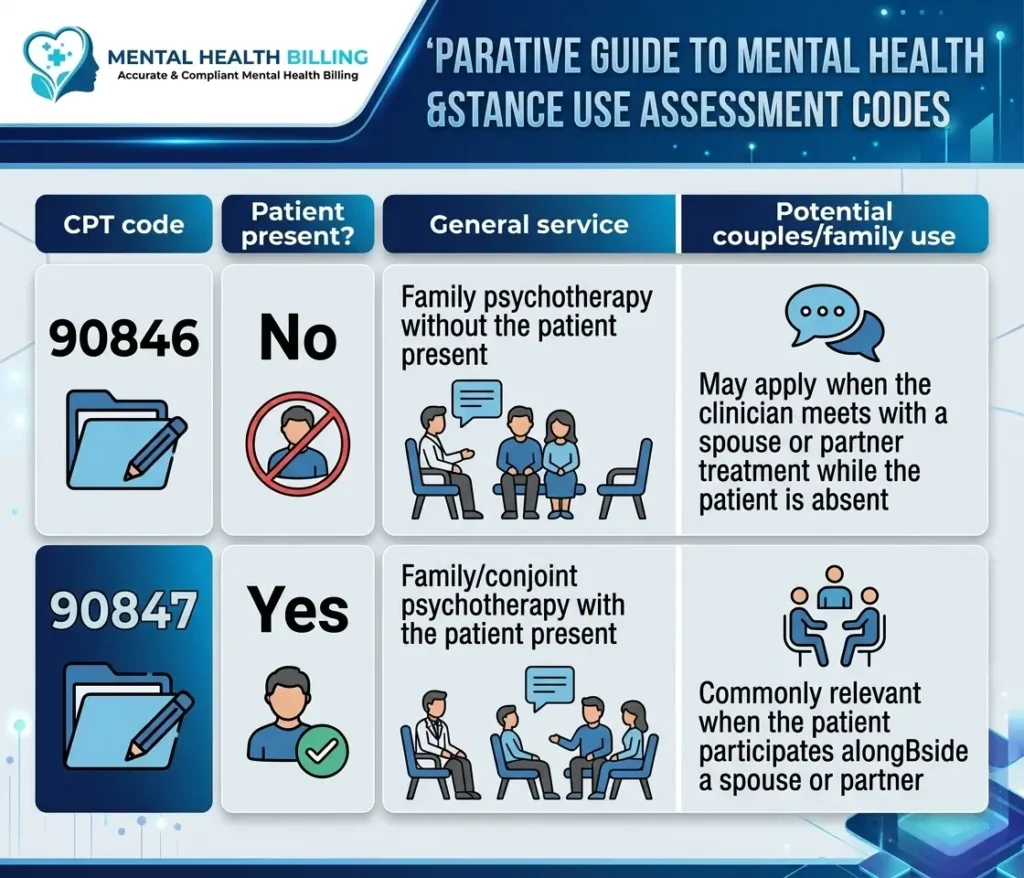
CMS guidance is explicit that 90846 is used when the patient is not present and 90847 when the patient is present. A related rule follows from that: the two codes cannot be reported on the same date of service for the same patient. If the partner joins for part of the session and the patient is present, 90847 is the code that fits.
The practical takeaway for billers is to code the service that occurred, not the service the schedule anticipated. A “couples session” where only one partner shows up and does individual work is an individual psychotherapy visit. A session labeled “family” where the clinician met only with the spouse to support the patient’s plan points toward 90846. Attendance drives the code.
Can you use CPT 90847 for couples counseling?
Sometimes. The question a coder has to answer is whether the session was psychotherapy for a diagnosed mental disorder, with the partner involved as part of that treatment.
CMS billing and coding guidance states that 90846 and 90847 represent family psychotherapy for the treatment of mental disorders and should not be used when the service performed is taking a family history or providing evaluation and management (E/M) counseling. That guidance draws a clear boundary between covered psychotherapy and several things that look similar:
- Treatment of a patient’s condition involving a spouse or partner — a strong fit for 90847 when the patient is present and the work targets the patient’s diagnosis.
- Relationship counseling with no treated mental disorder — often falls outside behavioral health coverage entirely, regardless of which code is entered.
- Family history-taking or E/M counseling — not reported with the family psychotherapy codes; E/M counseling belongs with the appropriate E/M code.
For couples work, the identified patient’s diagnosis anchors the claim. The clinical record should show that the partner’s participation supports treatment of that patient’s condition. When a session is really general relationship counseling without a covered diagnosis, choosing 90847 does not convert it into a covered service — it creates audit risk instead.
CPT code for couples therapy and insurance coverage
Coding and coverage are two different decisions and conflating them is where many practices lose money. Picking the right CPT code answers “what service was this?” Coverage answers “will this payer pay for it and how much of the cost falls to the patient?”
Several factors sit between a correct code and a paid claim:
- Medical necessity tied to a covered diagnosis for the identified patient
- Benefit design — some plans carry explicit marital- or couples-counseling exclusions
- Network status — in-network versus out-of-network affects the allowed amount and patient share
- Prior authorization where the plan requires it for behavioral health services
- Patient responsibility through deductible, coinsurance and copay
- Payer-specific billing rules on modifiers, place of service and documentation
A clean 90847 claim can still be denied if the plan excludes couples counseling, if the diagnosis does not support medical necessity, or if authorization was required and never obtained. Verify the patient’s behavioral health benefits before the first session rather than after a denial.
How to bill CPT 90847
A repeatable workflow keeps family psychotherapy claims clean:
- Confirm the identified patient and the covered service. Decide who is being treated and whether the visit is psychotherapy for a diagnosed condition.
- Verify behavioral health benefits. Check coverage, exclusions, authorization requirements and any age limits with the specific payer.
- Choose 90846 or 90847 based on attendance. Patient present points to 90847; patient absent points to 90846.
- Confirm the diagnosis code. Use the identified patient’s documented ICD-10-CM diagnosis, not a family member’s.
- Document medical necessity. Tie the family or couples work to the patient’s treatment.
- Record who participated and the patient’s role in the session.
- Capture required clinical detail and time, including start and stop times when time is part of the code.
- Submit the claim per payer requirements, including correct place of service and any telehealth modifiers.
- Work denials promptly, supplying additional documentation when a payer requests it.
Medicare billing guidance indicates that 90846 and 90847 are not reported for sessions lasting less than 26 minutes. That threshold reflects Medicare’s application of the CPT time rule; commercial payers may state their own expectations, so treat the 26-minute floor as a Medicare rule rather than a universal one.
90847 documentation requirements
Payers deny many family psychotherapy claims because the note reads like a conversation summary instead of treatment. Strong documentation for 90847 should establish:
- The reason for treatment and the identified patient’s diagnosis
- Medical necessity for involving the partner or family
- Who attended and each person’s relationship to the patient
- Confirmation that the patient was present and participating
- The specific therapeutic interventions used
- The patient’s clinical response and progress toward treatment goals
- The current treatment plan and how the couples component supports it
- Session duration, including start and stop times when time is a code element
Notes such as “family discussed concerns” or “provided support” rarely demonstrate psychotherapy. Auditors compare the attendance note against the code chosen, so the record should make the patient’s presence and the clinical work unmistakable. No single template is mandated across all payers, but the elements above hold up under review far better than boilerplate.
Common mistakes when billing couples therapy
The recurring errors in this area are predictable and avoidable:
- Defaulting to 90847 for every couples session without checking who attended or what was treated
- Confusing relationship counseling with family psychotherapy, then billing a covered code for a non-covered service
- Failing to establish medical necessity for the identified patient
- Using the wrong diagnosis, such as a partner’s diagnosis or a stand-alone Z-code that does not support treatment
- Poorly documenting attendance, so the note does not match the code
- Ignoring payer-specific rules on exclusions, authorization, or age limits
- Assuming a correct code guarantees payment
- Billing a service the plan excludes under the patient’s benefits
- Mixing up E/M and psychotherapy coding when one or the other is required
On that last point, CMS guidance is clear that when an E/M service and psychotherapy are both provided and reported, each must be significant and separately identifiable, with the time for the E/M work kept separate from the psychotherapy time. Family psychotherapy codes are not a substitute for E/M counseling and vice versa.
90847 reimbursement and insurance claims
Reimbursement for 90847 is not a fixed number. It shifts with the payer, the provider’s contract, geography, place of service and the patient’s specific benefits.
For a reference point, Medicare publishes a national payment amount for 90847 on the Physician Fee Schedule; the 2026 national non-facility amount is in the neighborhood of $109.55, adjusted up or down by locality under geographic practice cost index (GPCI) factors. That figure is a Medicare baseline, not what a commercial plan or Medicaid program will pay and it is not a promise of payment for any given claim. Pull the current amount for a specific locality from the CMS Physician Fee Schedule lookup tool rather than relying on a national average.
Beyond the fee schedule, the amount a practice actually collects depends on the allowed amount under the contract, the patient’s deductible and coinsurance, whether authorization was obtained and whether the documentation supports medical necessity. Two identical sessions can pay differently across two plans for exactly these reasons.
CPT code for couples therapy vs individual psychotherapy
When only one partner is treated one-on-one, the family psychotherapy codes do not apply. Individual psychotherapy uses time-based codes:
- 90832 — individual psychotherapy, about 30 minutes (16–37 minutes of face-to-face time)
- 90834 — individual psychotherapy, about 45 minutes (38–52 minutes)
- 90837 — individual psychotherapy, about 60 minutes (53 minutes or more)
CMS billing and coding guidance groups 90832, 90834 and 90837 as psychotherapy without medical evaluation and management services, while 90846 and 90847 sit in the family psychotherapy group. The choice between them is not about session length alone — it is about the service performed and who received it. A 55-minute session with one partner is 90837, not 90847, even though a couples visit and an individual visit can run the same clock. Code the service that actually happened.
Frequently asked questions about couples therapy CPT codes
What is the CPT code for couples therapy?
The CPT code for couples therapy is usually 90847 when the identified patient is present and 90846 when the couples work happens without the patient present. Both are family psychotherapy codes intended for treatment of a diagnosed mental disorder.
Is 90847 the CPT code for couples counseling?
Often, but not automatically. 90847 fits when the session is family or conjoint psychotherapy for a patient’s diagnosed condition with the patient present. General relationship counseling with no covered diagnosis may not be billable under this code at all.
What is the difference between 90846 and 90847?
Attendance. 90847 is used when the patient is present; 90846 is used when the clinician meets with family members or a partner about the patient’s treatment while the patient is absent. They cannot be reported on the same day for the same patient.
Can couples therapy be billed to insurance?
It can be, when it qualifies as medically necessary psychotherapy for one partner’s diagnosed condition and the plan covers the service. Some plans exclude marital or couples counseling, so benefits should be verified first.
Does insurance cover marriage counseling?
It depends entirely on the plan. Coverage generally hinges on a covered diagnosis and medical necessity rather than the “marriage counseling” label. Certain plans carry explicit exclusions for couples or marital counseling.
How do you bill 90847?
Confirm the identified patient and a covered diagnosis, verify behavioral health benefits, choose 90847 because the patient was present, document participation and medical necessity, record time and submit per payer rules with any required authorization and modifiers.
What diagnosis code is used with 90847?
The identified patient’s documented ICD-10-CM diagnosis. The diagnosis must reflect the patient’s clinical condition and support medical necessity — not a family member’s diagnosis and not a code chosen to influence payment.
Does 90847 require the patient to be present?
Yes. Patient presence and participation are what separate 90847 from 90846. If the patient is not present, the family psychotherapy service should be reported with 90846 when it is billable.
Can 90847 be used for telehealth?
Family psychotherapy can be delivered by telehealth in many circumstances, but telehealth coverage, required modifiers and place-of-service rules vary by payer and change over time. Verify the current telehealth policy with the applicable payer before billing.
Key takeaways for providers and medical billers
- 90847 is the primary CPT code to investigate when couples therapy is delivered as family or conjoint psychotherapy with the patient present.
- 90846 applies to family psychotherapy when the patient is not present and the two cannot be billed together on the same day for the same patient.
- The correct code depends on the service actually provided and who attended — not on how the appointment was labeled.
- Medical necessity, a covered diagnosis for the identified patient and specific documentation determine whether a claim survives review.
- Coverage is set by the patient’s benefits and the payer’s policy, not by the CPT code alone. A correct code is necessary but not sufficient for payment.
- Verify behavioral health benefits, exclusions and authorization requirements before the first session and treat Medicare-specific rules as Medicare rules rather than universal ones.