


H0035 CPT Code: Description, Billing Guidelines, Modifiers & Reimbursement
Search “H0035 CPT code” and most of what comes back repeats the same few sentences with different words swapped in. That’s a real problem for anyone responsible for getting a partial hospitalization claim paid, because H0035 is one of the more misunderstood codes in behavioral health billing. Part of the confusion starts with the name. H0035 is not a CPT code. It’s a HCPCS Level II code, maintained by the Centers for Medicare & Medicaid Services (CMS) rather than the American Medical Association and that distinction changes how the code behaves from payer to payer.
This guide covers what H0035 actually describes, which payers use it (and which ones don’t, despite what a surprising number of billing blogs claim), the modifiers that typically travel with it and what the per diem rate looks like in practice, using real state Medicaid fee schedules rather than a generic estimate. Anyone coding, billing, or studying for a career in medical billing and coding should come away knowing exactly where H0035 fits and where it doesn’t.
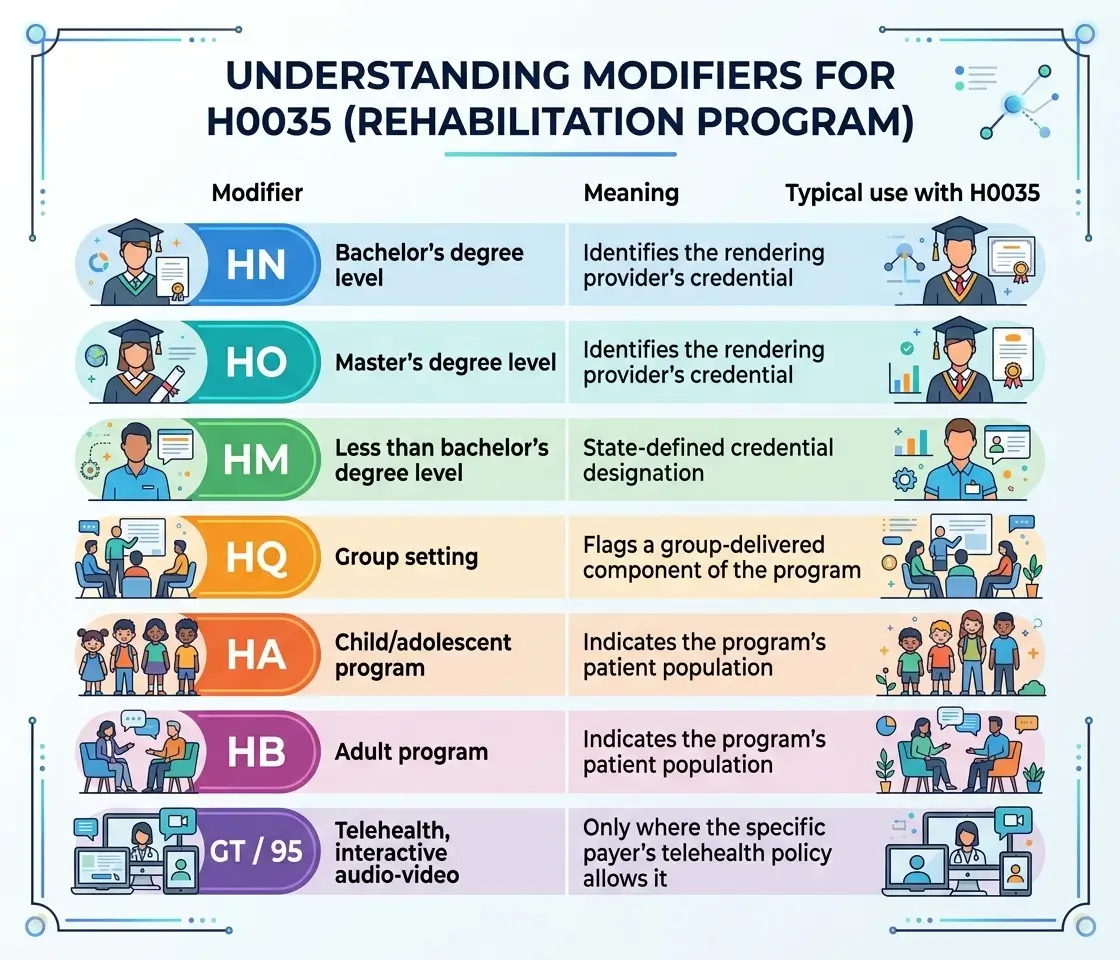
None of this is universal. Modifier requirements for H0035 are set state by state and payer by payer, so the definitive source for any given claim is that payer’s own current provider manual, not a generic list like this one. Ohio’s manual, for example, adds UK as a fourth education-level option that several other states don’t use at all.
What HCPCS code H0035 actually describes
CMS defines H0035 as “mental health partial hospitalization, treatment, less than 24 hours.” It sits inside the H0031 to H0040 block of HCPCS Level II codes, a range CMS set aside for mental health programs and medication administration training. In practical terms, the code represents a single day of structured, multidisciplinary psychiatric programming delivered on an outpatient basis: intensive enough to substitute for an inpatient admission, but not requiring an overnight stay. The CPT versus HCPCS mix-up matters more than it looks. CPT (Current Procedural Terminology) codes are five-digit numeric codes copyrighted and maintained by the American Medical Association. HCPCS Level II codes use a letter followed by four numbers and CMS created them to cover services, supplies and programs that CPT never addressed, including most of the state Medicaid-specific behavioral health code set. Calling H0035 a “CPT code” isn’t just a technicality for pedants to argue about. It’s a signal, to anyone reviewing a claim or a resume, that the person coding it doesn’t fully know which code set they’re working in and payers notice that kind of mismatch during audits. Partial hospitalization exists at this scale for a reason. The National Institute of Mental Health, drawing on the Substance Abuse and Mental Health Services Administration’s 2022 National Survey on Drug Use and Health, estimated that 59.3 million U.S. adults, or 23.1 percent of the adult population, lived with some diagnosable mental illness that year. PHP occupies the level of care between once-a-week outpatient therapy and a locked inpatient unit, built for the share of that population who need more than a weekly session but not round-the-clock supervision. One detail trips up newer billers regularly: the description says “mental health,” not substance use. On the AAPC coding forum, one biller flagged this directly after seeing H0035 billed for a substance use disorder program, noting that H0035 “doesn’t even mention alcohol/drug treatment in the description.” States that fund substance-use partial hospitalization as a distinct benefit generally use a different code, commonly H0012 or H0015 depending on the state’s own fee schedule. Confusing the two is a common, entirely avoidable error.Who actually bills H0035 and who doesn’t
This is where a lot of the free advice online gets it wrong. Several billing blogs describe H0035 as accepted by “Medicare, Medicaid and most private insurers.” Medicare’s own contractors say otherwise. Noridian Healthcare Solutions, the Medicare Administrative Contractor for Jurisdictions E and F, publishes separate billing guides for hospital-based and community mental health center partial hospitalization programs. Neither guide lists H0035 anywhere. Instead, Medicare bills PHP as a bundle of itemized services, tied to revenue codes 0912 (less intensive PHP) and 0913 (intensive PHP), with specific CPT and HCPCS codes attached: G0410 or G0411 for group psychotherapy, 90847 for family psychotherapy and 96116 for psychiatric testing, among others. National Government Services, which processes PHP claims for several other Medicare jurisdictions, lists the identical code set. CMS Transmittal 2578, implementing Change Request 8048 effective January 1, 2013, governs how these PHP claims must be sequenced and H0035 never appears in it either. In practice, H0035 belongs to state Medicaid programs. Ohio, North Carolina, Colorado and Montana all carry it in their behavioral health fee schedules as a distinct, separately payable per diem code. Commercial insurers tend to use a different code for the same underlying service: S0201, “partial hospitalization services, less than 24 hours, per diem.” A handful of commercial plans accept H0035 too, particularly smaller regional carriers that never adopted S-codes, but the safer assumption is to check each payer’s own fee schedule rather than guess. That leaves a simple rule that a surprising number of billing guides skip entirely: H0035 for state Medicaid, S0201 for most commercial plans and neither one for Medicare, which relies on itemized CPT and HCPCS codes tied to revenue codes instead of a single per diem code.The regulatory basis behind partial hospitalization billing
Even though Medicare doesn’t bill under H0035, the federal regulation defining partial hospitalization still shapes how nearly every payer, state Medicaid programs included, decides whether a PHP day is billable at all. 42 CFR 410.43 sets the conditions for partial hospitalization services. They must be reasonable and necessary for diagnosis or active treatment, reasonably expected to improve or maintain the patient’s condition and furnished under a physician’s certification and an individualized plan of care as described in 42 CFR 424.24(e). Section 410.43(c)(1) adds a threshold that shows up repeatedly in payer policy well beyond Medicare: the plan of care must call for a minimum of 20 hours of therapeutic services per week. State Medicaid programs set their own PHP criteria and the exact weekly-hour requirement isn’t identical everywhere. Most, though, build from the same basic structure: certification by a physician or qualified practitioner, a written and periodically reviewed treatment plan and documented daily attendance. In day-to-day billing terms, that 20-hour weekly minimum usually translates to somewhere between four and six hours of programming a day, five days a week. Fall short of that on a given day and the claim becomes exposed to a medical necessity denial no matter how clean the coding itself is.Billing guidelines for H0035
Unit and frequency
H0035 is a per diem code. One unit equals one full day of PHP attendance, not an hour of service and not a single therapy session. A patient who attends six hours of group therapy, one individual session and a medication management check-in on the same day still generates one unit of H0035, not several separate line items. Billing more than one unit per patient per date of service is a common submission error and it typically rejects outright rather than triggering a review.Place of service and claim type
On professional claims submitted via the CMS-1500, H0035 is usually reported with place of service 52 (psychiatric facility, partial hospitalization) or 53 (community mental health center), the two place-of-service codes CMS defines specifically for this level of care. Facility claims submitted on the UB-04 instead lead with a revenue code, most often 0912 or 0913, with H0035 reported as the accompanying HCPCS code on that same line.Telehealth
Some state Medicaid programs and commercial payers allow PHP days delivered partly or fully by telehealth, appending modifier GT or 95 along with place of service 02 or 10 depending on the specific payer’s policy. This is far from universal. A provider billing tele-PHP without confirming that payer’s telehealth policy in advance risks an automatic denial, since unauthorized use of these modifiers is precisely the kind of pattern payer claim-editing systems are built to catch.Modifiers used with H0035
Modifiers attached to H0035 generally fall into two categories: who delivered the service and what kind of program delivered it. Credential-level modifiers tell the payer the rendering practitioner’s education level. Ohio Medicaid’s behavioral health provider manual, for instance, requires modifiers HM, HN, HO, or UK on specified services to indicate that level, separate from any modifier describing the program itself. Getting this wrong isn’t a minor paperwork slip. A biller who appends HO (master’s level) for a bachelor’s-level clinician is misrepresenting who actually delivered the service and payers that cross-check modifiers against provider enrollment records treat that mismatch as upcoding.
None of this is universal. Modifier requirements for H0035 are set state by state and payer by payer, so the definitive source for any given claim is that payer’s own current provider manual, not a generic list like this one. Ohio’s manual, for example, adds UK as a fourth education-level option that several other states don’t use at all.