


Z13.30 Diagnosis Code: Billing, Documentation, and Coding Guidelines
Mental health screening has moved from an occasional add-on to a routine part of primary care. That shift put a small group of ICD-10-CM codes under closer payer scrutiny, and Z13.30 sits near the center of the confusion. It is easy to reach for, easy to misuse, and easy to get denied.
This guide explains what the Z13.30 diagnosis code actually reports, when it is the right choice, when a more specific code belongs on the claim instead, and how to document and bill a mental health screening so it survives payer review.
What Z13.30 means in ICD-10-CM
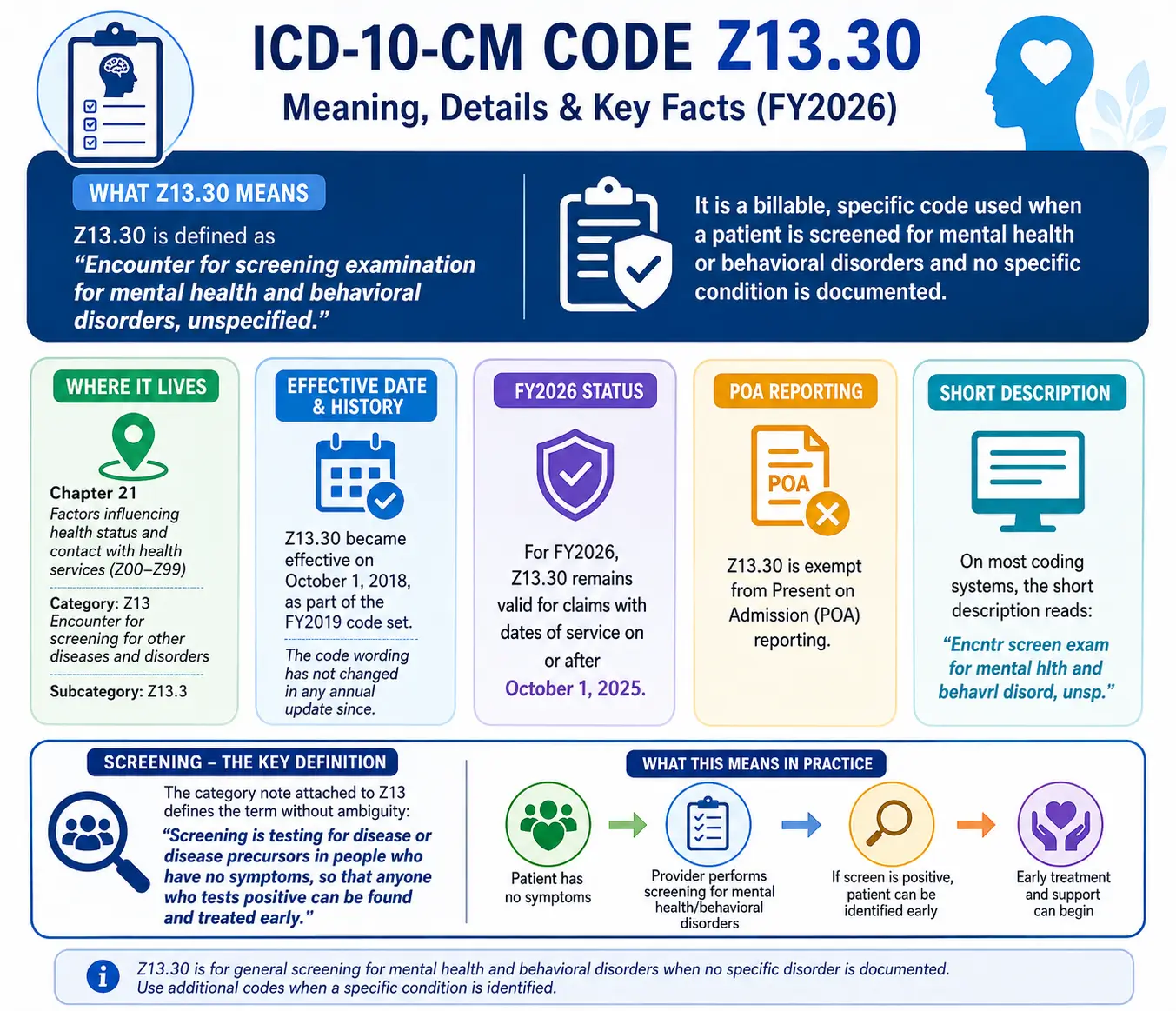
Z13.30 is defined as “Encounter for screening examination for mental health and behavioral disorders, unspecified.” It sits in Chapter 21 of ICD-10-CM (Factors influencing health status and contact with health services, Z00 to Z99), inside category Z13 (Encounter for screening for other diseases and disorders) and subcategory Z13.3.
It is a billable, specific code. Z13.30 became effective on October 1, 2018, as part of the FY2019 code set, and its wording has not changed in any annual update since. For FY2026 it remains valid for claims with dates of service on or after October 1, 2025. The code is exempt from Present on Admission (POA) reporting, and its short description on most systems reads “Encntr screen exam for mental hlth and behavrl disord, unsp.”
The category note attached to Z13 defines the term without ambiguity: screening is testing for disease or disease precursors in people who have no symptoms, so that anyone who tests positive can be found and treated early. That single sentence drives almost every coding decision that follows.
The Z13.3 family, and why Z13.30 is rarely your best choice
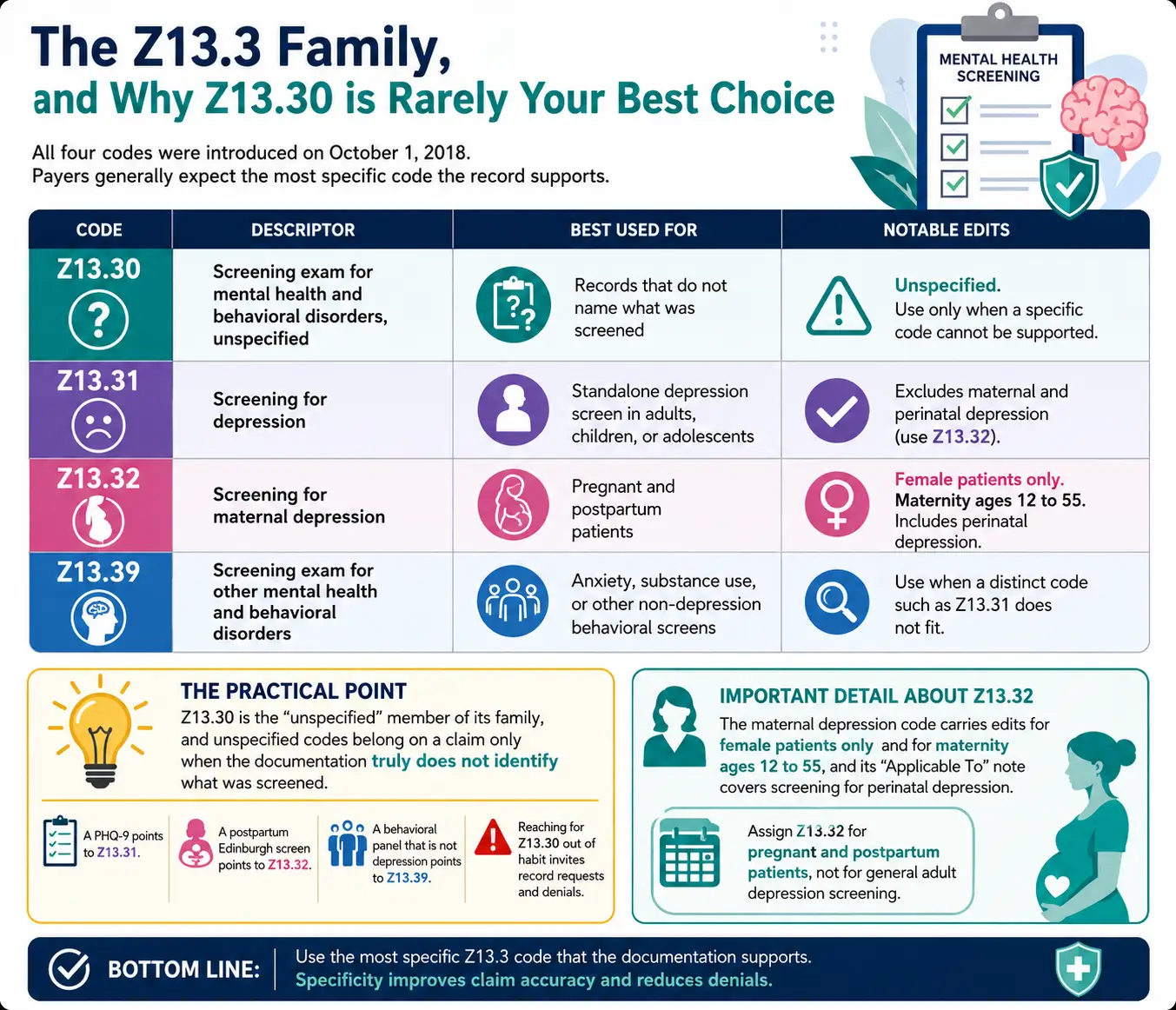
Z13.30 has three siblings, all introduced on the same date (October 1, 2018). Each is more specific, and payers generally expect the most specific code the record supports.
|
Code |
Descriptor |
Best used for |
Notable edits |
|
Z13.30 |
Screening exam for mental health and behavioral disorders, unspecified |
Records that do not name what was screened |
Unspecified. Use only when a specific code cannot be supported |
|
Z13.31 |
Screening for depression |
Standalone depression screen in adults, children, or adolescents |
Excludes maternal and perinatal depression (use Z13.32) |
|
Z13.32 |
Screening for maternal depression |
Pregnant and postpartum patients |
Female patients only. Maternity ages 12 to 55. Includes perinatal depression |
|
Z13.39 |
Screening exam for other mental health and behavioral disorders |
Anxiety, substance use, or other non-depression behavioral screens |
Use when a distinct code such as Z13.31 does not fit |
The practical point is direct. Z13.30 is the “unspecified” member of its family, and unspecified codes belong on a claim only when the documentation truly does not identify what was screened. In most real encounters, the clinician screened for something nameable. A PHQ-9 points to Z13.31. A postpartum Edinburgh screen points to Z13.32. A behavioral panel that is not depression points to Z13.39. Reaching for Z13.30 out of habit invites record requests and, on some plans, denials for lack of specificity.
One detail about Z13.32 is worth stating plainly, because it stops claims in scrubbing. The maternal depression code carries edits for female patients only and for maternity ages 12 to 55, and its “Applicable To” note covers screening for perinatal depression. Assign it for pregnant and postpartum patients, not for general adult depression screening.
When Z13.30 fits, and when it does not
The dividing line is the patient’s symptom status, and it is not a soft preference. Z13 carries a Type 1 Excludes note stating that an encounter for a diagnostic examination should be coded to the sign or symptom, not to a screening code. A Type 1 Excludes note means the two codes never appear together.
Read the rule this way. If the patient has no complaint and the visit exists to look for a problem that might be present but silent, that is screening, and a Z13.3 code applies. If the patient reports low mood, disrupted sleep, panic episodes, or any other symptom, the encounter is diagnostic. Code the symptom, or the confirmed condition with the appropriate F-code once it is established, and leave the screening code off.
A short example makes the distinction concrete. A 45-year-old comes in for a routine physical with no mental health complaint, and the medical assistant administers a PHQ-2 that returns a score of zero. That is a screening, reported with Z13.31. A different 45-year-old comes in specifically because she has felt persistently sad for a month. Her visit is diagnostic. The screening tool she completes supports the evaluation, but the first-listed code describes her symptom or diagnosis, not a screen.
Documentation that supports the Z13.30 diagnosis code
Payers reviewing a mental health screening line look for a short, specific set of elements. A note that contains all of them rarely gets questioned.
- The reason for the visit, recorded as a screening rather than a workup for a stated complaint.
- The named instrument. PHQ-2, PHQ-9, GAD-7, or the Edinburgh Postnatal Depression Scale, each identified by name.
- The score, written in the note, not just implied by a checkbox.
- The action taken on the result. A negative screen needs no follow-up beyond the record. A positive screen should show the next step: further evaluation, a referral, safety planning, or a treatment decision.
That last element carries more weight than most coders expect. HCPCS carrier guidance and vendor coding references consistently flag missing tool names, missing scores, and missing follow-up plans as the reasons a screening line fails on audit. A structured template that forces those fields into the encounter is the single most effective fix.
Sequencing: first-listed or additional
The ICD-10-CM Official Guidelines (Section I.C.21.c.5, Screening) give a screening code two valid positions. A screening code may be the first-listed code when the reason for the visit is specifically the screening exam. A screening code may also be an additional code when the screening happens during an office visit conducted for other problems.
When a screen turns up a finding, sequencing follows the same guideline. The screening code stays first-listed for a dedicated screening visit, and the positive finding is reported as a secondary diagnosis. Coders sometimes drop the Z code the moment a screen is positive, which misrepresents why the patient came in and can distort quality reporting tied to screening rates.
There is also a chapter-level instruction that quietly governs every Z13 claim. The Z-code note in Chapter 21 states that a corresponding procedure code must accompany a Z code when a procedure is performed. A mental health screening is a performed service, so the diagnosis rarely stands alone. It pairs with a CPT or HCPCS code, which is where the billing rules begin.
Billing and reimbursement
The screening diagnosis answers “why.” The procedure code answers “what was done.” Two codes carry most of this work.
CPT 96127 describes a brief emotional or behavioral assessment, with scoring and documentation, per standardized instrument. It covers tools such as the PHQ-9 and the GAD-7. Reported 2026 Medicare amounts put a single unit near five dollars, and a Medically Unlikely Edit caps the code at three units per date of service. When a screen is delivered alongside an evaluation and management visit, the common approach is to report the E/M code with modifier 25 (a significant, separately identifiable service) and 96127 with modifier 59 (a distinct procedural service), then attach the Z13.3 screening diagnosis to the screening line rather than to the E/M line. Sharing one diagnosis across both lines is a frequent trigger for a bundling denial.
HCPCS G0444 is Medicare’s code for annual depression screening, up to 15 minutes, in a primary care setting. Reported 2026 Medicare amounts put its allowance near eighteen dollars, and coverage is limited to once every 12 months. For a Medicare patient receiving a routine annual depression screen, G0444 is the expected code, not 96127. The pairing that carriers look for is G0444 with Z13.31.
Medicare specifics
Medicare’s screening benefit comes with rules that generate most of its denials.
- Frequency. One depression screening per 12 months. There is no modifier that overrides this, because it is a coverage limit rather than a coding issue. Checking the patient’s claim history before the visit prevents a predictable denial.
- Setting and provider. The benefit is built for primary care. Screens billed from certain places of service, including inpatient hospital, the emergency department, ambulatory surgical centers, and skilled nursing facilities, are denied on those grounds.
- Bundling. G0444 can collide with certain wellness-visit codes, including the Initial Preventive Physical Examination (G0402) and the initial Annual Wellness Visit (G0438). Confirm which service is being reported before adding the screen.
Commercial and Medicaid plans
Coverage on the commercial side traces back to a national recommendation. On June 20, 2023, the U.S. Preventive Services Task Force issued a B recommendation to screen all adults 19 and older for depression, including pregnant, postpartum, and older adults. That statement replaced the Task Force’s 2016 depression recommendation and its 2014 suicide-risk statement. A separate 2023 statement gave a B grade to anxiety screening in adults aged 19 to 64.
The grade matters for money. Under the Affordable Care Act’s preventive services provision (Section 2713), non-grandfathered health plans must cover services that the Task Force grades A or B without cost sharing when they are delivered in network. Depression screening carries a B grade, so a correctly coded preventive screen should reach the patient at no out-of-pocket cost on most commercial plans. Modifier 33 exists to flag the service as preventive so the plan applies that cost-sharing waiver. When the screen is positive, some payers accept the Z13.3 code and others prefer the corresponding F-code (for example, an F32 or F41 category code); confirming payer preference before submission avoids rework.
Common denials, and how to prevent them
A handful of errors account for most rejected screening claims.
- Unspecified when specific was available. Z13.30 was submitted although the note named a depression or anxiety screen. Replace it with Z13.31 or Z13.39.
- Wrong patient type on Z13.32. The maternal depression code was used for a non-pregnant adult, or for a male patient, and failed the sex and maternity edits.
- Shared diagnosis across the E/M and the screen. The same code appeared on both lines, so the payer folded 96127 into the visit. Keep the screening diagnosis on the screening line.
- Medicare frequency exceeded. A second G0444 landed inside the same 12 months. No modifier fixes it.
- Thin documentation. No tool name, no score, or no plan for a positive result. Build those fields into the encounter template.
Bringing it together
The Z13.30 diagnosis code reports an asymptomatic mental health or behavioral screen when the record does not specify what was screened, and its narrow “unspecified” wording is exactly why it should be the exception rather than the default. Effective since October 1, 2018 and unchanged through FY2026, it belongs to a four-code family in which Z13.31, Z13.32, and Z13.39 will fit most real encounters more precisely. Use the specific sibling whenever the note supports it, reserve Z13.30 for genuine gaps in documentation, and keep the screening-versus-diagnostic distinction firmly in mind: a symptom converts the visit into a workup and takes the screening code off the claim. Pair the diagnosis with the correct procedure code (96127 for most payers, G0444 for a Medicare annual depression screen), attach the right modifiers, and record the instrument, the score, and the follow-up. Those steps turn a screening line that often gets flagged into one that gets paid.