


F41.0 Diagnosis Code: Symptoms, Billing, and Documentation Tips
ICD-10-CM code F41.0 identifies panic disorder without agoraphobia. Mental health conditions account for a large volume of medical claims in the United States. According to the National Institute of Mental Health (NIMH), an estimated 2.7% of U.S. adults experience panic disorder each year. Accurate documentation and billing for this condition ensure healthcare providers receive appropriate reimbursement while maintaining precise patient records. Medical coders and clinicians must understand the specific requirements attached to F41.0 to avoid claim denials and compliance audits.
Understanding the F41.0 diagnosis code
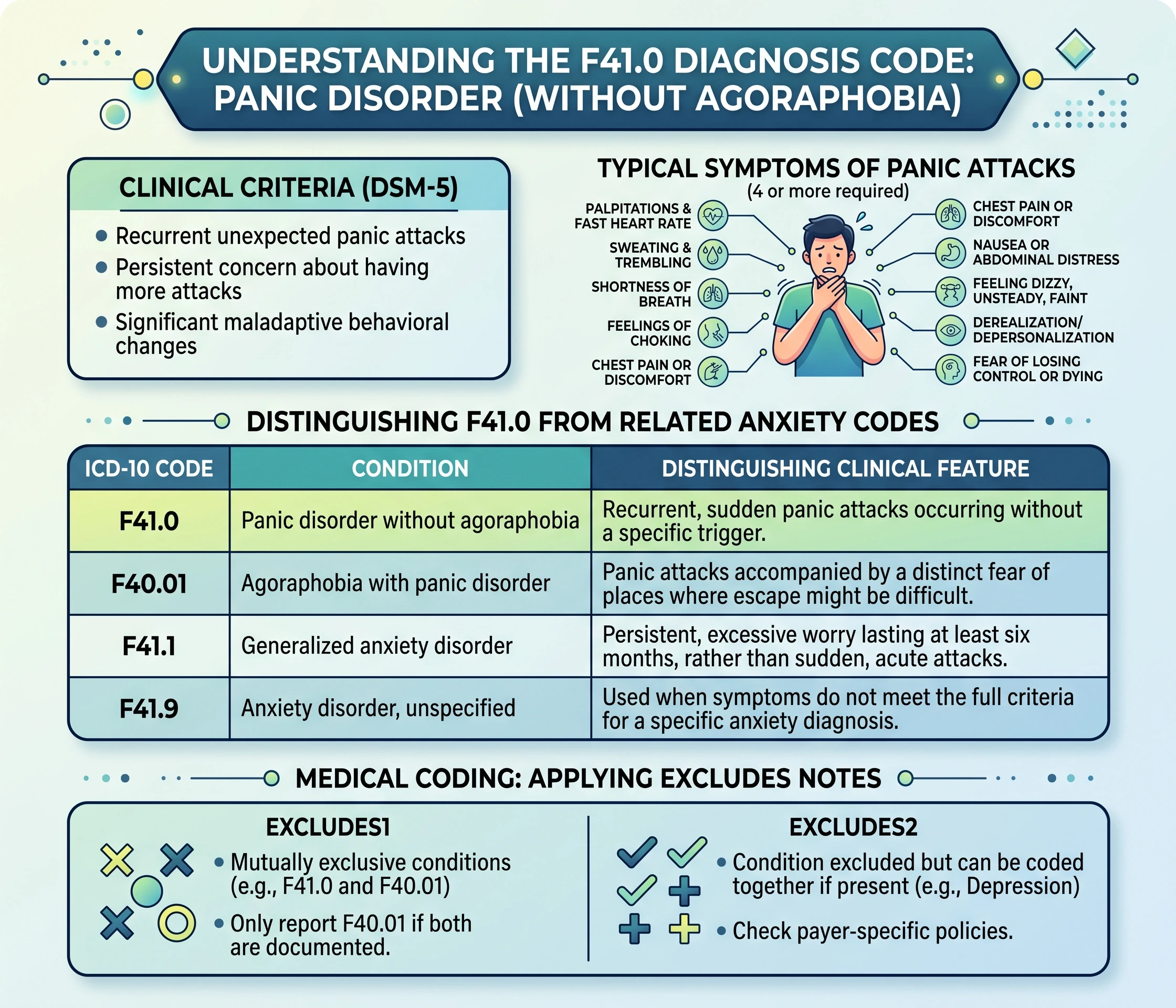
F41.0 falls under the broader category of anxiety, dissociative, stress-related, somatoform, and other nonpsychotic mental disorders. The Centers for Medicare and Medicaid Services (CMS) maintains this specific classification to separate pure panic disorder from conditions involving agoraphobia or generalized anxiety. The distinction relies entirely on the clinical presentation and the physician’s documented assessment.
Clinical criteria for panic disorder
The American Psychiatric Association (APA) outlines specific criteria for panic disorder in the Diagnostic and Statistical Manual of Mental Disorders, Fifth Edition (DSM-5). A patient must experience recurrent, unexpected panic attacks. These attacks are sudden surges of intense fear or discomfort that reach a peak within minutes. Following at least one of these attacks, the patient must show a persistent concern about having additional attacks. They might also make significant, maladaptive changes in their behavior to avoid future episodes.
Identifying physical and psychological symptoms
Panic attacks mimic severe physical health emergencies. Patients frequently present in emergency departments or urgent care centers believing they are experiencing a myocardial infarction. Physicians diagnosing F41.0 typically observe a combination of specific physiological and psychological responses.
Four or more of the following symptoms must occur during the episode to meet the clinical definition of a panic attack:
- Palpitations, pounding heart, or accelerated heart rate
- Sweating and trembling
- Sensations of shortness of breath or smothering
- Feelings of choking
- Chest pain or discomfort
- Nausea or abdominal distress
- Feeling dizzy, unsteady, lightheaded, or faint
- Derealization or depersonalization
- Fear of losing control or dying
Distinguishing F41.0 from related anxiety codes
Medical billers frequently encounter claims rejected due to incorrect code selection within the F40 and F41 series. Accurate coding requires the physician to distinguish episodic paroxysmal anxiety from generalized conditions. The table below outlines the differences between similar ICD-10 codes.
|
ICD-10 Code |
Condition |
Distinguishing Clinical Feature |
|
F41.0 |
Panic disorder without agoraphobia |
Recurrent, sudden panic attacks occurring without a specific trigger. |
|
F40.01 |
Agoraphobia with panic disorder |
Panic attacks accompanied by a distinct fear of places where escape might be difficult. |
|
F41.1 |
Generalized anxiety disorder |
Persistent, excessive worry lasting at least six months, rather than sudden, acute attacks. |
|
F41.9 |
Anxiety disorder, unspecified |
Used when symptoms do not meet the full criteria for a specific anxiety diagnosis. |
Navigating ICD-10 Excludes1 and Excludes2 notes
Medical coders must apply ICD-10-CM Excludes notes correctly when billing F41.0. An Excludes1 note indicates that two conditions cannot be billed together because they are mutually exclusive. F41.0 carries an Excludes1 note for panic disorder with agoraphobia (F40.01). If a patient has both conditions documented, the coder must only report F40.01.
Conversely, an Excludes2 note indicates that the condition is excluded from the current code, but a patient may have both conditions at the same time. While F41.0 does not have specific Excludes2 notes that prevent dual coding with major depressive disorder, coders must always verify payer-specific policies regarding primary and secondary psychiatric diagnoses.
Essential documentation tips for F41.0
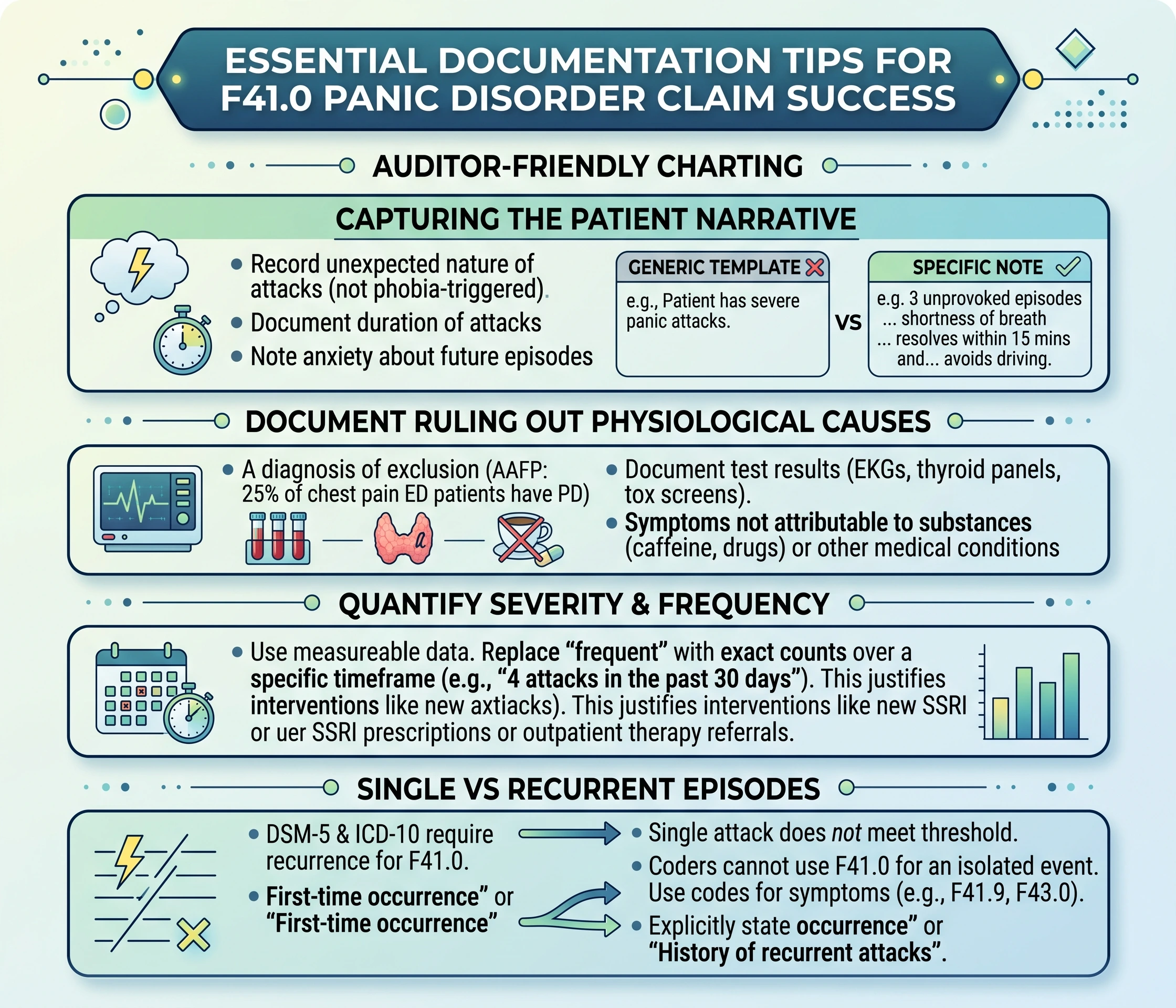
Clear clinical documentation directly impacts the success of a medical claim. Auditors look for specific notes detailing the nature, frequency, and severity of the patient’s symptoms. Generic templates or copy-and-pasted notes frequently lead to post-payment retractions during insurance audits.
Capturing the patient narrative
Physicians must record the unexpected nature of the panic attacks. If the patient only experiences attacks when exposed to a specific phobia, such as spiders or enclosed spaces, the F41.0 code is incorrect. The medical record should clearly state that the attacks occur spontaneously. Providers should also document the duration of the attacks and the patient’s anxiety about future episodes.
A compliant clinical note requires specificity. A physician should write a detailed observation. For example, a proper entry would read: “The patient reports three unprovoked episodes of severe chest pain, shortness of breath, and fear of dying over the past month. Episodes resolve within 15 minutes. The patient avoids driving due to fear of experiencing another attack.”
Ruling out physiological causes
Panic disorder is a diagnosis of exclusion in many acute care settings. The documentation must show that the provider considered and ruled out physical ailments. A clinical review published by the American Academy of Family Physicians (AAFP) notes that up to 25% of patients presenting to emergency departments with non-cardiac chest pain meet the criteria for panic disorder.
To support the F41.0 diagnosis, the chart should include the results of diagnostic tests. Electrocardiograms (EKGs), thyroid panels, and toxicology screens are standard procedures in emergency settings. The physician must explicitly note that the symptoms are not attributable to the physiological effects of a substance, such as caffeine or illicit drugs, or another medical condition, such as hyperthyroidism.
Documenting severity and frequency
Auditors for commercial health plans look for quantifiable data within the patient chart. Instead of writing that a patient has “frequent” panic attacks, the physician should specify the exact number of episodes over a given timeframe. Documenting that the patient experienced four attacks in the past 30 days provides measurable data. This information justifies the medical necessity for specific interventions, such as initiating a new prescription for an SSRI or referring the patient for intensive outpatient therapy.
Handling single versus recurrent episodes
The DSM-5 and ICD-10-CM guidelines require recurrent episodes for an F41.0 diagnosis. A single panic attack does not meet the clinical threshold for panic disorder. If a patient experiences their first and only panic attack, coders cannot use F41.0.
In the case of a single episode, the coder must assign a code that reflects the isolated symptom. Often, an unspecified anxiety disorder code (F41.9) or an acute stress reaction code (F43.0) is more appropriate, depending on the triggering event. The clinical documentation must explicitly state whether the patient has a history of these attacks or if the current visit addresses a first-time occurrence. This distinction prevents the patient from carrying a chronic mental health diagnosis on their permanent medical record based on an isolated event.
Billing and coding strategies for F41.0
Translating the clinical encounter into accurate billing codes requires strict adherence to the rules set by the American Hospital Association (AHA) Coding Clinic. Billers must also monitor payer-specific guidelines, which frequently change.
Avoiding common claim denials
Payers routinely deny F41.0 claims if the clinical documentation implies agoraphobia. If the physician’s notes mention that the patient refuses to leave their house or use public transportation, the coder must query the provider to determine if F40.01 is the more accurate diagnosis.
Another frequent billing error involves coding individual symptoms alongside the definitive diagnosis. Under standard ICD-10 guidelines, coders should not assign separate codes for symptoms that are integral to the disease process. If the physician definitively diagnoses F41.0, the coder should not add separate symptom codes for palpitations (R00.2) or hyperventilation (R06.4). The panic disorder diagnosis inherently includes these physiological responses.
Coordination with evaluation and management codes
Psychiatrists and primary care physicians frequently use Evaluation and Management (E/M) codes when treating panic disorder. Time-based E/M coding is highly utilized for mental health visits because a significant portion of the encounter involves counseling and care coordination.
The American Medical Association (AMA) allows providers to bill based on total time spent on the date of the encounter. If a physician spends 45 minutes assessing a patient with F41.0, discussing treatment options, and coordinating care with a therapist, they would use CPT code 99215 for an established patient. The provider’s documentation must clearly detail what was discussed during that 45-minute window to justify the higher-level E/M code.
Billing for therapy and pharmacological management
Treatment for F41.0 typically involves medication, psychotherapy, or a combination of both. When a primary care provider prescribes selective serotonin reuptake inhibitors (SSRIs) or benzodiazepines, the medication management must be documented as part of the medical decision-making process within the E/M code.
If a psychologist or licensed clinical social worker provides cognitive behavioral therapy (CBT) for the panic disorder, they use psychiatric therapeutic procedure codes. A standard 45-minute psychotherapy session is billed using CPT code 90834. The primary diagnosis on the CMS-1500 claim form remains F41.0. This diagnosis code establishes the medical necessity for the therapy sessions.
Telehealth coding considerations for panic disorder
The Department of Health and Human Services (HHS) permanently authorized many behavioral health services for telehealth delivery. Treating F41.0 via telehealth requires specific billing modifiers and place of service (POS) codes.
For Medicare claims, POS 10 indicates telehealth provided in the patient’s home. POS 02 indicates telehealth provided in a location other than the patient’s home, such as a remote clinic. Many commercial payers require the 95 modifier to indicate a synchronous telemedicine service rendered via a real-time interactive audio and video telecommunications system. Billers must verify the specific telehealth modifier requirements for each patient’s insurance plan, as Blue Cross Blue Shield, UnitedHealthcare, and Aetna maintain differing internal policies.
Impact of co-occurring mental health conditions
Patients with F41.0 frequently require treatment for concurrent psychiatric conditions. According to the Substance Abuse and Mental Health Services Administration (SAMHSA), co-occurring mental health disorders require precise sequencing on the medical claim.
Major depressive disorder (MDD) is a frequent comorbidity with panic disorder. When a patient presents with both conditions, the medical coder must report both ICD-10 codes. The primary diagnosis must reflect the chief reason for the specific medical visit. If the patient primarily requires a medication adjustment for daily panic attacks, F41.0 is listed as the primary diagnosis. If severe depression is the main focus of the encounter, the MDD code takes the primary position.
Risk adjustment and hierarchical condition categories
Medicare Advantage plans utilize the Hierarchical Condition Category (HCC) risk adjustment model to predict future healthcare costs for patients. While severe mental health conditions like schizophrenia map to specific HCCs that increase a patient’s risk score, F41.0 generally does not map to a payment-generating HCC in the standard CMS model.
However, accurate coding of F41.0 remains mandatory. Commercial payers frequently use proprietary risk models that track anxiety disorders. Capturing F41.0 accurately ensures the health plan recognizes the patient’s full clinical profile, which influences quality metrics and care management programs. Providers who under-report F41.0 risk having their patient population appear healthier than they actually are, which skews internal clinical data and resource allocation.
Accurate application of the F41.0 diagnosis code relies on highly specific clinical documentation and strict adherence to ICD-10-CM guidelines. Providers must record the spontaneous nature of the attacks, rule out physiological conditions, and confirm the absence of agoraphobia. Coders use this documentation to prevent claim denials related to mutually exclusive conditions and integral symptoms.