


F41.1 Diagnosis Code: Documentation and Billing Tips
Anxiety is the most common category of mental illness billed in the United States, and one code carries a large share of those claims. The F41.1 diagnosis code identifies generalized anxiety disorder (GAD) in ICD-10-CM. It is a billable, specific code, valid for HIPAA-covered transactions from October 1, 2025 through September 30, 2026 under the FY2026 code set. Getting it on a claim is easy. Getting it paid, and keeping it paid through an audit, depends on what the medical record actually says.
This guide covers what F41.1 represents, how it differs from its neighbors in the F41 family, the documentation payers look for, and the CPT combinations that move a GAD claim through cleanly.
What the F41.1 diagnosis code covers
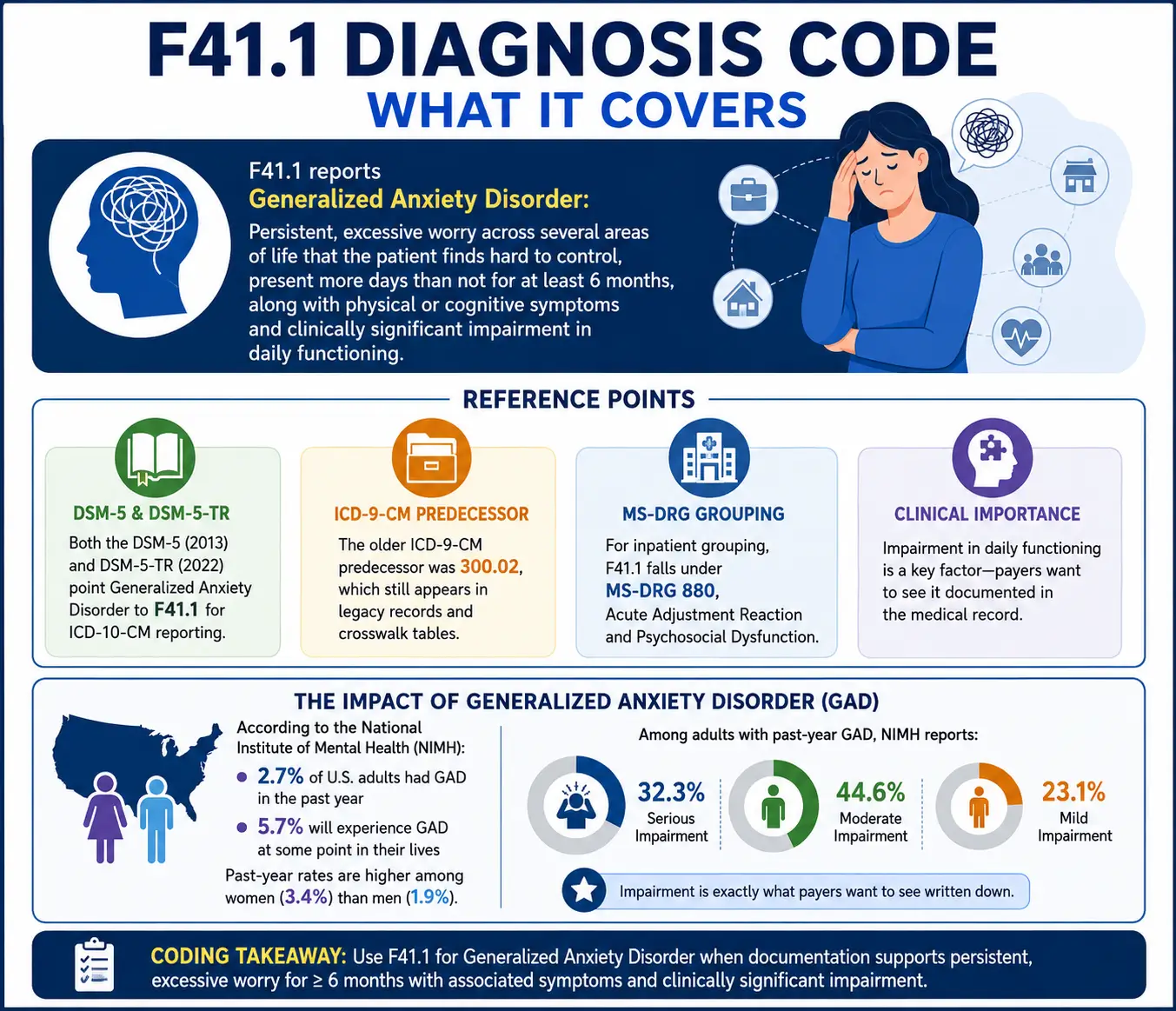
F41.1 reports generalized anxiety disorder: persistent, excessive worry across several areas of life that the patient finds hard to control, present more days than not for at least six months, along with physical or cognitive symptoms and clinically significant impairment in daily functioning.
A few reference points that come up often in coding conversations. The DSM-5 (American Psychiatric Association, 2013) and the DSM-5-TR (2022) both point generalized anxiety disorder to F41.1 for ICD-10-CM reporting. The older ICD-9-CM predecessor was 300.02, which still appears in legacy records and crosswalk tables. For inpatient grouping, F41.1 falls under MS-DRG 880, acute adjustment reaction and psychosocial dysfunction.
The clinical weight behind the code is real. The National Institute of Mental Health reports that an estimated 2.7 percent of U.S. adults had generalized anxiety disorder in the past year and 5.7 percent experience it at some point in their lives, with higher past-year rates among women (3.4 percent) than men (1.9 percent). Among adults with past-year GAD, NIMH puts serious impairment at 32.3 percent, moderate at 44.6 percent, and mild at 23.1 percent. Those impairment figures are worth remembering, because impairment is exactly what payers want to see written down.
Where F41.1 sits in the F41 family
The F41 block holds five billable codes. Choosing correctly is a documentation decision, not a guess, and the difference between F41.1 and F41.9 is where most avoidable coding errors happen.
|
ICD-10-CM code |
Description |
When it applies |
|
F41.0 |
Panic disorder (episodic paroxysmal anxiety) |
Recurrent unexpected panic attacks with ongoing concern about further attacks |
|
F41.1 |
Generalized anxiety disorder |
Excessive, hard-to-control worry, 6+ months, with associated symptoms and impairment |
|
F41.3 |
Other mixed anxiety disorders |
Anxiety features that mix without one clear predominant disorder |
|
F41.8 |
Other specified anxiety disorders |
A named anxiety presentation that does not fit the more specific codes |
|
F41.9 |
Anxiety disorder, unspecified (anxiety NOS) |
Clinically present anxiety that does not yet meet criteria for a specific type |
F41.9 is a transitional code. It says the anxiety is real but the type is not yet established. Payers expect it to give way to something specific as the picture clarifies, and unspecified codes without a documented rationale are a familiar audit flag. Defaulting to F41.9 when the record already supports GAD criteria is underspecification, and it can cost money. One billing firm, MCB Medical Billing, described a Denver psychology practice whose F41.1 denials dropped after it added a symptom-duration statement to its intake template, since the earlier notes described anxiety symptoms but rarely recorded the six-month threshold.
Documentation that supports F41.1
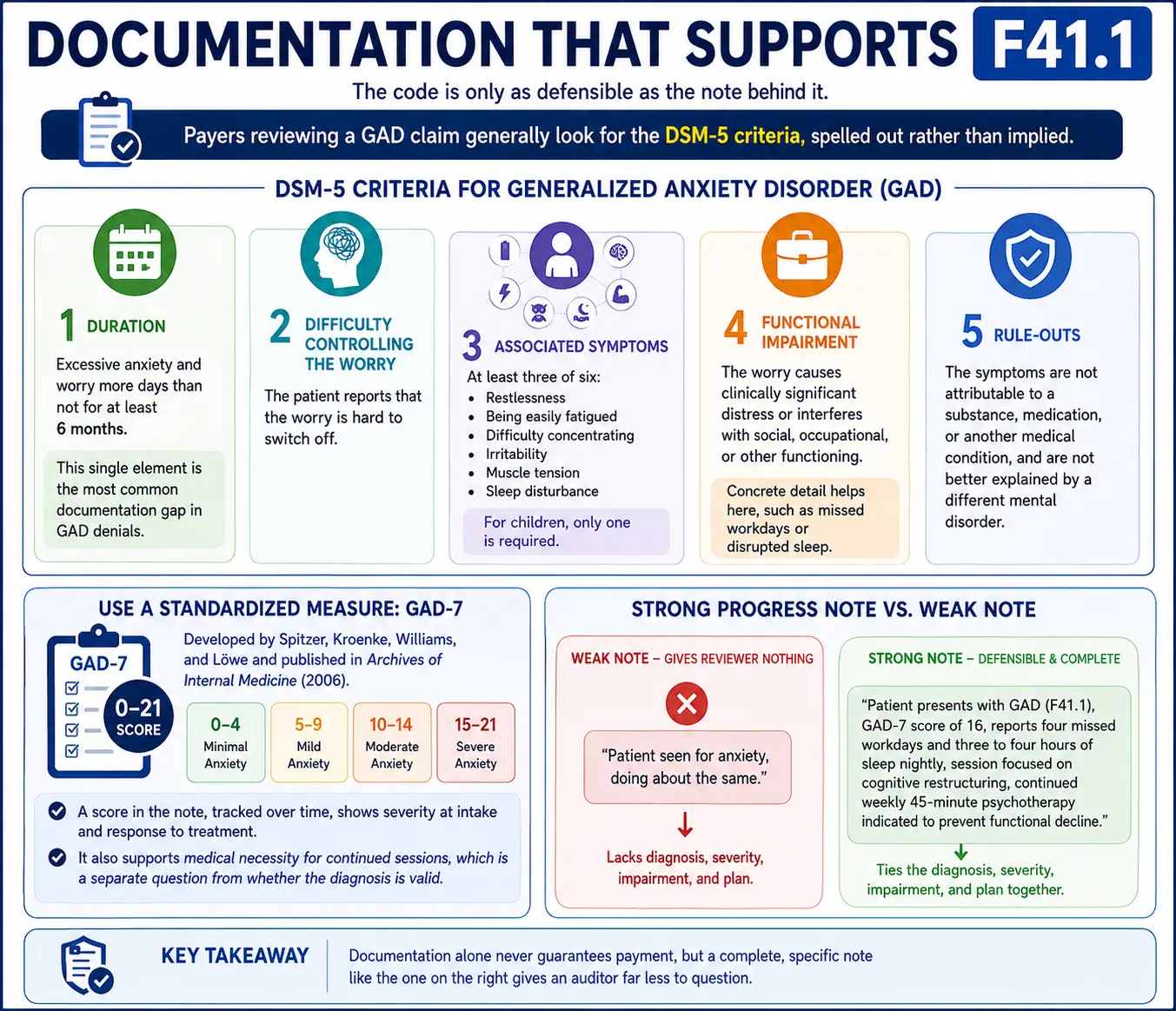
The code is only as defensible as the note behind it. Payers reviewing a GAD claim generally look for the DSM-5 criteria, spelled out rather than implied.
Those criteria include:
- Duration. Excessive anxiety and worry more days than not for at least six months. This single element is the most common documentation gap in GAD denials.
- Difficulty controlling the worry. The patient reports that the worry is hard to switch off.
- Associated symptoms. At least three of six: restlessness, being easily fatigued, difficulty concentrating, irritability, muscle tension, and sleep disturbance. For children, only one is required.
- Functional impairment. The worry causes clinically significant distress or interferes with social, occupational, or other functioning. Concrete detail helps here, such as missed workdays or disrupted sleep.
- Rule-outs. The symptoms are not attributable to a substance, medication, or another medical condition, and are not better explained by a different mental disorder.
A standardized measure strengthens the record. The GAD-7, developed by Spitzer, Kroenke, Williams, and Löwe and published in Archives of Internal Medicine in 2006, scores from 0 to 21, with commonly cited thresholds of 5, 10, and 15 marking mild, moderate, and severe anxiety. A score in the note, tracked over time, shows both severity at intake and response to treatment. It also supports medical necessity for continued sessions, which is a separate question from whether the diagnosis is valid.
A strong progress note reads less like an attendance record and more like a clinical status update. Compare two versions. “Patient seen for anxiety, doing about the same” gives a reviewer nothing. “Patient presents with GAD (F41.1), GAD-7 score of 16, reports four missed workdays and three to four hours of sleep nightly, session focused on cognitive restructuring, continued weekly 45-minute psychotherapy indicated to prevent functional decline” ties the diagnosis, the severity, the impairment, and the plan together. Documentation alone never guarantees payment, but the second note gives an auditor far less to question.
Excludes notes: when F41.1 can share a claim
A point that surprises some coders: F41.1 carries no Excludes1 notes. Excludes1 means “not coded here,” a hard block against reporting two codes together. Because F41.1 has none, there is no ICD-10-CM instruction that forbids pairing it with another diagnosis on clinical grounds alone.
What it does carry are seven Excludes2 notes, most inherited from the parent F41 category. Excludes2 means “not included here,” which signals that the excluded condition is separate but can coexist. When an Excludes2 note applies and both conditions are documented, both codes may be reported together. Those noted conditions include anxiety occurring in an acute stress reaction (F43.0), anxiety in a transient adjustment reaction (F43.2), neurasthenia (F48.8), psychophysiologic disorders (F45.-), and separation anxiety (F93.0).
In practice, this matters for the many patients who carry more than one behavioral health diagnosis. GAD frequently co-occurs with major depressive disorder, so a claim listing F41.1 alongside a depression code such as F32.x or F33.x is coded correctly when the record supports both. Sequence the codes by which condition is the primary reason for the encounter.
Billing the F41.1 diagnosis code with CPT
A diagnosis code establishes medical necessity. A CPT code describes what the clinician did. Both are required on most behavioral health claims, and mismatches between them are a leading cause of rejections.
The service codes that pair with F41.1 depend on the provider and the visit:
- Diagnostic evaluation: 90791 (without medical services) and 90792 (with medical services) for the initial psychiatric assessment.
- Individual psychotherapy: 90832 (about 30 minutes), 90834 (38 to 52 minutes of face-to-face time), and 90837 (53 or more minutes). The distinction is face-to-face time, not total appointment length.
- Evaluation and management: 99213 and 99214 for prescribers handling medication management.
- Psychotherapy add-ons: 90833, 90836, and 90838, billed with an E/M code when a prescriber provides both medication management and therapy in the same visit. Billing a standalone therapy code plus an E/M code separately for the same encounter is a classic unbundling denial.
- Group and family therapy: 90853 (group), 90846 (family without the patient present), and 90847 (family with the patient).
- Screening administration: 96127, brief emotional or behavioral assessment, used to bill administration of a validated tool such as the GAD-7, reportable up to four units per visit.
Several billing rules trip up otherwise clean GAD claims. The diagnostic evaluation code 90791 cannot be billed on the same day as psychotherapy or an E/M service by the same provider for the same patient, because National Correct Coding Initiative edits flag the pair. Frequency also matters: Medicare generally allows 90791 once every six months per episode of care with documented need for re-evaluation, while many commercial payers limit it to once per year. Billing it more often without a documented new episode is the kind of pattern that draws a Targeted Probe and Educate review.
Modifiers carry their own logic. When 96127 is billed alongside an E/M visit, the E/M usually takes modifier 25 (a significant, separately identifiable service) and the screening takes modifier 59 (a distinct procedural service). For telehealth, modifier 95 signals audio-video and modifier 93 signals audio-only, and the place-of-service code should reflect where the patient actually was, with POS 10 for the patient’s home rather than POS 02. The F41.1 diagnosis code itself does not change for telehealth. What changes lives entirely on the CPT side of the claim.
Screening, the USPSTF recommendation, and coverage
Screening feeds diagnosis, and the policy backdrop shifted in 2023. On June 20, 2023, the U.S. Preventive Services Task Force issued its first recommendation on this topic, advising screening for anxiety disorders in adults aged 19 to 64, including pregnant and postpartum persons, and assigned it a B grade. For adults 65 and older, the Task Force issued an I statement, meaning the current evidence was insufficient to weigh benefits against harms. The reviewed conditions included generalized anxiety disorder, social anxiety disorder, panic disorder, and anxiety not otherwise specified, and the Task Force noted that the GAD-2 and GAD-7 showed adequate sensitivity and specificity for detecting GAD.
The grade has billing consequences. Under the Affordable Care Act, most non-grandfathered commercial and marketplace plans must cover preventive services rated A or B by the USPSTF without patient cost sharing, which brings routine adult anxiety screening into covered preventive care for those plans. The Task Force also stressed that a positive screen is not a diagnosis. It should be confirmed by a diagnostic assessment before F41.1 goes on a claim as a confirmed condition rather than a screening finding.
One code caution here. A positive GAD-7 during a Medicare Annual Wellness Visit follows the depression-screening pathway and its own coding, and 96127 should not be reported on the same day as certain visit types. Verify each payer’s preventive-service policy rather than assuming the ACA rule reaches every plan and program.
Common denials and how to prevent them
Most F41.1 rejections trace back to a handful of fixable causes:
- Missing six-month duration. The most frequent gap. Add a duration statement to the assessment template.
- Unspecified code when GAD is documented. Move from F41.9 to F41.1 once the record supports the specific criteria.
- Thin progress notes. Record clinical status, GAD-7 trend, and impairment, not just that the patient showed up.
- Unbundling and same-day edits. Watch the 90791 same-day rule and use add-on psychotherapy codes with E/M rather than separate line items.
- Telehealth coding errors. Match the modifier and place-of-service code to the actual modality and patient location.
The F41.1 diagnosis code is straightforward to assign and well supported for reimbursement when the documentation carries its weight. Record the duration, the three or more associated symptoms, the functional impairment, and a standardized score, choose the CPT code that matches the service and the clinician, and follow the same-day and frequency edits. A GAD claim built that way reflects the clinical work accurately, and it holds up when a reviewer reads the note behind it.