


Schizoaffective disorder represents one of the most frequently miscoded psychiatric diagnoses in the United States. Because the condition includes features of both schizophrenia and mood disorders, accurately documenting and coding it requires specific clinical evidence. The Centers for Medicare & Medicaid Services (CMS) and the World Health Organization (WHO) maintain the ICD-10-CM coding system, which designates F25.0 as the billable code for schizoaffective disorder, bipolar type. Clinicians frequently refer to this as the manic type.
This guide details the exact requirements for using this code correctly. To navigate this subject, the content below is organized into the following headings:
- Understanding the F25.0 diagnosis code
- Distinguishing F25.0 from F25.1
- Diagnostic criteria and documentation requirements
- Differential diagnosis coding
- Billing risks and OIG audit concerns
- Coding guidelines and Excludes1 notes
- Prior authorization and pharmacy claims
- Telehealth billing considerations
- Practical documentation example
- Clinical validation tools
Understanding the F25.0 diagnosis code
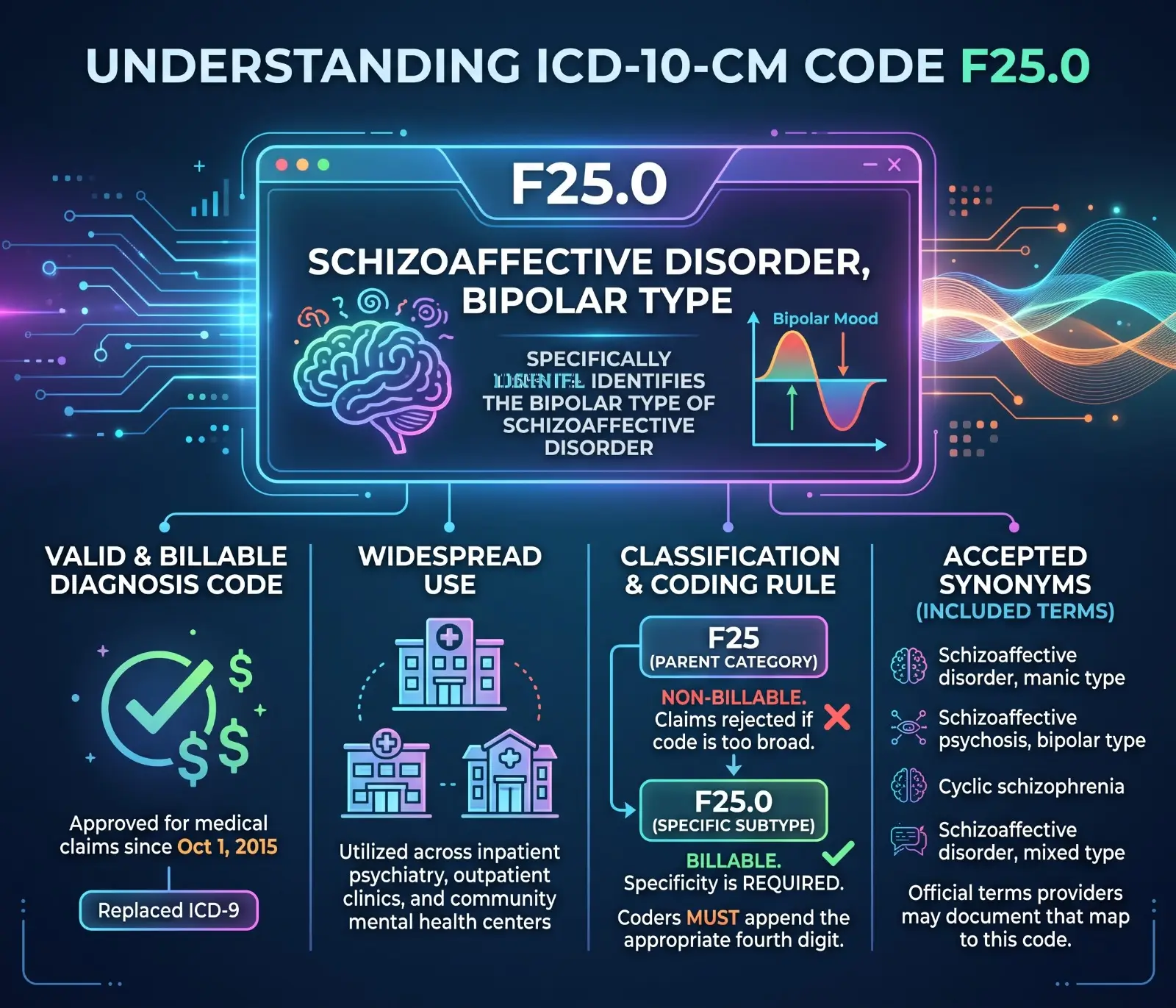
The ICD-10-CM code F25.0 specifically identifies schizoaffective disorder, bipolar type. The United States healthcare system adopted this specific alphanumeric code on October 1, 2015, replacing the older ICD-9 system. It functions as a valid, billable code used across inpatient psychiatry, outpatient clinics, and community mental health centers.
The broader parent category, F25, covers all schizoaffective disorders but is not billable on its own. Medical claims submitted with only the three-character F25 parent code face immediate rejection by clearinghouses. Medical coders must append the appropriate fourth digit to specify the exact subtype.
According to the official ICD-10-CM tabular list, the F25.0 code includes several synonymous clinical terms that providers may use in their documentation. These accepted synonyms include schizoaffective disorder, manic type; schizoaffective psychosis, bipolar type; cyclic schizophrenia; and schizoaffective disorder, mixed type.
Distinguishing F25.0 from F25.1
The ICD-10-CM classification separates schizoaffective disorder into two primary subtypes based entirely on the mood component. The F25.0 code applies when the patient’s history or current presentation includes a manic or mixed mood episode.
The F25.1 code designates the depressive type. Coders use F25.1 only when major depressive episodes occur without any history of mania. This distinction directly affects treatment planning and insurance processing. Research published in the American Journal of Psychiatry indicates that the bipolar type (F25.0) appears more frequently in young adults. The depressive type (F25.1) presents more commonly in older populations.
Diagnostic criteria and documentation requirements
To support the F25.0 code, a provider's clinical documentation must explicitly align with the Diagnostic and Statistical Manual of Mental Disorders, Fifth Edition, Text Revision (DSM-5-TR). The DSM-5-TR notes that schizoaffective disorder has a lifetime prevalence ranging from 0.32% to 1.1%. This makes it statistically less common than major depressive disorder or standard bipolar disorder.
The defining factor for an F25.0 diagnosis is the specific temporal relationship between psychotic symptoms and mood episodes. CMS guidelines require the clinical record to document four exact elements.
First, the patient must experience psychotic features. These include hallucinations, delusions, or disorganized speech. Second, the documentation must demonstrate the two-week rule. The psychotic symptoms must persist for at least two consecutive weeks in the absence of a major mood episode. Third, the medical record must explicitly detail a manic or mixed episode to justify the bipolar type over the depressive type. Fourth, the mood episode must remain present for a majority of the total duration of the active and residual periods of the illness.
Differential diagnosis coding
Proper code selection requires distinguishing F25.0 from similar psychiatric conditions. Misinterpreting the timeline of symptoms leads directly to coding errors and claim denials.
Bipolar disorder with psychotic features (F31.x)
The F31 category covers bipolar affective disorder. If a patient experiences psychotic symptoms only during an active manic or depressive episode, the correct code is an F31.x designation. An example is F31.2 (Bipolar disorder, current episode manic severe with psychotic features). Using F25.0 when psychosis is strictly bound to mood episodes constitutes a compliance violation.
Schizophrenia (F20.x)
The F20 category applies to schizophrenia spectrum disorders. These codes are appropriate when a patient exhibits persistent psychotic symptoms without a clinically significant mood component. If mood symptoms occur incidentally or for a brief fraction of the illness duration, the F20.x codes remain the accurate choice.
Substance-induced psychotic disorder (F10-F19 series)
Providers must document that the manic and psychotic symptoms do not stem from the physiological effects of a substance. If a patient presents with manic psychosis due to methamphetamine use, the coder must look to the F15 series (Other stimulant related disorders) rather than F25.0.
Billing risks and OIG audit concerns
Mental health coding represents a highly monitored area for medical billing. The Government Accountability Office (GAO) frequently reports high improper payment rates for psychiatric claims. When providers submit claims using vague or unsupported codes, they expose their practices to audits by the Office of Inspector General (OIG) and CMS recovery audit contractors.
The most significant compliance risk involves the F25.9 code (Schizoaffective disorder, unspecified). Relying on unspecified codes leads to higher denial rates. Auditors specifically look for exact alignment between the billed diagnosis code and the documented clinical evaluation.
Billing a high-level Evaluation and Management (E/M) code like 99215 requires linking the visit to a specific, highly complex diagnosis. If a provider bills 99215 but only writes "schizoaffective disorder" in the chart without detailing the manic symptoms necessary for F25.0, Medicare may flag the claim for upcoding. Similarly, when billing for an initial psychiatric diagnostic evaluation (CPT 90792), the provider must detail both the psychotic features and the manic mood symptoms.
Coding guidelines and Excludes1 notes
Medical billers must navigate specific ICD-10-CM tabular list instructions when assigning the F25.0 code. The most restrictive of these are Excludes1 notes.
The ICD-10-CM manual contains Excludes1 notes for the entire F25 category. An Excludes1 note means "not coded here." It dictates that F25.0 cannot be billed simultaneously with certain other conditions on the same date of service. For example, a coder cannot put both F25.0 and F20.9 (Schizophrenia, unspecified) on the same claim. The conditions are mutually exclusive by definition.
Unlike mood disorder codes, the F25.0 code does not require a fifth digit to indicate the current clinical status. A major depressive disorder code requires extra digits to show if the condition is mild, moderate, severe, or in remission. The F25.0 code remains exactly F25.0 regardless of the current phase of the patient's illness.
Prior authorization and pharmacy claims
Accurate ICD-10-CM coding directly impacts pharmacy benefit managers (PBMs) and medication prior authorizations. Patients with an F25.0 diagnosis typically require complex pharmacological management involving both atypical antipsychotics and mood stabilizers.
Common treatment regimens for the manic type include medications like lithium or valproate combined with paliperidone or risperidone. Insurance companies frequently require prior authorization for branded or high-cost long-acting injectable (LAI) antipsychotics. If a clinic submits a prior authorization request for a mood stabilizer but uses the F20.9 (Schizophrenia) code instead of F25.0, the PBM will likely deny the medication. The PBM's automated system will fail to see the clinical justification for a bipolar medication on a pure schizophrenia diagnosis. Using the specific F25.0 code proves the medical necessity for prescribing both classes of medication.
Telehealth billing considerations
Psychiatry relies heavily on telehealth services. When billing F25.0 for a virtual encounter, coders must append the correct modifiers and Place of Service (POS) codes to ensure payment.
For Medicare claims, POS 02 indicates telehealth provided in a location other than the patient's home. POS 10 indicates telehealth provided while the patient is located in their home. Commercial payers often require the 95 modifier (Synchronous Telemedicine Service Rendered via a Real-Time Interactive Audio and Video Telecommunications System) appended to the CPT code. A claim for a virtual medication management visit would look like: 99214-95 linked to primary diagnosis F25.0, using POS 10.
Practical documentation example
Vague documentation immediately leads to claim denials. A medical record stating "Patient presents with schizoaffective disorder, manic type. Continue current medications" fails to support the F25.0 code for an audit.
A compliant documentation entry contains exact timelines and symptom lists. A standard compliant entry reads: "The patient reports ongoing auditory hallucinations and persecutory delusions. These psychotic symptoms have persisted daily for the past month. The patient also exhibits pressured speech, decreased need for sleep, and impulsivity consistent with a manic episode. The manic symptoms began one week ago. The hallucinations were present for three weeks prior to the onset of any manic symptoms. Diagnosis: Schizoaffective disorder, bipolar type (F25.0)."
This entry satisfies the DSM-5-TR and CMS requirements. It explicitly notes the psychotic features, the manic episode, and the required timeline showing psychosis occurring independently of the mood disturbance.
Clinical validation tools
To strengthen documentation against audits, providers often incorporate standardized psychiatric assessment tools into their charting. For the F25.0 diagnosis, documenting scores from specific rating scales provides objective evidence of symptom severity.
The Young Mania Rating Scale (YMRS) measures the severity of manic episodes. The Positive and Negative Syndrome Scale (PANSS) measures the severity of psychotic symptoms. Noting a YMRS score of 20 or higher alongside a PANSS score of 70 or higher substantiates the presence of both the manic and psychotic components. Including these exact scores in the clinical note provides a measurable data point that auditors accept as proof of medical necessity.
Accurate application of the F25.0 code relies on exact clinical observation and highly specific documentation. By confirming the exact timeline separating psychotic features from manic episodes, medical providers ensure accurate clinical records and protect their organizations from financial clawbacks during post-payment audits.