


F20.9 Diagnosis Code Explained: Symptoms, Billing, and ICD-10 Guidelines
Coders who work behavioral health claims see F20.9 constantly, often more than any other code in the F20 through F29 range. It sits in ICD-10-CM’s chapter for mental, behavioral, and neurodevelopmental disorders, under the section for schizophrenia, schizotypal, delusional, and other non-mood psychotic disorders. For students studying medical billing and providers documenting psychiatric visits, understanding why this particular code shows up so often, and what supports it on a chart, matters as much as memorizing the code itself.
What the F20.9 code covers
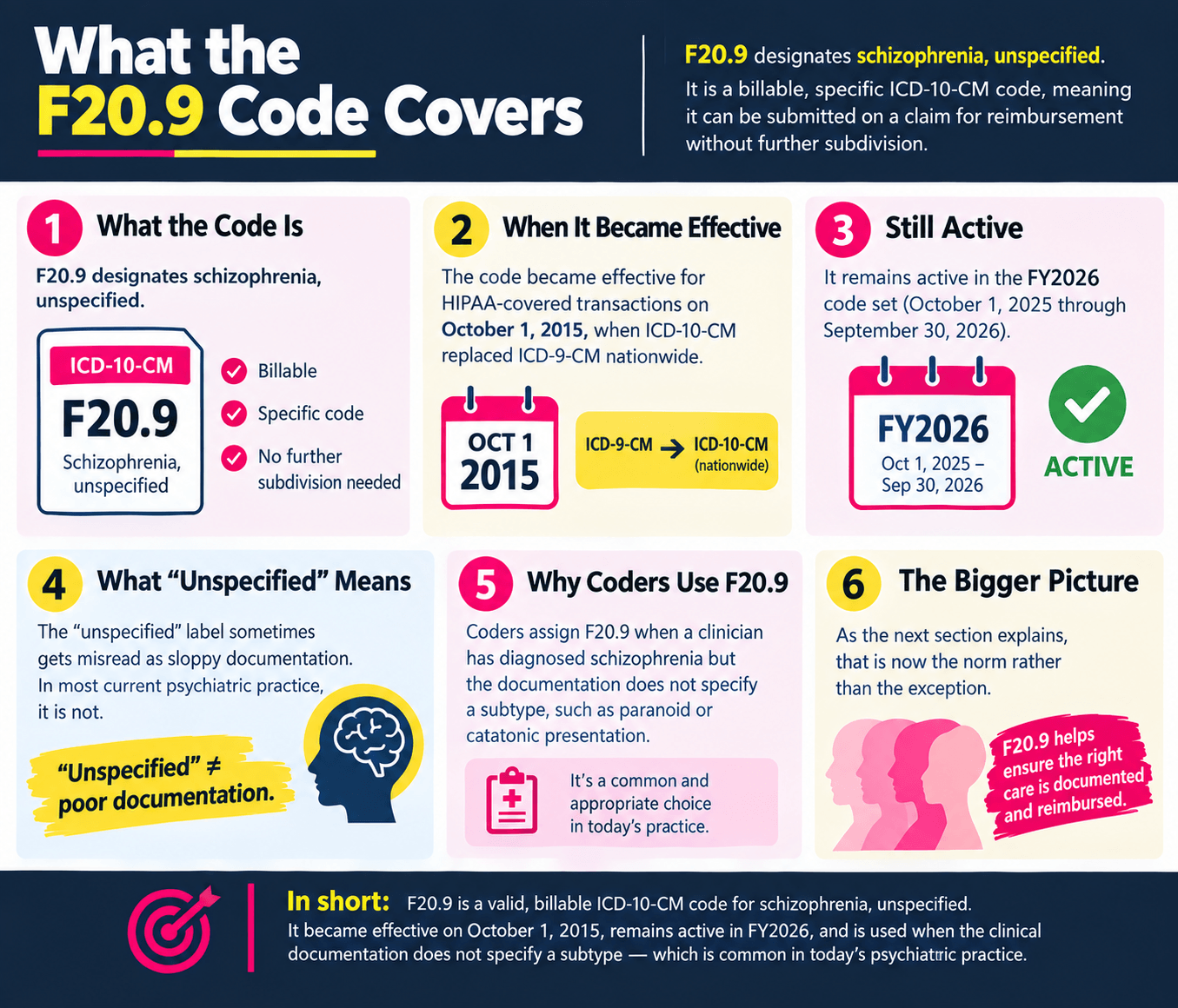
F20.9 designates schizophrenia, unspecified. It is a billable, specific ICD-10-CM code, meaning it can be submitted on a claim for reimbursement without further subdivision. The code became effective for HIPAA-covered transactions on October 1, 2015, when ICD-10-CM replaced ICD-9-CM nationwide, and it remains active in the FY2026 code set (October 1, 2025 through September 30, 2026).
The “unspecified” label sometimes gets misread as sloppy documentation. In most current psychiatric practice, it is not. Coders assign F20.9 when a clinician has diagnosed schizophrenia but the documentation does not specify a subtype, such as paranoid or catatonic presentation. As the next section explains, that is now the norm rather than the exception.
The clinical criteria a chart must support
Before any schizophrenia code gets assigned, the documentation needs to reflect actual diagnostic criteria, not just a label. Under DSM-5-TR, a schizophrenia diagnosis requires two or more of the following symptoms present for a significant portion of a one-month period, with at least one of the two coming from the first three items:
- Delusions
- Hallucinations
- Disorganized speech
- Grossly disorganized or catatonic behavior
- Negative symptoms (diminished emotional expression or avolition)
The disturbance must also cause a marked decline in work, relationships, or self-care, and continuous signs of the disorder must persist for at least six months, including at least one month of active-phase symptoms. Clinicians must rule out schizoaffective disorder, depressive or bipolar disorder with psychotic features, and any symptoms attributable to a substance or a medical condition. For patients with a history of autism spectrum disorder or a childhood communication disorder, schizophrenia can only be added as a diagnosis if prominent delusions or hallucinations are also present for at least a month.
None of this criteria set specifies a subtype. That absence is deliberate, and it explains the coding pattern billers see every day.
Why “unspecified” is usually the accurate choice
The American Psychiatric Association eliminated schizophrenia subtypes, paranoid, disorganized, catatonic, undifferentiated, and residual, when it published DSM-5 in 2013. The rationale, documented in the manual’s own transition materials, was that these subtypes showed poor diagnostic stability, low reliability, and limited clinical usefulness across a patient’s treatment course. A person who presented with paranoid features one year might present with disorganized features the next, without the underlying illness actually changing.
ICD-10-CM never removed the corresponding subtype codes, because the code set has to stay compatible with international ICD-10 reporting and with clinicians who still use older diagnostic frameworks. That mismatch is the entire reason F20.9 dominates claims data today.
ICD-10-CM code | Subtype | Status under DSM-5-TR |
F20.0 | Paranoid schizophrenia | Eliminated as a distinct subtype in 2013 |
F20.1 | Disorganized schizophrenia | Eliminated |
F20.2 | Catatonic schizophrenia | Eliminated; catatonia is now a specifier, not a subtype |
F20.3 | Undifferentiated schizophrenia | Eliminated |
F20.5 | Residual schizophrenia | Eliminated |
F20.9 | Schizophrenia, unspecified | Matches DSM-5-TR’s single, unified diagnosis |
A standard DSM-5-TR schizophrenia diagnosis, without a subtype qualifier, crosswalks to F20.9. That is not a documentation gap. It is the accurate translation of a diagnostic framework that no longer recognizes subtypes into a code set that still lists them.
When a coder should reach for a subtype code instead
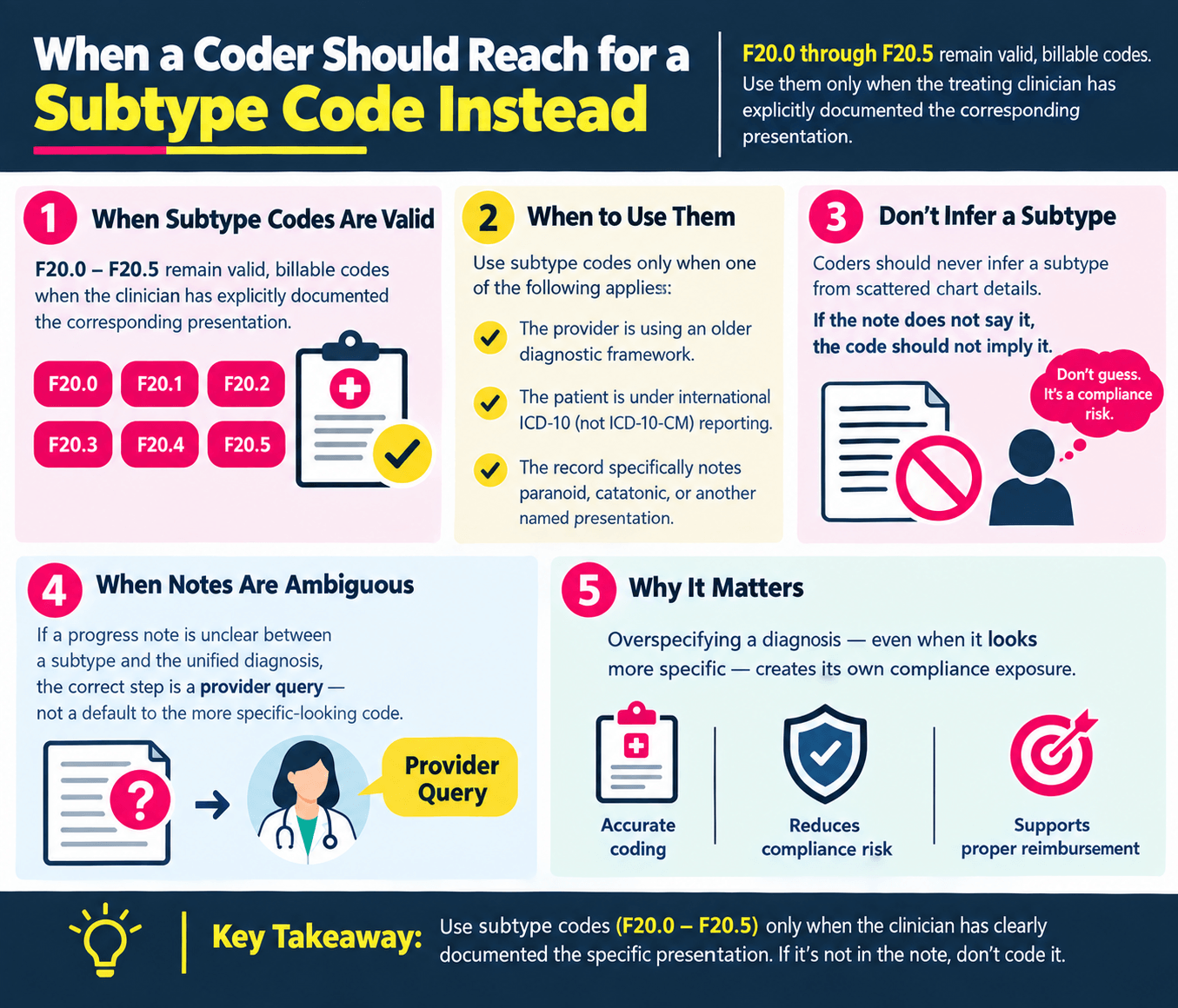
F20.0 through F20.5 remain valid, billable codes. Use them only when the treating clinician has explicitly documented the corresponding presentation, whether because the provider is working from an older diagnostic framework, treating a patient under international ICD-10 (not ICD-10-CM) reporting, or has specifically noted paranoid, catatonic, or another named presentation in the record. Coders should never infer a subtype from scattered chart details. If the note does not say it, the code should not imply it.
This is also where query habits matter. When a progress note is ambiguous between a subtype and the unified diagnosis, the correct step is a provider query, not a default to the more specific-looking code. Overspecifying a diagnosis the clinician never actually made creates its own compliance exposure.
Documentation and billing rules that keep the claim clean
CMS and the National Center for Health Statistics jointly publish the ICD-10-CM Official Guidelines for Coding and Reporting each fiscal year. Their guidance on unspecified codes is direct: sign, symptom, and unspecified codes have acceptable, even necessary, uses. Coders should report the specific code supported by the documentation, but when sufficient clinical detail is not available to assign a more specific code, the unspecified code is the correct choice. The standard is to code each encounter to the level of certainty actually known at that visit, not to guess toward specificity.
For F20.9 specifically, that means the diagnosis needs to reflect documented psychotic symptoms, not a chart that only references a patient’s psychiatric history without current supporting evidence. A stale diagnosis carried forward year after year without fresh clinical detail is one of the more common audit findings in behavioral health coding.
F20.9 and Medicare Advantage risk adjustment
Schizophrenia diagnoses, F20.9 included, map to a payment-relevant Hierarchical Condition Category (HCC) under the CMS-HCC risk adjustment model used for Medicare Advantage. That mapping means the diagnosis affects a plan’s expected cost calculation for that member, not just the individual claim. Because of that, CMS and its auditors expect the record to satisfy what risk adjustment coders call MEAT: evidence that the condition was Monitored, Evaluated, Assessed, or Treated at that specific encounter. A diagnosis pulled from an old problem list without any of those four elements documented at the current visit will not support the code for risk adjustment purposes, even if it is technically accurate.
Annual recapture is part of this. Because chronic conditions do not automatically carry forward in HCC models, F20.9 has to be re-documented with current clinical support at least once per calendar year for it to count toward a patient’s risk score.
Codes to distinguish from F20.9
A few adjacent codes trip up newer coders:
- F25.x (schizoaffective disorder) is a distinct diagnosis from schizophrenia, not a subtype of it. A patient with mood episodes alongside psychotic symptoms needs the F25 code, not F20.9, even though both fall under the same broader psychotic disorders section.
- F21 (schizotypal disorder) is explicitly excluded from F20.9’s code range and must be reported separately when that is the actual diagnosis.
- Schizophrenic reactions occurring in the context of alcoholism, other brain disease, epilepsy, or psychoactive substance use have their own dedicated codes (for example, F10.15-, F06.2, or the F11 through F19 series with the appropriate fifth character) rather than being folded into F20.9.
- When cognitive deficits accompany the diagnosis, coders may need to add R41.84 (other specified cognitive deficit) alongside F20.9, per the ICD-10-CM tabular instructions.
Missing these distinctions does not just create a coding error. It can misrepresent the clinical picture in a way that affects treatment authorization and quality reporting.
Where the code set is headed
The World Health Organization released ICD-11 for international implementation on January 1, 2022, and dozens of countries have already adopted it. The United States has not. ICD-10-CM is deeply embedded in domestic claims systems, quality programs, and payer contracts, and the National Committee on Vital and Health Statistics has advised the Department of Health and Human Services that a transition would likely take years of clinical modification work once it begins. For now, and for the foreseeable future, F20.9 and the rest of ICD-10-CM remain the operative code set for U.S. claims.
Prevalence estimates for schizophrenia illustrate why precise diagnosis coding matters beyond reimbursement. The National Institute of Mental Health puts the U.S. prevalence of schizophrenia and related psychotic disorders between 0.25% and 0.64% of adults, based on household surveys, clinical interviews, and medical records. Separate research on insurance claims data has found even wider variation by payer type, with estimated prevalence around 0.13% in commercial insurance populations and considerably higher, into the low single digits, among Medicaid enrollees. That spread reflects real differences in how populations access diagnosis and treatment, not measurement error alone, and it is exactly the kind of population-level detail that depends on coders applying F20.9 and its related codes consistently.
Getting the F20.9 diagnosis code right comes down to matching the chart to the criteria, choosing unspecified only when the documentation genuinely supports nothing more precise, and refreshing that documentation often enough to hold up under a payer’s or auditor’s review.