



90785 CPT Code Description: Complete Guide for Mental Health Billing
Behavioral health billing requires strict precision. Medical coders and mental health providers must translate subjective patient encounters into objective, standardized codes for accurate reimbursement. The American Medical Association (AMA) created the Current Procedural Terminology (CPT) code 90785 to account for specific barriers that complicate standard psychiatric services. The 90785 CPT code description outlines this as an add-on service for “interactive complexity.”
Providers use this code when a patient encounter demands significantly more clinical effort than a standard visit due to severe communication disruptions. This guide examines the strict criteria for applying 90785, the documentation required to survive medical audits, and the specific primary codes that allow this add-on to clear insurance claims processing systems.
Understanding the Mechanics of Add-On Codes
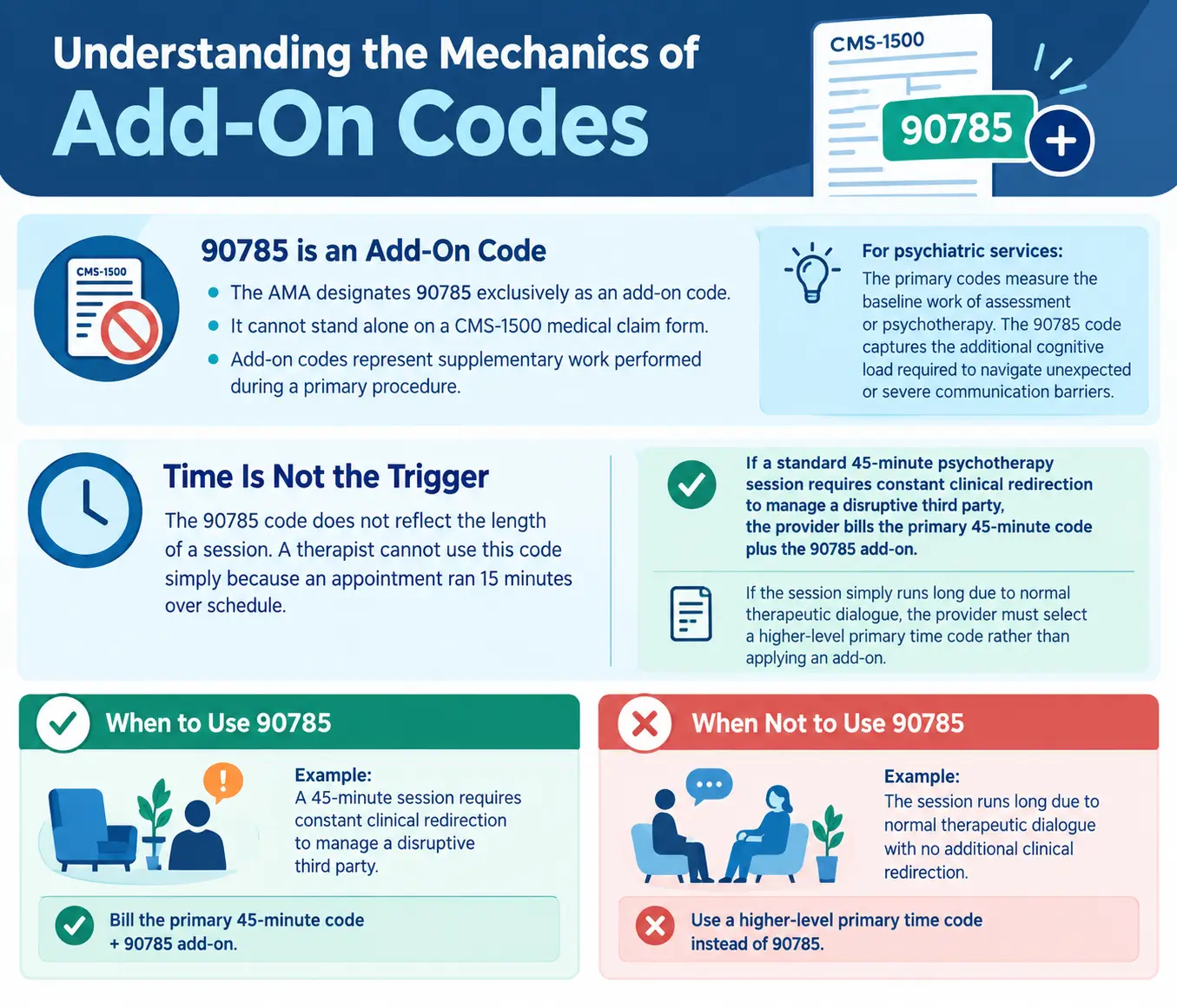
The AMA designates 90785 exclusively as an add-on code. It cannot stand alone on a CMS-1500 medical claim form. Add-on codes represent supplementary work performed during a primary procedure. For psychiatric services, the primary codes measure the baseline work of assessment or psychotherapy. The 90785 code captures the additional cognitive load required to navigate unexpected or severe communication barriers.
Time is a frequent source of confusion for billing specialists. The 90785 code does not reflect the length of a session. A therapist cannot use this code simply because an appointment ran 15 minutes over schedule. If a standard 45-minute psychotherapy session requires constant clinical redirection to manage a disruptive third party, the provider bills the primary 45-minute code plus the 90785 add-on. If the session simply runs long due to normal therapeutic dialogue, the provider must select a higher-level primary time code rather than applying an add-on.
Four Explicit Criteria for Interactive Complexity
The Centers for Medicare & Medicaid Services (CMS) and the AMA limit the application of 90785 to four exact scenarios. A clinical encounter must meet at least one of these criteria to qualify for reimbursement.
Maladaptive Communication
Patients experiencing severe psychiatric symptoms often exhibit communication patterns that halt standard therapeutic interventions. This criterion applies when a patient’s behavior actively prevents the provider from conducting a standard psychiatric assessment or delivering psychotherapy. Standard emotional distress, such as crying or reluctance to speak, does not meet the threshold for maladaptive communication. The patient must present a barrier that forces the provider to change their clinical strategy.
Consider a practical clinical scenario. A provider attempts to conduct a psychiatric diagnostic evaluation with a patient experiencing acute schizophrenia. The patient exhibits disorganized speech and responds to internal stimuli, making a standard question-and-answer interview impossible. The provider must abandon the standard assessment tool and use alternative environmental grounding exercises to gather basic diagnostic information. This level of immediate clinical adaptation justifies the 90785 code.
Interfering Caregiver Behavior
Mental health treatment frequently involves family members, particularly in pediatric or geriatric care. The physical presence of a parent, guardian, or caregiver does not automatically validate the use of 90785. The code applies exclusively when the third party’s behavior directly disrupts the delivery of care. The interference must be severe enough to require the provider to intervene and manage the caregiver before returning focus to the patient.
During a 30-minute individual psychotherapy session for an adolescent, a parent may insist on remaining in the room. If the parent continuously interrupts the patient, contradicts the patient’s statements, and attempts to direct the therapeutic intervention, the provider faces a clinical barrier. The therapist must spend a portion of the session managing the parent’s anxiety and establishing boundaries to allow the adolescent to speak. This active disruption qualifies for interactive complexity.
Disclosure of a Sentinel Event
Providers must use 90785 when a session involves the disclosure of a severe event that mandates immediate external coordination. Therapy sessions routinely involve discussions of past trauma. Discussing historical abuse does not trigger this code on its own. The interactive complexity add-on applies when the disclosure creates a legal or clinical obligation to act outside the boundaries of a standard session. This includes situations requiring mandated reporting to child protective services, initiating emergency holds for self-harm, or coordinating with law enforcement or probation officers.
For example, a patient reveals active plans for suicide with means and intent during a standard psychotherapy appointment. The provider must pivot from the planned therapeutic intervention to conduct a severe risk assessment, contact emergency medical services, and coordinate a safe transfer to a hospital emergency department. The sudden shift in clinical focus and required external coordination justifies the add-on code.
Required Use of Physical Equipment or Translators
Some patients lack the physical or cognitive capacity to communicate verbally. The fourth criterion applies when a provider must rely on specialized equipment or third-party translators to facilitate communication. This includes using play therapy equipment for young children who cannot articulate their psychological state, physical picture boards for patients with expressive aphasia, or professional human interpreters for non-English speakers.
The use of an interpreter faces heavy scrutiny in medical billing audits. The language barrier must significantly alter the cognitive work of the clinical assessment. Commercial payers frequently reject 90785 if the only justification is the use of a standard interpreter to comply with the Americans with Disabilities Act or Title VI of the Civil Rights Act. The documentation must prove that the translation process actively complicated the psychiatric evaluation. A provider assessing a non-verbal patient with profound autism spectrum disorder using a specialized tablet-based communication application easily meets this standard. The reliance on physical devices to establish a diagnostic baseline fulfills the AMA requirement.
Primary Codes Compatible With 90785
Billing departments must correctly link the add-on code to an approved primary CPT code. On a CMS-1500 form, the primary service goes on the first line in Box 24D, and the 90785 code immediately follows on the next line. If the primary code is missing or incompatible, the clearinghouse will automatically generate a denial code, typically CO-107 (The related or qualifying claim/service was not identified on this claim).
|
Primary CPT Code |
Service Description |
Compatibility with 90785 |
|
90791 |
Psychiatric diagnostic evaluation (no medical services) |
Approved |
|
90792 |
Psychiatric diagnostic evaluation with medical services |
Approved |
|
90832 |
Psychotherapy, 30 minutes |
Approved |
|
90834 |
Psychotherapy, 45 minutes |
Approved |
|
90837 |
Psychotherapy, 60 minutes |
Approved |
|
90853 |
Group psychotherapy |
Approved |
When billing for telehealth services, the provider attaches the appropriate telehealth modifier (such as modifier 95) and the correct Place of Service code (such as POS 02 for standard telehealth or POS 10 for telehealth in the patient’s home) to the primary psychotherapy code. The 90785 code typically does not require a separate telehealth modifier, though regional payer contracts occasionally require identical modifiers on all claim lines.
Services Excluded From Interactive Complexity Billing
The AMA regularly updates the CPT manual to prevent double billing for services that already account for high clinical difficulty. Clinicians cannot use 90785 with several specific psychiatric codes. Using the interactive complexity add-on with any of the following codes violates coding guidelines and triggers immediate claim rejections.
Psychotherapy for crisis codes (90839 and 90840) cannot be billed with 90785. Crisis sessions inherently involve high complexity, sentinel events, and severe distress. The relative value units assigned to crisis codes already compensate the provider for managing severe psychiatric barriers.
Family psychotherapy codes (90846, 90847, and 90849) are also excluded. Managing the dynamics of multiple family members is the baseline expectation for family therapy. Providers cannot bill an add-on code for caregiver interference when the primary code itself exists to address family conflict.
Providers cannot bill 90785 alongside standard medical Evaluation and Management codes (such as 99213 or 99214) unless they also provide and document a distinct psychotherapy service during the exact same encounter.
Audit-Proof Documentation Standards
Medical documentation dictates reimbursement security. The Office of Inspector General frequently targets behavioral health claims for upcoding, which is the practice of billing for a higher-level service than what the clinical documentation supports. Audits of the 90785 code usually reveal that the provider checked a generic box for “interactive complexity” in their electronic health record but failed to write a narrative explaining the event. A compliant clinical note must establish medical necessity by detailing three specific elements.
First, identify the specific barrier clearly. Avoid subjective descriptions like “the patient was difficult today” or “the session was complex.” State the observable facts. Document that a patient experienced a severe panic attack that lasted twenty minutes.
Second, explain the exact impact on standard care. Document how the barrier interrupted the planned intervention. Note that the panic attack prevented the completion of the trauma exposure exercise planned for that specific session.
Third, detail the clinical response. Describe the specific actions taken to manage the barrier. Note that the provider had to use progressive muscle relaxation and grounding techniques to stabilize the patient before any further clinical assessment could safely occur. This clear narrative proves the cognitive labor required to bill the code.
Financial Impact and Reimbursement Rates
The financial value of medical services is determined by the Resource-Based Relative Value Scale. The CMS assigns Relative Value Units (RVUs) to each CPT code based on provider work, practice expense, and malpractice risk. Under the 2026 Medicare Physician Fee Schedule, CPT code 90785 carries a base RVU weight that translates to a national average reimbursement of approximately $14.70 in non-facility settings (such as private practices) and $11.69 in facility settings (such as hospitals). Geographic adjustments will alter these exact figures by region.
Commercial insurance reimbursement rates vary by state and individual payer contracts. Private payers typically reimburse 90785 at rates ranging from $12 to $35 per unit, paid in addition to the primary service rate. While the per-session financial addition appears small, correctly applying the code across an entire patient panel affects the financial health of a medical practice. Failing to use the code leaves earned revenue unclaimed. Overusing the code without adequate documentation triggers recoupment demands from insurance companies, requiring the practice to refund thousands of dollars months after the initial payment.
Managing Claim Denials and Appeals
When a payer denies a claim containing 90785, the billing specialist must read the Electronic Remittance Advice to determine the exact denial reason. Most denials for this code stem from three distinct processing or documentation errors.
Age-based assumptions represent the most frequent billing error. Many pediatric providers mistakenly believe that treating a toddler automatically qualifies for 90785. The AMA strictly prohibits age-based billing. A five-year-old patient who communicates normally for their developmental stage does not meet the criteria. The child must exhibit maladaptive behavior or require specific physical play therapy equipment that significantly alters the provider’s communication strategy.
Time-based errors occur when providers use 90785 as a substitute for extended session codes. If a session runs longer than scheduled due to standard therapeutic dialogue, the provider must select a higher-level time-based code, billing 90837 instead of 90834. The interactive complexity code requires a documented disruption.
Missing primary codes cause automatic system rejections. The billing software must sequence the primary procedure first on the claim form. If the 90785 code appears on the very first line of the claim, the payer’s adjudication software will reject it automatically before human review occurs.
For claims denied due to lack of medical necessity, billers must file an appeal containing the original clinical note. Highlight the section of the note that explicitly describes the communication barrier, the disruption to care, and the provider’s specific intervention. If the clinical note lacks these three elements, the appeal will fail, and the practice must write off the charge.
Accurate medical billing requires strict adherence to CPT definitions. The 90785 add-on code provides a mechanism to reimburse behavioral health professionals for the intense cognitive work required to manage severe communication barriers. By limiting the code to cases involving maladaptive communication, disruptive caregivers, sentinel events, or the necessary use of specialized communication devices, providers remain compliant with AMA guidelines. Clean claims depend entirely on precise clinical documentation that identifies the exact barrier and explains how the provider adapted their clinical approach to deliver safe, effective care.