



How to Bill CPT Code 99213 Correctly and Avoid Claim Denials
CPT code 99213 shows up on more outpatient claims than almost any other evaluation and management code, which is exactly why small documentation gaps around it cause so many denials. Billers see the same errors repeat across specialties: vague assessment notes, missing time statements, and modifier 25 left off when a procedure happens on the same day as the visit. Getting CPT code 99213 right isn’t complicated once you understand what payers are actually checking for, but the details matter more than most training materials suggest.
This guide walks through what 99213 covers, how to document it under both current pathways, why claims get rejected, and how it compares to the codes on either side of it.
What CPT code 99213 actually covers
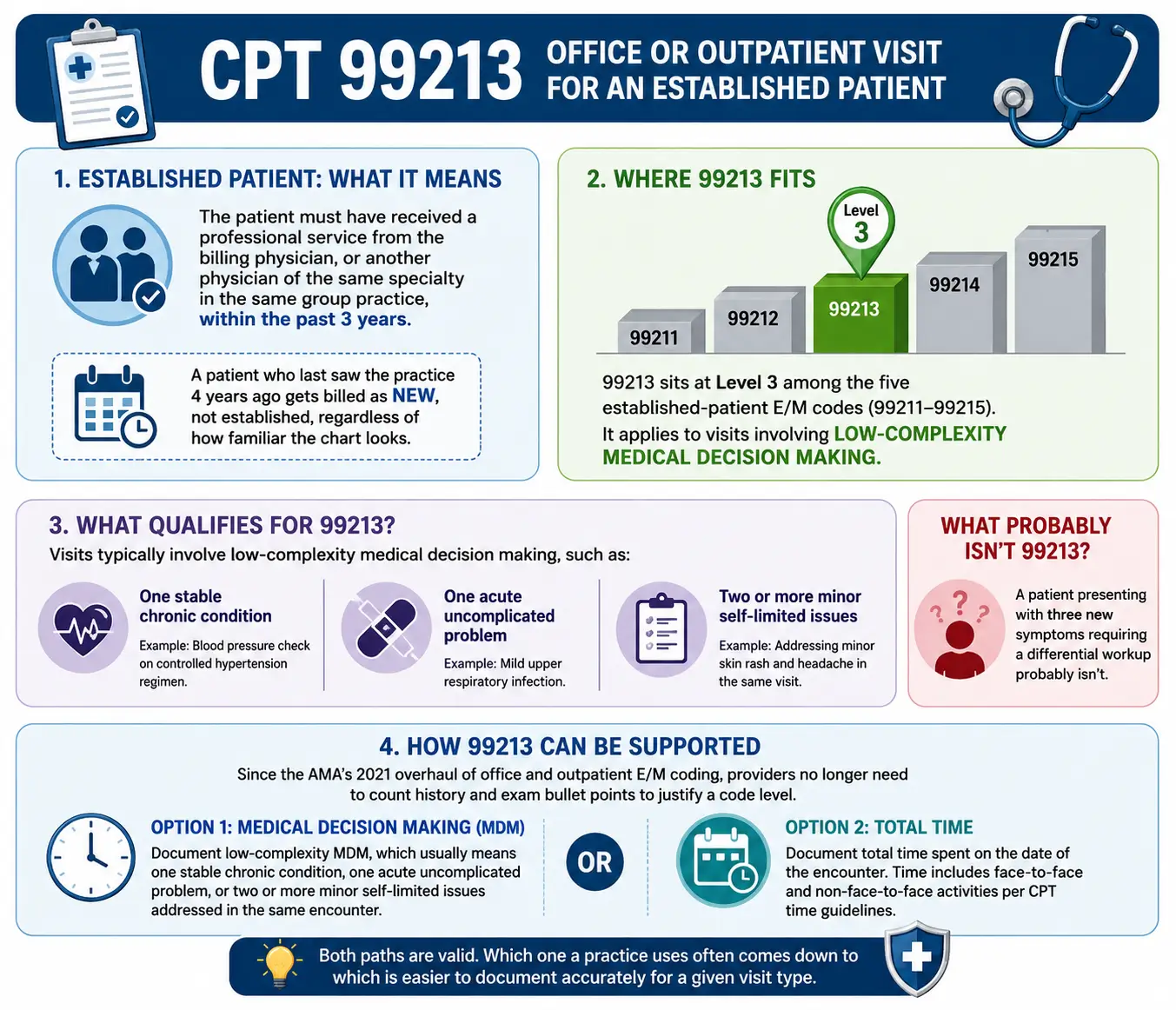
CPT 99213 describes an office or outpatient visit for an established patient. “Established” has a specific meaning under CPT rules: the patient must have received a professional service from the billing physician, or another physician of the same specialty in the same group practice, within the past three years. A patient who last saw the practice four years ago gets billed as new, not established, regardless of how familiar the chart looks.
The code sits at level 3 among the five established-patient E/M codes (99211 through 99215). It applies to visits involving low-complexity medical decision making, which usually means one stable chronic condition, one acute uncomplicated problem, or two or more minor self-limited issues addressed in the same encounter. A patient coming in for a blood pressure check on a controlled hypertension regimen is a textbook example. A patient presenting with three new symptoms requiring a differential workup probably isn’t.
Since the American Medical Association’s 2021 overhaul of office and outpatient E/M coding, providers no longer need to count history and exam bullet points to justify a code level. Instead, 99213 can be supported through medical decision making or through total time spent on the date of the encounter. Both paths are valid. Which one a practice uses often comes down to which is easier to document accurately for a given visit type.
Medical decision making: the low-complexity threshold
To support 99213 through MDM, the note needs to meet at least two of three elements at the low-complexity level:
- Problems addressed: two or more self-limited or minor problems, one stable chronic illness, or one acute uncomplicated illness or injury.
- Data reviewed and analyzed: a limited amount, generally falling into just one category, such as reviewing a single prior test result or ordering one lab panel.
- Risk of complications: low risk from the condition itself, the tests ordered, or the treatment plan, such as an over-the-counter medication or a minor adjustment to an existing prescription.
The MDM path fails most often because the note doesn’t show the reasoning behind the decision, only the decision itself. Writing “hypertension, continue lisinopril” documents an action, not medical decision making. A stronger note states what was reviewed, what was considered, and why the plan was chosen: “Blood pressure log reviewed, averaging 128/82 over the past two weeks. Continue lisinopril 10mg, patient tolerating well, no adjustment needed at this time.” That single sentence establishes data review, a stable chronic condition, and low risk, all three elements auditors look for even though only two are required.
Time-based billing: what counts and what doesn’t
The alternative path is total time. Under the current guidelines, 99213 corresponds to 20 to 29 minutes of total time spent by the billing provider on the date of the encounter. This includes face-to-face time with the patient as well as non-face-to-face work performed that same day: reviewing prior records before the visit, ordering or interpreting tests, documenting the encounter, and coordinating referrals or follow-up care.
Time spent by clinical staff generally doesn’t count toward the provider’s total unless the provider is directly supervising that work. Time spent on a different date, even if it relates to the same episode of care, doesn’t count either. A note that says “20 minutes spent with patient” without specifying what activities filled that time is weak support if a payer requests records; auditors want to see the components broken out, even briefly.
A well-documented time statement looks like this: “Total time on date of encounter: 24 minutes, including chart review, history, examination, and counseling on medication adherence.” That sentence alone satisfies the requirement. Vague phrasing such as “spent adequate time with patient” satisfies nothing.
One practical note: if a visit runs under 20 minutes, it likely belongs under 99212, not 99213. If it runs past 29 minutes with more complex decision making, 99214 is usually the more defensible choice. Coding down to avoid scrutiny is just as much a compliance risk as coding up, because it misrepresents the actual complexity of care delivered.
Documentation elements payers expect to see
Beyond the MDM or time justification itself, a complete 99213 note typically includes:
- A clearly stated chief complaint in the patient’s own words or a close paraphrase.
- A history of present illness relevant to that complaint, even if brief.
- A medically appropriate exam, scoped to the presenting problem rather than a head-to-toe review for a routine follow-up.
- An assessment that names the condition(s) addressed, not just a diagnosis code.
- A plan with specific next steps: medication changes, orders placed, follow-up interval, or referrals made.
Missing any one of these doesn’t automatically trigger a denial, but it weakens the note if a payer pulls it for review. Reviewers are trained to match the documented complexity against the billed code level, and a chart that reads like a checklist without clinical reasoning tends to get flagged even when the coder picked the right level.
Why 99213 claims get denied
Most 99213 denials trace back to a handful of recurring issues rather than exotic payer edge cases.
Insufficient support for the code level. This is the most common reason. The note describes a visit that reads more like a 99212 (very brief, minimal decision making) or doesn’t clearly meet either the MDM or time threshold for 99213. Payers compare the billed code against what the documentation actually supports, and a mismatch results in downcoding or outright denial.
Missing or incorrect modifier 25. When a minor procedure is performed on the same date as the E/M visit, such as a joint injection or a simple wound repair, modifier 25 must be appended to the E/M code to indicate that a significant, separately identifiable service was provided beyond the procedure itself. Without it, payers assume the office visit was bundled into the procedure’s global period and deny the E/M line outright. The documentation still needs to justify that separate service; simply appending the modifier without supporting notes invites an audit.
Time and MDM inconsistency. Some notes document both time and MDM elements that point to different code levels, for example 35 minutes of total time (which would support 99214) paired with MDM documentation that only supports low complexity. Payers and auditors flag these mismatches because they suggest the note was templated rather than written to reflect the actual encounter.
Frequency and medical necessity questions. For patients with chronic conditions, CPT code 99213 is often billed repeatedly over multiple follow-up visits as part of ongoing disease management. While this is appropriate when medically necessary, payers may scrutinize frequent claims tied to the same diagnosis if the documentation appears repetitive or unchanged. Even for clinically stable patients, each encounter should include individualized documentation that reflects the patient’s current status, assessment, and management to help support the medical necessity of the service.
Established patient status errors. Billing 99213 for a patient who hasn’t been seen by the practice or a same-specialty colleague within three years results in denial, since that visit should have been billed as new (99202-99205).
99213 compared with 99212 and 99214
99212 | 99213 | 99214 | |
Complexity | Straightforward | Low | Moderate |
Typical time | 10-19 minutes | 20-29 minutes | 30-39 minutes |
Problems addressed | 1 minor, self-limited | 1 stable chronic OR 1 acute uncomplicated OR 2+ minor | 1+ chronic with exacerbation, OR 2+ stable chronic, OR new problem with uncertain prognosis |
Data reviewed | Minimal | Limited, one category | Moderate, two or more categories |
Work RVU | 0.70 | 1.30 | 1.92 |
Work RVU values come from the CMS Physician Fee Schedule relative value files. Under the 2026 fee schedule, the national average non-facility Medicare payment for 99213 is approximately $95.19, compared to roughly $131.45 for 99214, a difference of about 43% per visit. Facility-setting payments are lower for both codes since the practice expense component shifts to the facility. These figures move slightly each year with the annual conversion factor and are further adjusted by geographic practice cost indices, so the exact payment in any given locality will differ from the national average.
The gap between 99213 and 99214 explains why accurate leveling matters financially, but it cuts both directions. Upcoding to 99214 without documentation to support moderate complexity creates audit exposure. Conservatively reporting 99213 when the encounter actually involved a new problem or a chronic condition with an exacerbation can result in lost reimbursement and fail to reflect the true complexity of the care provided.
Telehealth and 99213
CPT 99213 remains billable for telehealth encounters when the same MDM or time documentation standards are met. Claims typically require the appropriate place of service code, generally POS 02 for telehealth provided from the patient’s home or POS 10 depending on payer rules, along with modifier 95 to indicate a synchronous audio-video encounter. Time-based documentation for telehealth should specify what portion of the visit was spent on evaluation and counseling, since payers reviewing virtual visits pay particular attention to whether the encounter substituted meaningfully for an in-person visit or fell short of it.
A quick pre-submission checklist
Before submitting a 99213 claim, it helps to confirm:
- The patient qualifies as established under the three-year rule.
- Either the MDM or time-based coding criteria must be explicitly documented, not assumed.
- The assessment names the specific condition(s) addressed and reflects genuine reasoning, not just a diagnosis label.
- Modifier 25 is appended and supported whenever a same-day procedure was also billed.
- Time statements, if used, specify the total minutes and the activities that filled them.
- The note’s complexity matches the code level billed, without contradictory signals between time and MDM sections.
None of these steps take more than a minute or two of extra documentation time, but each one closes a gap that payers are specifically trained to look for. Practices that build this checklist into their workflow, rather than relying on coders to catch it after the fact, tend to see denial rates on 99213 claims drop within the first billing cycle or two.
CPT code 99213 will keep functioning as the workhorse code for routine follow-up care across primary care and specialty practices alike. Getting the documentation right the first time, rather than appealing denials after the fact, is the difference between a clean revenue cycle and a backlog of resubmissions.