



Common Mistakes to Avoid When Using the 99211 CPT Code
CPT code 99211 pays less than any other code in the office visit family, yet it shows up on audit worksheets far more often than its low dollar value would suggest. Payers watch it closely, and compliance officers flag it routinely. Front-desk staff and clinical teams often treat it as an automatic add-on for any nurse-led encounter, which is how a small billing habit turns into a repayment demand once a payer pulls two years of charts. The code covers a visit for an established patient that clinical staff can carry out without a physician standing in the room, and that flexibility is exactly why it gets misused so often. What follows are the mistakes that show up repeatedly in real denials and audit findings, along with what the rules behind the 99211 CPT code actually require.
What the 99211 CPT code covers, and what changed in 2021
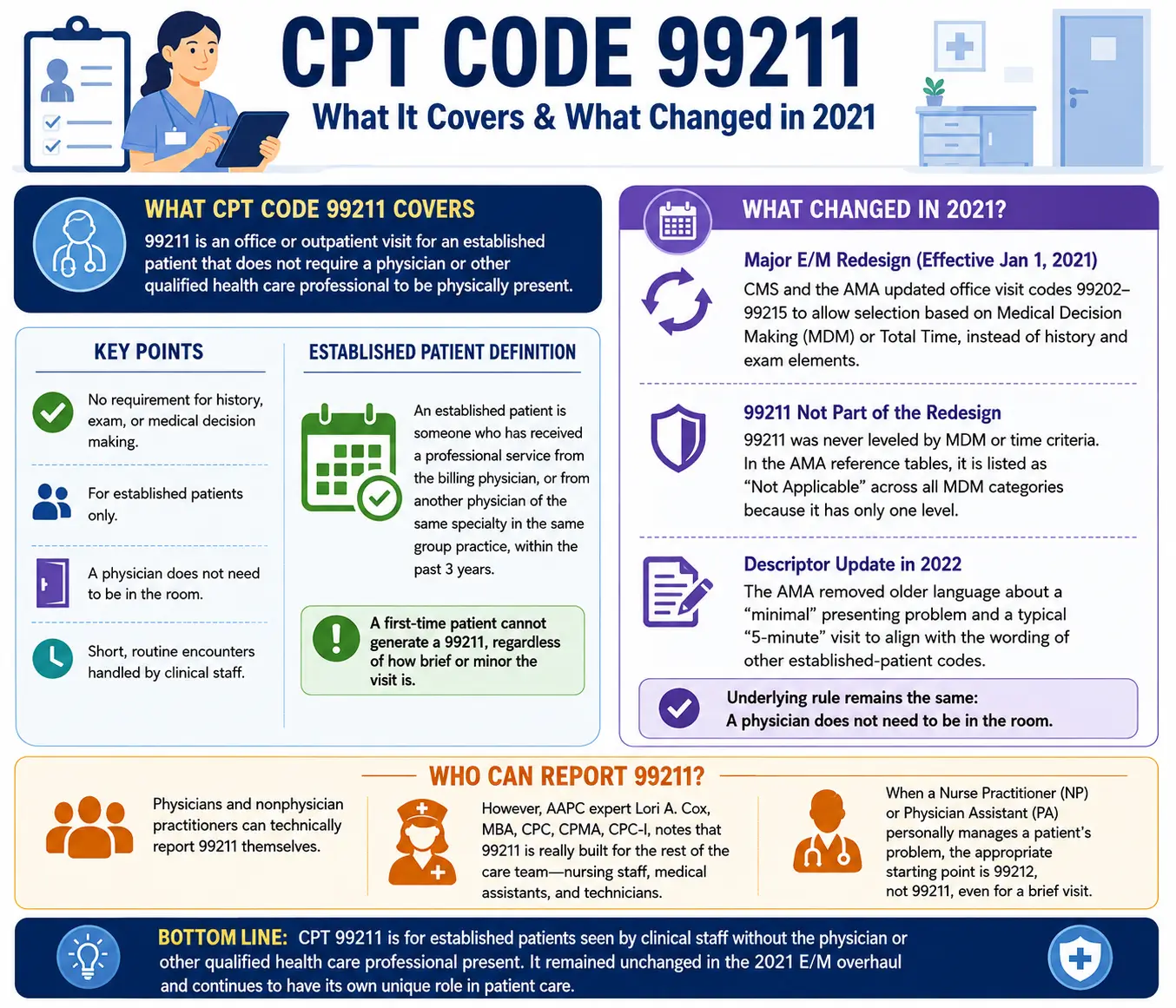
The American Medical Association’s CPT code set defines 99211 as an office or outpatient visit for an established patient that does not require a physician or other qualified health care professional to be physically present. That’s the entire definition. Unlike 99212 through 99215, it carries no requirement tied to history, exam, or medical decision making, which is what sets it apart from the rest of the family.
An established patient, under CPT’s own rule, is someone who has received a professional service from the billing physician, or from another physician of the same specialty in the same group practice, within the past three years. A first-time patient cannot generate a 99211, regardless of how brief or minor the visit is.
When CMS and the AMA rebuilt the office visit E/M codes for January 1, 2021, letting physicians select 99202 through 99215 by medical decision making or total time instead of counting history and exam elements, 99211 sat outside the redesign. It was never leveled by those criteria, and the reference tables published for the rollout list it as “not applicable” across every category of medical decision making, since the code has exactly one level to begin with. Pabau’s 2026 coding guide notes that the AMA later trimmed the descriptor further, in 2022, dropping older language about a “minimal” presenting problem and a typical five-minute visit, to match the wording of the rest of the established-patient codes. The underlying rule never moved: a physician does not need to be in the room.
Physicians and nonphysician practitioners can technically report 99211 themselves, but AAPC Services director Lori A. Cox, MBA, CPC, CPMA, CPC-I, notes that the code is really built for the rest of the care team, nursing staff, medical assistants, and technicians, since a physician-led visit almost always meets the criteria for a higher level anyway. When a nurse practitioner or physician assistant personally manages a patient’s problem, the appropriate starting point is 99212, not 99211, even for a brief encounter.
Mistake 1: Billing 99211 for tasks that were never an evaluation
The most common error treats 99211 as a fee for showing up rather than a fee for an evaluation. A patient walks in only to have blood drawn, and 99211 gets added out of habit. Medicare’s National Correct Coding Initiative has bundled routine venipuncture, CPT 36415, with 99211 since at least 2014, when NCCI version 20.1 formally paired the two codes, according to AAPC coding editor Erica T. Cousin, CPC, CPC-I. The same logic applies to injections: if the entire visit consists of a scheduled shot, the administration code already covers the brief clinical check that comes with it, and adding 99211 on top, without a distinct and separately documented reason, creates a bundling conflict instead of extra revenue.
Noridian, the Medicare Administrative Contractor for several western states, states this plainly: when a visit’s sole purpose is a blood draw or an injection, only the corresponding procedure code applies, and 99211 does not. It becomes appropriate again once clinical staff do something beyond the procedure itself, such as reviewing how a patient is tolerating a medication, assessing a new symptom, or acting on an adjustment a physician has already authorized.
A test several coding auditors use is simple enough to apply during a chart review: would this encounter have generated a bill on its own if the procedure had never happened? If the answer is no, 99211 does not belong on the claim.
Mistake 2: Treating incident-to supervision as a formality
Nearly every 99211 claim performed by a nurse, medical assistant, or technician depends on Medicare’s incident-to rules, and those rules leave little room for interpretation on supervision. Chapter 15, Section 60 of the Medicare Benefit Policy Manual requires a supervising physician or nonphysician practitioner, which can include a nurse practitioner, physician assistant, certified nurse-midwife, or clinical nurse specialist, to be immediately available in the office suite for the entire time the service is furnished. That supervisor does not need to be the physician who first treated the patient; in a group practice, any physician sharing supervisory responsibility for the plan of care can fill the role. Being three blocks away, across the street, or reachable only by phone does not satisfy the requirement, no matter how quickly someone could respond.
Two further conditions trip up practices almost as often. The visit has to follow a plan of care the supervising clinician already put in place; incident-to does not stretch to cover a new problem or a new medication decision made solely by clinical staff. And the supervising clinician has to stay actively involved over time, seeing the patient with enough frequency to show real ongoing management rather than one initial visit followed by months of nurse-only encounters.
One part of the rule did loosen recently. In the CY 2026 Medicare Physician Fee Schedule final rule, issued October 31, 2025, CMS made virtual direct supervision permanent for lower-risk services, 99211 among them, so the “immediately available” requirement can now be met through real-time audio and video rather than physical presence. That is a different question from whether the 99211 visit itself can be delivered by telehealth. Medicare and some commercial payers do allow a synchronous video 99211 encounter with modifier 95 attached, but coverage depends on the payer, and treating the supervision rule and the telehealth-delivery rule as the same thing is its own path to a denial.
Mistake 3: Documentation that proves a task instead of a service
A large share of 99211 claims get reversed on audit not because the visit was inappropriate, but because the note never shows that an evaluation happened. A chart entry reading “BP 128/82, patient left” or “B12 injection given” documents a procedure, not a level 1 evaluation and management service. This pattern, a note that records only the task with no assessment or management language, is one of the most frequent reasons cited when 99211 claims are recouped after payer review.
Two scenarios make the distinction concrete. Noridian’s provider guidance notes that anticoagulation monitoring, a routine INR check for a patient on warfarin, for example, can support 99211 when the physician has documented a medically necessary decision to change or maintain the medication dose, even though a nurse is the one who relays that decision to the patient. What matters is not whether the dose changes. What matters is whether the decision comes from the supervising physician rather than from clinical staff acting on their own judgment.
AAPC’s coding education materials, written by Karla M. Hurraw, CPC, CCS-P, walk through where that line gets crossed. In one example, a nurse performs a urinalysis for a patient with urinary symptoms, relays the results to the physician, and calls in a new prescription without the physician seeing the patient. That fails incident-to on two counts: there is no existing written plan of care for this specific problem, and the medication decision was never the physician’s own documented call. Only the urinalysis is billable in that case; 99211 is not.
A defensible note generally covers four things: the reason for the visit, what the staff member observed or reviewed, any action taken, and the name of the supervising clinician who was available during the encounter. A vital sign by itself satisfies none of them.
Mistake 4: Assuming federal billing rules override state scope of practice
Incident-to is a Medicare billing concept. It says nothing about what a given staff member is legally permitted to do to a patient, and that distinction gets lost more often than it should. A medical assistant can satisfy every incident-to requirement on paper and still be performing a task their state does not allow them to perform.
The American Association of Medical Assistants, whose legal counsel, Donald A. Balasa, JD, MBA, has written extensively on this issue, points out that medical assistants are classified as unlicensed personnel in most states, meaning their scope of practice comes from state delegation law and training requirements rather than from a professional license. California requires documented training hours before a medical assistant may give injections or draw blood; other states set no comparable threshold at all. A practice that lets an undertrained assistant handle the clinical portion of a 99211 visit is exposed twice over: once as a Medicare compliance problem if audited, and again as a state licensing or liability problem regardless of what Medicare decides. Check the delegating state’s rules before billing 99211 for work performed by a medical assistant, not just CMS’s.
Mistake 5: Getting modifier 25 backwards
Modifier 25 tells a payer that the E/M work done that day was real and separate from the procedure performed, not just the routine evaluation baked into it. It belongs on the E/M code, never on the procedure, and it should not be a reflex addition every time 99211 shares a claim with something else. This is a common coder error, according to Pabau’s 2026 billing guidance: appending modifier 25 without documentation to support a distinct service tends to trigger claim review rather than added payment. Some payer bulletins spell out related restrictions directly. Health Net’s provider guidance, for example, lists vaccine administration codes among the services that cannot be billed alongside 99211 without a separately documented reason.
CMS’s National Correct Coding Initiative guidance confirms that a separate E/M service can share the same diagnosis code as the procedure it accompanies. What decides the question is whether the documentation shows distinct evaluation work, not whether two different diagnosis codes appear on the claim. The table below shows how that plays out in practice.
|
Scenario |
Bill 99211? |
Reason |
|
Patient comes in only to have blood drawn |
No |
Venipuncture code 36415 covers the encounter; no separate evaluation occurred |
|
Patient on a physician-directed anticoagulation protocol has a routine INR check, with a documented physician decision to change or maintain the dose |
Often, yes |
Falls within an established plan of care that incident-to allows |
|
Nurse checks blood pressure at a scheduled follow-up and records a stable reading, no action taken |
No |
A reading by itself is not an evaluation or a management decision |
|
During a scheduled allergy injection, the patient reports a new reaction; the nurse assesses it and the physician adjusts the plan |
Yes, with modifier 25 |
A distinct, medically necessary E/M service occurred alongside the injection |
Practices billing Medicare should also check whether add-on code G2211 applies. CMS pairs G2211 with any office or outpatient E/M code, 99211 included, when the billing clinician serves as the ongoing focal point for a patient’s care or manages a single complex condition over time. The catch is that G2211 tracks the relationship, not the visit’s complexity, so a brief nurse visit inside an established longitudinal care relationship can technically qualify, while a one-off visit for an unattached patient cannot, whatever the 99211 note itself says.
What thin margins mean for audit exposure
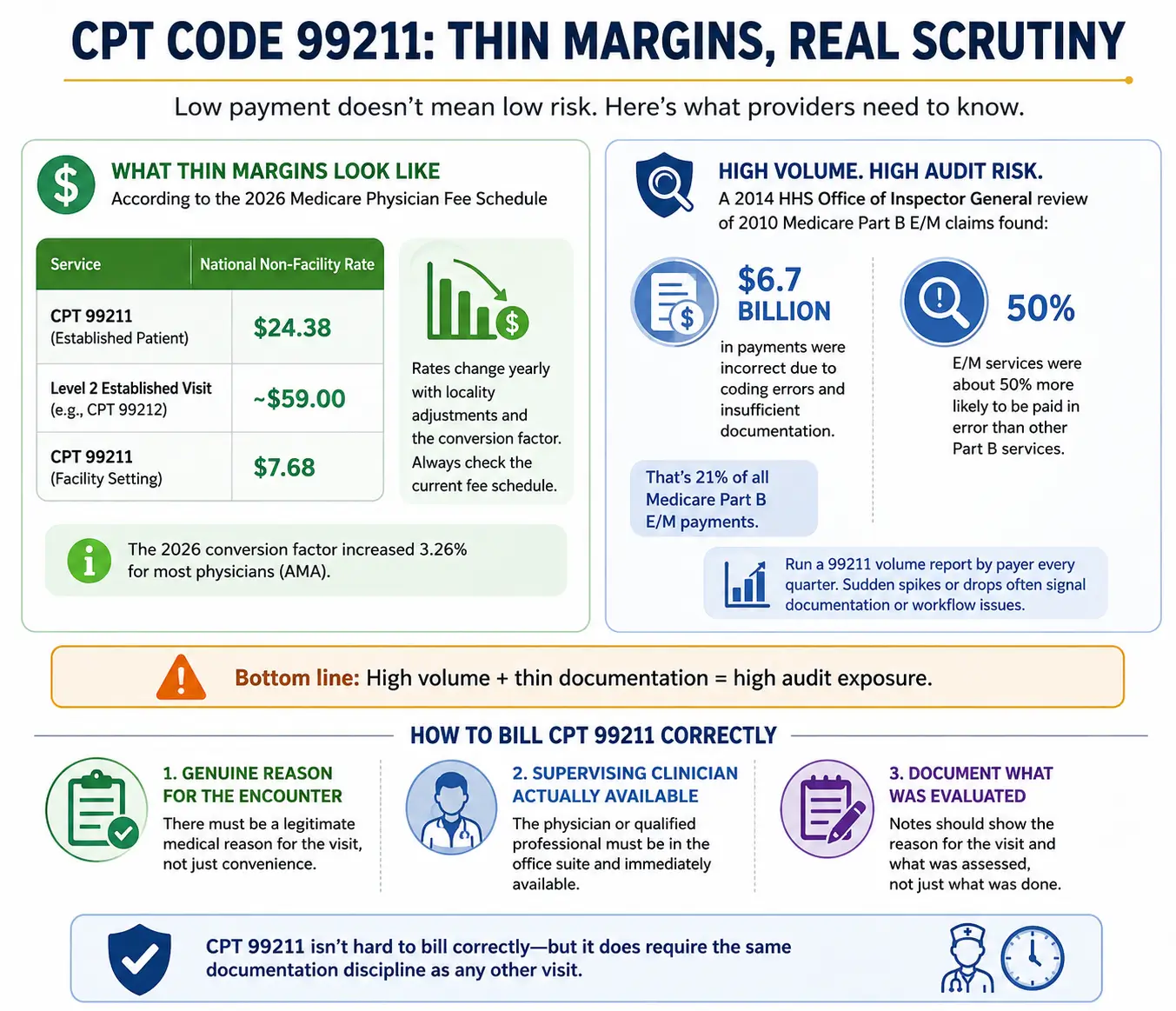
CPT code 99211 pays less than any other E/M code by a wide margin. Calculations published by MedFeeSchedule, based on the 2026 Medicare Physician Fee Schedule, put the national non-facility rate at $24.38, against roughly $59 for a level 2 established-patient visit, with the 99211 rate dropping to $7.68 in a facility setting. Those figures move every year with locality adjustments and the annual conversion factor, which the AMA reports rose 3.26 percent for most physicians in 2026, so a practice checking its own numbers should pull the current fee schedule rather than rely on a national average.
Low dollar value does not mean low scrutiny. A 2014 review by the HHS Office of Inspector General, examining 2010 Medicare Part B claims across the entire evaluation and management category, found that incorrect coding and insufficient documentation accounted for $6.7 billion in payments that year, 21 percent of everything Medicare paid for E/M services. The same report cited CMS’s own error-rate testing program, which found E/M services roughly 50 percent more likely to be paid in error than other Part B services. That review predates the current 99211 rules, but the pattern it describes, high volume paired with thin documentation, is exactly what keeps this code on audit lists today. Several billing platforms now recommend running a 99211 volume report by payer every quarter, since a sudden spike or drop is usually the first sign of a workflow or documentation problem worth catching early.
None of this makes the 99211 CPT code hard to bill correctly, but it does mean treating a five-minute nurse visit with the same documentation discipline as a longer one: a genuine reason for the encounter, a supervising clinician who was actually available, and a note that shows what was evaluated rather than only what was done.