


CPT Code 99215 Audit Risks and Compliance Best Practices (2026)
Physicians and medical coders use CPT code 99215 to report the most complex evaluation and management (E/M) visits for established patients in an office setting. Because this code generates the highest relative value units (RVUs) in its category, Medicare Administrative Contractors (MACs) and private insurance companies monitor its usage heavily. Claims face high denial and post-payment recoupment rates when clinical documentation lacks the detail required to justify the payment. Protecting practice revenue requires strict compliance with exact billing parameters.
To ensure proper payment, clinical documentation must accurately reflect either the exact time spent managing the patient’s care or the high complexity of the medical decisions made by the provider.
Current requirements for billing a level 5 office visit
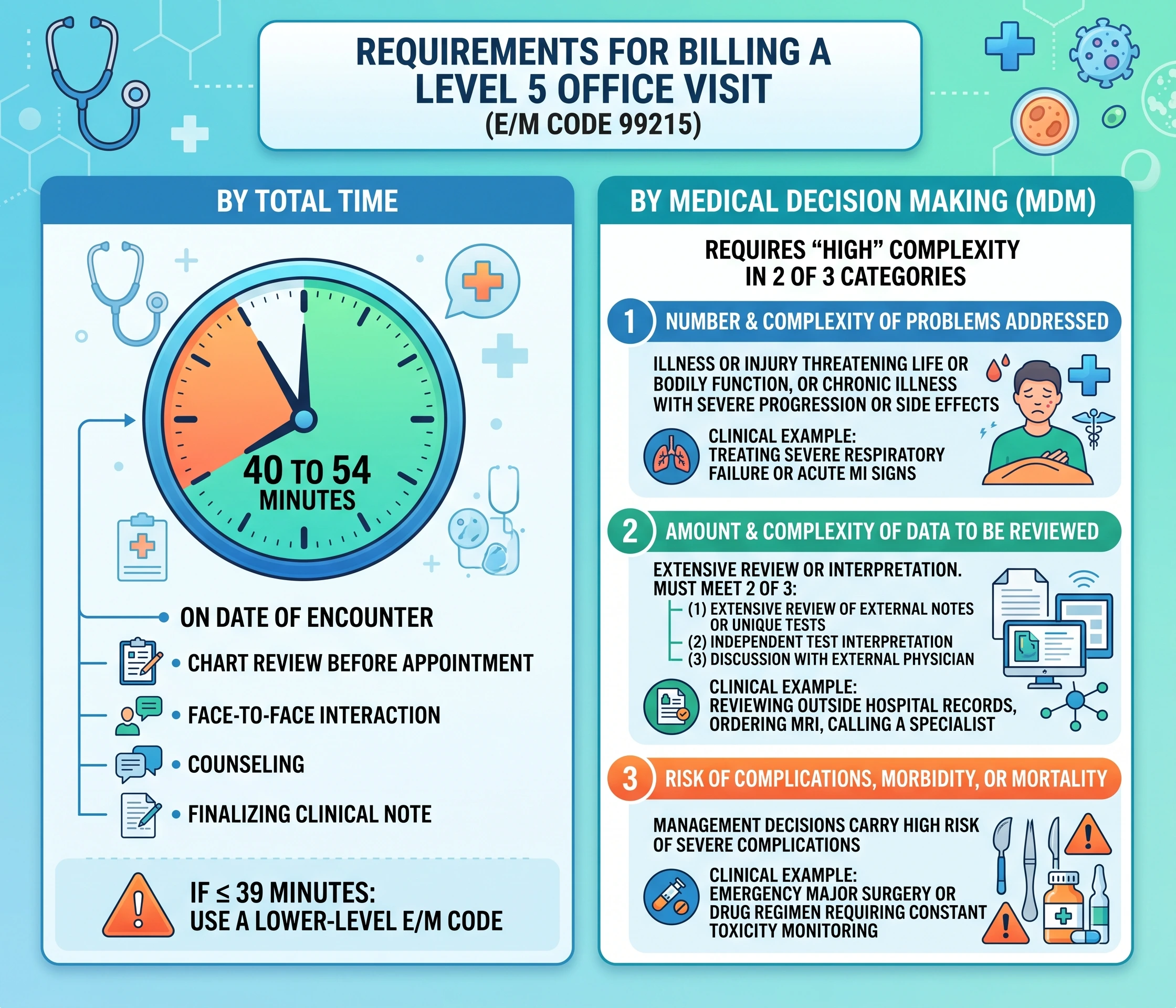
Providers secure payment for a level 5 visit through one of two methods: total time or medical decision making (MDM).
When calculating time, the physician must spend between 40 and 54 minutes on patient care during the exact date of the encounter. This total includes reviewing charts before the appointment, face-to-face interaction, counseling, and finalizing the clinical note. Encounters lasting 39 minutes or less require a lower-level E/M code.
Alternatively, providers can bill based on MDM. The American Medical Association (AMA) requires the encounter to reach a “high” level of complexity in two out of three specific categories:
|
MDM Element |
Criteria for High Complexity |
Clinical Example |
|
Number and complexity of problems addressed |
The patient has an illness or injury threatening life or bodily function, or a chronic illness experiencing severe progression or side effects. |
Treating a patient experiencing severe respiratory failure or acute signs of a myocardial infarction. |
|
Amount and/or complexity of data to be reviewed and analyzed |
The provider must meet two of three requirements: (1) extensive review of external notes or unique tests, (2) independent test interpretation, or (3) discussion with an external physician. |
Reviewing extensive records from an outside hospital, ordering new MRI scans, and calling a specialist to discuss the case. |
|
Risk of complications, morbidity, or mortality |
The management decisions carry a high risk of severe complications to the patient. |
Deciding to proceed with emergency major surgery or initiating a drug regimen that requires constant monitoring for high toxicity. |
Major audit risks and compliance strategies
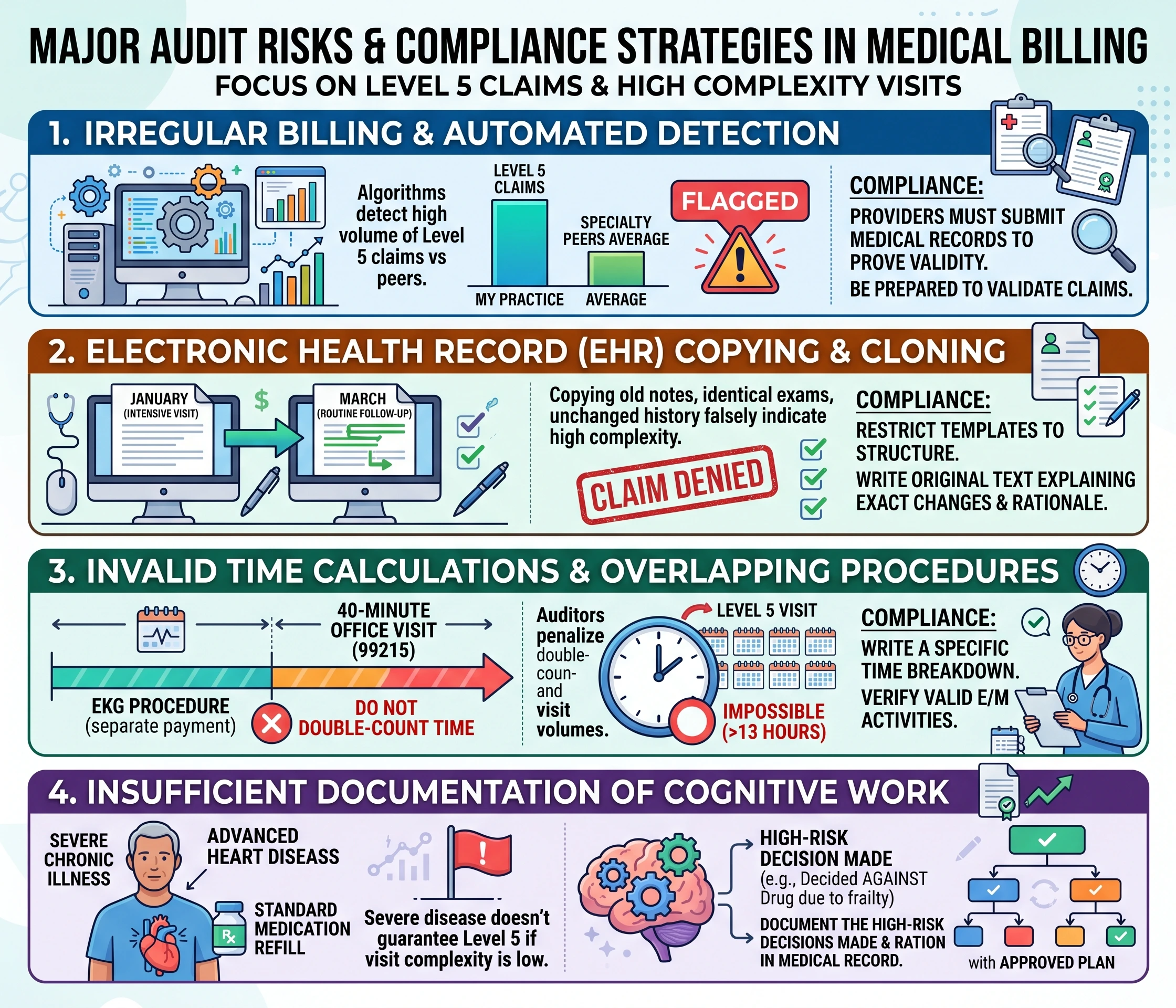
Health insurance payers run automated algorithms to detect irregular billing habits. These systems flag providers who submit a higher volume of level 5 claims compared to other physicians in the exact same medical specialty. Once flagged, the provider must submit medical records to prove the claims were valid.
Electronic health record copying and cloning
The Department of Health and Human Services Office of Inspector General (OIG) actively investigates practices that abuse electronic health record (EHR) features. Copying previous notes and pasting them into new encounters is a major compliance failure.
Auditors deny claims when they see identical physical exam findings or unchanged patient histories across multiple dates of service. If a physician copies text from an intensive visit in January and pastes it into a routine follow-up in March, the March documentation falsely indicates a high level of complexity.
Every note must reflect the specific work performed on that exact day. Clinics must restrict the use of templates to structural formatting only. The physician must type original text explaining the exact changes in the patient’s symptoms and the specific reasons for the current treatment plan.
Invalid time calculations and overlapping procedures
Auditors frequently penalize practices for double-counting time. If a provider performs an electrocardiogram (EKG), they receive separate payment for that specific procedure. The time spent administering and reviewing that EKG cannot count toward the 40-minute threshold for the 99215 office visit.
Additionally, auditors look for mathematical impossibilities. If a physician bills twenty level 5 visits based on time in a single day, they are claiming over 13 hours of continuous face-to-face and administrative work. This pattern triggers immediate fraud investigations.
Medical coders must verify that the documented time includes only valid E/M activities. The physician should write a specific breakdown in the chart. A compliant note should state exactly how the time was spent, such as noting 15 minutes reviewing external lab results, 20 minutes examining the patient, and 7 minutes coordinating care with a physical therapist.
Insufficient documentation of cognitive work
A patient with a severe chronic illness does not automatically generate a level 5 visit. If a patient with advanced heart disease comes in for a standard medication refill and reports no new symptoms, the cognitive work for that specific visit remains low or moderate.
The clinical documentation must explain the high-risk decisions made during that exact appointment. If a physician decides against prescribing a high-risk medication because the patient is too frail, that thought process represents high medical decision making. The provider must write this exact rationale into the medical record to survive an audit.
Medical necessity dictates payment
According to the CMS Medicare Claims Processing Manual, medical necessity dictates payment regardless of the specific CPT code requirements. The volume of text inside the patient chart does not guarantee a higher payment.
An EHR system might automatically generate six pages of imported lab results and past medical history. If the patient presented for a minor ankle sprain, the sheer volume of the text will not protect the claim. Auditors assess whether the intensity of the evaluation matched the severity of the patient’s presenting problem. A level 5 visit requires a clinical scenario that genuinely demands intense medical management.
Internal chart reviews protect revenue
According to guidance published by the American Academy of Professional Coders (AAPC), clinics must conduct routine internal reviews to catch errors before insurance payers do.
- Establish consistent audit schedules. Clinics should review 10 to 15 encounters per physician on a quarterly basis.
- Use certified auditors. Certified Professional Coders (CPC) or Certified Professional Medical Auditors (CPMA) should conduct the reviews to ensure an objective analysis of the billing patterns.
- Investigate internal outliers. If a clinic manager notices a specific physician bills level 5 codes at triple the rate of their peers, the coding staff must pull those specific charts for immediate evaluation.
- Conduct pre-bill reviews. Many practices require a coder to review every single level 5 encounter before the claim goes to the clearinghouse. If the chart lacks sufficient detail, the coder downgrades the claim to a 99214 prior to submission.
Accurate billing for complex established patient visits requires precise tracking of time and clear explanations of clinical decisions. Healthcare facilities protect their revenue by auditing claims internally, avoiding copied text, and ensuring the documentation matches the actual medical necessity of the encounter.