


The 99205 CPT code describes a new-patient office or other outpatient evaluation and management visit selected through high-complexity medical decision making (MDM) or qualifying total practitioner time. These are alternative methods. A visit does not have to satisfy both.
That distinction affects everyday coding. A shorter encounter may support 99205 through high MDM, while a longer, medically necessary encounter may qualify through time even when its decision making is moderate. The documentation must support the method used. The American Academy of Family Physicians explains this framework in The 2021 Office Visit Coding Changes: Putting the Pieces Together, written by Carol Self, Kent Moore, and Samuel L. Church in November/December 2020.
What does the 99205 CPT code mean?
99205 belongs to the new-patient office/outpatient E/M family. It requires a medically appropriate history and/or examination, with the service level determined through MDM or time.
| CPT code | Patient status | MDM level when selected by MDM | Minimum time when selected by time |
|---|---|---|---|
| 99204 | New | Moderate | 45 minutes |
| 99205 | New | High | 60 minutes |
| 99215 | Established | High | 40 minutes |
Older coding references describe 99205 as a 60–74-minute service. Beginning in 2024, CPT changed office/outpatient time descriptors to minimum thresholds. For 99205, the practitioner must meet or exceed 60 minutes when selecting the code by time. Prolonged-service reporting has additional rules.
The American College of Surgeons describes that revision in its January 2024 Bulletin article, “New 2024 CPT Coding Changes Affect General Surgery, Related Specialties.”
Confirm that the patient qualifies as new
A first visit to a particular office does not necessarily establish new-patient status.
Under CPT guidelines, a new patient has not received professional services during the preceding three years from the reporting physician or qualified healthcare professional, or another practitioner of the exact same specialty and subspecialty in the same group.
Medicare’s Claims Processing Manual, Chapter 12, section 30.6.7, uses a three-year test involving the physician or same-specialty group practice. It also clarifies that a diagnostic interpretation without an E/M or other face-to-face service does not, by itself, establish the patient.
Consider two hypothetical situations:
- A patient saw another cardiologist in the same group last year and now schedules with a different cardiologist of the same specialty. The change of clinician does not automatically make the patient new.
- A radiologist previously interpreted an image without seeing the patient. That interpretation alone does not necessarily prevent a later qualifying new-patient encounter.
Check prior professional services before choosing the code family. A new diagnosis, insurance plan, or office address does not independently reset the three-year period.
How the 99205 time requirement works
Time-based selection counts qualifying work personally performed by the physician or other qualified healthcare professional on the encounter date. It includes both patient-facing work and eligible work performed before or after the appointment.
The American College of Surgeons’ online guidance, “Time,” describing the rules effective in 2021, explains that counseling does not need to occupy most of the encounter for time-based coding.
Activities that count
Eligible activities include:
- Reviewing records and preparing for the encounter.
- Obtaining or reviewing the patient’s history.
- Performing the examination and evaluation.
- Counseling the patient, family, or caregiver.
- Ordering medications, tests, or procedures.
- Communicating with other professionals when not separately reported.
- Documenting the encounter.
- Performing eligible care coordination.
Thomas Weida and Jane Weida describe these activities in “Outpatient E/M Coding Simplified,” published in the AAFP’s FPM in January/February 2022.
Activities that do not count
Exclude clinical staff time, work on a different calendar date, and time attributable to separately reported services. A scheduled appointment length does not establish actual practitioner time.
For example, a hypothetical encounter includes 12 minutes of same-day record review, 38 minutes evaluating and counseling the patient, and 15 minutes completing orders and documentation. The qualifying total is 65 minutes.
Assuming medical necessity and new-patient status, that total supports 99205 through time. However, if the 12-minute review occurred the previous evening, only 53 minutes remain for this encounter’s time calculation. The practitioner would need another supported basis to report 99205.
What qualifies as high-complexity medical decision making?
MDM evaluates three elements:
- Problems addressed.
- Data reviewed and analyzed.
- Risk associated with patient management.
At least two of the three elements must reach the high level. A serious diagnosis alone does not establish high MDM. The AMA’s online CPT Evaluation and Management Revisions FAQs, accessed October 13, 2026, confirms the two-element requirement.
Problems and management risk
High-level problems can include severe worsening of chronic illness or an illness or injury threatening life or bodily function.
Examples of high management risk include decisions about hospitalization, emergency major surgery, or drug treatment requiring intensive toxicity monitoring. Routine prescription management does not automatically meet that standard.
A hypothetical patient with severe deterioration requiring hospitalization could support high problem complexity and high management risk. The note should describe the deterioration and explain the hospitalization decision.
Data requirements
High data complexity requires qualifying work in at least two of three categories: tests/documents/independent historian, independent test interpretation, and discussion with an external professional or appropriate source. The first category has its own three-item requirement.
Simply ordering several tests does not satisfy two categories. Nor does reading a radiology report automatically establish independent interpretation. Document the actual analytical work.
The AMA also cautions that management risk depends on the patient-specific decision. A procedure’s ordinary risks do not automatically make every related encounter high risk.
Documentation requirements for 99205
The record should make the clinical encounter understandable and show why the selected billing method applies.
CMS’s May 2026 Evaluation and Management Services booklet identifies core documentation elements: the encounter reason, relevant history and findings, assessment, care plan, and support for reported diagnosis and treatment codes.
When using medical decision making
Write the assessment and plan so another reader can follow the decisions:
- Describe the status of conditions actually addressed.
- Identify records, tests, and external discussions used.
- Explain treatment choices and relevant patient-specific risks.
- Record the reasoning behind escalation or decisions to defer intervention.
Avoid expecting a diagnosis list to communicate this work. “High complexity” is a conclusion; the clinical details provide its support. The AMA’s FAQs distinguish the risk of a condition from the management decisions made during the reported encounter.
When using time
Record the actual qualifying total and the activities it represents. An illustrative statement might read:
Total practitioner time on the encounter date was 65 minutes, including record review, evaluation, counseling, orders, and documentation. Separately reported services were excluded.
This is an example, not language to insert automatically.
A minute-by-minute breakdown can help explain a complicated encounter, but the central requirement is a supported total. Avoid copying the same duration into every note without verifying it.
History and examination remain clinically necessary as appropriate, but their length does not determine the office E/M level. The AAFP’s 2022 guidance specifically explains the removal of history and examination bullet counting from level selection.
Prolonged services: 99417 versus G2212
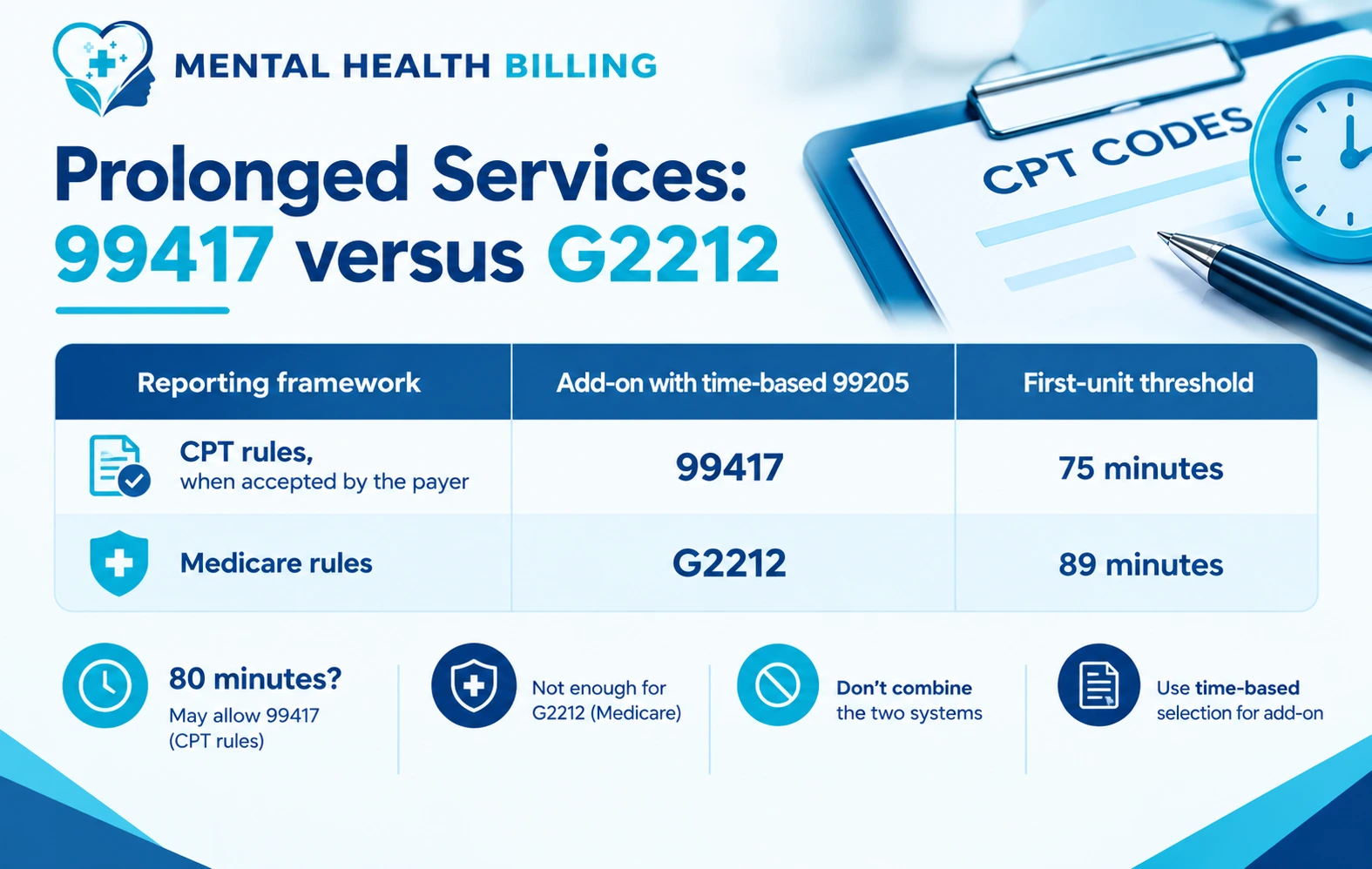
An encounter exceeding 60 minutes does not immediately qualify for a prolonged-service add-on. The payer’s reporting method controls the threshold.
| Reporting framework | Add-on with time-based 99205 | First-unit threshold |
|---|---|---|
| CPT rules, when accepted by the payer | 99417 | 75 total minutes |
| Medicare rules | G2212 | 89 total minutes |
The CPT threshold is described in the American College of Surgeons’ time guidance. CMS’s May 2026 booklet lists 89–103 minutes for 99205 plus one unit of G2212.
For an 80-minute qualifying encounter, a payer accepting CPT rules may allow 99205 plus 99417. Under Medicare’s threshold, those same 80 minutes do not support G2212.
Do not combine the two prolonged-service systems. Also, prolonged-service reporting requires selection of the base encounter by time; high MDM alone does not justify a time-based add-on.
A practical review before claim submission
Review the note in a consistent order: patient status, selection method, supporting evidence, and any separately reported services.
Three questions catch different documentation gaps:
- If the claim relies on time, does the total exclude staff work, other dates, and separately billed services?
- If it relies on MDM, can the reviewer identify two high-level elements?
- If it includes prolonged services, does the payer accept that code and threshold?
Medical necessity remains relevant even when a numerical threshold is met. CMS’s Medicare Claims Processing Manual cautions against reporting a higher E/M level when a lower level is warranted and explains that documentation volume should not drive code selection.
Choosing 99205 with a defensible record
Use the 99205 CPT code after confirming new-patient status and documenting either high MDM or at least 60 qualifying minutes. Make the selection method visible in the record. For extended encounters, verify the payer’s prolonged-service threshold before adding another code.