



99212 CPT Code Explained: Billing, Documentation, and Reimbursement Guide
The 99212 CPT code sits at the bottom of the established patient office visit family, and that position causes two opposite problems. Some practices report it defensively when the note clearly supports a higher level. Others report it when nothing separately billable happened at all. The first quietly drains revenue. The second invites recoupment.
Both errors come from the same source: treating 99212 as a fallback rather than as a code with its own definition. This guide covers what the definition requires, what Medicare pays in 2026, and where behavioral health billing departs from the general rules.
What CPT 99212 describes
CPT 99212 reports an office or other outpatient visit for an established patient that involves a medically appropriate history and or examination and straightforward medical decision making. When time is used instead, the encounter must reach at least 10 minutes of total time on the date of the encounter.
Two definitional points cause most denials before any clinical question comes up.
An established patient is one who has received a professional service from the same clinician, or from another clinician of the same specialty and subspecialty in the same group practice, within the previous three years. A patient who returns after 38 months is new again, and the claim belongs in the 99202 to 99205 range. Payers apply this rule mechanically, and the resulting denials are rarely worth appealing.
The time ceiling is implied rather than stated. The descriptor sets a floor of 10 minutes, and 99213 begins at 20 minutes, so 99212 covers total time from 10 through 19 minutes on the date of service.
The 2021 rewrite still governs every 99212 decision
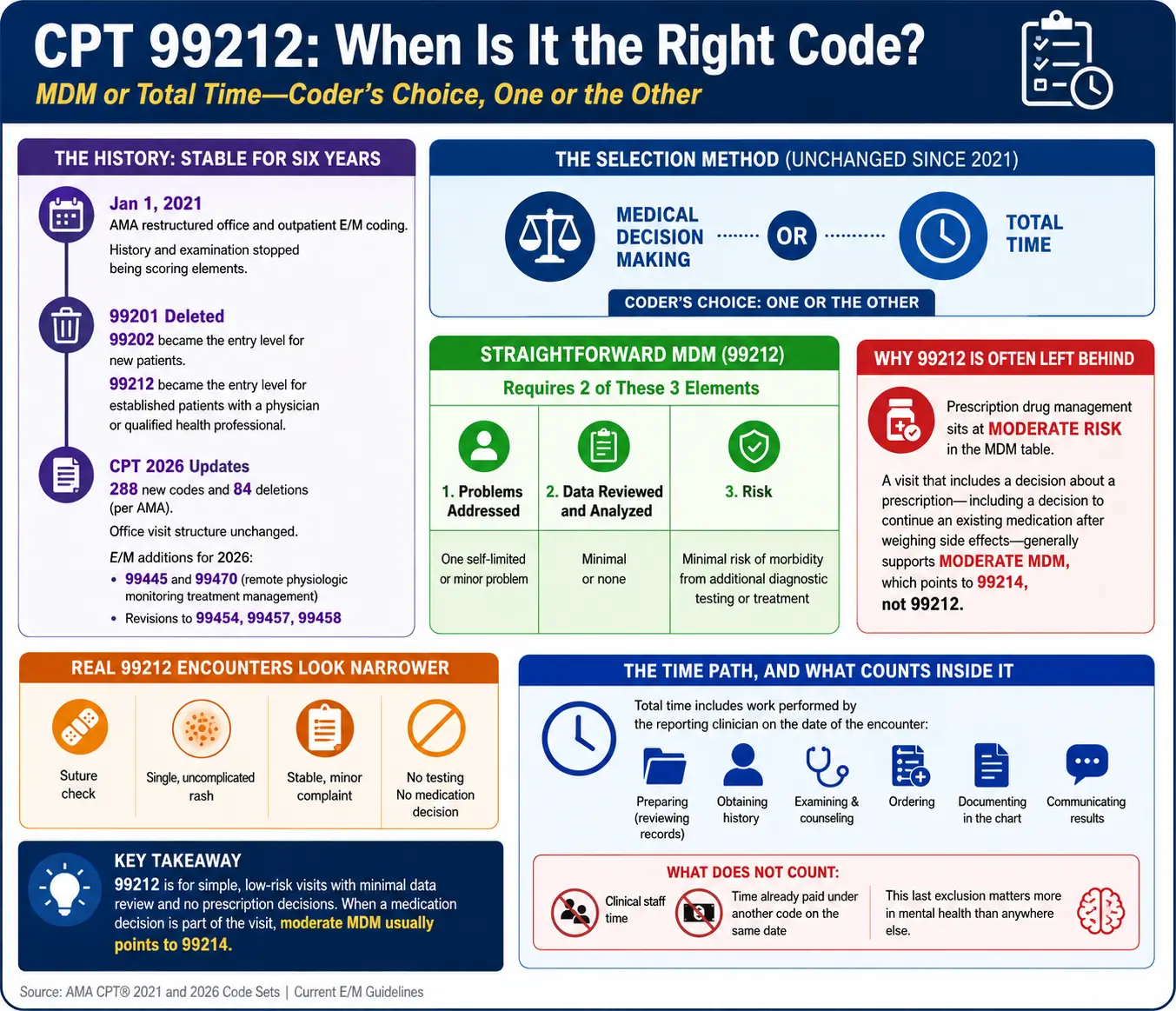
The AMA restructured office and outpatient E/M coding effective January 1, 2021. History and examination stopped being scoring elements. Code 99201 was deleted, which left 99202 as the entry level for new patients and 99212 as the effective entry level for established patients with a physician or qualified health professional. The CPT 2026 code set introduced 288 new codes and 84 deletions, according to the AMA, but left the office visit structure alone. The only E/M section additions for 2026 were remote physiologic monitoring treatment management codes 99445 and 99470, along with revisions to 99454, 99457, and 99458.
So the selection method has been stable for six years: medical decision making or total time, coder’s choice, one or the other.
Straightforward MDM, element by element
Straightforward MDM requires two of these three elements:
- Problems addressed: one self-limited or minor problem
- Data reviewed and analyzed: minimal or none
- Risk: minimal risk of morbidity from additional diagnostic testing or treatment
The risk column is where behavioral health and primary care notes usually leave 99212 behind. Prescription drug management sits at moderate risk in the MDM table. A visit that includes a decision about a prescription, including a decision to continue an existing medication after weighing side effects, generally supports moderate MDM, which points to 99214 rather than 99212. That single fact explains why a psychiatric medication management panel loaded with 99212 claims usually signals undercoding rather than conservative compliance.
Real 99212 encounters look narrower: a suture check, a single uncomplicated rash, a stable minor complaint reviewed with no testing and no medication decision.
The time path, and what counts inside it
Total time includes work performed by the reporting clinician on the date of the encounter: preparing by reviewing records, obtaining history, examining, counseling, ordering, documenting in the chart, and communicating results. Clinical staff time does not count. Neither does time that is already being paid under another code on the same date.
That last exclusion matters more in mental health than anywhere else, and it is covered below.
99211, 99212, and 99213 side by side
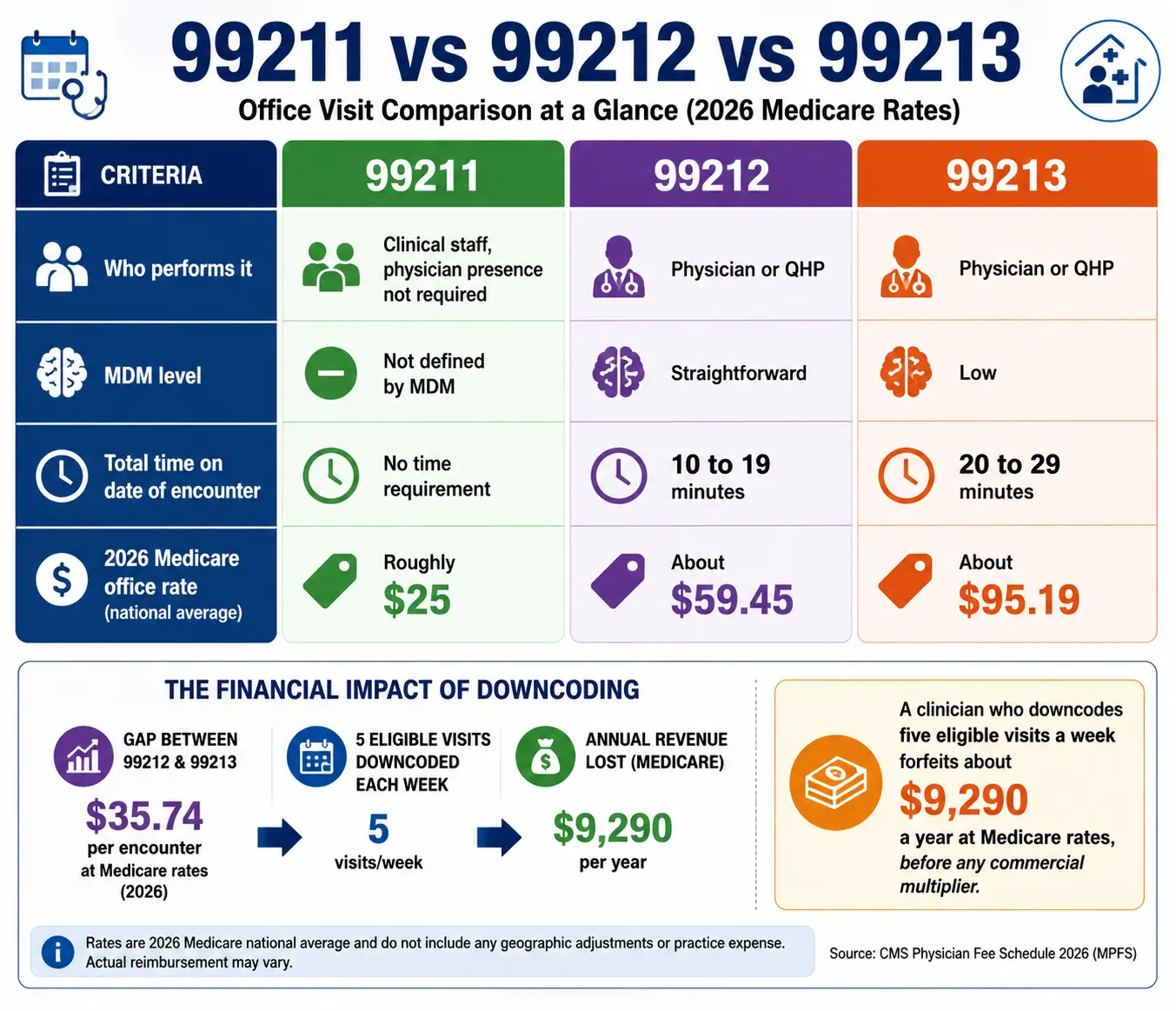
99211 | 99212 | 99213 | |
Who performs it | Clinical staff, physician presence not required | Physician or QHP | Physician or QHP |
MDM level | Not defined by MDM | Straightforward | Low |
Total time on date of encounter | No time requirement | 10 to 19 minutes | 20 to 29 minutes |
2026 Medicare office rate (national average) | Roughly $25 | About $59.45 | About $95.19 |
The gap between 99212 and 99213 in the office setting is roughly $35.74 per encounter in 2026. A clinician who downcodes five eligible visits a week forfeits about $9,290 a year at Medicare rates, before any commercial multiplier.
What 99212 pays in 2026
CMS issued the CY 2026 Physician Fee Schedule final rule (CMS-1832-F) on October 31, 2025. For the first time, the rule set two conversion factors, as required under MACRA: $33.5675 for qualifying APM participants and $33.4009 for everyone else. Both figures reflect the temporary 2.5 percent increase enacted in the One Big Beautiful Bill Act (H.R. 1) plus a 0.49 percent budget neutrality adjustment. The 2025 conversion factor was $32.3465.
Here is how 99212 breaks down at the national level for 2026, before geographic adjustment:
Component | Office (non-facility) | Facility |
Work RVU | 0.70 | 0.70 |
Practice expense RVU | 1.02 | 0.17 |
Malpractice RVU | 0.06 | 0.06 |
Total RVUs | 1.78 | 0.93 |
National payment estimate | About $59.45 | About $31.06 |
The direction of change is the part worth flagging to your finance team. The office rate rose from roughly $54.99 in 2025 to about $59.45, an increase of about 8 percent. The facility rate moved the other way, falling from roughly $33.96 to about $31.06. That split follows the site of service payment differential finalized for 2026, under which CMS reduced the indirect practice expense allocated to services delivered in hospital settings on the reasoning that facilities already bear those costs.
Independent practices gained. Hospital-employed behavioral health clinics billing professional fees under the facility rate lost close to 9 percent on this code. If your organization budgeted 2026 on a flat rate assumption, that variance is already showing up in your monthly professional fee reports.
One piece of good news for E/M billing: the 2.5 percent efficiency adjustment finalized for 2026 applies to work RVUs and intraservice time for non-time-based services. Office visit E/M codes were not subject to it.
Always confirm your locality rate through the CMS Physician Fee Schedule Look-Up Tool. Geographic practice cost indices move the national estimate by double digit percentages in high cost and rural areas alike.
Adding G2211 to a 99212
HCPCS code G2211 pays for visit complexity tied to a continuing care relationship. It carries 0.33 work RVUs and 0.49 total RVUs, which comes to roughly $16.37 at the 2026 non-QP conversion factor. It attaches to 99202 through 99215, and beginning January 1, 2026, CMS extended it to home and residence services codes 99341 through 99350.
Two operational rules govern it. First, G2211 is not payable when the base E/M carries modifier 25 for a same-day procedure, with an exception effective January 1, 2025 for annual wellness visits, vaccine administration, and other Medicare Part B preventive services. Second, the justification is the longitudinal relationship, not the severity of the presenting problem, which means a legitimate 99212 for a stable patient you have followed for years can carry it while a one-time evaluation cannot.
Where behavioral health billing changes the rules
When a prescriber delivers medication management and psychotherapy in the same encounter, the psychotherapy is reported with an add-on code: 90833 for 16 to 37 minutes, 90836 for 38 to 52 minutes, and 90838 for 53 minutes or more.
The rule that trips up new coders is this one. When an E/M service is reported with a psychotherapy add-on, the E/M level must be selected on medical decision making. Time is off the table, because the add-on code is itself time-based and the same minutes cannot support both services. Payer policies state this directly, including Blue Shield of California Promise Health Plan’s psychotherapy add-on policy and Moda Health’s E/M with psychotherapy policy, both of which also confirm that prolonged services are not reportable with this pairing.
Two further points from those same policies:
- Time spent on history, examination, and medical decision making is not psychotherapy time. The note needs to separate the two.
- Reporting standalone psychotherapy codes 90832, 90834, or 90837 with an E/M on the same date triggers NCCI edits that are not eligible for a modifier bypass. The corrected claim uses the add-on instead.
Given the moderate risk associated with prescription drug management, a 99212 paired with 90833 should be uncommon in a prescriber panel. When it appears frequently, the usual cause is a template that documents therapy thoroughly and medical decision making thinly.
Documentation that survives an audit
Federal audit findings in mental health billing have been consistently unfavorable, and the deficiencies are documentation failures rather than clinical ones.
In a July 2020 audit (report A-02-19-01012), the HHS Office of Inspector General reviewed a stratified random sample of 120 claims drawn from 23,947 psychotherapy claims billed by On-Site Psychological Services over 2017 and 2018. 111 of the 120 sampled claims did not comply with Medicare billing requirements. Treatment plans were the leading problem, therapeutic maneuvers were unspecified in 9 claims, and treatment notes failed to support the service billed in 5. OIG estimated at least $3.3 million in overpayments.
A broader OIG audit released in 2023 examined psychotherapy services furnished from March 1, 2020 through February 28, 2021. Of 216 sampled enrollee days, 128 contained documentation deficiencies such as missing start and stop times, missing treatment plans, or unmet incident to criteria. OIG estimated that $580 million of the $1 billion Medicare paid during that period was improper, split between $348 million for telehealth and $232 million for non-telehealth services.
For a 99212 note, the defensible minimum is short but specific: the problem addressed and its status, what was reviewed, the decision made and why, and either the MDM elements or a stated total time with the activities it covers. Cloned text carried forward from a prior visit is the single most common finding auditors cite when a note fails.
Telehealth status for 99212 in 2026
The Consolidated Appropriations Act, 2026 (H.R. 7148), signed February 3, 2026, extended Medicare telehealth flexibilities through December 31, 2027. Beneficiaries can continue to receive telehealth from any location, including home, without geographic restriction.
Behavioral health carries additional protections. The Consolidated Appropriations Act, 2021 permanently removed geographic and originating site restrictions for behavioral telehealth, and audio-only delivery is permitted when the patient cannot use or does not consent to video. Per the CMS telehealth FAQ updated February 26, 2026, the statutory in-person visit requirement for mental health telehealth furnished in the home applies to services after December 31, 2027, at which point an in-person visit within the prior six months and annual in-person visits thereafter come back into force.
Report place of service 10 when the patient is at home and 02 when the patient is elsewhere. Medicare does not require modifier 95 with POS 10. Several commercial payers do, so check contract language rather than assuming parity.
Denial patterns worth tracking
Three claim edits account for most preventable 99212 denials.
Same-day preventive services require modifier 25 on the problem-oriented E/M, with the problem work documented separately from the preventive service. Diagnosis linkage failures produce medical necessity denials when a generic or stale ICD-10 code is attached to the visit. New versus established patient errors, discussed above, remain automatic.
Run a quarterly distribution report of 99211 through 99215 by rendering provider. When one clinician’s curve sits far below the group on identical patient panels, the note templates are usually the cause. That single report tends to recover more revenue than any appeal workflow, and it is the fastest way to confirm whether your 99212 CPT code volume reflects the care being delivered or the documentation habits behind it.