


90785 CPT Code Add-On Service: Rules, Guidelines, and Examples
Medical billing and coding require absolute precision, especially when documenting the additional time and expertise required for complex clinical encounters. For mental health professionals, CPT code 90785 serves as a vital tool to capture the reality of challenging sessions. However, its specialized status as an add-on code means it carries strict rules, specific documentation standards, and a high risk of audit if used incorrectly.
This guide breaks down the rules, guidelines, and practical examples for using the 90785 CPT code accurately and compliantly.
What is CPT Code 90785?
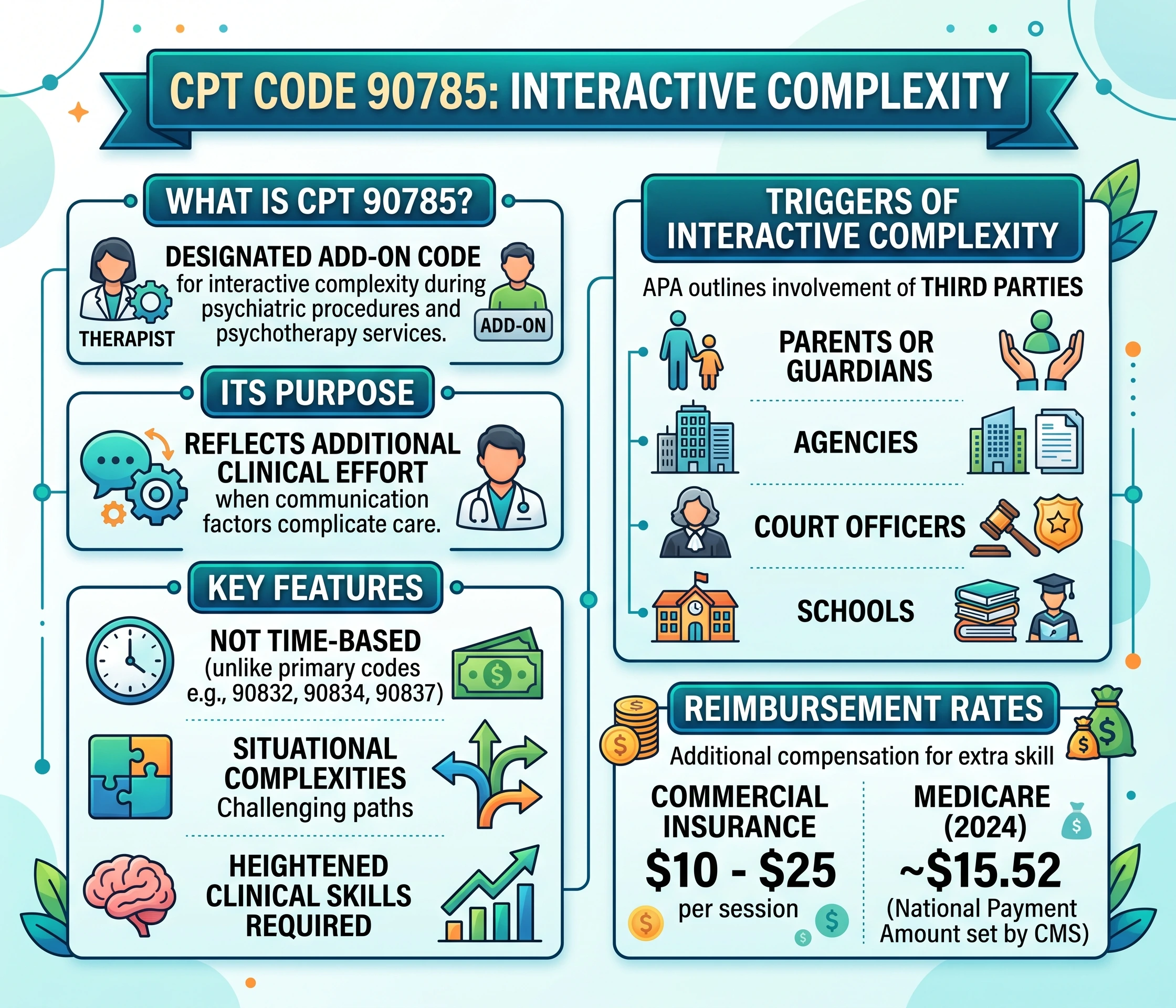
CPT code 90785 is the designated add-on code for interactive complexity during psychiatric procedures and psychotherapy services. It exists to reflect the additional clinical effort required when specific communication factors complicate the delivery of care.
Unlike primary service codes (such as 90832, 90834, or 90837 for psychotherapy) that are based on time, 90785 is based entirely on the presence of specific situational complexities. It provides a standardized way for practitioners to account for the heightened clinical skills needed when straightforward therapeutic interaction is impossible.
The American Psychological Association (APA) outlines that interactive complexity is typically present when third parties such as parents, guardians, agencies, court officers, or schools are involved in a patient’s care.
Reimbursement Rates for 90785
Because managing interactive complexity requires additional clinical skill, insurance carriers provide additional compensation when this add-on code is used correctly.
- Commercial Insurance: Private insurers typically pay between $10 and $25 per session for the 90785 add-on code, depending on the specific carrier and contract.
- Medicare: The Centers for Medicare & Medicaid Services (CMS) set the national payment amount for 90785 at approximately $15.52 for the 2024 calendar year.
The 4 Qualifying Factors for Interactive Complexity
You cannot bill 90785 simply because a session felt difficult or a patient was resistant. According to APA guidelines, the session must include at least one of four specific communication factors that complicate the delivery of care.
1. Maladaptive Communication
This occurs when the patient exhibits communication patterns that actively interfere with care delivery. The clinical record must show how the practitioner had to manage high anxiety, extreme reactivity, repeated questioning, or active disagreement among session participants.
2. Interfering Caregiver Behaviors
This factor applies when a caregiver, guardian, or third party present in the session behaves in a way that disrupts the treatment plan.
Example: A pediatric session where parents continually challenge each other’s observations of the child, requiring the therapist to manage the conflict rather than deliver the primary service.
3. Sentinel Event Disclosure and Mandated Reporting
This applies when there is evidence or disclosure of a sentinel event during the session that requires a mandated report to a third party (such as a state agency for abuse or neglect). The code covers the initiation of the discussion regarding the event and the reporting process with the patient or participants.
4. Use of Physical Devices or Play Equipment
This factor justifies the use of 90785 when a clinician must use play equipment, physical devices, or assistive tools to communicate with a patient who lacks expressive language skills or has lost the capacity for typical verbal interaction.
Strict Rules for Using Add-On Code 90785
The most common reason for denied claims regarding 90785 is a misunderstanding of how add-on codes function within the billing system.
It Can Never Be Billed Alone
CPT code 90785 is an add-on code. By definition, it can never be reported as a stand-alone service. It must always be billed in conjunction with an appropriate primary psychiatric or psychotherapy service code.
According to CMS guidelines, 90785 is approved for use with:
- 90791, 90792: Psychiatric diagnostic evaluation
- 90832, 90834, 90837: Individual psychotherapy
- 90853: Group psychotherapy (when the complexity applies to a specific patient, not the entire group)
- Psychotherapy when performed with an Evaluation and Management (E/M) service (90833, 90836, 90838)
It Cannot Be Used for Evaluation and Management (E/M) Alone
The 2022 CPT Manual clearly states that interactive complexity is not applicable to an E/M service alone. If a practitioner performs an E/M service and a psychotherapy service, 90785 can be reported for the psychotherapy portion, but never the E/M alone.
Translation Services Do Not Qualify
Many practitioners mistakenly believe that using an interpreter qualifies a session for interactive complexity. However, billing 90785 solely for translation or interpretation services is invalid and could potentially violate the Americans with Disabilities Act (ADA) and federal anti-discrimination statutes.
Documentation Requirements That Survive Audits
Insurance payers closely audit the use of 90785. A clinical note that simply states “90785 used due to communication barriers” will almost certainly result in a denied claim.
To withstand scrutiny, clinical documentation must capture specific, observable details.
Real-Time, Specific Documentation
The leading cause of denied claims is after-the-fact documentation that lacks session-specific detail. Documentation should identify the exact qualifying factor and detail the observable behavior. Vague language such as “complex session” or “difficult patient” does not meet the standard.
Your documentation must explicitly state:
- The Specific Factor: Name the exact interactive complexity factor present (e.g., interfering caregiver behavior).
- The Observable Behavior: Describe what actually happened (e.g., “biological parent and court-appointed guardian provided conflicting histories”).
- The Clinical Impact: Explain how the factor complicated the delivery of care and the extra expertise required to manage it (e.g., “clinician intervened three times to restore therapeutic focus and de-escalate the conflict”).
Documentation Examples
Proper documentation demonstrates the direct link between the patient’s presentation and the necessity of the add-on code.
Example 1: Mandated Reporting
Insufficient Note: Patient disclosed abuse. Billed 90785.
Compliant Note: During the 45-minute psychotherapy session (90834), the patient’s daughter disclosed that her father had recently been the victim of elder abuse by a neighbor. The therapist explained state mandated reporting obligations to the patient and initiated the reporting process with the state agency during the session (+90785).
Example 2: Assistive Devices
Insufficient Note: Used picture cards with patient.
Compliant Note: The young pediatric patient has not developed expressive language skills. The clinician utilized picture-exchange cards and drawing prompts to elicit responses during the psychiatric diagnostic evaluation (90791), which required significant additional clinical effort to interpret the responses and complete the assessment (+90785).
Example 3: Maladaptive Communication (Adult)
Insufficient Note: Patient was very anxious today.
Compliant Note: During the 60-minute psychotherapy session (90837), the patient exhibited extreme reactivity and high anxiety regarding a proposed treatment intervention. The patient repeatedly asked the same questions and actively disagreed with the clinical assessment. The clinician had to adapt the therapeutic approach, spending an additional 15 minutes managing the maladaptive communication to stabilize the patient before proceeding with the treatment plan (+90785).
Common Scenarios Where 90785 Does Not Apply
Understanding when not to bill CPT code 90785 is just as important as knowing when to use it. Billing this code in inappropriate scenarios inflates healthcare costs and exposes a practice to compliance risks.
You should not bill 90785 in the following situations:
- Routine Family Involvement: If a patient brings a spouse or parent to therapy, and the third party participates appropriately without complicating the delivery of care, the session does not qualify.
- Typical Emotional Expression: A patient who is tearful, sad, or appropriately expressing emotion during therapy does not meet the criteria for maladaptive communication. The behavior must actively interfere with the treatment plan.
- Non-Communicative Patients: According to Medicare guidelines (Article A57520), if a patient is entirely unable to communicate by any means, the interactive complexity CPT code 90785 should not be billed. The code requires interaction, even if that interaction is facilitated by devices or play.
- Excluded Primary Codes: 90785 cannot be billed alongside family psychotherapy codes (90846 and 90847) or crisis psychotherapy codes (90839 and 90840).
CPT code 90785 provides a mechanism for mental health professionals to be fairly compensated for the complex clinical work required when communication barriers threaten therapeutic progress. By adhering strictly to the four qualifying factors and maintaining precise, session-specific documentation, billing teams and providers can utilize this add-on code effectively while remaining compliant with federal regulations and insurance guidelines.