



CPT Code 99215 Requirements: Time, Complexity & Documentation
Medical billing underwent a structural shift on January 1, 2021, when the American Medical Association (AMA) abandoned the 1995 and 1997 Evaluation and Management (E/M) guidelines for outpatient visits. Providers no longer count body systems examined or history questions asked to justify their coding levels. Current rules dictate that medical coders assign the code level strictly based on total time spent on the date of service or the final level of Medical Decision Making (MDM).
CPT code 99215 designates the highest complexity tier for established outpatient encounters. Because this code commands the highest reimbursement rate in its category paying approximately $180 based on the 2024 Medicare National Physician Fee Schedule it draws intense scrutiny from commercial payers and federal auditors. Healthcare providers and medical billers must apply the AMA criteria precisely to secure legal reimbursement and survive post-payment compliance audits.
Defining the Established Patient
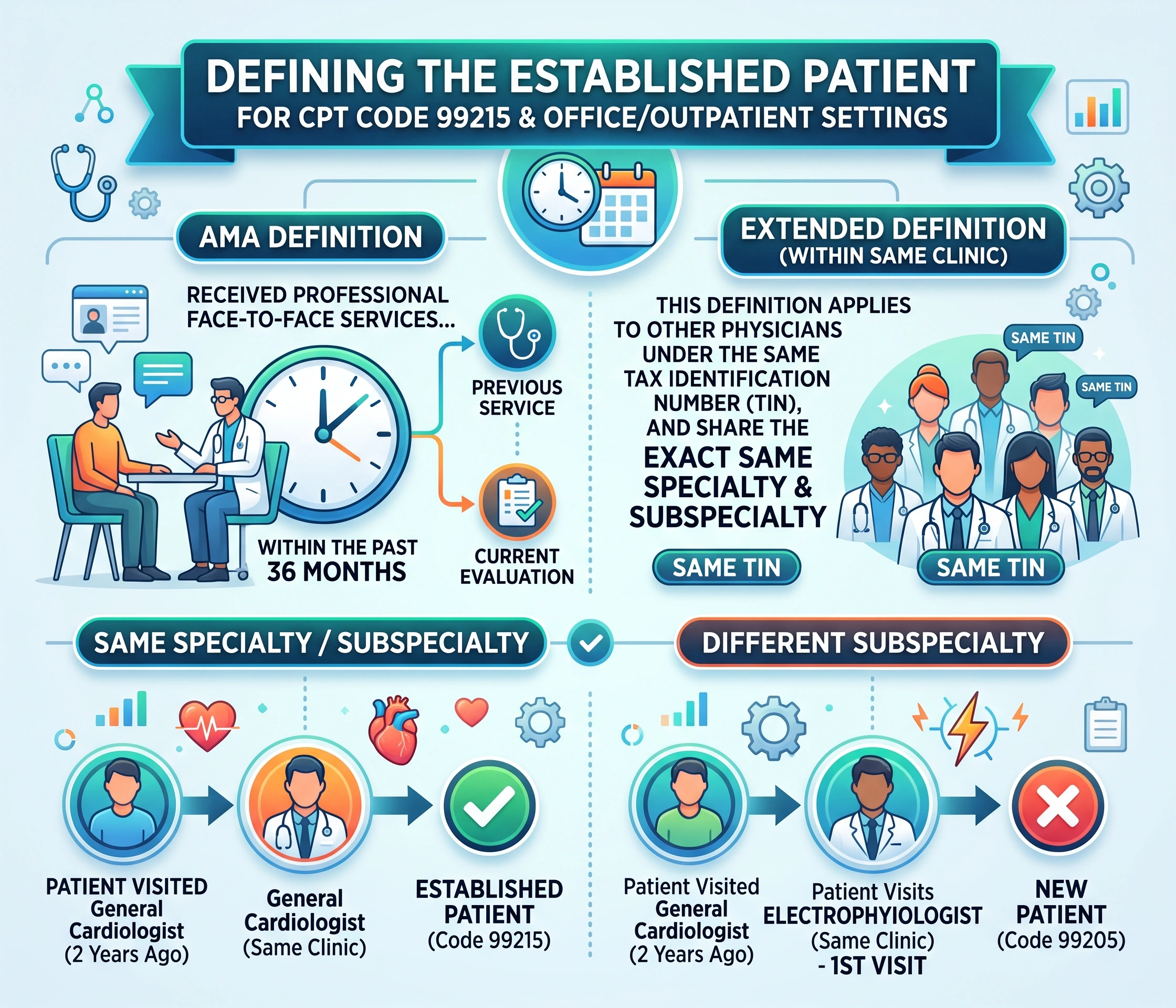
CPT code 99215 applies exclusively to established patients evaluated in an office or outpatient setting. The AMA defines an established patient as an individual who has received professional face-to-face services from the billing provider within the past 36 months.
This definition extends to other physicians operating under the same tax identification number who share the exact same specialty and subspecialty. If a patient visited a general cardiologist in a large multispecialty clinic two years ago, that patient is considered established to every other general cardiologist in that specific clinic. However, if that same patient sees an electrophysiologist in the same clinic for the first time, the biller submits a new patient code (such as 99205) because the exact subspecialty differs.
Time-Based Billing Requirements
Providers can bypass the complex MDM calculation entirely by billing 99215 based on time. The 2024 CPT Professional Edition requires a threshold of 40 to 54 total minutes dedicated to the patient’s care.
This calculation aggregates both direct patient contact and administrative work, provided all activities occur on the exact calendar date of the encounter. If a physician spends 15 minutes reviewing a hospital discharge summary at 11:30 PM on Monday for a Tuesday morning appointment, those 15 minutes cannot apply to Tuesday’s E/M time calculation.
When performed on the same calendar date, the following activities contribute to the 40-minute minimum:
- Preparing for the visit by reviewing external diagnostic tests or provider notes
- Obtaining the clinical history
- Performing a medically appropriate physical examination
- Counseling the patient, their family, or designated caregivers
- Submitting orders for prescription medications, laboratory tests, or imaging
- Communicating with external medical specialists regarding the case
- Documenting the clinical assessment in the electronic health record (EHR)
- Coordinating patient care with external agencies
Strict Exclusions from Total Time
Clinical documentation must reflect only the time spent personally by the physician or qualified health care professional (QHCP), such as a nurse practitioner or physician assistant. Time spent by clinical support staff does not count. A medical assistant spending 12 minutes recording vital signs, updating the active medication list, and administering a depression screening questionnaire cannot transfer those minutes to the provider’s total.
Providers must strictly exclude time spent on separately billable procedures. The AMA prohibits double-counting labor. If an orthopedic surgeon spends 45 total minutes with a patient but dedicates 15 of those minutes to performing a major joint injection (CPT 20610), the billing department must deduct the injection time from the encounter total. This subtraction drops the E/M time to 30 minutes, lowering the visit to CPT code 99214.
Prolonged Services and Medicare Discrepancies
Complex clinical cases frequently push providers beyond the 54-minute ceiling of CPT 99215. Billing departments utilize prolonged service add-on codes to capture this extended labor, but commercial payers and Medicare operate under contradictory rule sets.
The AMA utilizes CPT 99417 for prolonged outpatient services, designed to be billed in 15-minute increments. Under AMA rules, coders append 99417 as soon as the provider hits 55 minutes.
The Centers for Medicare & Medicaid Services (CMS) rejected the AMA timeline, arguing that providers must exceed the absolute maximum time for 99215 by a full 15 minutes before claiming extra compensation. Medicare Part B claims require the use of a specific Healthcare Common Procedure Coding System (HCPCS) code: G2212. Medical billers cannot append G2212 to a Medicare claim until the provider documents 69 total minutes on the date of service.
Medical Decision Making Criteria
Providers who quickly resolve severe clinical issues often miss the 40-minute threshold but still qualify for 99215 based on cognitive labor. To justify the code without using time, the clinical documentation must support a “High” level of Medical Decision Making.
The AMA evaluates MDM using a specific grid containing three elements: the complexity of problems addressed, the amount of data analyzed, and the risk of patient management. A 99215 claim requires the clinical note to meet the “High” criteria in two of these three categories.
1. Number and Complexity of Problems Addressed
The clinical issue driving the visit must represent a severe threat to the patient’s baseline health. Routine management of stable chronic illnesses like hypertension or hyperlipidemia falls into lower billing tiers. High complexity demands one of two specific clinical scenarios.
The provider must evaluate a chronic illness experiencing a severe exacerbation, progression, or adverse side effect of treatment. A patient with congestive heart failure presenting with acute respiratory distress and severe peripheral edema requiring immediate medication overhauls meets this standard. A patient with Crohn’s disease experiencing a severe flare that threatens bowel integrity also qualifies.
Alternatively, the provider must evaluate an acute or chronic illness or injury that poses a near-term threat to life or bodily function. The condition does not need to cause permanent damage to qualify, but the immediate threat must be severe. Examples include an acute myocardial infarction, a suspected pulmonary embolism, severe anaphylaxis, or a psychiatric crisis requiring immediate intervention to prevent self-harm.
2. Amount and Complexity of Data to be Reviewed
Gathering and interpreting diagnostic information forms the second element of MDM. Scoring a “High” level requires extensive analytical work. The provider must satisfy the criteria in two of three data sub-categories.
Category 1: Tests, Documents, or Independent Historians
The provider must accumulate three distinct points from the following list:
- Reviewing external notes from a unique medical organization
- Reviewing the results of a unique diagnostic test
- Ordering a unique diagnostic test
- Assessing an independent historian (such as a parent, spouse, or caregiver)
An independent historian counts only when the patient cannot provide a reliable history themselves. A language barrier requiring a translator does not justify an independent historian. The patient must have a cognitive impairment, severe psychiatric condition, or be a pediatric patient unable to articulate their symptoms.
Category 2: Independent Interpretation of Tests
The billing provider must independently read and interpret a test usually performed by another specialist. A primary care physician who independently examines a chest X-ray to diagnose pneumonia satisfies this category, provided the physician does not bill a separate CPT code for the radiological interpretation. Reading the radiologist’s typed report falls under Category 1; looking at the actual images qualifies for Category 2.
Category 3: Discussion of Management
The provider must engage in a direct discussion of patient management or test interpretation with an external physician or qualified healthcare professional. Sending an electronic referral or a faxed records request does not count. The provider must have a two-way dialogue regarding the case.
3. Risk of Complications and Morbidity
The final MDM element measures the risk associated with the provider’s chosen treatment plan. The AMA categorizes several specific clinical decisions as high risk, regardless of whether a complication ultimately occurs.
Prescribing drug therapy requiring intensive monitoring for toxicity serves as the most frequent justification for high-risk management. The physician must order specific tests to look for dangerous adverse effects, not just therapeutic efficacy. Monitoring a patient’s hemoglobin A1C to verify insulin effectiveness fails the toxicity test. However, ordering routine comprehensive metabolic panels to monitor for hepatotoxicity in a patient taking methotrexate strictly meets the AMA definition. Other common examples include monitoring prothrombin time (PT/INR) for patients on warfarin or checking serum levels for patients on lithium.
Decisions regarding major surgery also carry high risk. Referring a patient to the emergency department for an immediate appendectomy satisfies this element. Deciding to proceed with elective major surgery on a patient with identified systemic risk factors such as a poorly controlled diabetic patient requiring a total knee arthroplasty also qualifies.
Finally, making formal decisions to escalate care to an inpatient hospital setting, or deciding to de-escalate care by transitioning a terminal patient to hospice, represents high-risk management.
Audit Defense and Documentation Standards
Because CPT 99215 generates the highest E/M payment, Medicare Administrative Contractors (MACs) and private payers routinely audit these claims. According to the 2023 Medicare Fee-For-Service Supplemental Improper Payment Data report, office visits consistently show high error rates, primarily driven by unsupported upcoding.
The elimination of the 1995 and 1997 bullet-point systems reduced administrative bloat, but it did not alter the legal requirement to prove medical necessity. Auditors deny claims rapidly when documentation lacks specific details.
Avoiding EHR Cloning
EHR cloning also known as “note bloat” remains a primary target for auditors. When a provider copies the exact history of present illness and review of systems from a visit six months prior and pastes it into the current date of service, auditors assume the work was not actually performed. The clinical note must reflect the unique, specific circumstances of the patient on that exact calendar date.
Defending Time-Based Claims
Time-based billing failures usually stem from brevity. A medical note stating “Total time: 42 minutes” will fail a strict review. A compliant note details the breakdown of labor. An auditor wants to see a statement resembling: “I spent 42 minutes personally managing this patient today. This time included reviewing previous endocrinology notes before the visit, conducting a face-to-face examination, counseling the patient on diabetic neuropathy management, and documenting this clinical assessment.”
Defending MDM Claims
MDM-based claim denials frequently result from unstated clinical logic. If a provider claims high risk due to drug toxicity monitoring, the chart must explicitly name the specific drug, identify the exact test ordered, and state the potential toxicity being monitored.
If a provider reviews multiple laboratory panels, stating “labs reviewed” leaves the auditor guessing. The medical record must specify which diagnostic panels the provider analyzed and explain exactly how those specific laboratory values altered or confirmed the current medical treatment plan. Medical coders cannot assume the provider’s thought process; if the complexity is not explicitly written in the chart, it cannot be billed on the claim.