


F33.2 Diagnosis Code Explained: Symptoms, Billing, and ICD-10 Guidelines
Medical billers, medical coding students, and healthcare providers use the ICD-10-CM code F33.2 to document a specific and intense presentation of clinical depression. The World Health Organization reported in a September 2026 fact sheet that an estimated 5.2% of adults globally experience depression. Among this population, certain individuals present with multiple severe episodes that require targeted clinical interventions and extended treatment plans. Accurate medical coding for these specific cases ensures regulatory compliance, supports risk adjustment models, and secures appropriate reimbursement for behavioral health facilities.
This article explains the clinical presentation, billing requirements, and Centers for Medicare and Medicaid Services (CMS) guidelines for the F33.2 diagnosis code.
What is the F33.2 diagnosis code?
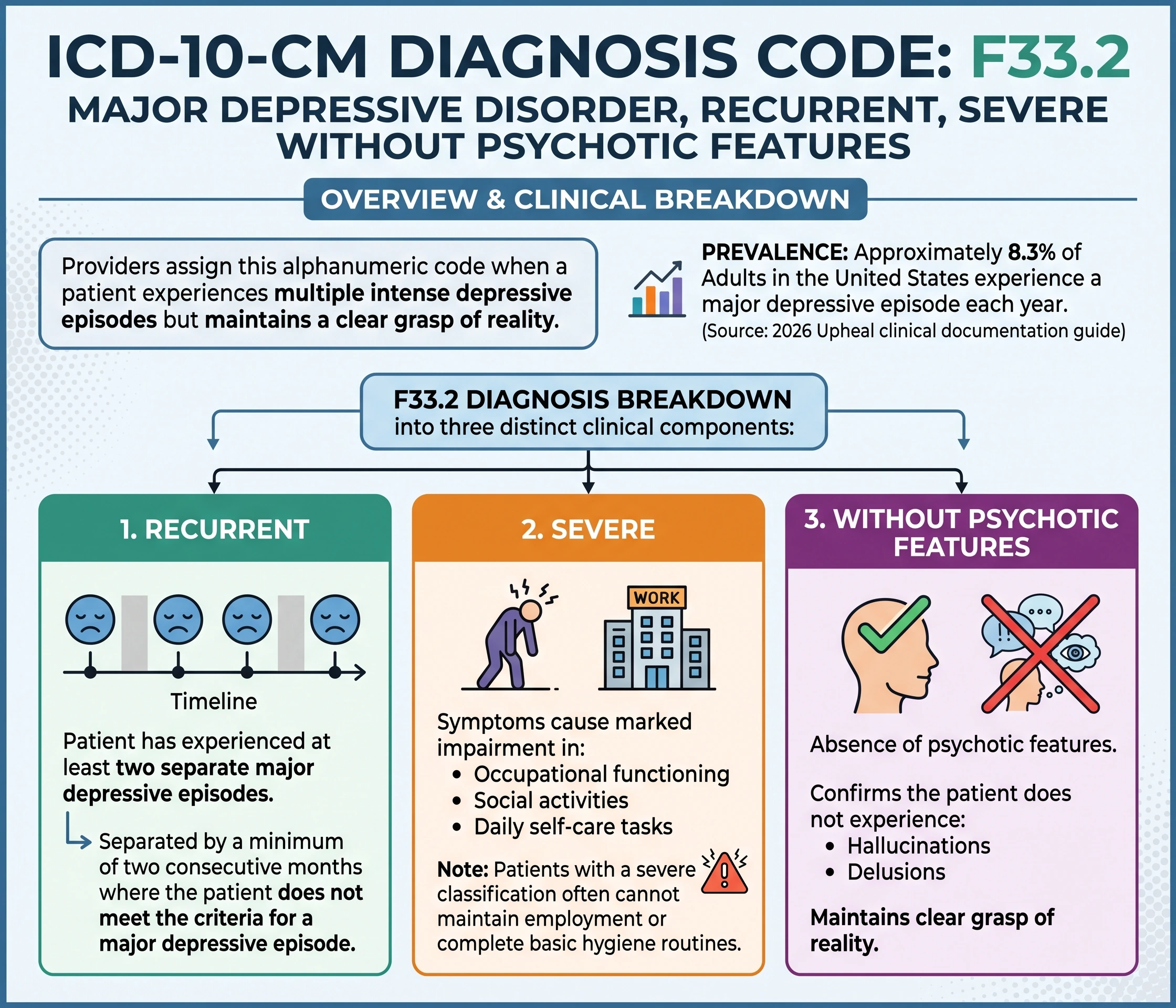
The ICD-10-CM manual defines F33.2 as Major Depressive Disorder, Recurrent, Severe Without Psychotic Features. Providers assign this alphanumeric code when a patient experiences multiple intense depressive episodes but maintains a clear grasp of reality. According to a 2026 Upheal clinical documentation guide, approximately 8.3% of adults in the United States experience a major depressive episode each year. The F33.2 classification isolates a specific subset of this population experiencing repeated, highly debilitating symptoms.
The F33.2 diagnosis breaks down into three distinct clinical components. The term recurrent dictates that the patient has experienced at least two separate major depressive episodes. These distinct episodes must be separated by a minimum of two consecutive months where the patient does not meet the criteria for a major depressive episode.
The severity indicator means the symptoms cause marked impairment in occupational functioning, social activities, or daily self-care tasks. Patients with a severe classification often cannot maintain employment or complete basic hygiene routines. Finally, the absence of psychotic features confirms the patient does not experience hallucinations or delusions.
Clinical criteria and symptom presentation
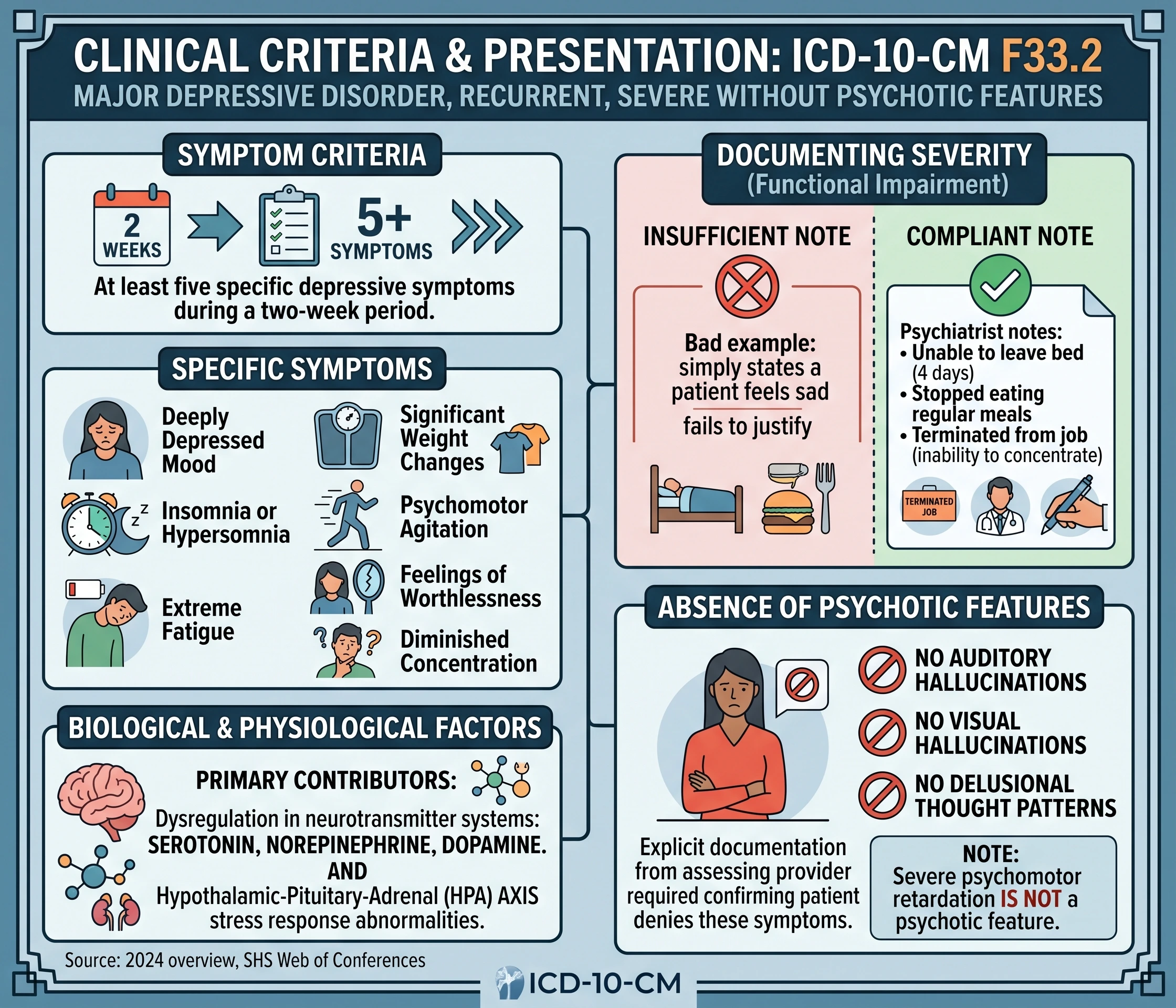
To support an F33.2 diagnosis, the patient’s medical record must reflect the intensity of the condition. A patient with an F33.2 diagnosis presents with at least five specific depressive symptoms during a two-week period. These symptoms frequently include a deeply depressed mood, significant weight changes, insomnia or hypersomnia, psychomotor agitation, extreme fatigue, feelings of worthlessness, and diminished concentration.
The development of recurrent severe major depressive disorder involves biological, physiological, and social factors. According to a 2024 overview published in SHS Web of Conferences, researchers have identified dysregulation in neurotransmitter systems involving serotonin, norepinephrine, and dopamine as primary physiological contributors to the disease. Furthermore, a patient’s hypothalamic-pituitary-adrenal axis often exhibits stress response abnormalities.
Providers must document exactly how these symptoms disrupt the patient’s life. A clinical note simply stating that a patient feels sad fails to justify a severe classification. A compliant clinical note specifies functional impairments. An example of appropriate documentation is a psychiatrist noting that a patient has been unable to leave their bed for four days, has stopped eating regular meals, and was recently terminated from their job due to an inability to concentrate on basic tasks.
The absence of psychotic features also requires explicit documentation. Medical coders look for statements from the assessing provider confirming that the patient denies auditory hallucinations, visual hallucinations, and delusional thought patterns. If a patient exhibits psychomotor retardation so severe that they stop speaking entirely, but they do not report psychotic symptoms, F33.2 remains the correct diagnostic code.
ICD-10-CM guidelines and risk adjustment for 2024 and 2025
The Centers for Medicare and Medicaid Services updates the ICD-10-CM code set annually on October 1. For the 2024 and 2025 fiscal years, the definition and clinical application of F33.2 remain consistent. However, the role this code plays in risk adjustment billing requires careful attention from medical coders and health information management directors.
Under the CMS Hierarchical Condition Category (HCC) Version 28 risk adjustment model, F33.2 maps directly to specific risk categories. Medicare Advantage plans use the HCC model to estimate future healthcare costs for enrolled patients. A diagnosis of recurrent severe major depressive disorder carries a higher risk score than a single, mild episode because patients with this condition statistically require more healthcare resources.
Providers must ensure that the F33.2 diagnosis is assessed, monitored, evaluated, and documented at least once every calendar year for the risk adjustment to remain active on the patient’s profile. Auditors frequently review severe depression claims to verify that the clinical documentation matches the assigned code severity. If a provider bills F33.2 but only documents mild symptoms or fails to reference any previous episodes in the patient’s history, insurance payers will likely downcode the claim and request a refund for the overpayment.
Common CPT codes for F33.2 billing
Mental health professionals use specific Current Procedural Terminology (CPT) codes when treating patients diagnosed with F33.2. Because this condition is severe and recurrent, standard treatment plans involve extended psychotherapy sessions and regular medication management.
Individual psychotherapy sessions represent the most frequent billing scenarios for this diagnosis. Providers use time-based CPT codes to report these therapeutic services.
- 90832 corresponds to a 30-minute psychotherapy session.
- 90834 corresponds to a 45-minute psychotherapy session.
- 90837 corresponds to a 60-minute psychotherapy session.
Clinical notes must record the exact start and stop times of the therapy session to comply with billing regulations. Billing the 90837 code requires a minimum of 53 minutes of face-to-face time with the patient. If a session scheduled for an hour ends at 45 minutes, the medical coder must assign 90834 instead.
Patients with an F33.2 diagnosis almost always require pharmacological intervention. According to research cited in a 2026 Upheal guide, 60% of patients at risk for recurrent depression experience a depressive episode within one year if left untreated. Providing proper maintenance treatment drops this relapse risk to between 10% and 30%. Psychiatrists and psychiatric nurse practitioners billing for medication management use Evaluation and Management (E/M) codes, such as 99213 or 99214, depending on the medical decision-making complexity during the visit. When a provider conducts psychotherapy and medication management during the same encounter, they bill an E/M code along with a specific add-on psychotherapy code.
Differentiating F33.2 from similar ICD-10 codes
Selecting the correct depression code requires understanding the structural differences between the F32 and F33 categories in the ICD-10-CM manual. The F32 block designates single episodes of depression. The F33 block designates recurrent episodes. Medical coders must read the provider’s clinical assessment carefully to distinguish between the following related diagnosis codes.
|
ICD-10 Code |
Diagnosis Description |
Clinical Distinction |
|
F33.2 |
Major Depressive Disorder, Recurrent, Severe Without Psychotic Features |
Multiple episodes; severe functional impairment; no hallucinations or delusions. |
|
F32.2 |
Major Depressive Disorder, Single Episode, Severe |
The patient is experiencing their first major depressive episode. |
|
F33.3 |
Major Depressive Disorder, Recurrent, Severe With Psychotic Features |
The patient experiences hallucinations or delusions alongside severe depression. |
|
F34.1 |
Persistent Depressive Disorder (Dysthymia) |
Chronic, milder depression lasting at least two consecutive years. |
A patient cannot receive an F33.2 diagnosis if they have a documented history of manic episodes. If a clinical note references a past manic episode, the diagnostic category immediately shifts to the bipolar disorder spectrum (the F31 category). Code selection relies entirely on the provider’s specific phrasing regarding the patient’s psychiatric history.
F33.2 Diagnosis Code Explained: Final documentation practices
Insurance payers look for strict medical necessity when processing claims for F33.2. Because this code indicates a severe and recurring condition, submitted treatment plans must reflect a high level of care. A patient with this diagnosis routinely requires weekly or bi-weekly therapy sessions during the acute phase of a depressive episode. Once the patient enters partial remission, the provider may reduce the frequency of clinical visits to once a month.
The medical record must track the patient’s progress or lack of progress over time. Providers frequently use standardized assessment tools, such as the Patient Health Questionnaire (PHQ-9), to measure symptom severity objectively. A baseline PHQ-9 score of 20 or higher aligns directly with a diagnosis of severe major depressive disorder. Documenting these specific numerical scores at regular intervals provides quantifiable evidence to support ongoing billing for intensive therapy or medication management.
Accurate medical coding for recurrent severe major depressive disorder relies entirely on precise language within the clinical note. Healthcare providers must clearly state that the patient has a history of previous depressive episodes to satisfy the recurrent criteria. They must document the specific severity of the current symptoms and explain exactly how these symptoms impair the patient’s daily functioning. Finally, the provider must explicitly rule out the presence of psychotic features in their assessment. When medical billers and coders understand the clinical criteria behind the F33.2 diagnosis code, they can identify missing information in a provider’s chart before submitting a claim. This proactive review process prevents costly claim denials and ensures the healthcare facility receives accurate reimbursement for the specialized mental health services required to treat this condition.