


Understanding Bulimia Nervosa (F50.2): ICD-10 Classification and Clinical
Bulimia nervosa presents complex administrative challenges for healthcare providers and medical coders. The International Classification of Diseases, Tenth Revision (ICD-10) designates the code F50.2 for bulimia nervosa. Accurate application of this code requires providers to document specific behavioral and physiological criteria. Coders must then translate clinical notes into claims that demonstrate medical necessity for treatments ranging from outpatient psychotherapy to inpatient metabolic stabilization.
According to the National Institute of Mental Health (NIMH) 2017 epidemiological data, bulimia nervosa has a lifetime prevalence of 0.3% among adults in the United States. The condition drives significant healthcare utilization. A 2020 study published in the International Journal of Eating Disorders calculated the annual economic cost of eating disorders in the United States at $64.7 billion. Proper coding protocols help facilities secure adequate reimbursement for these resource-intensive treatments while tracking exact epidemiological data.
Diagnostic criteria for bulimia nervosa under ICD-10
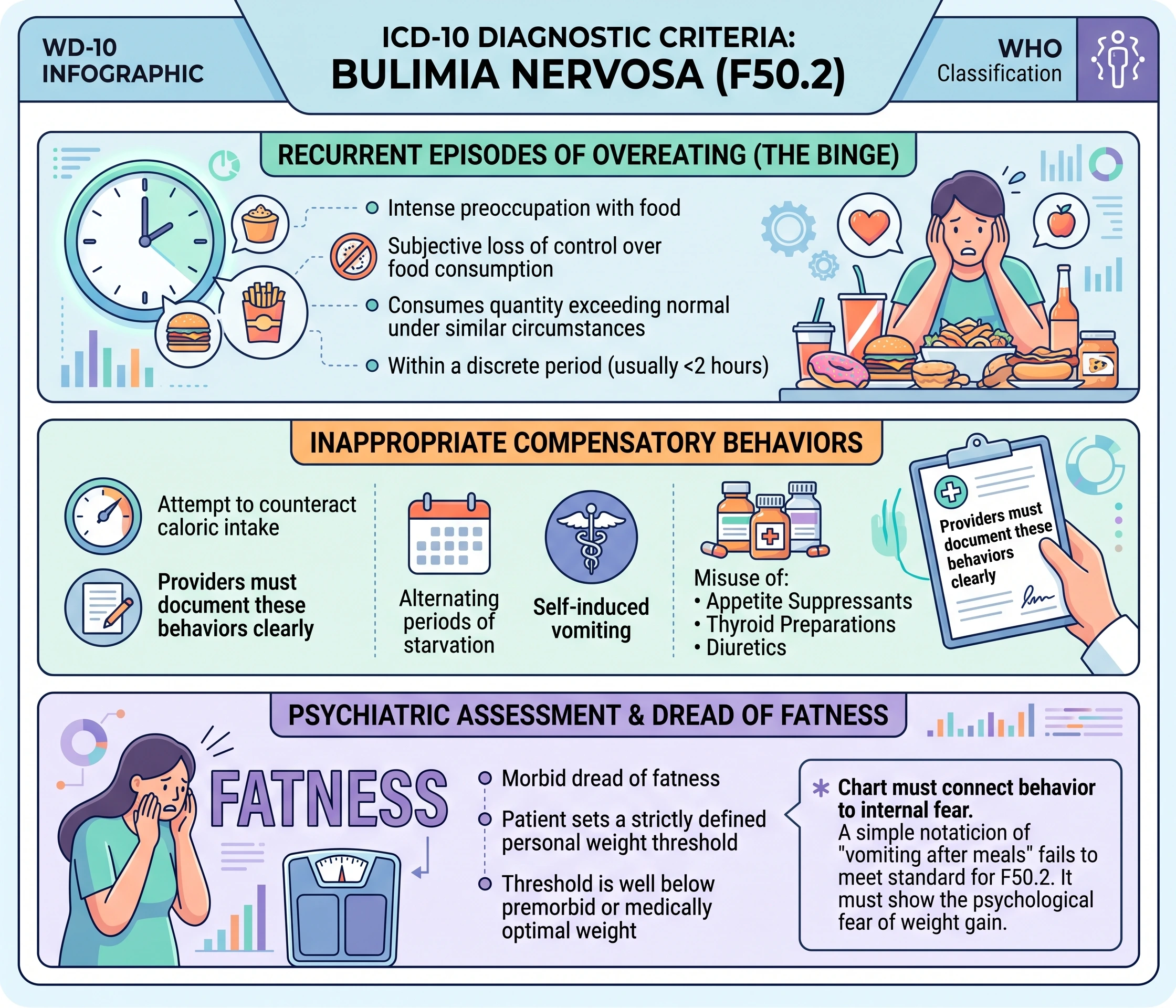
The World Health Organization structured the F50.2 classification to capture a distinct pattern of eating behaviors and psychological symptoms. ICD-10 defines bulimia nervosa by the presence of recurrent episodes of overeating accompanied by an intense preoccupation with food. Patients experience a subjective loss of control over their food consumption. They consume a quantity of food that exceeds what most individuals would eat under similar circumstances within a discrete period, usually defined as two hours.
To qualify for the F50.2 diagnosis, the patient must attempt to counteract the caloric intake through inappropriate compensatory behaviors. Providers must document these compensatory actions clearly. Common behaviors include self-induced vomiting, alternating periods of starvation, and the misuse of laxatives, appetite suppressants, thyroid preparations, or diuretics.
The psychiatric assessment usually reveals a morbid dread of fatness. The provider will often note that the patient sets a strictly defined personal weight threshold. This threshold falls well below the patient’s premorbid or medically optimal weight. The provider’s notes must reflect the patient’s internal fear. A simple notation of “vomiting after meals” fails to meet the standard for F50.2. The chart must connect the behavior to the psychological fear of weight gain.
Distinguishing F50.2 from related eating disorders
Medical billers frequently encounter claim denials due to overlapping symptoms between different eating disorders. The ICD-10 manual includes strict Excludes1 and Excludes2 notes to prevent contradictory code assignments.
An Excludes1 note signifies that two conditions cannot be billed together. For F50.2, anorexia nervosa (F50.0-) is an Excludes1 condition. A patient cannot receive a simultaneous active diagnosis of both anorexia nervosa and bulimia nervosa. If a patient with a history of anorexia develops bulimic symptoms, the provider must clarify whether the current presentation is a subtype of anorexia (such as anorexia nervosa, binge-eating/purging type, coded as F50.02) or a distinct transition to bulimia nervosa.
Atypical bulimia nervosa requires a different code. Providers assign F50.3 when a patient exhibits some features of bulimia nervosa but fails to meet the complete diagnostic criteria. A patient might engage in binge eating and purging behaviors but at a frequency that falls below the diagnostic threshold. Coders must read the physician’s exact wording. Assigning F50.2 when the physician wrote “atypical bulimia” constitutes upcoding.
Binge eating disorder (F50.81) shares the symptom of excessive food consumption but lacks the compensatory purging behaviors. If the provider documents recurrent binge eating without the presence of laxative abuse, fasting, or self-induced vomiting, the coder must assign F50.81 instead of F50.2.
Clinical documentation requirements for F50.2
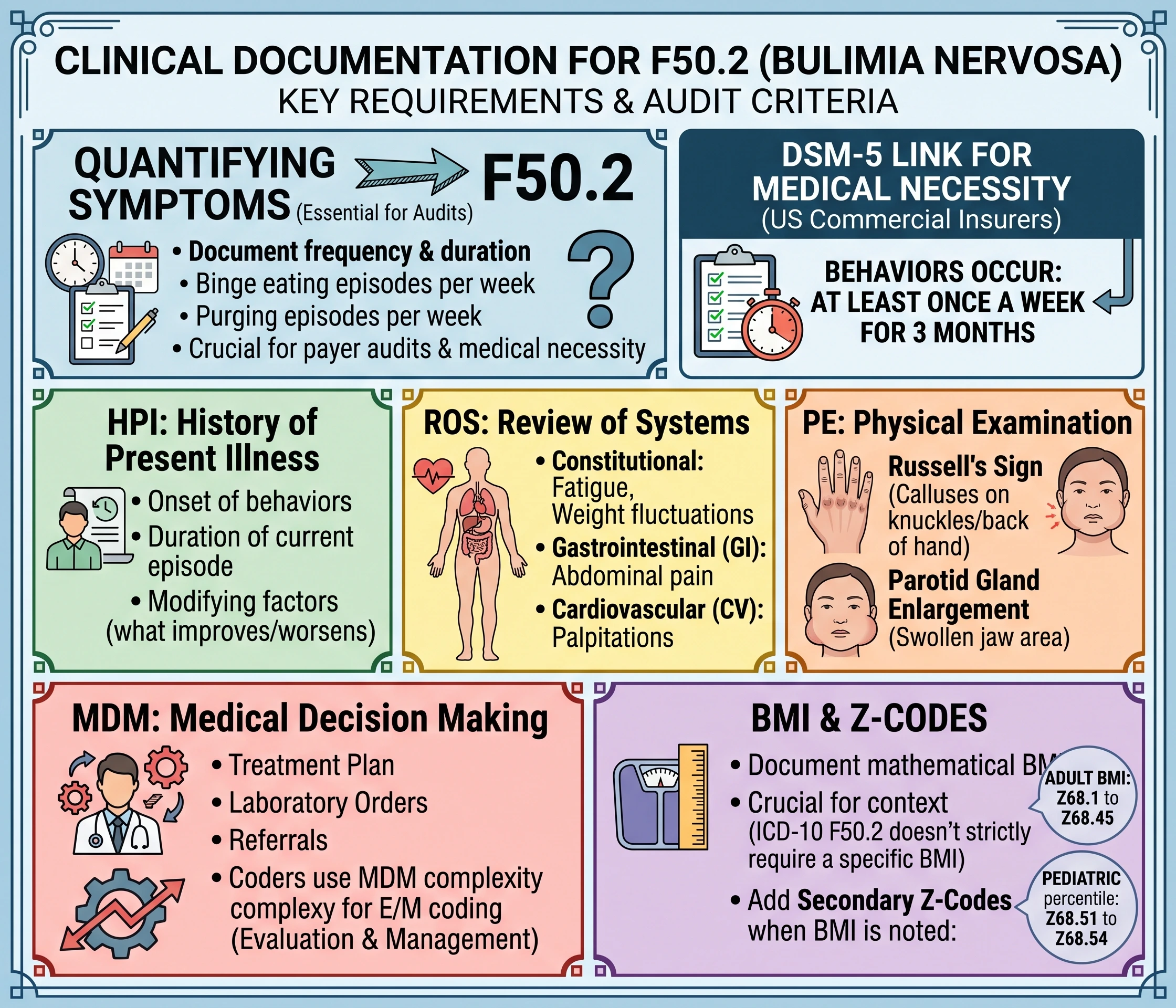
Insurance payers audit claims based on the specificity of the clinical documentation. To support an F50.2 diagnosis, the medical record must quantify the patient’s symptoms. Providers should document the frequency of binge eating and purging episodes per week. The Diagnostic and Statistical Manual of Mental Disorders, Fifth Edition (DSM-5) requires these behaviors to occur at least once a week for three months. While ICD-10 and DSM-5 operate as separate systems, most commercial insurers in the United States use DSM-5 criteria to determine the medical necessity of psychiatric diagnoses.
A complete medical record for a patient with bulimia nervosa contains specific elements across multiple sections:
- History of Present Illness (HPI): The provider documents the onset of the behaviors, the duration of the current episode, and modifying factors.
- Review of Systems (ROS): The physician notes constitutional symptoms such as fatigue or weight fluctuations. The gastrointestinal ROS often includes abdominal pain. The cardiovascular ROS documents any reported palpitations.
- Physical Examination: The physician details objective findings. A physical sign of self-induced vomiting is Russell’s sign, which involves calluses on the knuckles or back of the hand. The provider might also document parotid gland enlargement.
- Medical Decision Making (MDM): The provider outlines the treatment plan, laboratory orders, and referrals. Coders use the complexity of the MDM to select the appropriate Evaluation and Management (E/M) code.
The medical record should include the patient’s current Body Mass Index (BMI). While ICD-10 does not strictly require a specific BMI for the F50.2 code, the presence of an adult BMI code (Z68.1 to Z68.45) or pediatric BMI percentile code (Z68.51 to Z68.54) provides necessary context. Coders should append the appropriate Z-code as a secondary diagnosis when the provider documents the mathematical BMI value.
Coding physical complications of bulimia nervosa
Bulimia nervosa rarely exists in a clinical vacuum. The repetitive cycle of binging and purging damages multiple organ systems. When a patient receives inpatient treatment, the primary reason for admission is often a severe physiological complication rather than the psychiatric diagnosis itself. Coders must follow inpatient sequencing rules to determine the principal diagnosis.
If a patient is admitted for severe hypokalemia caused by self-induced vomiting, the coder sequences the hypokalemia first. The provider documents the metabolic disturbance, and the coder assigns E87.6 (Low potassium level). F50.2 becomes the secondary diagnosis.
Cardiac arrhythmias pose the highest mortality risk for patients with active bulimia nervosa. Severe electrolyte imbalances disrupt normal cardiac conduction. If an electrocardiogram (ECG) reveals an abnormality, the provider documents the specific arrhythmia. The coder assigns a code from the I49 category, such as I49.9 (Cardiac arrhythmia, unspecified), or a more specific code if the physician details the exact block or tachycardia.
Gastrointestinal and dental complications appear frequently in outpatient and dental billing. A 2022 study published in the Journal of the American Dental Association found that up to 89% of patients with bulimia nervosa exhibit signs of dental erosion.
|
Clinical Condition |
ICD-10 Code |
Description |
|
Hypokalemia |
E87.6 |
Low blood potassium |
|
Mallory-Weiss syndrome |
K22.6 |
Gastro-esophageal laceration with hemorrhage |
|
Dental erosion |
K03.2 |
Erosion of teeth from repeated exposure to gastric acid |
|
Esophagitis |
K20.9 |
Inflammation of the esophagus |
|
Dehydration |
E86.0 |
Volume depletion |
Coders should only assign these additional codes if the provider explicitly documents them and indicates they require evaluation, treatment, or extended length of stay. Linking the physiological complication to the eating disorder requires the provider to document a cause-and-effect relationship, usually written as “hypokalemia secondary to bulimia nervosa.”
Pharmacological management and medication coding
Treatment for bulimia nervosa often involves a combination of psychotherapy and pharmacotherapy. The US Food and Drug Administration (FDA) approved fluoxetine for the treatment of bulimia nervosa in 1996. Providers prescribe this selective serotonin reuptake inhibitor (SSRI) to reduce binge-eating and purging behaviors.
When providers prescribe long-term medications, coders may need to assign additional Z-codes to capture the management of these prescriptions. The code Z79.899 (Other long term (current) drug therapy) applies when a patient takes an SSRI continuously. Coders must verify payer-specific guidelines, as some Medicare Administrative Contractors consider Z79.899 redundant when billed alongside the primary psychiatric diagnosis.
Coders must distinguish between adverse effects and poisoning when coding complications from weight-loss drugs or laxatives. An adverse effect occurs when a patient takes the correct dosage of a prescribed medication but experiences a negative reaction. Poisoning occurs when a patient intentionally takes an overdose. If a patient with bulimia nervosa intentionally ingests a massive dose of diuretics to accelerate weight loss, the coder classifies this as poisoning. The coder references the ICD-10 Table of Drugs and Chemicals, selects the specific substance, and assigns the code for intentional self-harm.
Reimbursement and medical necessity guidelines
Health insurance companies scrutinize eating disorder treatments due to the high cost of extended inpatient or residential care. Providers must establish clear medical necessity to secure authorization for higher levels of care. The American Psychiatric Association (APA) publishes specific level-of-care guidelines for patients with eating disorders.
For an outpatient claim, an F50.2 diagnosis generally supports routine psychotherapy codes, such as 90834 (Psychotherapy, 45 minutes with patient). When the treatment team recommends partial hospitalization (PHP) or intensive outpatient programs (IOP), the documentation must show that the patient failed lower levels of care or exhibits a high risk of medical instability.
Billers use revenue codes to indicate the level of care for facility billing. Revenue code 0912 designates partial hospitalization for psychiatric treatment. To prevent denials, the billing department must ensure the clinical documentation matches the intensity of the revenue code. If a chart lacks notes regarding daily weight monitoring, electrolyte panels, or supervised meals, the payer will usually downgrade the claim to standard outpatient therapy.
When a payer denies an F50.2 claim for lack of medical necessity, the billing department initiates an appeal. The appeals specialist gathers the clinical notes, laboratory results, and therapy logs. They compare these records against the Milliman Care Guidelines or InterQual criteria used by the insurance company. Successful appeals require objective data. The appeal letter must point to specific documented facts, such as a documented 10% weight loss over 30 days or laboratory reports showing critical potassium levels.
Risk adjustment and Hierarchical Condition Categories (HCC)
Medicare Advantage plans and some commercial insurers use the Hierarchical Condition Category model to predict future healthcare costs. Diagnoses map to specific risk scores. Under the Centers for Medicare & Medicaid Services HCC model, specific mental health conditions carry weighted risk scores.
Accurate assignment of F50.2 ensures the patient’s risk profile reflects their true clinical complexity. If a provider treats a patient for bulimia nervosa but only codes a generic anxiety disorder, the health plan underestimates the expected cost of care. Providers must evaluate and document the condition at least once per calendar year to maintain the active HCC capture. The documentation must follow the MEAT criteria. The provider must Monitor, Evaluate, Assess, or Treat the bulimia nervosa during the face-to-face encounter for the code to validate the risk score.
Telehealth considerations for eating disorder treatment
The delivery of psychiatric care changed following the regulatory shifts of 2020. The Centers for Medicare & Medicaid Services (CMS) expanded telehealth coverage, allowing providers to treat patients with F50.2 remotely.
Medical billers must apply the correct place of service (POS) codes and modifiers for these virtual encounters. For commercial claims, billers typically append modifier 95 (Synchronous telemedicine service rendered via a real-time interactive audio and video telecommunications system) to the standard E/M or psychotherapy CPT codes.
Providers face specific challenges documenting bulimia nervosa via telehealth. They cannot physically obtain a patient’s weight or check orthostatic vitals. Documentation must explicitly state that the weight is patient-reported. If the provider suspects medical instability based on visual assessment or reported symptoms during the video visit, they must document the referral to an in-person facility for laboratory testing.
Transitioning data to the ICD-11 framework
The World Health Organization implemented the Eleventh Revision of the International Classification of Diseases (ICD-11) globally in January 2022. While the United States healthcare system uses the ICD-10-CM clinical modification for claims processing, medical researchers and international health organizations have adopted the new taxonomy.
In ICD-11, bulimia nervosa falls under code 6B81. The diagnostic parameters in ICD-11 place a stronger emphasis on the subjective sense of a loss of control during eating episodes. ICD-11 also explicitly addresses the impact of the disorder on the patient’s personal, family, and occupational functioning. Healthcare administrators monitor ICD-11 updates to prepare crosswalks for future systemic implementations. Current billing software maps exclusively to the F50 block, but hospital systems use ICD-11 data to standardize international research registries regarding eating disorder treatment outcomes.
Accurate capture of bulimia nervosa requires precise alignment between physician documentation and the ICD-10 coding manual. Medical coders rely on exact documentation of compensatory behaviors, episode frequency, and associated physical complications to assign F50.2 and its required secondary codes. Health insurance payers demand this specificity to determine medical necessity for partial hospitalization, intensive outpatient programs, and pharmaceutical management. By detailing the physiological and psychological parameters of the disorder, healthcare facilities maintain compliance with billing regulations and generate accurate epidemiological data.