



F42.9 ICD-10 Code: Documentation, Diagnosis, and Reimbursement Tips
Coders reach for F42.9 more often than most OCD claims should require. It is the catch-all for obsessive-compulsive disorder when the record does not pin down a specific presentation. That makes it useful and, at the same time, a frequent target for payer questions. The F42.9 ICD-10 code sits inside a small family of codes that changed shape in 2016, and that history explains most of the confusion that shows up on rejected claims.
This article covers what the code represents, how it differs from the codes it gets swapped with, what documentation supports it, and how to keep reimbursement clean.
What the F42.9 ICD-10 code covers
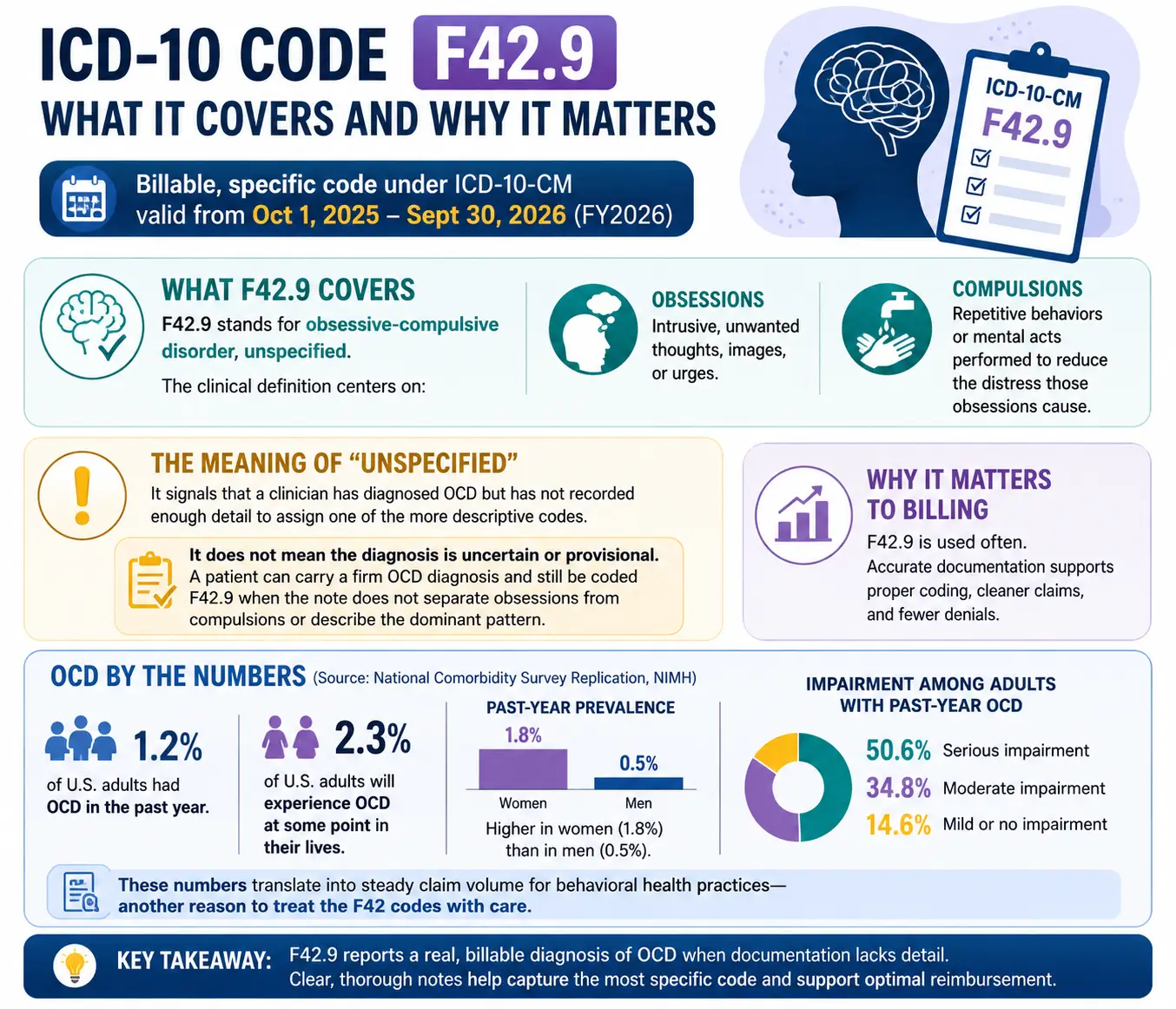
F42.9 stands for obsessive-compulsive disorder, unspecified. It is a billable, specific code under ICD-10-CM, valid for claims with dates of service from October 1, 2025 through September 30, 2026 under the FY2026 code set. The clinical definition centers on recurrent obsessions (intrusive, unwanted thoughts, images, or urges) and compulsions (repetitive behaviors or mental acts performed to reduce the distress those obsessions cause).
“Unspecified” carries a narrow meaning here. It signals that a clinician has diagnosed OCD but has not recorded enough detail to assign one of the more descriptive codes. It does not mean the diagnosis is uncertain or provisional. A patient can carry a firm OCD diagnosis and still be coded F42.9 when the note does not separate obsessions from compulsions or describe the dominant pattern.
Why does any of this matter to a busy billing desk? Volume. Drawing on the National Comorbidity Survey Replication, the National Institute of Mental Health estimates that 1.2% of U.S. adults had OCD in the past year and that 2.3% experience it at some point in their lives. Past-year prevalence runs higher in women (1.8%) than in men (0.5%). Among adults with past-year OCD, roughly half (50.6%) had serious impairment, with another 34.8% at moderate impairment. Those figures turn into steady claim volume for behavioral health practices, which is reason enough to treat the F42 codes with care rather than reflex.
How F42.9 fits inside the F42 family
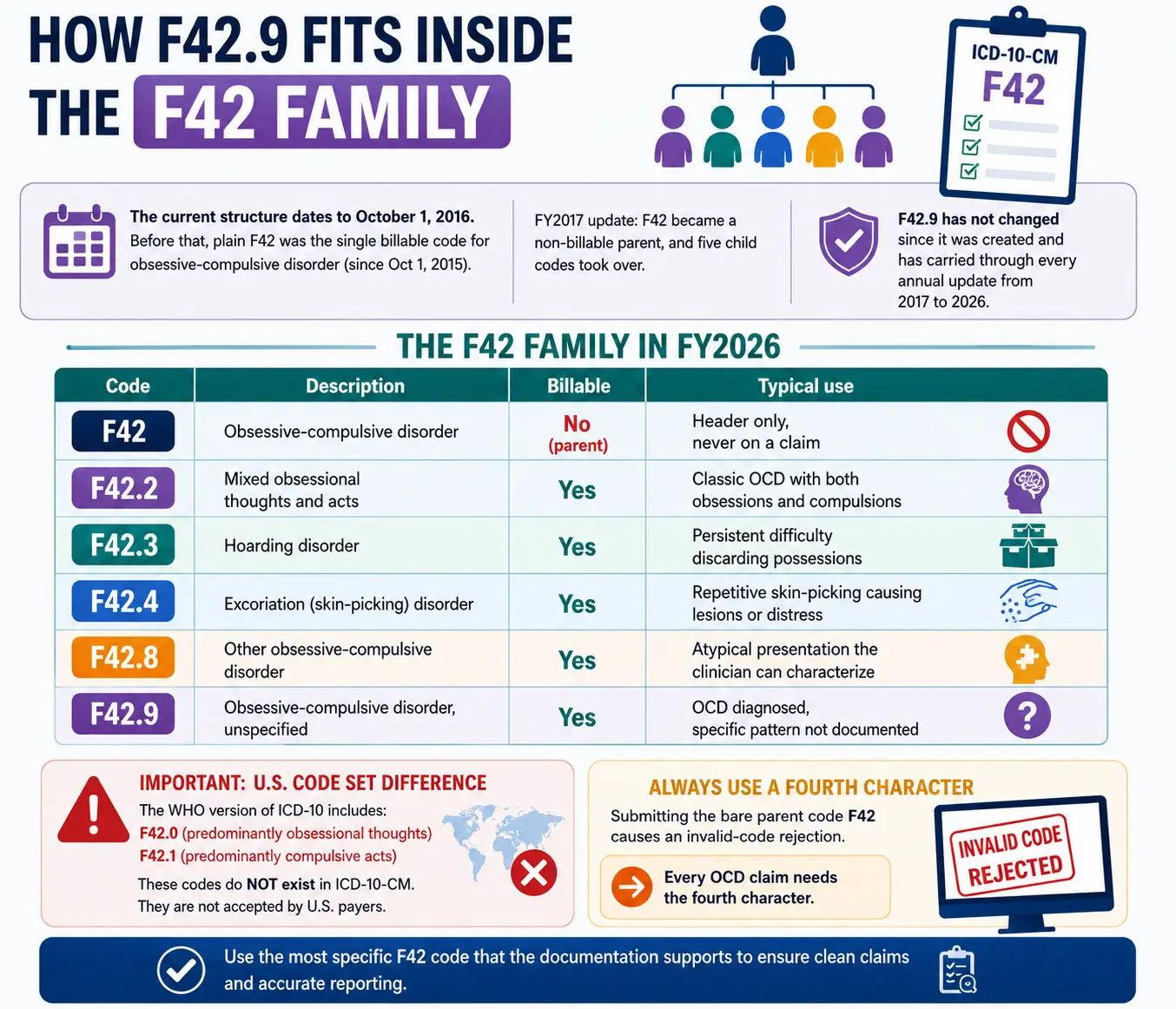
The current structure dates to October 1, 2016. Before that, going back to the start of ICD-10-CM on October 1, 2015, plain F42 was a single billable code for obsessive-compulsive disorder. The FY2017 update ended that arrangement. F42 became a non-billable parent, and five child codes took over the reporting work. F42.9 has not changed since it was created, carrying through every annual update from 2017 to 2026 without revision.
Here is the family as it stands in FY2026:
|
Code |
Description |
Billable |
Typical use |
|
F42 |
Obsessive-compulsive disorder |
No (parent) |
Header only, never on a claim |
|
F42.2 |
Mixed obsessional thoughts and acts |
Yes |
Classic OCD with both obsessions and compulsions |
|
F42.3 |
Hoarding disorder |
Yes |
Persistent difficulty discarding possessions |
|
F42.4 |
Excoriation (skin-picking) disorder |
Yes |
Repetitive skin-picking causing lesions or distress |
|
F42.8 |
Other obsessive-compulsive disorder |
Yes |
Atypical presentation the clinician can characterize |
|
F42.9 |
Obsessive-compulsive disorder, unspecified |
Yes |
OCD diagnosed, specific pattern not documented |
One detail catches people who cross-reference international sources. The World Health Organization version of ICD-10 includes F42.0 (predominantly obsessional thoughts) and F42.1 (predominantly compulsive acts). The U.S. clinical modification does not. There is no F42.0 or F42.1 in ICD-10-CM, so any reference sheet or template that lists them is pulling from the WHO code set, not the version American payers accept. Submit F42.0 and you will draw an invalid-code rejection.
Submitting the bare parent code F42 causes the same problem for a different reason. Every OCD claim needs the fourth character.
Where OCD sits: DSM-5 and ICD-10-CM disagree
A quiet source of friction for coders is that the two systems clinicians rely on file OCD in different places. In the DSM-5, published by the American Psychiatric Association in 2013, OCD was pulled out of the anxiety disorders and placed in a new chapter, “Obsessive-Compulsive and Related Disorders,” alongside body dysmorphic disorder, hoarding disorder, trichotillomania, and excoriation disorder. ICD-10-CM did not follow. F42 still lives in the F40 to F48 block, which is titled “Anxiety, dissociative, stress-related, somatoform and other nonpsychotic mental disorders.”
The practical effect is small but real. A clinician working from a DSM-5 frame may describe the diagnosis in that framework, while the biller has to land it in the ICD-10-CM structure payers require. Standard crosswalks handle the translation, and DSM-5-TR OCD (defined by obsessions, compulsions, or both) maps most often to F42.2. Recognizing that the two systems part ways here prevents the quiet assumption that a DSM label transfers one-to-one to a code.
F42.9 next to the codes it gets confused with
Most F42.9 errors are really mix-ups with neighboring codes. Four come up again and again.
F42.2 is the code most crosswalks land on for typical OCD, because it describes both obsessional thoughts and compulsive acts, which matches how the disorder usually presents. When a note documents both, F42.2 is the more accurate choice than F42.9.
F42.8 is for a presentation the clinician understands well enough to call atypical, such as certain body-focused behaviors or culturally specific variants. The distinction from F42.9 is about clarity rather than severity. F42.8 reflects a confident read of an unusual case. F42.9 reflects a case still being sorted out.
F60.5 is obsessive-compulsive personality disorder, a separate condition in the personality disorder block. It describes a rigid, perfectionistic character style, not the intrusive obsessions and compulsions of OCD. Despite the shared name, the two are unrelated diagnostically, and mixing them is a common documentation error.
R46.81 is obsessive-compulsive behavior. It is a symptom code from the “symptoms and signs” chapter, appropriate when a clinician observes the behavior without diagnosing the disorder itself.
ICD-10-CM flags several of these relationships directly. The F42 category carries Excludes2 notes for obsessive-compulsive personality disorder (F60.5) and for obsessive-compulsive symptoms occurring in depression (F32.-, F33.-) or in schizophrenia (F20.-). Excludes2 means “not included here.” If a patient genuinely has both conditions, both codes may appear on the claim. That is different from an Excludes1 note, which would bar the two from being reported together.
Documentation that supports F42.9
The ICD-10-CM Official Guidelines for Coding and Reporting allow unspecified codes when the record does not contain the detail a more specific code requires. The guidance is direct. A more specific code is preferable, but a specific code should not be used unless the documentation supports it. Coding F42.2 off a note that never mentions compulsions invents clinical information, which is the opposite of what an auditor wants to find.
F42.9 is defensible in the right situations:
- An intake where OCD is diagnosed but the presentation has not been characterized yet.
- A records review or handoff where the underlying detail is unavailable.
- An early session before symptom dimensions and compulsive patterns are clear.
It is harder to defend after several visits. By the time a clinician has run an assessment such as the Yale-Brown Obsessive-Compulsive Scale and charted specific obsessions and compulsions, the record usually supports F42.2 or another child code. Repeated F42.9 across a long course of treatment is a pattern that invites review.
Strong OCD documentation names the obsessions (their content and intrusive quality), the compulsions (what the patient does and the purpose it serves), the time burden or functional impairment, and the clinician’s diagnostic reasoning. When those elements are present, the note points to a specific code on its own. When they are thin, F42.9 is the honest choice, and the correct fix is better charting, not a guessed code.
Reimbursement tips for the F42.9 ICD-10 code
A diagnosis code does not bill a service by itself. F42.9 identifies the condition. The encounter is billed with a CPT code, such as 90791 for a psychiatric diagnostic evaluation or the psychotherapy codes (90832, 90834, and 90837) for treatment sessions. Exposure and response prevention, the first-line behavioral treatment for OCD, has no dedicated CPT code and is reported under the standard psychotherapy codes. The diagnosis and the service have to fit together for the claim to clear.
A handful of habits keep F42.9 claims moving:
- Check payer policy before leaning on the unspecified code. Some commercial plans and prior-authorization programs review unspecified behavioral health diagnoses more closely and may request records or a specific code before approving certain services.
- Re-evaluate the code as treatment progresses. If the diagnosis sharpens to mixed obsessions and compulsions, move to F42.2 on later claims so the record and the code stay aligned.
- Capture co-occurring conditions. OCD frequently accompanies depression and anxiety disorders, and coding those alongside F42.9 (where the Excludes2 rules allow) can help support medical necessity for the level of care.
- Watch the confusable codes. A claim that accidentally pairs an OCD service with F60.5 or R46.81 can trigger automated edits and manual review.
For inpatient reporting, F42.9 groups to MS-DRG 882, Neuroses except depressive, under the Medicare severity DRG system. Most OCD care happens in the outpatient setting, so this point matters mainly for facilities.
A short scenario shows how the logic plays out in practice. A new patient presents with contamination fears and hours of daily handwashing. The intake clinician diagnoses OCD, but the first note records the fears without detailing the ritual, so the biller assigns F42.9 for that visit. At the second session, the clinician documents both the intrusive thoughts and the washing compulsion. From that visit forward, F42.2 is the supported code. The change is not a correction of an error. It reflects documentation catching up to the clinical picture, and it is precisely the progression payers expect to see.
Summary
F42.9 is the billable ICD-10-CM code for obsessive-compulsive disorder, unspecified, valid through September 30, 2026. It belongs to a five-code family created on October 1, 2016, when the older single F42 code was retired as a non-billable parent, and it has not changed since. Reserve it for cases where OCD is diagnosed but the record does not yet support F42.2, F42.3, F42.4, or F42.8, then move to the specific code once documentation describes the presentation. Keep it clearly separate from F60.5 and R46.81, respect the Excludes2 notes, and recheck the code as clinical detail accumulates. Accurate coding here comes down to matching the code to what the chart actually documents rather than defaulting to the safest-looking option.