


F20.0 ICD-10 Code: Diagnosis, Documentation, and Reimbursement Guide
The F20.0 ICD-10 code reports paranoid schizophrenia, and it sits at an awkward intersection in American medicine. The manual that most United States clinicians use to make the diagnosis, the DSM-5, retired the paranoid subtype in 2013. The code set those same clinicians must use to bill kept it. New coders and seasoned ones both stumble over that gap. This guide explains what the code means, when it applies, how to document it defensibly, and how it moves through the payment system.
What the F20.0 ICD-10 code covers
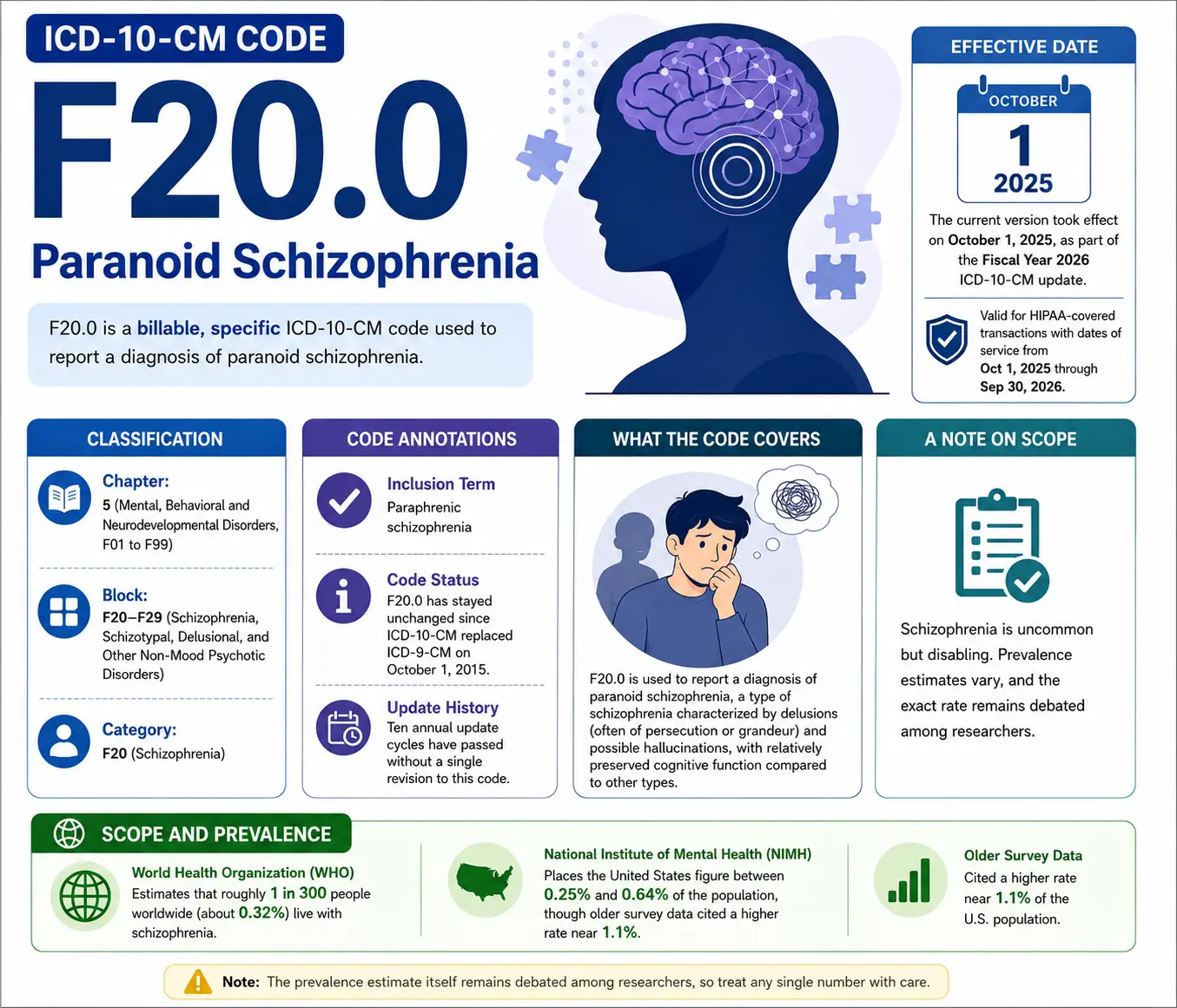
F20.0 stands for paranoid schizophrenia. It is a billable, specific ICD-10-CM code, which means it carries enough detail to appear on a claim without any additional characters. Within the classification it belongs to Chapter 5 (Mental, Behavioral and Neurodevelopmental disorders, F01 to F99), inside the F20 to F29 block (schizophrenia, schizotypal, delusional, and other non-mood psychotic disorders), under category F20 (schizophrenia).
The current version took effect on October 1, 2025, as part of the fiscal year 2026 ICD-10-CM update maintained by the Centers for Medicare and Medicaid Services and the National Center for Health Statistics. It is valid for HIPAA-covered transactions with dates of service from October 1, 2025 through September 30, 2026.
The code annotations recognize one inclusion term, paraphrenic schizophrenia. F20.0 has stayed unchanged since ICD-10-CM replaced ICD-9-CM on October 1, 2015. Ten annual update cycles have passed without a single revision to it.
A note on scope. Schizophrenia is uncommon but disabling. The World Health Organization estimates that roughly 1 in 300 people worldwide (about 0.32 percent) live with it, and the National Institute of Mental Health places the United States figure between 0.25 percent and 0.64 percent of the population, though older survey data cited a higher rate near 1.1 percent. The prevalence estimate itself remains debated among researchers, so treat any single number with care.
Why the DSM-5 and ICD-10-CM disagree about paranoid schizophrenia
Here is the source of most confusion around this code.
In May 2013, the American Psychiatric Association published the DSM-5 and eliminated the five classic schizophrenia subtypes: paranoid, disorganized, catatonic, undifferentiated, and residual. The APA’s own summary, “Highlights of Changes from DSM-IV-TR to DSM-5,” attributed the decision to the subtypes’ “limited diagnostic stability, low reliability, and poor validity.” Clinicians frequently disagreed on which subtype a patient had, and the labels did not predict treatment response or the course of illness. In place of subtypes, the DSM-5 introduced a dimensional approach that rates the severity of core symptoms.
ICD-10-CM did not follow. It retained F20.0 (paranoid), F20.1 (disorganized), F20.2 (catatonic), F20.3 (undifferentiated), and F20.5 (residual) as separate billable codes. The World Health Organization went the other direction: ICD-11, which WHO adopted for global use, drops the traditional subtypes in favor of symptom specifiers, aligning it more closely with the DSM-5.
So a United States provider can face three reference systems at once. The DSM-5-TR (the 2022 text revision) is used to reach the diagnosis. ICD-10-CM is used to bill it. ICD-11 shapes international research and comparison. Only ICD-10-CM still contains a discrete code for the paranoid presentation.
The practical result matters for coders. When a clinician diagnoses “schizophrenia” strictly by DSM-5-TR criteria and records nothing more specific, the correct code is F20.9, schizophrenia unspecified, not F20.0. F20.0 belongs to records where the provider documents paranoid features by name.
When F20.0 still applies
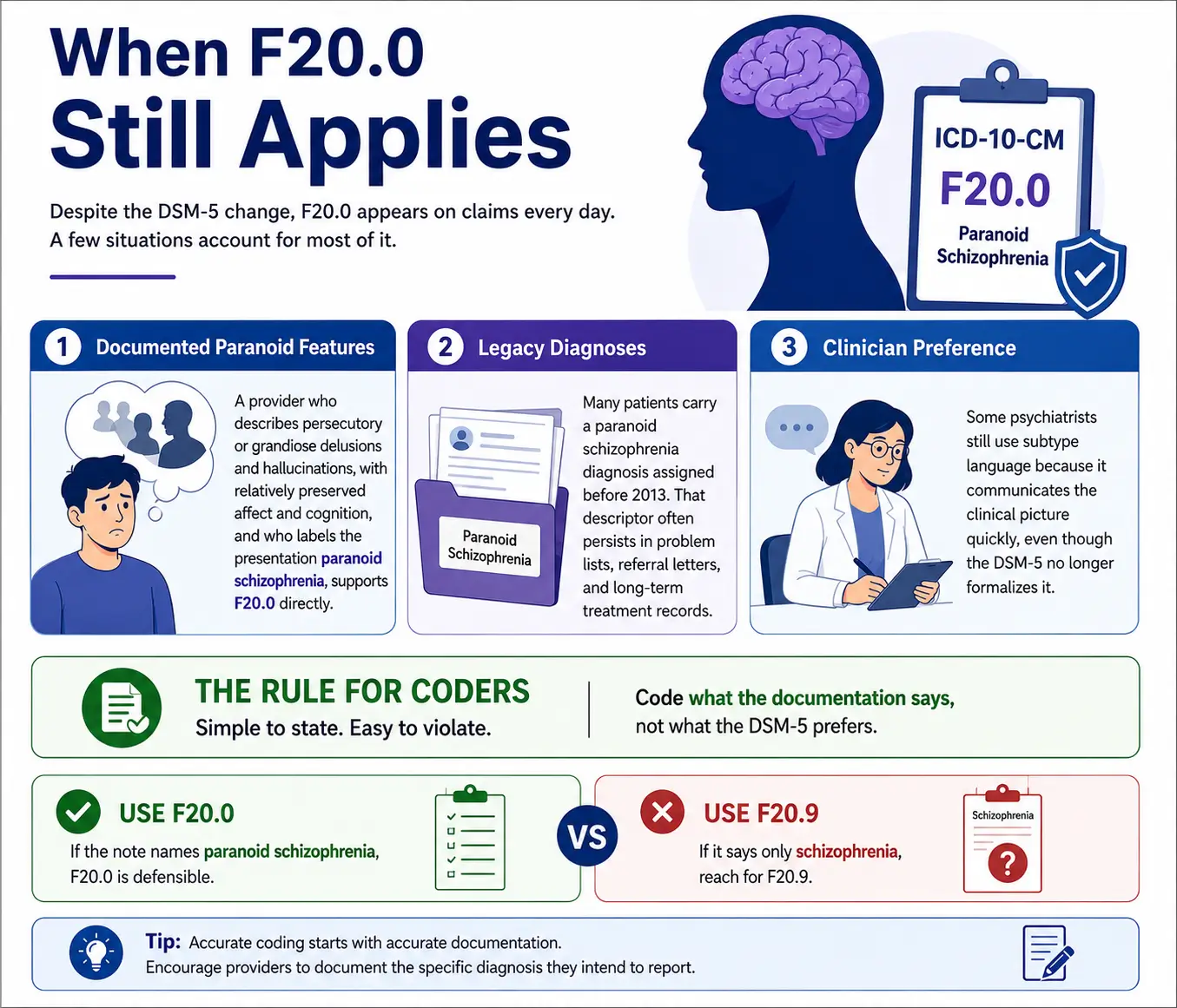
Despite the DSM-5 change, F20.0 appears on claims every day. A few situations account for most of it.
- Documented paranoid features. A provider who describes persecutory or grandiose delusions and hallucinations, with relatively preserved affect and cognition, and who labels the presentation paranoid schizophrenia, supports F20.0 directly.
- Legacy diagnoses. Many patients carry a paranoid schizophrenia diagnosis assigned before 2013. That descriptor often persists in problem lists, referral letters, and long-term treatment records.
- Clinician preference. Some psychiatrists still use subtype language because it communicates the clinical picture quickly, even though the DSM-5 no longer formalizes it.
The rule for coders is simple to state and easy to violate: code what the documentation says, not what the DSM-5 prefers. If the note names paranoid schizophrenia, F20.0 is defensible. If it says only schizophrenia, reach for F20.9.
Documentation that supports the F20.0 code
Specificity separates a clean claim from a denied one. F20.0 asks the record to show a particular clinical shape.
The note should establish the presence of persecutory or grandiose delusions, or prominent hallucinations, as the leading feature. It should show that symptoms have persisted, generally for a month or longer for the active phase, with continuous signs of disturbance over a longer span. Cognition and affect are usually described as comparatively intact, which is what distinguishes the paranoid presentation from the disorganized one. Positive symptoms carry the diagnosis; a record built only on negative symptoms points elsewhere.
Two habits protect the code. First, tie the diagnostic statement to observed findings in the same encounter rather than copying a label from an old problem list. Second, avoid coding schizophrenia from a medication list or a scheduling note; an antipsychotic prescription is not a diagnosis.
When the documentation is thinner, F20.9 is the honest choice. Reporting F20.0 without paranoid-specific findings inflates specificity the record cannot back up, and that is exactly the pattern auditors look for.
Excludes notes and additional codes tied to F20.0
ICD-10-CM attaches several instructional notes to F20.0 and to its parent category. Ignoring them produces edits and denials.
F20.0 carries a Type 1 Excludes note pointing to category F22 (delusional disorders), covering involutional paranoid state and paranoia. A Type 1 Excludes note means the two codes are mutually exclusive and must never be reported together for the same condition.
The parent F20 category adds more Type 1 Excludes that flow down to F20.0. You cannot report F20.0 together with brief psychotic disorder (F23), schizoaffective disorder (F25.-), cyclic schizophrenia (F25.0), or a mood disorder with psychotic symptoms (for example F30.2, F31.2, or F32.3) when the excluded condition is the actual diagnosis.
The category also lists Type 2 Excludes, which behave differently. A Type 2 Excludes note means the excluded condition is not part of F20 but can be reported alongside it when both are present. Schizotypal disorder (F21) and psychoactive substance use with a schizophrenia-like reaction (codes in the F10 to F19 range) fall here.
One Use Additional instruction applies at the category level: add a code, if applicable, to identify an associated cognitive deficit (R41.84-). When the record documents a measurable cognitive problem alongside the psychosis, the secondary code belongs on the claim.
The table below sets F20.0 next to the codes it is most often confused with.
Code | Description | Reach for it when |
F20.0 | Paranoid schizophrenia | Note documents persecutory or grandiose delusions or hallucinations, with preserved affect |
F20.9 | Schizophrenia, unspecified | Note states schizophrenia with no subtype detail (the usual DSM-5-TR result) |
F25.- | Schizoaffective disorder | A mood episode is present for most of the illness after psychotic criteria are met |
F22 | Delusional disorders | Delusions without the fuller schizophrenia picture (mutually exclusive with F20.0) |
How the F20.0 code affects reimbursement
The code influences payment differently across care settings.
For inpatient stays paid under the Medicare Severity Diagnosis Related Group system, F20.0 groups to MS-DRG 885, Psychoses. That single DRG covers most acute psychiatric admissions for schizophrenia and related disorders, so the subtype distinction rarely changes the inpatient payment on its own; length of stay, procedures, and comorbidities move the needle more.
In outpatient behavioral health, F20.0 is a diagnosis code that must pair with a procedure code to generate payment. Common pairings include the psychiatric diagnostic evaluation (CPT 90792 when medical services are involved), individual psychotherapy sessions (such as CPT 90834 and 90837), and evaluation and management visits for medication management. The diagnosis supports medical necessity for the service billed, and payers test that link through coverage policies and claim edits.
Medical necessity is where behavioral health claims most often fail. A recurring example: a laboratory order that carries only a psychiatric diagnosis such as schizophrenia can be denied because the payer does not accept that diagnosis as justification for the test. The fix is not a better schizophrenia code but the correct diagnosis for the reason the test was ordered. Coders should confirm each payer’s local coverage determinations and behavioral health policies rather than assume a psychiatric code alone clears the necessity bar.
For Medicare Advantage patients, F20.0 carries its largest financial weight through risk adjustment. Under the CMS-HCC Version 28 model, which reached full phase-in for payment year 2026, the F20 schizophrenia codes map to HCC 151 (Schizophrenia). The community, non-dual, aged base relative factor for that category is 0.511, though the exact coefficient shifts by enrollment segment and should be checked against the current CMS rate announcement. Two points matter for coders. First, schizophrenia is a chronic condition, so the diagnosis has to be documented and recaptured every calendar year to keep the HCC; a patient stable on medication still has schizophrenia, and the note needs support at a face-to-face visit. Second, Version 28 rewards specificity: unspecified and low-severity behavioral health codes lost their risk-adjustment value in the transition from Version 24, which raises the stakes on documenting the condition clearly at every encounter.
Documentation quality, not the specific subtype, drives most reimbursement outcomes here. A record that supports F20.0 with clear paranoid findings, correct excludes handling, and a properly linked procedure code moves through adjudication cleanly.
F20.0 coding errors that trigger denials
A short field guide to the mistakes that recur most:
- Assigning F20.0 when the note documents only “schizophrenia.” Use F20.9 unless paranoid features are named.
- Reporting F20.0 with a Type 1 Excludes code such as F25.- (schizoaffective disorder) or F23 (brief psychotic disorder) for the same condition.
- Confusing F22 (delusional disorders) with F20.0. Delusions alone, without the broader schizophrenia picture, point to F22.
- Coding from a problem list or medication record instead of the current clinical documentation.
- Missing the Use Additional code for a documented cognitive deficit (R41.84-).
- Treating a psychiatric diagnosis as automatic proof of medical necessity for laboratory or ancillary services.
Summary
F20.0 is the FY2026 ICD-10-CM code for paranoid schizophrenia, effective October 1, 2025, and unchanged since ICD-10-CM began in 2015. It survives in the code set even though the DSM-5 removed the paranoid subtype in 2013 for its poor reliability and validity, which is why coders should reserve F20.0 for records that document paranoid features and default to F20.9 otherwise. Correct use depends on honoring the Type 1 Excludes links to F22, F23, and F25.-, adding R41.84- when a cognitive deficit is documented, and pairing the diagnosis with a procedure code that carries its own medical necessity. Get those pieces right, and the code does its job: describing the clinical picture accurately and supporting a claim that holds up under review.