


Understanding F34.1 Diagnosis Code: Symptoms, Billing, and ICD-10 Guidelines
The F34.1 diagnosis code identifies dysthymic disorder within the 10th revision of the International Statistical Classification of Diseases and Related Health Problems (ICD-10-CM). The American Psychiatric Association defines this condition as persistent depressive disorder (PDD). Patients with this diagnosis experience a consistently depressed mood for a minimum of two years. Medical billers, coders, and clinicians must adhere to specific documentation rules to report this code accurately. This guide details the clinical criteria, coding exclusions, and billing standards for F34.1.
Clinical definition and epidemiological statistics
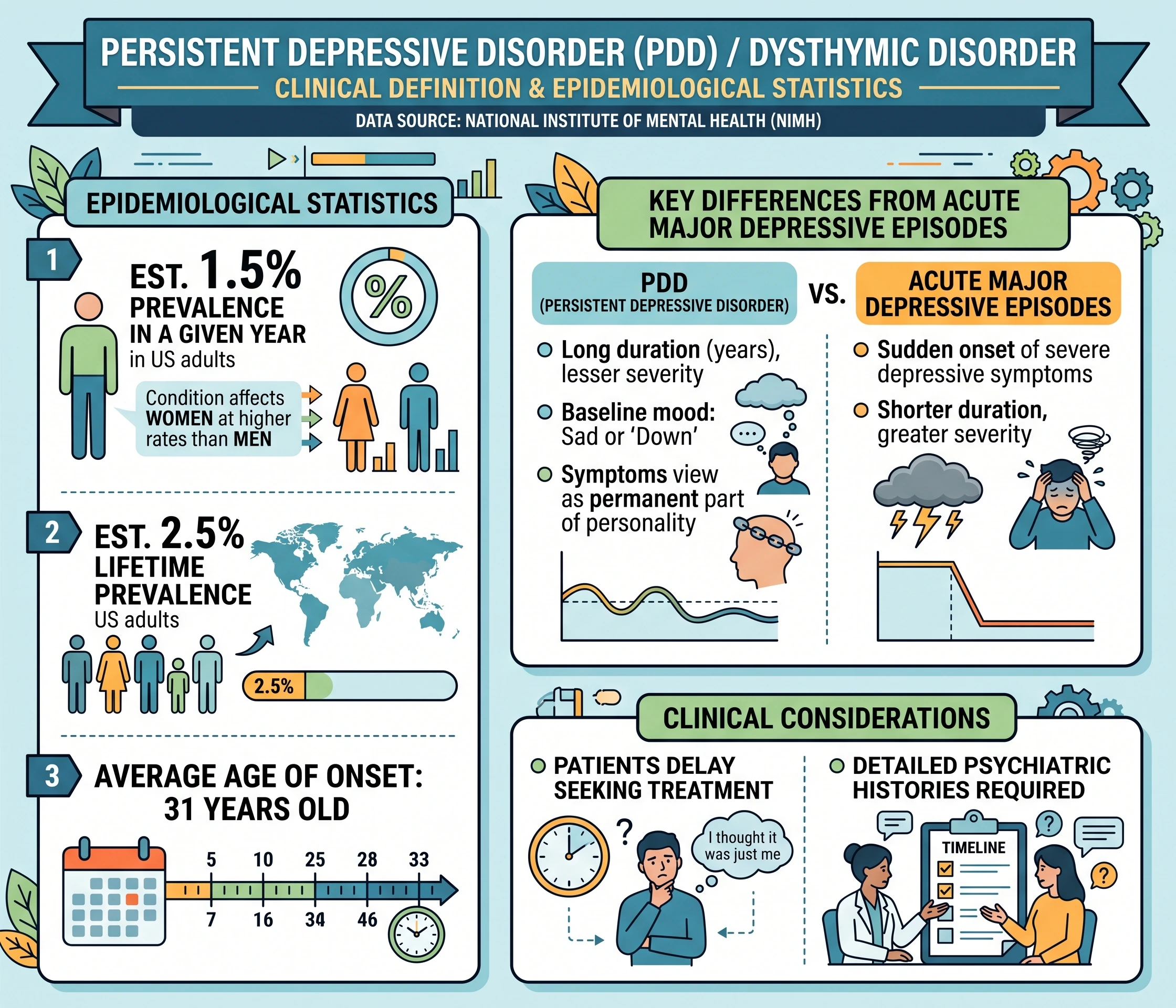
According to the National Institute of Mental Health (NIMH), an estimated 1.5 percent of adults in the United States experience persistent depressive disorder in a given year. The condition affects women at higher rates than men. The NIMH reports the lifetime prevalence for adults is 2.5 percent. The average age of onset is 31 years old.
Dysthymic disorder differs from acute major depressive episodes primarily in duration and symptom severity. Patients often describe their baseline mood as sad or down rather than experiencing a sudden onset of severe depressive symptoms. Because the symptoms persist for years, patients sometimes view their low mood as a permanent part of their personality. This delay in seeking treatment requires clinicians to take detailed psychiatric histories to establish the correct timeline for diagnostic purposes.
Diagnostic criteria for persistent depressive disorder
The Diagnostic and Statistical Manual of Mental Disorders, Fifth Edition, Text Revision (DSM-5-TR) outlines strict criteria for diagnosing this condition. The primary requirement is a depressed mood for most of the day, for more days than not, spanning at least 24 months in adult patients. Pediatric patients require a 12-month duration for the same diagnosis.
Clinicians must document the primary depressed mood alongside at least two secondary symptoms. These secondary symptoms include:
- Poor appetite or overeating
- Insomnia or hypersomnia
- Low energy or fatigue
- Low self-esteem
- Poor concentration or difficulty making decisions
- Feelings of hopelessness
The patient cannot be without symptoms for more than two consecutive months during the specified diagnostic period. If a patient experiences a manic or hypomanic episode, the F34.1 diagnosis becomes invalid. The provider must then evaluate the patient for a bipolar spectrum disorder.
ICD-10-CM classification and tabular list instructions
F34.1 is a billable, specific ICD-10-CM code. Providers use it to indicate a medical diagnosis for reimbursement purposes. The Centers for Disease Control and Prevention (CDC) updates ICD-10-CM codes annually. In the 2024 classification, F34.1 falls under the broader category F34, which covers persistent mood disorders.
The F34 category includes other distinct codes. Medical coders must select the specific code that matches the clinical documentation. The related codes in this block include:
- F34.0 (Cyclothymic disorder)
- F34.81 (Disruptive mood dysregulation disorder)
- F34.89 (Other specified persistent mood disorders)
- F34.9 (Persistent mood disorder, unspecified)
The tabular list for F34.1 includes several synonymous clinical terms. Coders should map the following documented terms directly to F34.1: depressive neurosis, depressive personality disorder, neurotic depression, persistent anxiety depression, and persistent depressive disorder.
Navigating Excludes1 and Excludes2 directives
Medical coders must strictly observe the exclusion notes attached to the F34 category. The ICD-10-CM manual uses two types of exclusion notes. An Excludes1 note translates to “not coded here.” It indicates that the excluded condition cannot be billed together with F34.1 on the same claim because the two conditions are mutually exclusive.
The Excludes1 directives for F34.1 prohibit reporting it alongside anxiety depression that is mild or not persistent (F41.8). It also strictly forbids billing F34.1 on the same claim as single-episode major depressive disorder (F32.0 through F32.9) and recurrent major depressive disorder (F33.0 through F33.9). If a patient presents with symptoms meeting the criteria for both a current major depressive episode and dysthymic disorder, standard coding practices prioritize the major depressive disorder code.
An Excludes2 note means “not included here.” It indicates that the patient may have both conditions simultaneously. If the clinical documentation supports both diagnoses, the coder may report both codes. Currently, the ICD-10-CM manual does not list any Excludes2 notes specifically under F34.1.
Provider documentation requirements for medical coders
Accurate medical coding begins with precise clinical documentation. A coder cannot assign F34.1 simply because a provider writes “depression.” The clinical notes must explicitly state “dysthymic disorder” or “persistent depressive disorder.”
If the provider records “depression” without specifying chronicity, the coder must assign F32.A (Depression, unspecified). Unspecified codes frequently result in claim denials. Commercial insurance payers and Medicare require specific diagnostic data to justify long-term psychiatric management.
Medical auditors look for temporal markers in the progress notes. The provider should document the exact onset date or clearly state that symptoms have persisted for over two years. The medical record must also reflect the ongoing treatment plan. This documentation usually includes psychotherapy modalities, such as cognitive behavioral therapy (CBT), and any prescribed pharmacological treatments.
Screening and assessment tools for F34.1
Clinicians frequently use standardized screening tools to quantify the severity of depressive symptoms. The Patient Health Questionnaire (PHQ-9) is the most common instrument used in primary care and psychiatric settings. The PHQ-9 asks patients to rate the frequency of nine specific depressive symptoms over the preceding two weeks.
While the PHQ-9 measures current symptom severity, it does not measure chronicity. A high PHQ-9 score alone cannot justify an F34.1 diagnosis. The provider must verbally confirm the two-year duration of symptoms. Medical billers can report the administration of the PHQ-9 using CPT code 96127 (Brief emotional/behavioral assessment, with scoring and documentation, per standardized instrument). Payers typically reimburse this assessment code when billed alongside an Evaluation and Management (E/M) visit and the F34.1 diagnosis code.
Procedure coding and F34.1 billing
Reimbursement depends on medical necessity. The procedure codes billed alongside F34.1 must align with standard psychiatric care. Providers frequently pair this diagnosis code with E/M codes. E/M codes 99213, 99214, and 99215 are standard for established patients undergoing medication management.
Psychotherapy codes also frequently accompany the F34.1 diagnosis. The American Medical Association (AMA) Current Procedural Terminology (CPT) manual categorizes psychotherapy codes by time. Common CPT codes billed with F34.1 include:
- 90832 (Psychotherapy, 30 minutes)
- 90834 (Psychotherapy, 45 minutes)
- 90837 (Psychotherapy, 60 minutes)
If a provider performs both medication management and psychotherapy during the same visit, they must bill an E/M code along with an add-on psychotherapy code (such as 90833, 90836, or 90838). The documentation must clearly separate the time spent on medication management from the time spent on psychotherapy to pass payer audits.
Comparing major depressive disorder and dysthymic disorder coding
Coders frequently navigate the distinction between acute and persistent depressive diagnoses. Major depressive disorder codes require fifth and sixth characters to indicate severity and remission status. Dysthymic disorder does not require additional characters. F34.1 stands alone as a complete four-character code.
|
Coding Feature |
Major Depressive Disorder (F32/F33) |
Dysthymic Disorder (F34.1) |
|
Duration requirement |
2 weeks minimum |
2 years minimum |
|
Code length |
4 to 6 characters |
4 characters |
|
Severity modifiers |
Yes (Mild, moderate, severe) |
No |
|
Remission modifiers |
Yes (Partial, full) |
No |
|
Condition type |
Episodic or recurrent |
Persistent and chronic |
The structural simplicity of the F34.1 diagnosis code limits the coder’s ability to express clinical improvement through diagnosis coding alone. Since there is no “F34.1 in partial remission” code available in the ICD-10-CM tabular list, providers demonstrate patient progress entirely through the narrative portions of the clinical encounter note.
Telehealth billing for dysthymic disorder
The delivery of psychiatric care relies heavily on virtual visits. The Centers for Medicare and Medicaid Services (CMS) maintains specific place of service (POS) rules for mental health telehealth encounters.
When a provider treats a patient with dysthymic disorder via a two-way, audio-video communication system, the biller typically uses POS 10 (Telehealth Provided in Patient’s Home) or POS 02 (Telehealth Provided Other than in Patient’s Home). Depending on the payer’s specific contract terms, the biller may also need to append modifier 95 (Synchronous Telemedicine Service Rendered via a Real-Time Interactive Audio and Video Telecommunications System) to the CPT codes.
CMS also permits audio-only telehealth visits for established mental health patients under certain conditions. For audio-only encounters, billers append modifier FQ (The service was furnished using audio-only communication technology) to the E/M or psychotherapy code associated with the F34.1 diagnosis.
Hierarchical Condition Category (HCC) risk adjustment
Medicare Advantage plans use the Hierarchical Condition Category (HCC) risk adjustment model to calculate patient risk scores. These scores determine the capitated payments insurance plans receive for managing a patient’s care. Accurate reporting of chronic psychiatric conditions directly affects these calculations.
Under the CMS-HCC Version 24 risk adjustment model, F34.1 mapped to HCC 59 (Major Depressive, Bipolar, and Paranoid Disorders). The Centers for Medicare and Medicaid Services implemented the CMS-HCC Version 28 model in 2024. Version 28 restructured the psychiatric categories and altered the risk weights for depressive disorders. Medical coders working in value-based care organizations must verify which CMS-HCC model their specific payer contracts use. They must capture the F34.1 diagnosis code at least once per calendar year during a face-to-face encounter to maintain the patient’s risk profile. Failing to report the chronic condition annually results in a drop in the patient’s risk score and subsequent revenue loss for the healthcare organization.
Commercial payer policies versus Medicare guidelines
Billing regulations for the F34.1 diagnosis code vary by payer. Medicare Part B operates under Local Coverage Determinations (LCDs) managed by regional Medicare Administrative Contractors (MACs). These MACs outline the specific medical necessity requirements for psychiatric services billed with F34.1. Medicare strictly enforces the documentation of a customized treatment plan. If an auditor finds a cloned treatment plan copied and pasted across multiple patient visits, Medicare will recoup the payments.
Commercial insurers, such as UnitedHealthcare and Aetna, publish their own medical policies for behavioral health services. Private payers often implement strict frequency limits on psychotherapy codes. A commercial plan might cover only 20 psychotherapy sessions per calendar year for a patient with dysthymic disorder. Once the patient exhausts this benefit, the biller must obtain prior authorization for additional sessions. The billing department must attach the F34.1 diagnosis code to the authorization request and provide clinical notes demonstrating why the chronic nature of the disorder requires extended therapy.
Audit compliance for behavioral health practices
Insurance companies conduct post-payment audits to verify that billed diagnosis codes match the clinical documentation. Practices specializing in behavioral health face continuous scrutiny regarding chronic condition coding.
During an audit of claims containing the F34.1 code, reviewers check the initial psychiatric evaluation. They verify that the provider established the two-year symptom duration. They also review subsequent encounter notes to ensure the condition remains active and requires ongoing management.
If a patient recovers and the provider discontinues treatment, the F34.1 code should not appear on future claims for unrelated medical visits. Continuing to bill a resolved psychiatric condition constitutes upcoding. This practice can trigger financial penalties from commercial payers and federal health programs.
The impact of DSM-5-TR updates on ICD-10 mapping
The American Psychiatric Association published the DSM-5-TR in 2022. This text revision consolidated chronic major depressive disorder and dysthymic disorder under the single diagnosis of persistent depressive disorder.
The ICD-10-CM manual maintained its existing structure. It lists dysthymic disorder as the primary descriptor for F34.1. This creates a terminological difference between clinical practice and coding manuals. Providers almost exclusively use the term “persistent depressive disorder” during clinical assessments. Medical coders map this term directly to the F34.1 code in the ICD-10 alphabetic index.
The World Health Organization (WHO) has scheduled the full implementation of ICD-11 for international mortality and morbidity statistics. The ICD-11 manual features updated psychiatric classifications that align more closely with the DSM-5-TR. The United States healthcare system currently continues to use the clinical modification of ICD-10. Medical coders will rely on F34.1 to report persistent depressive disorder until the federal government mandates the transition to ICD-11.
Accurate application of the F34.1 diagnosis code requires strict alignment between clinical assessment and standard coding guidelines. Providers establish the diagnosis by confirming a two-year history of depressed mood accompanied by at least two secondary symptoms. Medical coders translate this documentation into the specific F34.1 code while monitoring for Excludes1 violations involving major depressive disorder. Accurate mapping between the provider’s terminology and the ICD-10-CM tabular list ensures clean claims and compliant medical records. Medical billing professionals reduce denial rates by verifying that chronicity is explicitly stated in the clinical note prior to claim submission.