



99203 CPT Code Explained: Billing, Documentation, and Reimbursement Guide (2026)
Coders new to the office and outpatient E/M family often assume CPT code 99203 is the “easy” new patient code, one step above the entry level. That assumption causes problems. The code sits in the middle of a five-tier system that was rebuilt from the ground up in 2021, and the rules governing it have kept shifting since, most recently with a new Medicare add-on code and a 2026 fee schedule that pays physicians on two separate conversion factors for the first time in the program’s history. This guide walks through what CPT code 99203 actually requires, how to document it so it survives an audit, and what it pays under the current Medicare Physician Fee Schedule.
What is CPT code 99203?
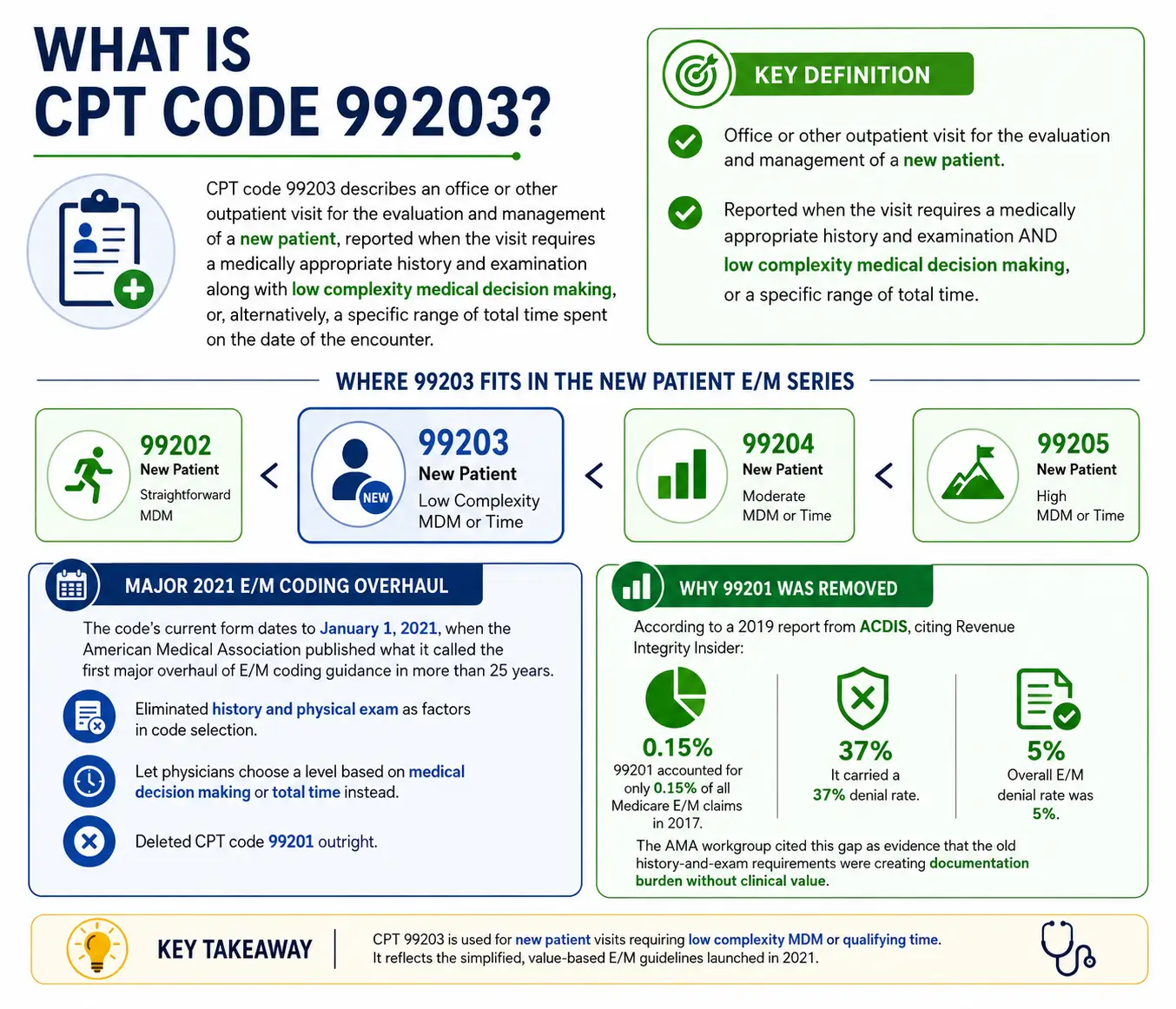
CPT code 99203 describes an office or other outpatient visit for the evaluation and management of a new patient, reported when the visit requires a medically appropriate history and examination along with low complexity medical decision making, or, alternatively, a specific range of total time spent on the date of the encounter. It sits third in the new patient series, below 99202 (straightforward MDM) and below 99204 and 99205 (moderate and high MDM).
The code’s current form dates to January 1, 2021, when the American Medical Association published what it called the first major overhaul of E/M coding guidance in more than 25 years. The revision eliminated history and physical exam as factors in code selection and let physicians choose a level based on medical decision making or total time instead. The change also deleted CPT code 99201 outright. According to a 2019 report from ACDIS, citing Revenue Integrity Insider, code 99201 accounted for only 0.15% of all Medicare E/M claims in 2017, yet carried a 37% denial rate against an overall E/M denial rate of 5%, a gap the AMA workgroup cited as evidence that the old history-and-exam requirements were creating documentation burden without clinical value. Since 99201 and 99202 both required straightforward MDM and differed only by history and exam depth, removing that distinction made 99201 redundant.
Who counts as a new patient
A patient qualifies as new for CPT code 99203 purposes when they, or another physician of the same specialty and subspecialty within the same group practice, have not received any professional face-to-face service from the billing provider within the prior three years. The three-year clock resets with each qualifying encounter, so a patient who saw the same internist in early 2023 and returns in 2026 has crossed the threshold and can again be billed as new, provided the visit otherwise meets the code’s requirements. Coders should verify this against the practice’s own claims history or EHR record before assigning any code in the 99202 to 99205 range. Misclassifying an established patient as new is a common and easily caught denial trigger, since payers can cross-reference their own claims data in seconds.
Two ways to select the code: MDM or time
The 2021 restructuring gave physicians a choice. A visit can be leveled by medical decision making or by total time, but not both, and whichever method is used, the documentation has to support it on its own.
Selecting by medical decision making
Medical decision making is built from three elements, and a code level is reached when two of the three are met or exceeded. For low complexity MDM, the threshold for 99203, the elements typically look like this:
MDM element | Low complexity threshold (99203) |
Number and complexity of problems addressed | Two or more self-limited or minor problems, one stable chronic illness, or one acute uncomplicated illness or injury |
Amount and complexity of data reviewed | Limited: meets one of two categories, such as reviewing or ordering a combination of two unique tests or prior external notes, or requires an independent historian |
Risk of complications, morbidity, or mortality | Low risk from the condition and from any tests or treatment ordered |
This table reflects the 2023 revision to the AMA’s MDM grid, which sharpened definitions that coders had struggled with since 2021, including how to count unique tests and how to credit review of records from an outside source. A frequent point of confusion, repeated even in some payer education materials, is the belief that 99203 requires moderate complexity MDM. It does not. Moderate complexity is the threshold for 99204. If a note only supports straightforward MDM, the correct code is 99202, not 99203.
Selecting by time
When time drives the code, CPT 99203 covers 30 to 44 minutes of total time on the date of the encounter. Total time is not limited to face-to-face minutes. Under AMA guidance, it includes preparing to see the patient by reviewing prior records, obtaining a history, performing an exam, counseling, ordering tests or medications, referring and communicating with other professionals when not separately reported, and documenting the encounter in the medical record, as long as all of that work happens on the same calendar day as the visit. Time spent the day before or after does not count. There is no rounding: a visit documented at 29 minutes supports 99202, and one at 45 minutes crosses into 99204 territory, even though both are close to the 99203 range.
Documentation that supports 99203
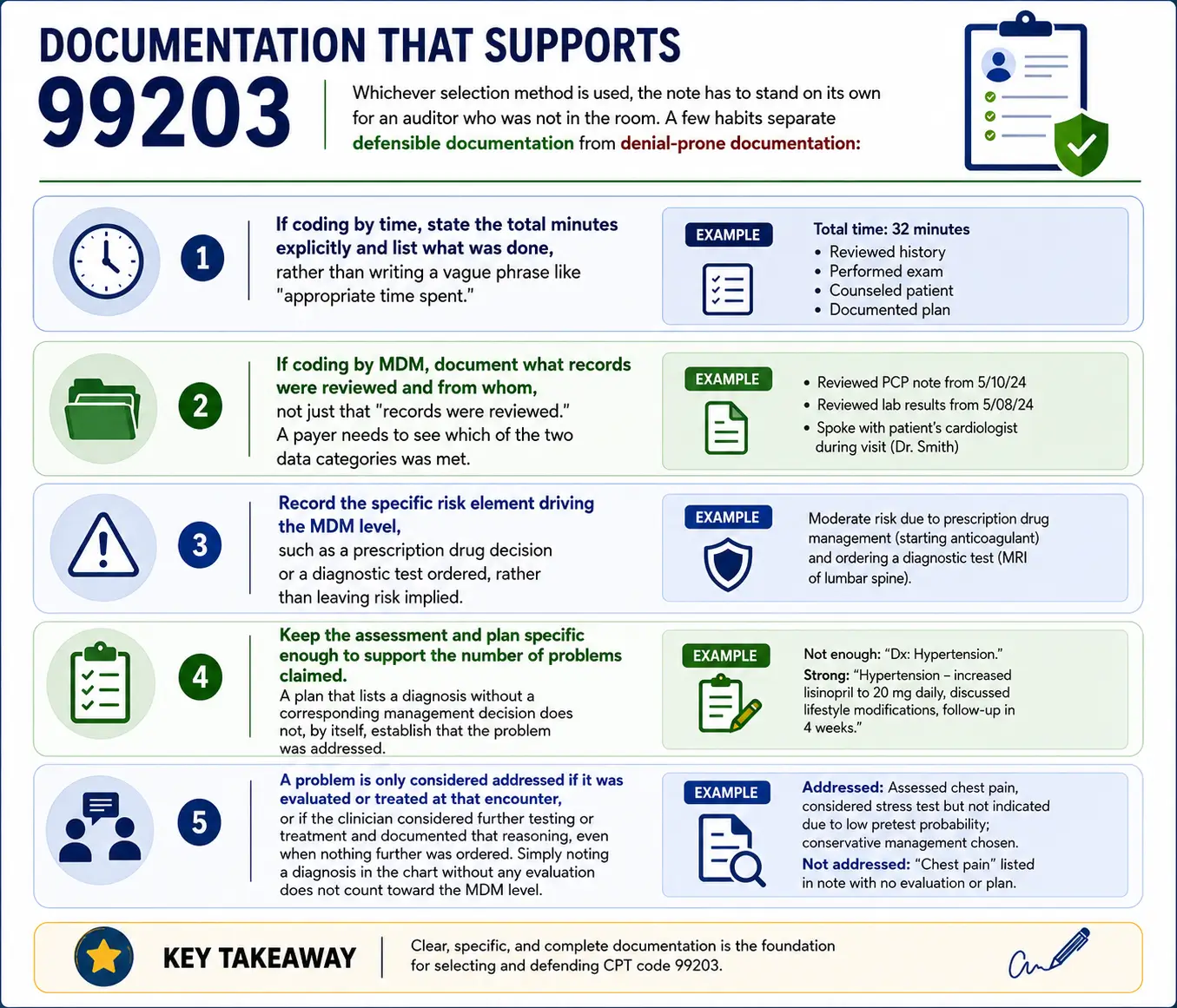
Whichever selection method is used, the note has to stand on its own for an auditor who was not in the room. A few habits separate defensible documentation from denial-prone documentation:
- If coding by time, state the total minutes explicitly and list what was done, rather than writing a vague phrase like “appropriate time spent.”
- If coding by MDM, document what records were reviewed and from whom, not just that “records were reviewed.” A payer reviewing the chart needs to see which of the two data categories was met.
- Record the specific risk element driving the MDM level, such as a prescription drug decision or a diagnostic test ordered, rather than leaving risk implied.
- Keep the assessment and plan specific enough to support the number of problems claimed. A plan that lists a diagnosis without a corresponding management decision does not, by itself, establish that the problem was addressed.
A problem is only considered addressed if it was evaluated or treated at that encounter, or if the clinician considered further testing or treatment and documented that reasoning, even when nothing further was ordered. Simply noting a diagnosis in the chart without any evaluation does not count toward the MDM level.
99203 compared with the rest of the new patient series
Code | MDM level | Time range | Typical scenario |
99202 | Straightforward | 15 to 29 minutes | New patient, single minor self-limited problem |
99203 | Low | 30 to 44 minutes | New patient with a stable chronic illness or one uncomplicated acute problem |
99204 | Moderate | 45 to 59 minutes | New patient with multiple chronic conditions or a new prescription started |
99205 | High | 60 to 74 minutes | New patient with a problem posing threat to life or bodily function |
Undercoding a visit that actually supports 99204 as a 99203 is a real revenue loss, not just a technicality. Overcoding in the other direction, billing 99203 when the note only supports straightforward MDM, creates audit exposure instead. Neither error is harmless, and both stem from the same root cause: documentation that does not clearly map to one of the two selection methods.
2026 reimbursement for CPT code 99203
Medicare pays office and outpatient E/M codes through the Physician Fee Schedule, using a formula that multiplies each code’s work, practice expense, and malpractice relative value units (RVUs) by the corresponding Geographic Practice Cost Index for the provider’s location, then applies the annual conversion factor.
For 2026, the Centers for Medicare & Medicaid Services finalized two separate conversion factors for the first time in the program’s history, a change required by the Medicare Access and CHIP Reauthorization Act of 2015. Qualifying Alternative Payment Model participants use $33.5675, a 3.77% increase over 2025’s $32.3465. Clinicians who are not qualifying participants use $33.4009, a 3.26% increase. Both figures include a temporary 2.5% payment bump enacted through the One Big Beautiful Bill Act along with a 0.49% budget-neutrality adjustment tied to updated work RVUs, according to CMS’s CY 2026 Physician Fee Schedule final rule and confirmed in the American Medical Association’s own summary of the rule.
CPT code 99203 carries a work RVU of 1.60, a figure that has held steady across recent fee schedule cycles. Combined with practice expense and malpractice RVUs, the non-facility total RVU lands in the neighborhood of 3.1 to 3.3, which puts the national non-facility Medicare payment at roughly $105 before geographic adjustment. Facility-setting payment runs lower, closer to $70 to $78, because facility practice expense RVUs are set well below non-facility ones. These are national averages; actual payment depends on the Work, Practice Expense, and Malpractice GPCI values for the provider’s locality, which can push urban rates meaningfully higher than rural ones for the identical code and documentation. Providers should confirm exact figures using the CMS Physician Fee Schedule Look-Up Tool rather than relying on published national estimates, since locality adjustments and mid-year corrections both affect the final number.
Commercial payers generally reimburse above Medicare rates for this code, commonly in the range of 120% to 170% of the Medicare benchmark, which puts a rough estimate for 99203 somewhere between $125 and $180 depending on the specific contract.
One code worth tracking alongside 99203 is G2211, the visit complexity add-on code CMS introduced effective January 1, 2024, after a moratorium on its payment under the Consolidated Appropriations Act of 2021 expired. G2211 can be appended to new or established patient office visit codes, including 99203, when the billing clinician serves as the continuing focal point for the patient’s care or manages an ongoing single, serious, or complex condition. It cannot be billed on the same claim as modifier 25, and CMS’s own program estimates anticipated it would be reported alongside a majority of office and outpatient E/M claims among specialties with longitudinal patient relationships, primary care in particular.
Common documentation and billing errors
Several recurring issues push 99203 claims toward denial or audit review. Missing or vague time documentation is one, especially when a note states a code level without stating the minutes that justify it. A second is data review documentation that names no source, such as “records reviewed” without specifying which records, from where, or what was clinically relevant in them. A third is an assessment and plan that lists diagnoses without a management decision attached to each one, leaving the number of problems addressed unclear to a reviewer. A fourth, specific to new patient coding, is billing 99203 for a patient who does not actually meet the three-year new patient definition, which payers catch quickly through their own claims history.
A practical scenario
A 58-year-old presents to a family medicine practice for the first time with mild, newly identified hypertension and no target organ damage. The physician takes a history, performs a focused exam, reviews no outside records, and starts a low-dose ACE inhibitor after discussing side effects and follow-up monitoring. Total time on the date of the encounter, including chart setup, the visit itself, and same-day documentation, runs 34 minutes.
Under MDM, this meets one stable, newly diagnosed problem being actively managed and a prescription drug decision, which typically supports low complexity. Under time, 34 minutes falls inside the 30 to 44 minute window. Either path lands on CPT code 99203, and a coder billing this encounter would document the total time explicitly, note the diagnosis and the prescribing decision, and confirm through the practice’s records that the patient has no professional service history with the practice in the past three years.
Getting the code right the first time
CPT code 99203 rewards precision more than volume. A short note that clearly states either the minutes spent or the two MDM elements met will hold up under review better than a long note that never quite states which selection method the clinician used. Coders and billers who build that habit into every new patient encounter, rather than reconstructing it after the fact for an audit request, spend far less time defending claims that should never have been questioned in the first place.