



Current procedural terminology (CPT) code 99204 identifies a moderate-level evaluation and management visit for a new patient in an office or outpatient setting. The American Medical Association revised the evaluation and management guidelines in 2021. Those revisions shifted the focus of code selection away from history and physical examination elements. Providers now select code 99204 based on either the level of medical decision making or the total time spent on the date of the encounter.
This CPT code 99204 cheat sheet for medical billers and coders details the exact criteria required to justify a moderate-level new patient visit under current American Medical Association guidelines.
Official definition of CPT code 99204
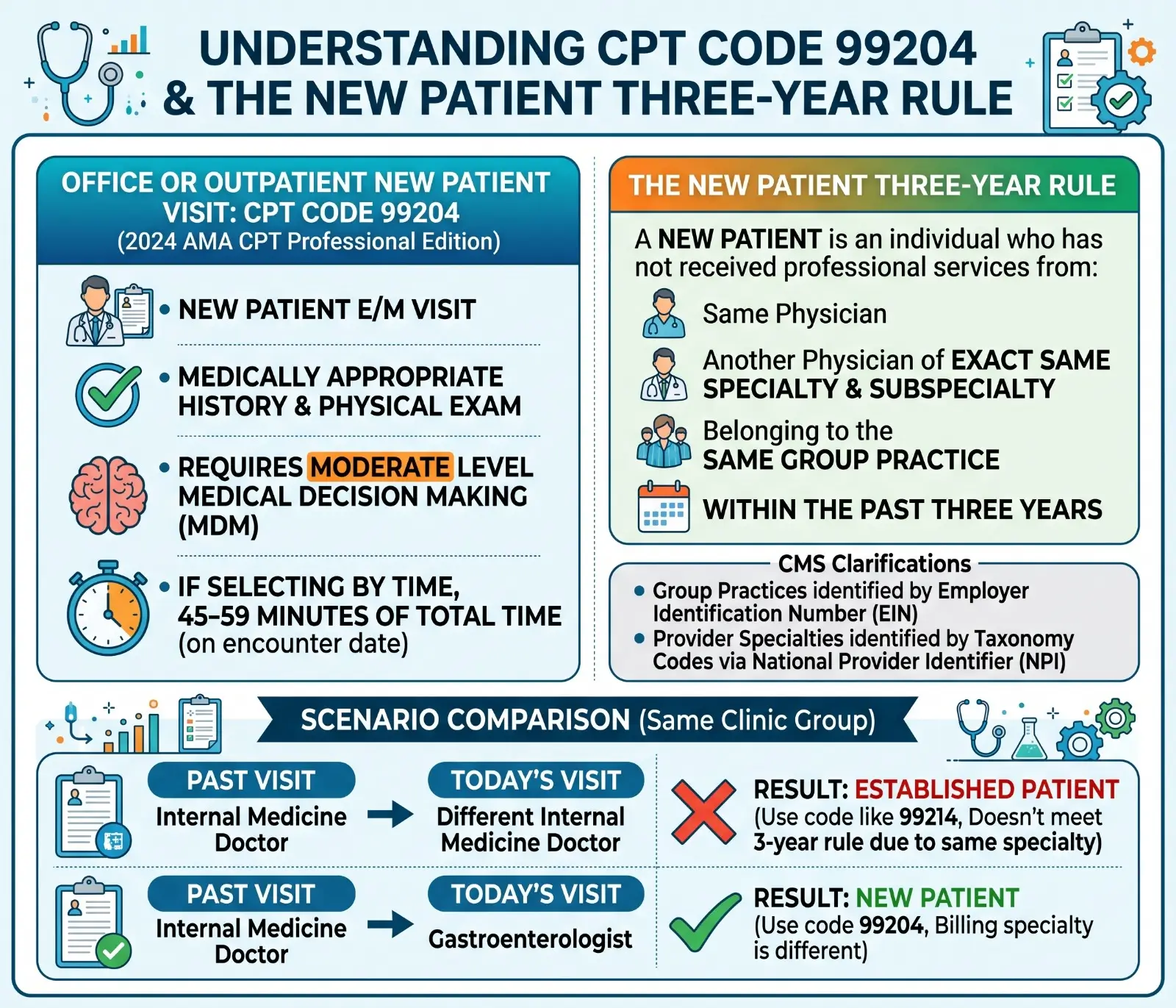
According to the 2024 American Medical Association CPT Professional Edition, 99204 represents an office or other outpatient visit for the evaluation and management of a new patient. The visit requires a medically appropriate history and physical examination. The code requires a moderate level of medical decision making. When a physician or other qualified healthcare professional uses time to select the code, they must document 45 to 59 minutes of total time spent on the date of the encounter.
Understanding the new patient three-year rule
A new patient is an individual who has not received any professional services from the physician or another physician of the exact same specialty and subspecialty who belongs to the same group practice within the past three years.
The Centers for Medicare and Medicaid Services identifies group practices by their employer identification number. They identify provider specialties using the taxonomy codes registered under a National Provider Identifier.
If a patient saw an internal medicine doctor in a clinic two years ago, and sees a different internal medicine doctor in the same clinic today, that patient is established. If the patient sees a gastroenterologist in that exact same clinic, the patient is new because the billing specialty is different. If the patient does not meet this three-year rule, the coder must use an established patient code like 99214.
Medical decision making requirements for 99204
Medical decision making establishes the cognitive effort required to evaluate and treat a patient. To qualify for moderate medical decision making, the documentation must meet or exceed the requirements in two of three specific categories. These categories are the complexity of the problems addressed, the amount of data reviewed, and the risk of patient management.
Number and complexity of problems addressed
The provider must document specific patient conditions that require moderate cognitive effort. The American Medical Association defines several clinical scenarios that meet this requirement for a 99204 visit.
One scenario is the management of one or more chronic illnesses experiencing an exacerbation, progression, or side effects of treatment. A patient presenting with poorly controlled type 2 diabetes requiring an insulin adjustment fits this category.
Another qualifying scenario is the management of two or more stable chronic illnesses. The documentation must show that both conditions are actively addressed during the visit. Mentioning a condition in the past medical history without assessing it does not count toward the medical decision making level.
A third scenario involves one undiagnosed new problem with an uncertain prognosis. This applies when the provider suspects a condition but requires further evaluation to confirm the diagnosis. A new patient presenting with an unexplained breast lump falls into this category.
Other qualifying problems include one acute illness with systemic symptoms, such as pyelonephritis, or one acute complicated injury, such as a closed head injury with a brief loss of consciousness.
Amount and complexity of data reviewed
The data category measures the information a provider analyzes to formulate a treatment plan. Moderate complexity requires meeting the criteria in one of three distinct sub-categories.
Category one requires the provider to review or order three independent elements. These elements can include tests, documents from external sources, or information gathered from an independent historian. Ordering a complete blood count, reviewing previous hospital records, and obtaining history from a caregiver counts as three distinct elements.
Category two requires the independent interpretation of a test performed by another physician. The interpreting provider cannot bill a separate CPT code for this interpretation. Reviewing an electrocardiogram completed at an urgent care center satisfies this requirement.
Category three involves a documented discussion of management or test interpretation with an external physician or appropriate source. The discussion must occur with a professional not in the same group practice.
Risk of complications and patient management
This element evaluates the probability of adverse events related to the condition or the proposed treatment. A moderate risk level means the patient faces significant consequences from the treatment plan or the underlying disease.
Prescription drug management is the most frequently documented moderate risk factor. The provider must actively evaluate, start, discontinue, or adjust a prescription medication. Renewing a routine prescription during an annual exam without evaluating its efficacy does not automatically qualify as moderate risk. The documentation must link the medication management to an active clinical assessment.
Other moderate risk scenarios include the decision regarding minor surgery with identified patient risk factors. The decision regarding elective major surgery without identified patient risk factors also qualifies.
The American Medical Association explicitly lists the diagnosis or treatment significantly limited by social determinants of health as a moderate risk factor. Providers must document how a patient's economic or social condition directly limits the treatment plan. Coders capture these situations using ICD-10-CM Z codes (Z55 through Z65). An example is Z59.00 for homelessness. If a physician cannot safely prescribe a medication requiring refrigeration because the patient lives in a vehicle, the provider documents this limitation. This documentation automatically qualifies the risk element as moderate.
Billing 99204 based on total time
Coders can bypass the medical decision making requirements and assign 99204 based purely on time. The total time for a 99204 visit must fall strictly between 45 and 59 minutes. The Centers for Medicare and Medicaid Services requires the provider to document the exact time spent and summarize the activities performed.
What counts toward total time
Total time includes both face-to-face and non-face-to-face activities performed by the provider on the exact date of the encounter. Time spent by clinical staff, such as medical assistants taking vital signs, does not count toward the billing provider's total time.
Providers can count time spent preparing to see the patient. Obtaining the clinical history, performing the examination, and counseling the patient all contribute to total time. Time spent ordering medications, coordinating care, and documenting clinical information in the electronic health record on the same calendar date also counts.
If a provider spends 30 minutes face-to-face with a new patient and an additional 15 minutes documenting the chart that same evening, the 45-minute total qualifies the visit for code 99204.
Comparing CPT code 99204 to 99203 and 99205
Accurate coding requires differentiating 99204 from the levels immediately below and above it. A comparison highlights the distinct criteria for each code.
| Code | MDM Level | Time Requirement | Common Clinical Example |
|---|---|---|---|
| 99203 | Low | 30 to 44 minutes | Two or more self-limiting or minor problems. |
| 99204 | Moderate | 45 to 59 minutes | One chronic illness with exacerbation and prescription drug management. |
| 99205 | High | 60 to 74 minutes | One acute or chronic illness posing a threat to life or bodily function. |
Medical billers frequently downcode 99204 to 99203 when the documentation lacks specific details regarding prescription management or the exact status of a chronic illness.
Common documentation errors and audit risks
The Department of Health and Human Services Office of Inspector General regularly monitors evaluation and management billing patterns. In a 2023 evaluation, the Centers for Medicare and Medicaid Services identified insufficient documentation as a primary driver of improper payments for office visits.
One specific error occurs when a provider pulls forward diagnoses from a previous electronic health record entry without addressing them during the current visit. Auditors refer to this as note bloat or cloning. If a patient presents for shoulder pain, copying a previous list of ten stable chronic conditions does not justify moderate medical decision making. The provider must document a specific assessment and plan for every condition factored into the code selection.
Another frequent error involves vague time documentation. Statements like "I spent a minimum of 45 minutes with the patient" often fail audits. Providers should document exact times, such as "Total time spent on patient care today was 48 minutes, including record review and care coordination."
Billing 99204 for a consultation when a specific consultation code applies is another compliance risk. Medicare eliminated consultation codes (99241 through 99245) in 2010, requiring providers to use new or established patient codes. Many commercial payers still process consultation codes. Billers must verify the payer policy before substituting 99204 for a requested consultation.
Financial impact of accurate 99204 code selection
Assigning the correct evaluation and management code directly affects practice revenue. According to the 2024 Medicare Physician Fee Schedule, the national unadjusted facility relative value unit (RVU) total for 99204 is 3.75. The non-facility (office) total RVU is 4.79. Multiplying these values by the annual Medicare conversion factor determines the allowable reimbursement.
An incorrect downgrade to 99203 (non-facility RVU 3.29) results in a loss of 1.50 RVUs per visit. Over a year, routinely undercoding moderate complexity visits creates a measurable revenue deficit for a medical practice.
Practical clinical scenarios for 99204
Applying the guidelines to actual patient encounters clarifies the coding rules.
Scenario 1: Internal Medicine Follow-Up
A 55-year-old new patient presents to an internal medicine clinic for a follow-up after a recent emergency department visit for hypertension. The physician reviews the hospital records and obtains an independent history from the patient's spouse regarding medication adherence. The physician notes the blood pressure remains elevated at 160/95. The physician diagnoses poorly controlled essential hypertension. The treatment plan includes increasing the dosage of lisinopril.
The visit qualifies for 99204 because it meets the criteria for moderate problem complexity (chronic illness with exacerbation) and moderate risk (prescription drug management).
Scenario 2: Dermatology Consultation
A 30-year-old new patient visits a dermatologist for severe acne. The provider spends 20 minutes taking a history and performing an examination. The provider diagnoses nodulocystic acne and prescribes an oral antibiotic. The physician spends 10 minutes counseling the patient on medication side effects. The total time documented is 30 minutes.
Because 30 minutes does not meet the 45-minute threshold for 99204 based on time, the coder evaluates the medical decision making. The visit involves a moderate problem (one undiagnosed new problem with uncertain prognosis/systemic treatment requirement) and moderate risk (prescription drug management). The coder correctly assigns 99204 based on medical decision making, overriding the time deficit.
Applying CPT code 99204 in clinical practice
Assigning evaluation and management codes requires precise alignment between the provider's clinical notes and the official coding guidelines. Medical billers and coders rely on clear documentation of either 45 minutes of total time or a moderate level of medical decision making. Documenting prescription management, data review, and problem complexity explicitly protects the practice from audit liabilities while securing accurate reimbursement for the medical services provided.