


H0004 CPT Code Explained: Definition, Reimbursement, and Guidelines
Billers searching for the “H0004 CPT code” run into a labeling problem before they even open a claim form. H0004 is not a CPT code. It belongs to HCPCS Level II, the code set the Centers for Medicare and Medicaid Services (CMS) maintains for services the American Medical Association’s CPT manual does not cover. The mix-up is common enough to be worth correcting up front, because the distinction affects which payers accept the code and how reimbursement gets calculated.
H0004 is officially defined as “Behavioral health counseling and therapy, per 15 minutes.” CMS added the code effective January 1, 2001, and placed it in the H0001 to H0030 range, a block of HCPCS codes reserved for substance use treatment and mental health counseling services. The code has carried an action code of “N” (no maintenance) since January 2003, meaning its core definition has not changed since then.
What H0004 actually covers
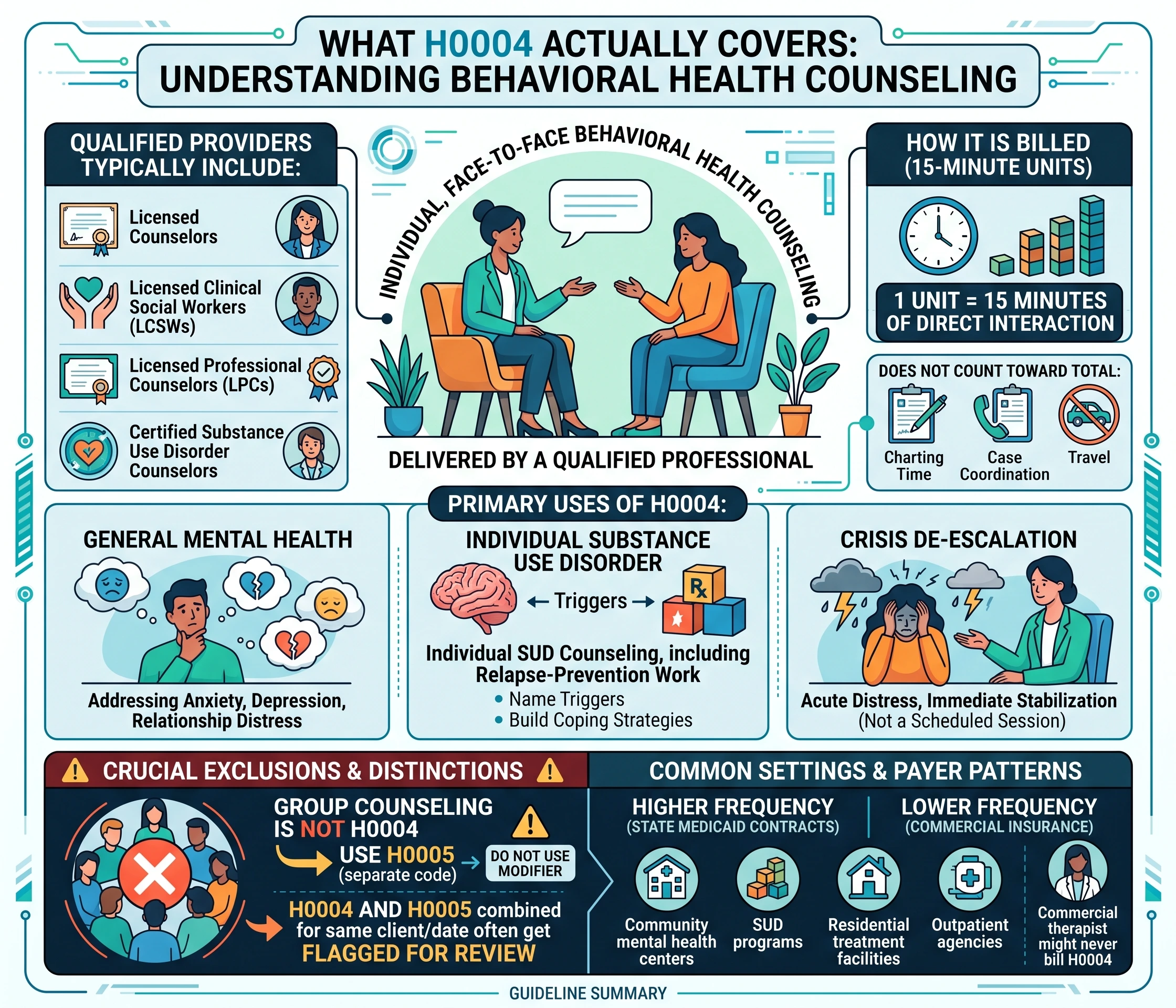
H0004 pays for individual, face-to-face behavioral health counseling delivered by a qualified professional. Licensed counselors, licensed clinical social workers (LCSWs), licensed professional counselors (LPCs), and certified substance use disorder counselors are the providers who typically bill it. One unit equals 15 minutes of direct interaction between the provider and the client. Charting time, case coordination, and travel do not count toward that total.
Providers use H0004 for several distinct purposes:
- General mental health counseling addressing anxiety, depression, or relationship distress
- Individual substance use disorder counseling, including relapse-prevention work that helps a client name triggers and build coping strategies
- Crisis de-escalation, when a client is in acute distress and needs immediate stabilization rather than a scheduled session
What the code excludes matters just as much. Group counseling is billed under H0005 (“Alcohol and/or drug services, group counseling by a clinician”), a separate HCPCS code, not H0004 with a modifier attached. Most payers will not accept H0004 and a group session for the same client on the same date, and claims that combine the two tend to get flagged for review.
The settings where H0004 shows up follow a pattern. Community mental health centers, substance use disorder programs, residential treatment facilities, and outpatient behavioral health agencies bill it far more often than private psychiatric practices do, mainly because those settings are the ones built around state Medicaid contracts in the first place. A solo therapist accepting only commercial insurance may never file an H0004 claim in an entire career, while a counselor at a community-based SUD program might bill it dozens of times a week.
H0004 versus CPT psychotherapy codes
A question that comes up constantly among students studying medical billing: does H0004 duplicate CPT codes 90832, 90834, and 90837? It does not. Those three are AMA-maintained CPT codes for time-based psychotherapy, and each one represents a fixed session length rather than a repeatable unit.
Code | Code system | Time structure | Typical payer |
H0004 | HCPCS Level II | 15-minute units, billed repeatedly for the session length | Medicaid, state-funded behavioral health programs, some managed care organizations |
90832 | CPT | Flat 30-minute session | Commercial insurance, Medicare, Medicaid |
90834 | CPT | Flat 45-minute session | Commercial insurance, Medicare, Medicaid |
90837 | CPT | Flat 60-minute session | Commercial insurance, Medicare, Medicaid |
The practical difference shows up in how odd session lengths get billed. A 22-minute encounter bills as one H0004 unit. A 50-minute encounter might bill as three or four H0004 units depending on the payer’s rounding rule, while the same 50 minutes under CPT rules typically rounds down to 90834 rather than up to 90837. Medicare does not separately price H0004 under Part B; CMS records list the code with a pricing indicator showing it is not reimbursed on the physician fee schedule. That is a large part of why H0004 lives almost entirely in Medicaid and state behavioral health billing rather than in Medicare claims.
Calculating units correctly
Most Medicaid programs apply the same minutes-to-units logic CMS uses for other timed codes elsewhere in the fee schedule: a session needs at least 8 minutes to count as one billable unit, and each additional full 15-minute block adds another unit once the remainder reaches 8 minutes or more. Under that method, a 22-minute session bills as one unit, and a 38-minute session bills as three units. This is not universal, though. CareOregon’s provider billing guide, updated for dates of service in 2026, caps H0004 at eight hours (32 units) per provider per day and flags anything over 16 units for a single member on a single day, unless the medical record supports it. Confirm the rounding method with each payer rather than assuming the CMS approach applies everywhere, since some Medicaid managed care contracts round differently.
Documentation for every billed unit should include:
- Start and end time of the encounter, not just a total minute count
- The client’s response to the intervention and progress toward treatment goals
- Location and method of service delivery (office, community setting, telehealth, audio-only)
- The rendering provider’s name, credentials, and signature
Telehealth adds one more layer. CareOregon’s guidance, effective January 1, 2024, requires a telehealth modifier on every H0004 claim delivered remotely, along with a note documenting the platform used and confirmation that the client consented to a virtual session. Audio-only sessions are billable under many Medicaid programs, but the chart needs to state explicitly that video was unavailable or declined, since payers increasingly distinguish audio-only from video visits when setting rates.
Modifiers used with H0004
Credential-level modifiers tell the payer who actually delivered the service, and several state Medicaid programs will not process a claim without one attached.
Modifier | Meaning |
HN | Rendering provider’s highest credential is a bachelor’s degree |
HO | Rendering provider’s highest credential is a master’s degree |
HP | Rendering provider’s highest credential is a doctoral degree |
HQ | Service delivered in a group setting (paired with H0005, not H0004, for the counseling itself) |
GT or 95 | Service delivered by telehealth; which one a payer wants varies by contract |
Reimbursement commonly scales with credential level: doctoral-level providers billing with HP are generally paid more per unit than master’s-level providers billing with HO, who are in turn paid more than bachelor’s-level providers billing with HN. Medicaid programs are the primary source of this requirement. Medicare does not require credential modifiers on behavioral health claims, and most commercial payers do not either, so the rule is almost entirely a Medicaid and state-contract issue rather than a universal billing standard.
Reimbursement rates and payer variation
There is no national H0004 rate because HCPCS Level II codes tied to Medicaid are priced state by state. The Vermont Department of Health Access’s 2026 fee schedule, for example, lists H0004 at $30.62 per 15-minute unit and a related assessment code, H0001, at $212.49 per encounter. Vermont updates these figures monthly rather than annually, which is common among state Medicaid programs that adjust behavioral health rates outside the standard fiscal-year cycle.
Daily and annual limits are just as important as the per-unit rate. CareOregon’s provider guide describes a per-member cap of 16 units (four hours) of H0004 in a single day before additional units are denied outright rather than reduced, and a separate eight-hour cap per provider per day effective for 2026 dates of service. Exceeding a payer’s threshold usually means the claim needs supporting documentation submitted for reconsideration, or a request for prior authorization before the extra units are delivered. Students studying reimbursement should treat these limits as payer-specific rules to verify, not as fixed features of the H0004 code itself.
Where H0004 claims get denied
A handful of errors account for most H0004 denials:
- Billing a group session under H0004 instead of H0005
- Omitting a required credential modifier in a state Medicaid program that mandates one
- Rounding time up past what the documented start and end times actually support
- Billing more units in a day than the payer’s stated limit without prior authorization
- Submitting H0004 to a commercial payer that only recognizes CPT psychotherapy codes for outpatient counseling
Most of these come down to matching the code to the payer’s system rather than to the service itself. The clinical work behind an H0004 claim and a 90834 claim can look nearly identical in the room. What changes is which code set the payer built its behavioral health program around.
For billers moving between Medicaid behavioral health claims and commercial psychotherapy claims, the working distinction is simple: use H0004 when the payer is Medicaid or a state-funded program built on 15-minute HCPCS units, and use 90832, 90834, or 90837 when the payer processes outpatient psychotherapy through the standard CPT framework. Confirming which system a given payer runs on before the first session prevents most of the denials that show up later.