


F51.01 Diagnosis Code Explained: Symptoms, Causes, and Billing Guidelines
The F51.01 diagnosis code classifies primary insomnia within the ICD-10-CM manual. Medical coders and healthcare providers apply this specific alphanumeric designation when documenting non-organic sleep disturbances. The F51 category encompasses sleep disorders not caused by a known physiological condition or substance use. Correctly applying F51.01 requires a clear understanding of its clinical parameters and strict adherence to official coding guidelines set by the Centers for Medicare and Medicaid Services (CMS) and the National Center for Health Statistics (NCHS).
Primary insomnia represents an independent condition. The World Health Organization (WHO) structures the ICD-10 manual to separate sleep disorders into two distinct chapters. Chapter 5 covers mental, behavioral, and neurodevelopmental disorders, housing the F51 codes. Chapter 6 contains diseases of the nervous system, where the G47 organic sleep disorder codes reside. Providers use F51.01 when the patient’s insomnia is the primary clinical issue rather than a secondary symptom of a medical disease.
Clinical symptoms of primary insomnia
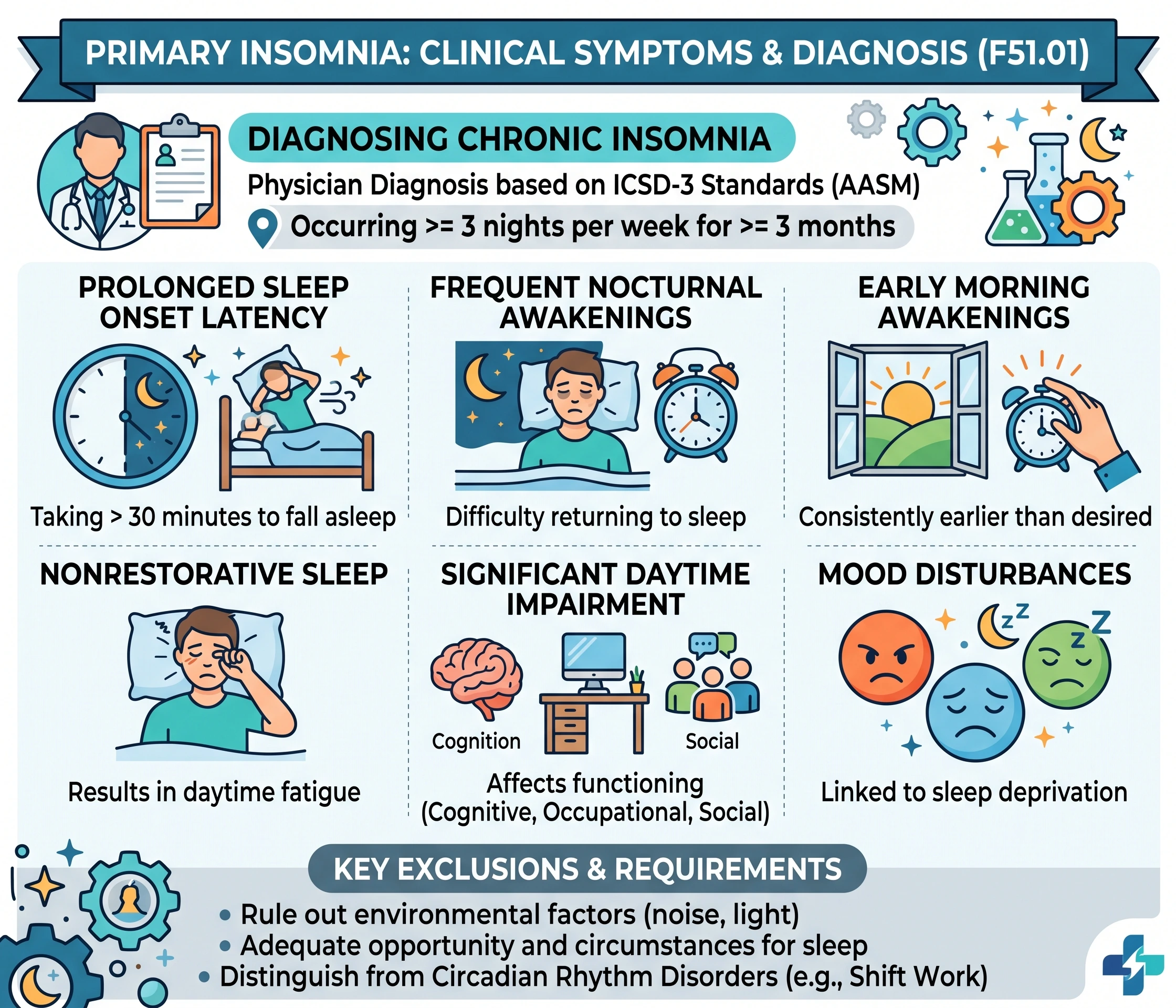
The diagnostic criteria for F51.01 align with established sleep medicine standards. According to the International Classification of Sleep Disorders, Third Edition (ICSD-3), published by the American Academy of Sleep Medicine (AASM), a physician diagnoses chronic insomnia when a patient reports sleep difficulties occurring at least three nights per week for a minimum of three months.
Physicians look for specific clinical indicators before assigning the F51.01 diagnosis code. Medical records must demonstrate that the patient experiences one or more of the following sleep disturbances:
- Prolonged sleep onset latency (taking more than 30 minutes to fall asleep).
- Frequent nocturnal awakenings combined with difficulty returning to sleep.
- Early morning awakenings occurring consistently earlier than desired.
- Nonrestorative sleep resulting in daytime fatigue.
- Significant daytime impairment affecting cognitive, occupational, or social functioning.
- Mood disturbances directly linked to sleep deprivation.
The diagnosis requires the provider to rule out environmental factors. If a patient cannot sleep because they work a night shift, the provider would look toward circadian rhythm sleep disorder codes rather than primary insomnia. The patient must have adequate opportunity and circumstances for sleep to receive an F51.01 diagnosis.
Underlying causes and mechanisms
The etiology of primary insomnia centers on physiological hyperarousal and psychological conditioning. Patients diagnosed with F51.01 exhibit heightened states of arousal during both daytime and nighttime hours. Clinical studies documented by the AASM show that these individuals often demonstrate elevated heart rates, increased core body temperatures, and higher cortisol secretion during the evening compared to healthy sleepers.
Psychophysiological conditioning occurs when a patient begins associating their bedroom with wakefulness. A brief period of poor sleep triggered by an acute stressor can cause anxiety about sleep itself. This anxiety creates a cycle where the pressure to fall asleep prevents sleep onset. The patient’s bed becomes a cue for frustration rather than rest.
Poor sleep hygiene frequently exacerbates these conditioned responses. Irregular sleep schedules, excessive caffeine consumption in the late afternoon, and exposure to light-emitting screens before bed contribute to the persistence of primary insomnia. Physicians documenting F51.01 often record these behavioral factors in the patient’s history of present illness.
ICD-10-CM classification rules
Medical coders face specific challenges when abstracting sleep disorder documentation. F51.01 comes with strict instructional notes in the ICD-10-CM tabular list. Coders must review these notes to prevent claim denials and ensure compliance with CMS guidelines.
Navigating Excludes1 and Excludes2 notes
The ICD-10-CM manual uses Excludes1 notes to indicate mutually exclusive conditions. An Excludes1 note means “not coded here.” For F51.01, the Excludes1 note lists insomnia due to a known physiological condition (G47.0-). If a provider documents that the insomnia results from obstructive sleep apnea (G47.33) or chronic pain, the coder cannot report F51.01. The G-series code takes precedence because the root cause is organic.
F51.01 also lists sleep disorders due to alcohol or psychoactive substance use in its Excludes1 notes. If a patient experiences insomnia induced by alcohol dependence, the coder must use the appropriate code from the F10-F19 series, not F51.01.
Excludes2 notes indicate “not included here,” meaning the patient can have both conditions simultaneously if the medical documentation supports it. F51.01 does not have standard Excludes2 notes that frequently override its usage, but coders must verify the tabular list annually as the NCHS updates ICD-10-CM guidelines every October.
F51.01 billing and documentation guidelines
Commercial payers and Medicare Part B require medical records to support the medical necessity of services billed with F51.01. Vague documentation routinely leads to audit failures. The provider must establish the non-organic nature of the insomnia within the clinical notes.
If a medical record simply states “insomnia,” coders follow the ICD-10 alphabetic index, which directs them to G47.00 (Insomnia, unspecified). To utilize F51.01, the physician must explicitly state “primary insomnia” or “non-organic insomnia.” Coders must query the provider if the medical record lacks the specificity needed to choose between F51.01 and a G-series code.
Supporting evaluation and management services
Healthcare providers frequently bill Evaluation and Management (E/M) codes, such as 99213 or 99214, alongside the F51.01 diagnosis code. The complexity of medical decision-making justifies the E/M level.
When treating F51.01, the assessment and plan should outline interventions specific to behavioral sleep medicine. The primary treatment standard recommended by the AASM is Cognitive Behavioral Therapy for Insomnia (CBT-I). If a physician performs CBT-I, they may bill specific psychotherapy CPT codes, such as 90832 (Psychotherapy, 30 minutes).
If a provider prescribes a Continuous Positive Airway Pressure (CPAP) machine, F51.01 is highly likely the incorrect diagnosis code. CPAP treats sleep apnea, an organic condition requiring a G47 code. Auditors specifically look for mismatches between non-organic diagnosis codes and organic medical equipment prescriptions.
Pharmacological management also requires clear documentation. If a physician prescribes sedative-hypnotics to treat primary insomnia, the chart must detail the dosage, frequency, and side effect monitoring to support the E/M code billed with F51.01.
Comparing F51.01 with other insomnia codes
Accurate code selection requires understanding the nuances between similar ICD-10 designations. The table below outlines the differences between F51.01 and related sleep disorder codes.
|
ICD-10 Code |
Official Description |
Clinical Application |
|
F51.01 |
Primary insomnia |
Chronic, independent non-organic sleep disorder not caused by another condition. |
|
F51.02 |
Adjustment insomnia |
Acute sleep disturbance directly tied to a specific recent stressor or life event. |
|
F51.04 |
Psychophysiologic insomnia |
Insomnia primarily driven by conditioned anxiety regarding the inability to sleep. |
|
G47.00 |
Insomnia, unspecified |
Default code for organic or undefined sleep disorders lacking specific documentation. |
|
G47.01 |
Insomnia due to medical condition |
Sleep disturbance directly resulting from a documented physiological disease. |
Practical coding scenarios
Applying ICD-10 guidelines to real-world medical records requires analytical skills. The following scenarios demonstrate correct and incorrect applications of F51.01.
Scenario A: Correct application of F51.01
A 45-year-old patient presents to a sleep clinic reporting a six-month history of taking two hours to fall asleep. The physician conducts a physical examination and reviews recent laboratory results, finding no underlying medical issues. The patient denies substance use. The physician documents “Primary insomnia characterized by hyperarousal and poor sleep hygiene” and prescribes a course of CBT-I. The coder correctly assigns F51.01 because the provider explicitly identified the condition as primary and ruled out organic causes.
Scenario B: Incorrect application of F51.01
A 60-year-old patient complains of frequent nocturnal awakenings. The physician notes that the patient has a body mass index (BMI) of 35 and snores heavily. The physician orders a polysomnography (CPT 95810) to test for obstructive sleep apnea. The provider lists “Insomnia” in the assessment. A coder cannot apply F51.01 here. The documentation lacks the word “primary,” and the physician suspects a physiological airway issue. The correct diagnosis code pending the test results is G47.00 (Insomnia, unspecified).
The impact of DSM-5 updates on F51.01
The relationship between psychiatric manuals and coding systems often creates confusion in sleep medicine billing. In 2013, the American Psychiatric Association published the Diagnostic and Statistical Manual of Mental Disorders, Fifth Edition (DSM-5). This update officially removed the diagnosis of “primary insomnia.”
The DSM-5 replaced it with “insomnia disorder.” The psychiatric community made this change to recognize that insomnia requires independent clinical attention even when co-occurring with other medical or psychiatric conditions. Treating depression does not automatically cure a patient’s concurrent insomnia.
Despite this clinical shift in the psychiatric community, the CMS and NCHS maintained the primary insomnia classification (F51.01) within the ICD-10-CM manual. Medical coders must bridge the gap between clinical terminology and billing requirements. When a physician documents “DSM-5 Insomnia Disorder” and specifies that it is not caused by a known physiological condition, medical coders map this diagnosis to F51.01 for billing purposes.
Providers who update their electronic health record (EHR) templates to align exclusively with DSM-5 terminology without mapping those terms to specific ICD-10 codes often experience increased claim denials. Clinical documentation improvement (CDI) specialists routinely educate physicians to include the word “primary” or “non-organic” in their notes to satisfy the strict tabular list requirements of the F51 category.
Proper application of the F51.01 diagnosis code requires distinguishing non-organic sleep disorders from physiological conditions. Medical coders rely on exact physician documentation to satisfy ICD-10-CM Excludes1 notes and prevent payer audits. When a patient presents with chronic sleep difficulties lacking an underlying medical or substance-related cause, F51.01 accurately captures the clinical picture and establishes medical necessity for behavioral therapies and pharmacological interventions.