


F33.1 ICD-10 Explained: Symptoms, Diagnosis & Billing Guide
The F33.1 ICD-10 code classifies patients diagnosed with Major depressive disorder, recurrent, moderate. The World Health Organization (WHO) established this specific alphanumeric code to track and bill for patients experiencing multiple depressive episodes, where the current episode meets the clinical threshold for moderate severity. Proper application of this code requires documented evidence of past depressive episodes separated by a period of normal mood, alongside current symptoms that interfere with standard daily functioning.
Medical coders, billers, and healthcare providers must align clinical documentation with specific payer rules to ensure claim approval. F33.1 triggers specific medical necessity rules for psychotherapy and pharmacological management.
Clinical Diagnostic Criteria for F33.1
The American Psychiatric Association (APA) outlines specific parameters for depressive disorders in the Diagnostic and Statistical Manual of Mental Disorders, Fifth Edition (DSM-5). While DSM-5 provides the clinical criteria, the healthcare industry relies on the ICD-10-CM code set for reporting and reimbursement.
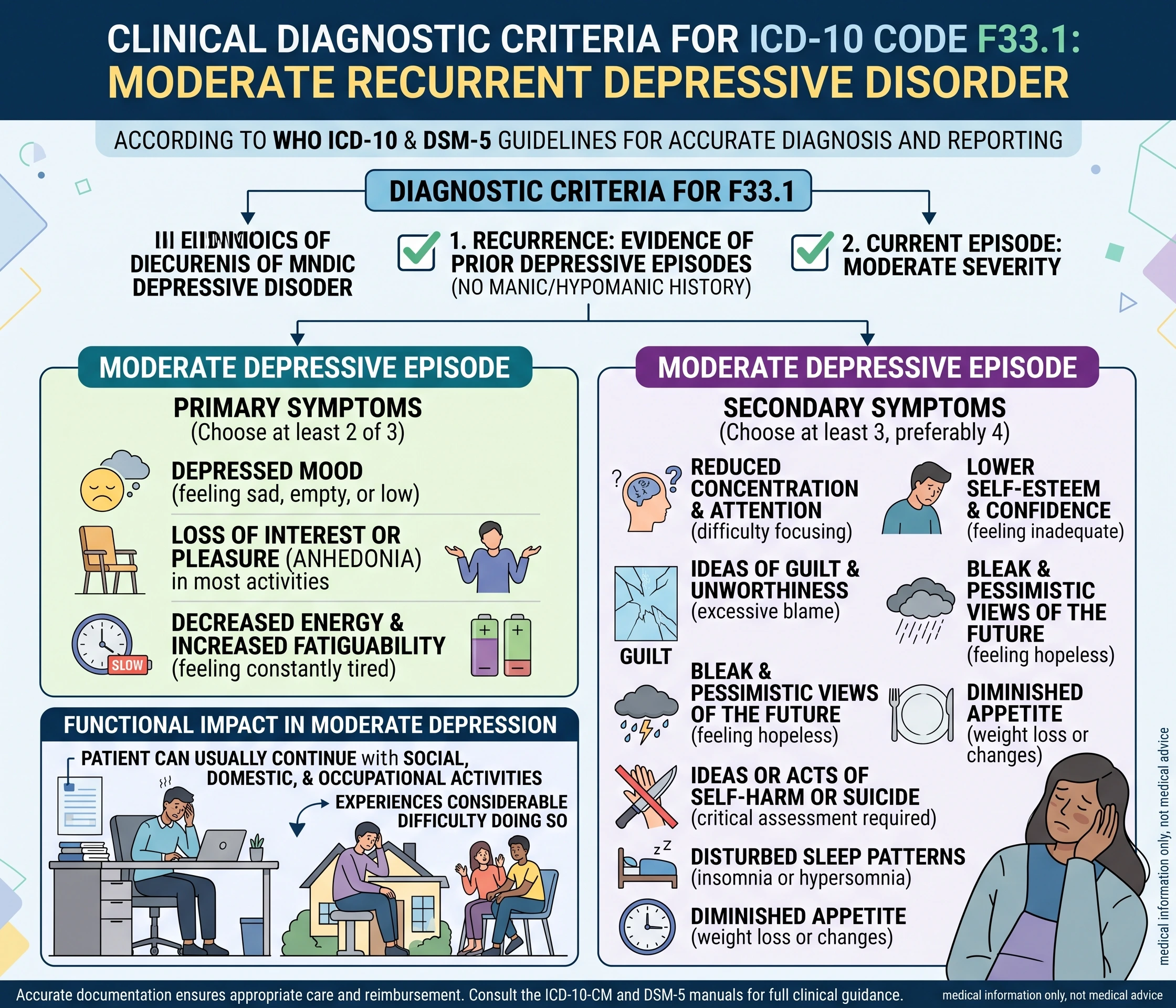
To assign F33.1 accurately, a provider must document two distinct elements: severity and recurrence.
According to the WHO ICD-10 Classification of Mental and Behavioural Disorders, a moderate episode typically presents with at least two of the three primary symptoms of depression. These primary symptoms include depressed mood, loss of interest or pleasure (anhedonia), and decreased energy leading to increased fatiguability.
The patient must also exhibit at least three, and preferably four, secondary symptoms. Secondary symptoms include:
- Reduced concentration and attention
- Lower self-esteem and self-confidence
- Ideas of guilt and unworthiness
- Bleak and pessimistic views of the future
- Ideas or acts of self-harm or suicide
- Disturbed sleep patterns
- Diminished appetite
A patient with a moderate depressive episode can usually continue with social, domestic, and occupational activities, but they experience considerable difficulty doing so.
Defining Recurrent Episodes
The “recurrent” classification separates F33 codes from F32 codes. The F32 category applies exclusively to a patient’s first major depressive episode. Once a patient experiences a second distinct episode, the diagnosis permanently shifts to the F33 category.
A recurrent episode requires a documented gap between depressive states. Clinical documentation must show a remission period of at least two consecutive months without significant depressive symptoms between the previous episode and the current one. If the patient has not experienced this two-month break in symptoms, the episode is continuous. In continuous cases, the provider continues billing the original episode code rather than identifying a new recurrent episode.
Many clinics utilize the Patient Health Questionnaire (PHQ-9) to quantify symptom intensity. A PHQ-9 score between 10 and 14 correlates with moderate depression. Clinical judgment supersedes screening questionnaires, as the PHQ-9 relies entirely on patient self-reporting.
Comparing Recurrent Depressive Diagnoses
Accurate medical coding requires selecting the code that matches the highest level of specificity in the physician’s notes. Downcoding leads to lost revenue, while upcoding invites audits.
ICD-10 Code | Description | Functional Impairment Indicator |
F33.0 | Major depressive disorder, recurrent, mild | Minor impairment in occupational or social functioning. Symptoms are distressing but manageable. |
F33.1 | Major depressive disorder, recurrent, moderate | Significant difficulty continuing standard daily activities. Requires active management. |
F33.2 | Major depressive disorder, recurrent, severe without psychotic features | Patient cannot continue standard activities. Severe distress and marked functional disability. |
F33.3 | Major depressive disorder, recurrent, severe with psychotic symptoms | Presence of hallucinations, delusions, or depressive stupor. High risk of hospitalization. |
Billing Guidelines and Excludes Notes
The Centers for Medicare & Medicaid Services (CMS) enforces specific inclusion and exclusion notes for psychiatric conditions. Claim denials frequently stem from ignoring these instructions.
An Excludes1 note means “not coded here.” This designates conditions that cannot coexist with F33.1 on a medical claim. For F33.1, Excludes1 notes apply strictly to bipolar disorder (F31 series) and manic episodes (F30 series). If a patient has any documented history of mania or hypomania, the clinical diagnosis defaults to a bipolar disorder classification. Submitting F33.1 alongside a bipolar diagnosis code will result in an immediate claim denial.
Excludes1 also applies to schizoaffective disorders (F25 series). A patient cannot have a primary diagnosis of moderate recurrent major depression if their symptoms stem from schizoaffective disorder.
An Excludes2 note means “not included here.” This indicates that the excluded condition is not part of F33.1, but a patient may have both conditions simultaneously. Providers can bill F33.1 alongside an Excludes2 condition if the patient’s chart supports both diagnoses.
CPT Code Pairing for F33.1
F33.1 justifies the medical necessity for specific Current Procedural Terminology (CPT) codes.
When a psychiatrist or psychiatric nurse practitioner prescribes medication such as Selective Serotonin Reuptake Inhibitors (SSRIs), the provider bills Evaluation and Management (E/M) codes. These codes (typically 99213 or 99214 for established patients) require specific documentation of medical decision-making. Treating a recurrent, moderate systemic illness with prescription medication generally meets the criteria for moderate medical decision-making complexity.
When psychologists or Licensed Clinical Social Workers (LCSWs) treat a patient, they utilize psychotherapy CPT codes.
- 90832 (Psychotherapy, 30 minutes)
- 90834 (Psychotherapy, 45 minutes)
- 90837 (Psychotherapy, 60 minutes)
If a prescribing provider conducts medication management and psychotherapy during the same visit, they must bill an E/M code along with an add-on psychotherapy code (such as +90833 or +90836). The clinical note must clearly separate the time spent on medication management from the time spent delivering therapeutic interventions.
Risk Adjustment and HCC Coding
CMS utilizes the Hierarchical Condition Category (HCC) risk adjustment model to calculate reimbursements for Medicare Advantage plans. Diagnoses directly affect a patient’s Risk Adjustment Factor (RAF) score, which determines the funding a health plan receives to manage that patient’s care.
Major depressive disorders carry specific risk weights. In the CMS-HCC V24 model, F33.1 falls under HCC 59 (Major Depressive, Bipolar, and Paranoid Disorders). In the updated V28 model, it maps to HCC 88.
Capturing this diagnosis requires strict adherence to the MEAT criteria during a face-to-face encounter.
- Monitor: Recording symptom changes, PHQ-9 scores, or weight fluctuations.
- Evaluate: Reviewing treatment efficacy or medication side effects.
- Assess: Documenting the current severity (moderate) and status (recurrent).
- Treat: Prescribing medications, adjusting dosages, or providing psychotherapy.
Listing F33.1 in the assessment block without documenting how the provider managed the condition fails HCC validation audits. Every reported diagnosis must include a corresponding plan of care for that specific date of service.
Documenting Social Determinants of Health (SDOH)
The American Hospital Association (AHA) advises medical coders to track Z-codes alongside primary psychiatric diagnoses. F33.1 frequently intersects with external socioeconomic pressures.
ICD-10 Z-codes capture these environmental factors. If a patient with moderate recurrent depression also experiences housing instability (Z59.0) or extreme poverty (Z59.5), coders should append these secondary codes. While Z-codes do not currently drive direct fee-for-service reimbursement, payers and government agencies track this data to predict hospital readmission rates, assess treatment non-compliance, and allocate population health resources. Providers must identify the specific social determinant in the subjective or objective portion of the encounter note for the coder to assign the Z-code.
Common Audit Triggers and Claim Denials
The Office of Inspector General (OIG) actively monitors Medicare billing for behavioral health services. Psychiatric notes face heavy scrutiny due to high error rates in historical claims.
One frequent audit trigger is cloned documentation. Electronic Health Records (EHR) allow providers to copy and paste previous notes into the current encounter. If an auditor reviews a chart and sees identical phrasing for the History of Present Illness and Mental Status Exam across six consecutive months, they will invalidate the claims. Each progress note must reflect the patient’s exact presentation on that specific date.
Another error involves failing to update the diagnosis when the patient’s condition changes. If a patient responds well to an antidepressant and their symptoms subside, the clinical classification changes. F33.1 should transition to F33.41 (Major depressive disorder, recurrent, in partial remission) or F33.42 (in full remission). Maintaining the F33.1 code when the patient no longer exhibits moderate symptoms is a compliance violation.
Clinical Documentation Improvement (CDI) Checklist
To survive an audit and ensure prompt reimbursement, a patient encounter note for F33.1 must contain distinct, verifiable elements. Medical coders cannot assume severity or recurrence; the provider must state it explicitly.
A compliant chart note includes:
- A chief complaint detailing the exact mood disturbance requiring treatment that day.
- A psychiatric history confirming the date or timeframe of the previous depressive episode.
- A clear statement confirming a remission period of at least two months between episodes.
- An updated Mental Status Examination (MSE) observing affect, speech, thought process, and behavior.
- A specific, individualized treatment plan addressing the current symptoms.
Medical coders should query the provider if a chart mentions “depression” without specifying the episode type or severity. Generic diagnoses default to F32.A (Depression, unspecified), which frequently lacks the specificity required to support long-term intensive psychotherapy or complex medication management. Accurate application of the F33.1 ICD-10 code ensures the patient’s clinical history is preserved and the healthcare facility receives the exact reimbursement permitted by the payer contracts.