


The F31.3 ICD-10 diagnosis code categorizes Bipolar disorder, current episode depressed, mild or moderate severity. Medical coders, billing specialists, and healthcare providers use this category frequently in both psychiatric and primary care settings. Submitting a claim using only these four characters will result in an automatic denial from insurance payers.
The Centers for Medicare and Medicaid Services (CMS) require healthcare facilities to bill to the highest level of specificity. The F31.3 category requires a valid fifth character to complete the code and indicate the exact severity of the patient's current depressive episode.
Clinical definition and code expansion
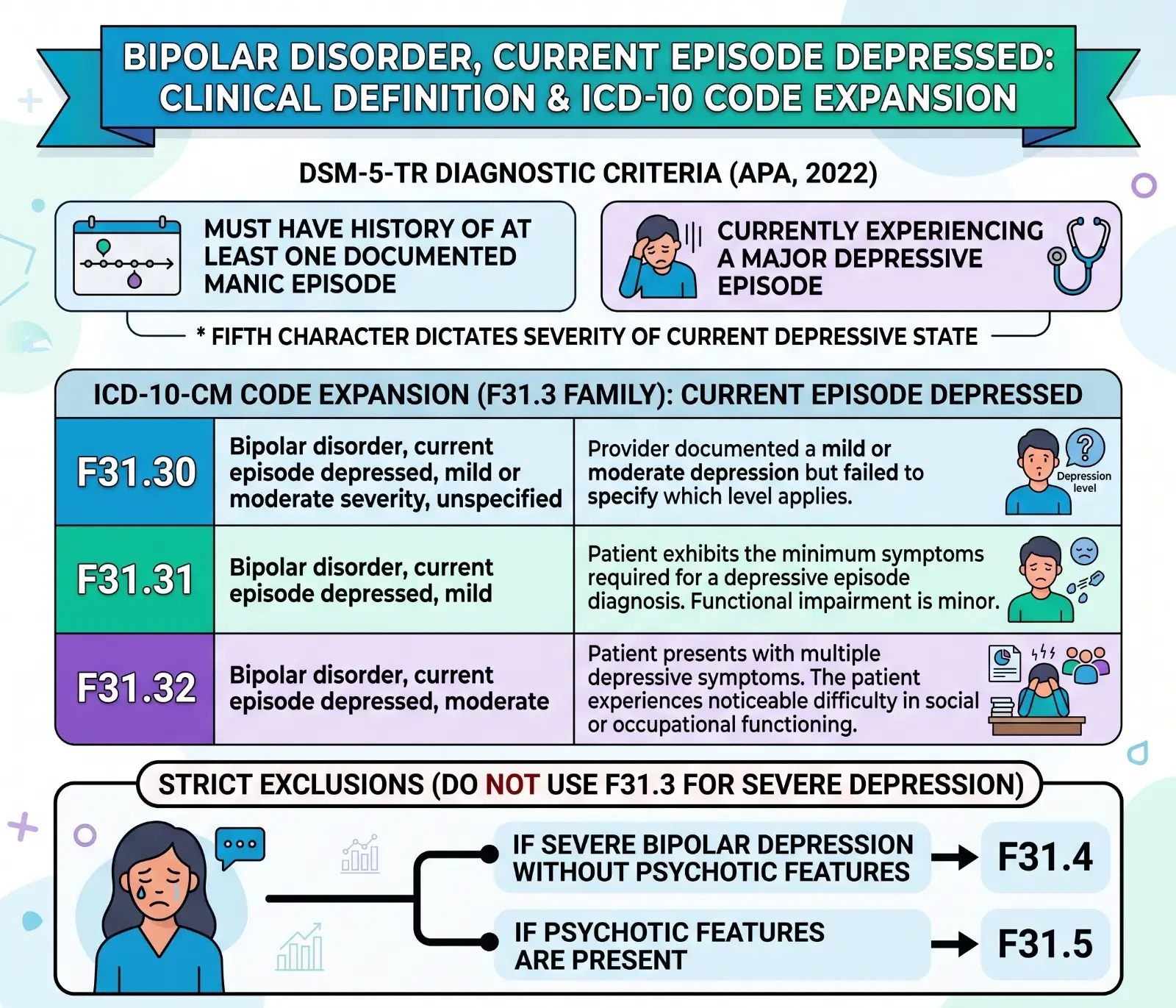
The American Psychiatric Association defines the diagnostic criteria for bipolar disorder in the Diagnostic and Statistical Manual of Mental Disorders, Fifth Edition, Text Revision (DSM-5-TR), published in 2022. To justify a code from the F31.3 family, the patient's medical history must include at least one documented manic episode. The patient must also be experiencing a major depressive episode at the time of the encounter.
The fifth character dictates the severity of this current depressive state.
| ICD-10 Code | Official Description | Clinical Presentation |
|---|---|---|
| F31.30 | Bipolar disorder, current episode depressed, mild or moderate severity, unspecified | The provider documented a mild or moderate depression but failed to specify which level applies. |
| F31.31 | Bipolar disorder, current episode depressed, mild | The patient exhibits the minimum symptoms required for a depressive episode diagnosis. Functional impairment is minor. |
| F31.32 | Bipolar disorder, current episode depressed, moderate | The patient presents with multiple depressive symptoms. The patient experiences noticeable difficulty in social or occupational functioning. |
This category strictly excludes severe depressive episodes. If the patient has severe bipolar depression without psychotic features, the correct code is F31.4. If psychotic features are present, the code changes to F31.5.
Medical record documentation requirements
Clinical documentation must explicitly state the current severity level. When a physician simply writes "bipolar depression" in the assessment phase of a chart, coders are forced to either query the provider or assign the unspecified code F31.30. Many commercial insurance networks automatically deny claims containing unspecified psychiatric codes.
To support F31.31 or F31.32, the clinical note must reflect the patient's exact condition on the date of service. The provider must document the specific depressive symptoms observed during the encounter. They should note measured changes in sleep patterns, appetite, energy levels, and concentration.
The written assessment must clearly state the word "mild" or "moderate."
Auditors look for a clear connection between the documented severity and the treatment plan. The treatment plan needs to align with the assigned code. If a provider assigns F31.31 (mild) but immediately admits the patient to an inpatient psychiatric unit, an insurance auditor will flag the claim. The documented intervention must make clinical sense for a mild or moderate episode.
Excludes1 and Excludes2 billing rules
The National Center for Health Statistics (NCHS) and CMS update the ICD-10-CM Official Guidelines for Coding and Reporting annually. The 2024 guidelines contain strict rules regarding conditions that cannot be billed together.
The F31 category carries an Excludes1 note for major depressive disorder, single episode (F32 category) and recurrent (F33 category). An Excludes1 note means "not coded here." A patient cannot be diagnosed with bipolar depression and unipolar major depressive disorder at the same time. If a biller submits a CMS-1500 claim form containing both F31.32 and F32.1, the clearinghouse will reject the claim.
The F31 category also contains an Excludes2 note for bipolar disorder, single manic episode (F30 category). An Excludes2 note means "not included here." In rare clinical scenarios where documentation supports it, a code from an Excludes2 note may be billed alongside the primary diagnosis. However, billing a current depressive episode (F31.3) alongside a current single manic episode (F30) usually triggers payer scrutiny and requires extensive medical record review.
Common coding errors and claim denials
Truncation is the most common error associated with the F31.3 ICD-10 diagnosis code. Truncation occurs when a biller submits a base category code instead of the fully expanded five-character code. The clearinghouse software will catch this missing character before the claim even reaches the payer.
Another frequent error involves conflicting chart documentation. A provider might select F31.32 in the electronic health record (EHR) drop-down menu but describe a patient with severe psychomotor retardation and suicidal ideation in the narrative text. Payer algorithms checking for medical necessity often detect these discrepancies. The narrative description must match the moderate severity definition of F31.32 rather than describing a severe episode that warrants an F31.4 assignment.
Incorrect historical referencing also causes denials. Sometimes a provider will assign F31.32 because the patient had a moderate depressive episode three years ago, even though the patient is currently asymptomatic. If the patient is asymptomatic on current medications, the correct code is F31.73 (Bipolar disorder, in partial remission, most recent episode depressed) or F31.74 (Bipolar disorder, in full remission, most recent episode depressed). F31.32 requires the episode to be actively occurring.
Reimbursement guidelines for Medicare and commercial payers
Medicare Administrative Contractors (MACs) and private health maintenance organizations (HMOs) apply specific medical necessity edits to psychiatric diagnoses. The F31.3 category supports behavioral health evaluation and management (E/M) codes, such as 99213 or 99214, provided the documentation reflects the appropriate level of medical decision-making or time spent.
When billing psychotherapy add-on codes (such as 90833, 90836, or 90838) alongside an E/M service, the F31.3 code must accurately reflect the patient's focus of treatment. An auditor reviewing a claim for a 45-minute psychotherapy session will look for notes indicating how the mild or moderate depressive symptoms were actively addressed through therapeutic interventions.
Certain Medicare Advantage plans require prior authorization for extended psychiatric treatments. Submitting the highly specific F31.31 or F31.32 code on the prior authorization request, rather than an unspecified code, reduces administrative delays and prevents peer-to-peer review requirements.
Practical scenario for F31.32 application
Consider a patient with a confirmed history of Bipolar I disorder who presents for a medication management appointment. The patient reports waking up multiple times during the night, feeling fatigued during the day, and experiencing a depressed mood for the past three weeks. The physician notes that the patient is continuing to work but is struggling to meet basic deadlines. The physician adjusts the dosage of the patient's mood stabilizer and schedules a follow-up in four weeks.
The correct diagnosis code for this encounter is F31.32. The documentation supports a current depressive episode based on the symptoms. The functional impairment at work justifies the "moderate" severity designation. The treatment plan correlates directly with the assessed condition. If the physician had simply billed F31.9 (Bipolar disorder, unspecified), the practice would risk a denial for lacking the specificity required by the documented functional impairment.
Relying on EHR default settings causes persistent coding errors in modern clinics. Many systems default to F31.9 if the provider types "bipolar" into the search bar. Billers and coders must audit these claims before submission. Ensuring that the selected F31.3 ICD-10 diagnosis code matches the physician's explicitly documented severity level protects the practice from recoupments. Accurate coding at the highest level of specificity remains a legal requirement under the Health Insurance Portability and Accountability Act (HIPAA) transactions and code sets standards.