

F40.10 Diagnosis Code: What Every Clinician and Biller Needs to Truly Understand
In the world of behavioral health billing, a single code can make the difference between a claim that sails through and one that gets denied, delayed, or flagged for audit. The F40.10 diagnosis code representing Social Phobia, Unspecified in the ICD-10-CM classification system is one of those codes that practitioners encounter regularly but often misapply.
Whether you are a licensed therapist, a psychiatric nurse practitioner, a billing specialist, or a practice manager, understanding the clinical and administrative nuances of F40.10 is genuinely essential. This blog walks you through everything: what the diagnosis actually means, how it presents in real patients, what documentation you need to support it, and the billing tips that keep your claims clean and your practice protected.
Situating F40.10 Within the ICD-10-CM Classification Architecture
Medical coding exists within a taxonomy, and taxonomies only yield insight when you understand their internal logic rather than merely their surface labels. The ICD-10-CM the International Classification of Diseases, 10th Revision, Clinical Modification organizes mental and behavioral disorders within Chapter 5, spanning codes F01 through F99. Anxiety and related conditions occupy the F40 F48 range, which the classification system designates as neurotic, stress-related, and somatoform disorders.
Within that corridor:
- F40: Phobic Anxiety Disorders serves as the parent category, encompassing all conditions where anxiety is triggered principally by contact with, or anticipation of, specific external stimuli or situations rather than arising spontaneously or diffusely.
Beneath F40:
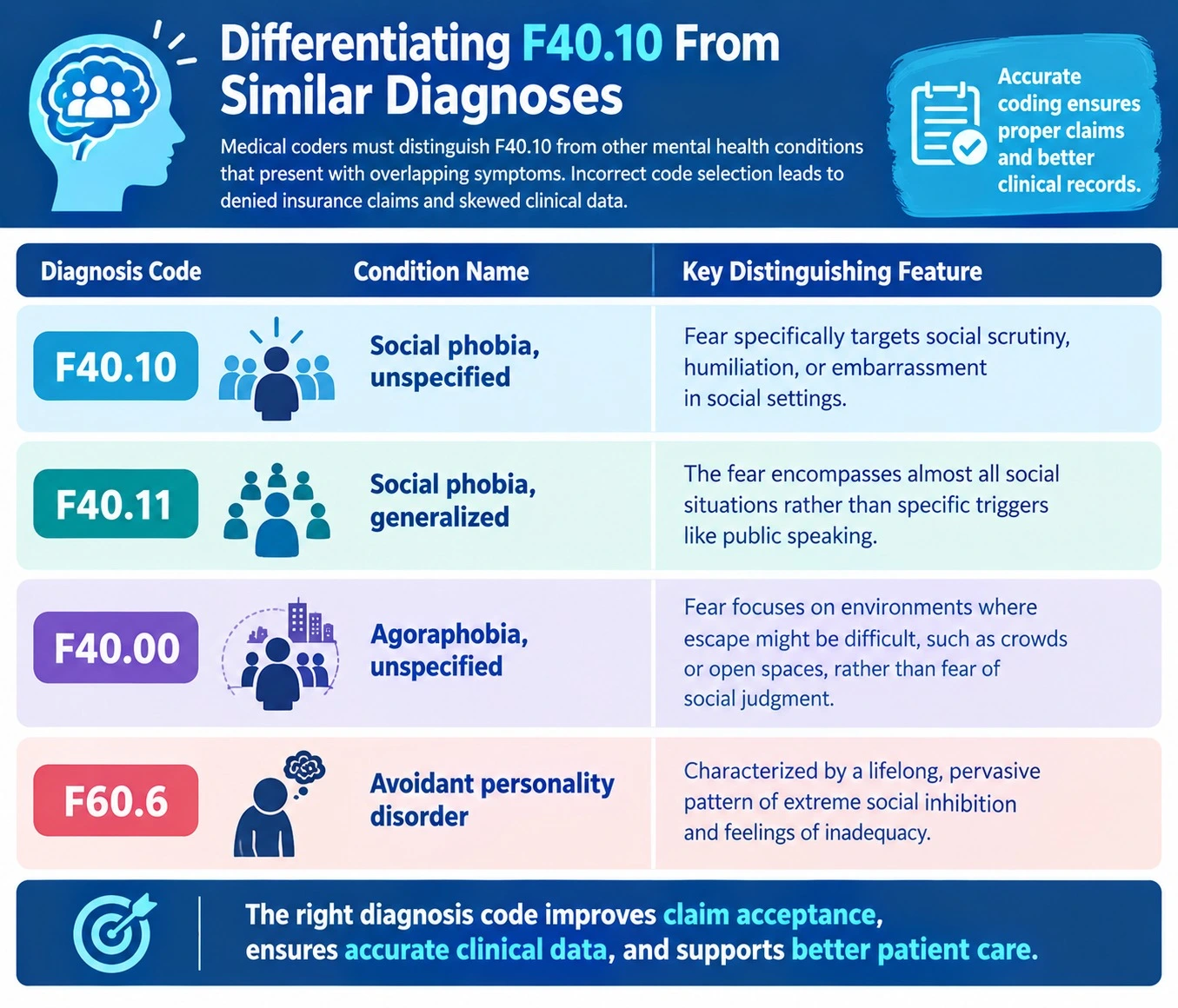
- F40.0: captures agoraphobia fear of situations where escape is difficult or embarrassing
- F40.1: houses the social phobias as a subcategory
- F40.10: Social Phobia, Unspecified
- F40.11: Social Phobia, Generalized
- F40.2: contains specific or isolated phobias circumscribed fears of discrete stimuli (blood, heights, particular animals)
- F40.8 and F40.9: hold residual categories
This architecture is not bureaucratic decoration. It is a scaffold of clinical meaning. Assigning F40.10 instead of F41.1 (Generalized Anxiety Disorder) or F40.2 (Specific Phobia) is not merely a coding choice it is a diagnostic statement. It tells every downstream reader of that record another clinician, a utilization reviewer, an insurance auditor that the organizing principle of this patient’s anxiety is social evaluation, not free-floating apprehension, not a fear of elevators or enclosed spaces, but specifically and centrally the imagined or anticipated judgment of other human beings.
Getting that right matters enormously. Not just for compliance, but for care.
Unpacking the Word “Unspecified”: Defending a Misunderstood Designation
Few things irritate experienced billers more than unspecified codes. There is a cultural instinct in healthcare administration reinforced by payer audits and compliance training to treat “unspecified” as a red flag, a signal of incomplete work, a placeholder waiting to be filled in by someone who takes the job more seriously.
This instinct, when applied to F40.10, is frequently wrong.
The “unspecified” designation in Social Phobia, Unspecified carries meaning that is genuinely distinct from vagueness. It signals a clinician’s deliberate acknowledgment that the breadth of a patient’s social fear has not yet been characterized with sufficient clinical confidence to warrant a specifier. The alternative F40.11, Social Phobia, Generalized is a more specific diagnosis that carries its own evidentiary burden. To assign it responsibly, the record must demonstrate that the patient’s fear extends across most social situations rather than remaining confined to particular performance contexts.
Here is a scenario that illustrates the distinction concretely: A 34-year-old patient presents describing overwhelming anxiety when required to speak at work. He avoids all meetings, refuses to lead trainings, and has turned down two promotions rather than accept positions that require more public-facing responsibilities. At the same time, he describes a robust social life dinners with friends, family gatherings he attends without difficulty, casual conversations with neighbors that do not trigger distress.
The Clinical Presentation: Reading Between the Lines of What Patients Report
The social phobia diagnosis criteria embedded within ICD-10-CM and its DSM-5 parallel are conceptually straightforward. The real clinical challenge lies not in knowing the criteria but in recognizing how infrequently patients present them in any orderly fashion.
What Patients Say vs. What They Mean
Consider the vocabulary patients use when social phobia has been the organizing principle of their emotional life for years or even decades. By the time many of them reach a clinician, they have developed elaborate personal narratives explanatory frameworks for their own behavior that feel truthful but that systematically misattribute clinical symptoms to character defects or simple preferences.
“I’m just an introvert.” This phrase is perhaps the most common deflection. Introversion is a stable personality trait characterized by a preference for less social stimulation; social phobia is a clinical condition characterized by fear, avoidance, and impairment. The two can coexist, but they are not the same phenomenon, and conflating them delays recognition and treatment by years.
“I’ve always been quiet.” Framing chronic anxiety-driven withdrawal as a lifelong temperamental given shields the patient from confronting the extent of what they have lost relationships not pursued, risks not taken, careers not built but it also functions as a diagnostic smokescreen in your office if you accept it at face value.
“I just prefer smaller gatherings.” Perhaps. Or perhaps large gatherings trigger a level of anticipatory dread so significant that avoiding them feels less like preference and more like survival.
The clinician’s task is not to challenge the patient’s narrative aggressively but to probe it gently and systematically. Questions like “What would happen, do you think, if you did attend that event?” or “Can you tell me about a time recently when you wanted to do something social but talked yourself out of it?” create space for the clinical reality to surface.
Physiology as Diagnostic Evidence
One of the most underutilized areas of documentation in F40.10 mental health billing is the patient’s physiological symptom profile. The body’s response to perceived social threat is not a gentle nudge it is often the same full-scale autonomic cascade that accompanies genuine physical danger.
Patients with social phobia frequently report blushing so intense it feels visible across a room. Palmar sweating that makes handshakes mortifying. Trembling that starts in the hands and radiates. Voice changes a pitch shift, a crack, a sudden dryness that confirm their worst fears about being noticed. Gastrointestinal responses severe enough to produce genuine medical complaints, which is often how these patients find their way into mental health referrals in the first place.
These physiological experiences are not secondary or incidental. They are core diagnostic data. Documenting them with specificity “patient reports involuntary facial flushing and visible hand tremor in all performance-related situations at work, occurring for approximately 20–30 minutes following the triggering event” transforms a vague symptom report into a clinically detailed record that supports both the diagnosis and the medical necessity of ongoing treatment.
Differential Diagnosis: Precision Work With Real Billing Consequences
The diagnostic landscape surrounding the ICD-10 social anxiety code is genuinely complex, and the stakes of misclassification extend well beyond intellectual tidiness. When a payer’s clinical reviewer reads a record and finds that the assigned code F40.10 does not align persuasively with the documented symptoms, the claim is vulnerable. Worse, if the misalignment appears systematic rather than incidental, it can trigger broader audit activity.
Distinguishing F40.10 from F41.1 The Question of Focus
Generalized Anxiety Disorder (F41.1) and social phobia share a surface resemblance that has frustrated diagnosticians for generations. Both conditions involve significant anxiety, avoidance, and functional impairment. Both create ripples across multiple life domains. But they differ in what organizes the anxiety.
In GAD, the anxious cognitions are pluralistic and ungovernable finances, health, family safety, professional performance, global events, the future broadly conceived. The worry proliferates. In social phobia, regardless of how many situations trigger anxiety, the underlying generator is singular: the anticipated scrutiny of other people. Pull that generator out of the equation remove the possibility of social evaluation and the anxiety in F40.10 largely dissolves. In GAD, it does not.
That distinction, rendered explicitly in your clinical note, is what anchors the code.
Distinguishing F40.10 from F60.6: The Personality Question
Avoidant Personality Disorder (F60.6) poses arguably the most challenging differential in this space. The behavioral overlap is substantial social withdrawal, hypersensitivity to criticism, reluctance to engage without certainty of acceptance and the two conditions co-occur at clinically significant rates. Some researchers have suggested they represent different points on a single continuum rather than categorically distinct entities.
For practical coding purposes, the key questions are: How pervasive is the pattern? How ego-syntonic? How developmentally rooted? Avoidant PD tends to present as a stable, chronic feature of the patient’s entire relational history, felt as an extension of who they are rather than something happening to them. Social phobia, particularly in its unspecified variant, may be more episodic, more situationally bounded, and more likely to be experienced as ego-dystonic something the patient wishes they could change rather than something they regard as definitional.
When both diagnoses are present, both should be coded. Documenting the co-occurrence is not a liability; it is clinical accuracy.
Building Documentation That Withstands Real-World Scrutiny
The phrase “documentation supports the code” gets repeated so frequently in billing education that it risks becoming meaningless. Let us be specific about what high-quality documentation for social anxiety disorder ICD-10-CM claims actually looks like in practice not as an abstract ideal but as a set of concrete habits.
Writing Initial Evaluations That Do Real Work
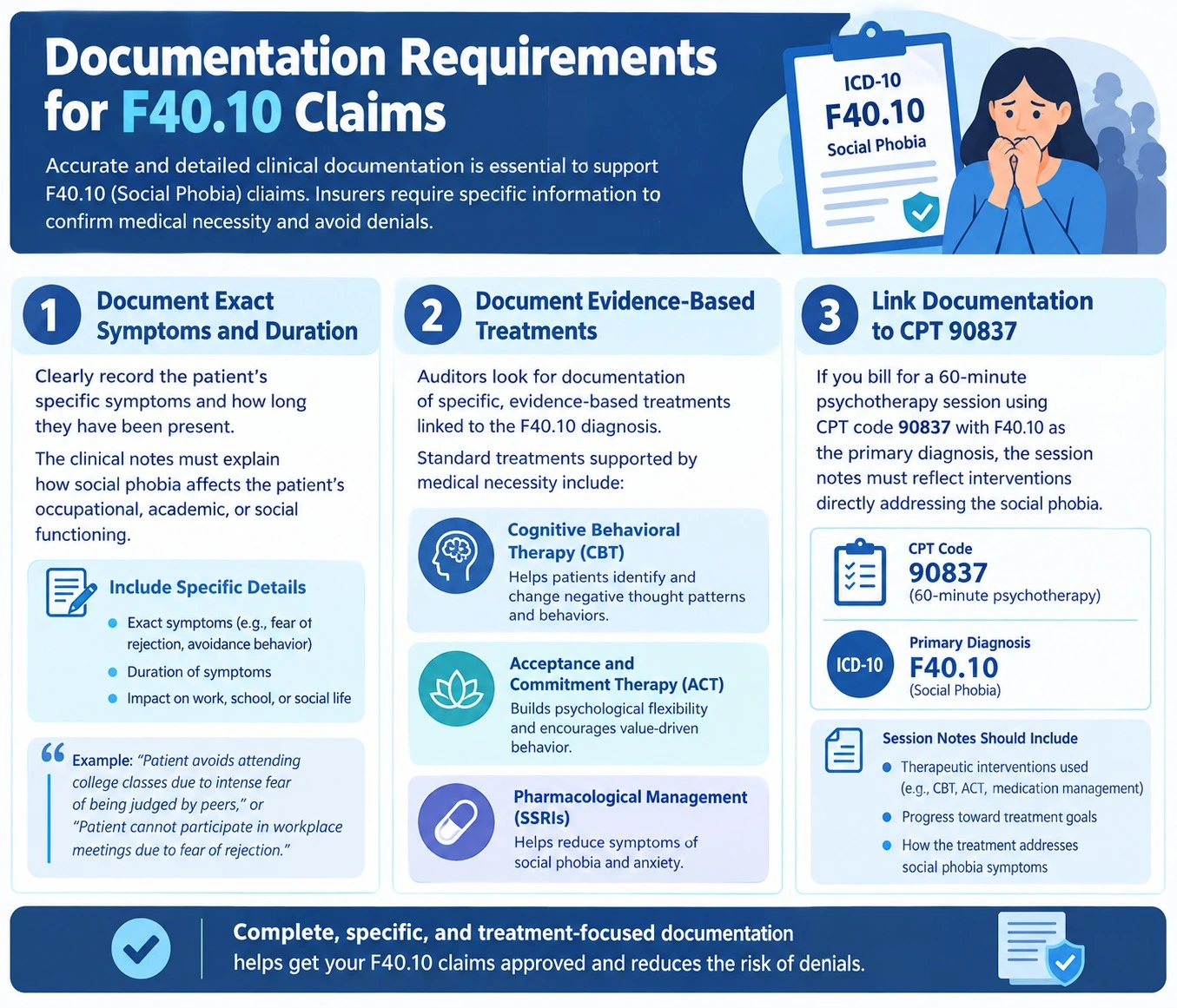
Your first-contact note is the foundational document of the entire treatment episode. For F40.10 specifically, it should accomplish five things simultaneously:
It should establish the social fear as the primary presenting concern, in the patient’s own language as well as clinical language. Verbatim quotes from the patient particularly quotes that illustrate the nature of the feared evaluation are extraordinarily powerful documentation tools because they cannot be manufactured after the fact. It should describe the avoidance pattern in behavioral terms, not merely emotional ones. “Patient avoids” followed by a specific list of situations is more valuable than “patient reports significant distress in social settings.”
It should quantify functional impairment across meaningful life domains. Employment, academic functioning, romantic relationships, friendships, family roles each deserves at least a sentence of clinical attention.
It should contain differential diagnosis reasoning. Even a single paragraph that addresses why F40.10 was selected over F41.1, F41.0, or F60.6 transforms an adequate note into a defensible one.
It should anchor the diagnosis in time. Duration is a diagnostic criterion, not a background detail. The note should specify when symptoms began, whether they have been continuous or episodic, and how they have evolved.
Progress Notes That Justify Continued Care
The progress note is the document that justifies why this patient, at this point in their treatment, still requires this level of care. Every note submitted alongside an F40.10 claim should reflect:
A current symptom report that is patient-specific and session-specific, not copied from the previous visit. Payers have become sophisticated enough to flag notes that share verbatim language across multiple dates of service.
A description of the therapeutic work done in that session, anchored to the patient’s social anxiety specifically. “Processed avoidance response to last week’s office social event; patient identified the cognitive distortions driving anticipatory anxiety and practiced defusion techniques” is a progress note. “Discussed coping skills” is a liability.
A brief functional update, even if brief one sentence about how the patient’s social functioning has shifted, remained stable, or deteriorated since the last session.
The CPT Pairing Problem Codes That Must Match the Notes
Behavioral health coding tips that focus only on the ICD-10 side of the claim miss half of the picture. The CPT procedure code submitted alongside F40.10 must be defensible on its own terms, and it must match the clinical content of the note that ostensibly supports it.
The most common CPT codes appearing alongside F40.10 in outpatient practice:
| CPT Code | Service Description | Critical Documentation Requirement |
|---|---|---|
| 90791 | Psychiatric Diagnostic Evaluation | Full diagnostic formulation including differential reasoning |
| 90834 | Individual Psychotherapy, 45 minutes | Session start/stop times; specific therapeutic content |
| 90837 | Individual Psychotherapy, 53+ minutes | Same as above; note must reflect extended clinical complexity |
| 90792 | Diagnostic Evaluation with Medical Services | Medication discussion documented; prescribing rationale present |
| 96130 | Psychological Testing Evaluation | Test battery identified; clinical question stated |
| 90847 | Family Psychotherapy with Patient Present | Family member participation documented; relational context tied to social anxiety |
| 90833 | Psychotherapy Add-On (30 min) | Clearly distinguishable from the E&M portion of the visit |
The mismatch pattern that most commonly triggers F40.10 claim denial prevention concerns a 90837 note that clocks fewer than 53 minutes of psychotherapy, a 90791 note that reads more like a session note than a diagnostic evaluation, or a 90847 note with no family member present these are the vulnerabilities that a skilled reviewer identifies immediately.
Prior Authorization Writing Clinical Summaries That Actually Win Approvals
Authorization reviewers are frequently not clinicians. They are trained to match submitted clinical information against coverage criteria, and they are doing so across dozens of cases simultaneously. The clinical summary you submit for prior authorization of F40.10 services is not a conversation it is a document that must argue its own case in your absence.
Effective authorization letters for anxiety disorder reimbursement under F40.10 share several structural features. They lead with the most functionally compelling information first — not the diagnosis code, but the impairment. They connect symptom severity to treatment necessity without requiring the reviewer to draw inferences. They demonstrate that the proposed level of care (rather than something less intensive) is clinically indicated, with a brief statement of why a lower level was considered and why it is not sufficient.
A clinical summary that reads “Patient presents with social phobia and requires ongoing weekly therapy” is thin. A summary that begins “Patient presents with Social Phobia, Unspecified (F40.10), with significant functional impairment across occupational and interpersonal domains. Patient has declined two promotions in 18 months, maintains no social relationships outside the nuclear family, and scores 68 on the Liebowitz Social Anxiety Scale indicating marked severity” that is a document built to succeed.
Telehealth, Social Phobia and the Documentation Responsibility That Comes With It
There is an underappreciated clinical irony embedded in the telehealth expansion of recent years: the patient population that stands to benefit most dramatically from remote mental health access is, in many ways, the social phobia population.
Waiting rooms are activating. Parking structures and building lobbies where strangers observe your arrival are activating. Scheduling and front-desk interactions are activating. The social choreography of presenting oneself to a stranger in a physical office space is, for the patient with significant unspecified social phobia, a genuine clinical barrier one that delays or altogether prevents treatment entry.
Remote delivery dissolves much of that barrier. And yet the documentation obligation that arises is not trivial: when telehealth is chosen specifically because of the patient’s social phobia, that clinical rationale should be stated explicitly in the record. It transforms the delivery modality from a logistical convenience into a clinically justified treatment decision which is a meaningful distinction if a payer ever questions why this patient never transitioned to in-person care.
For social phobia CPT codes delivered via telehealth, confirm appropriate modifier use (95 for synchronous audio-video delivery is the most widely recognized, though payer-specific modifiers still exist), verify state-specific licensure requirements, and document the technology platform used and the patient’s location at the time of service.
Denial Management: Responding to F40.10 Rejections With Precision
Even practices with exemplary documentation occasionally receive denials. The response strategy depends entirely on the specific denial rationale:
“Diagnosis not supported by clinical record” this is a documentation gap denial. Your appeal needs to supply what the original submission lacked: a letter of medical necessity that maps the documented clinical findings to the diagnostic criteria explicitly, not inferentially.
“Unspecified code additional specificity required” a payer-driven push toward F40.11 or another more specific code. If the clinical record genuinely supports F40.11 at this point in treatment, update the code and resubmit with a note documenting the diagnostic evolution. If F40.10 remains clinically appropriate, the appeal must explain why, citing the specific clinical reasoning that keeps the specifier unresolved.
“Service not medically necessary” almost always a progress note quality issue. The appeal response should include supplemental clinical documentation session notes, updated functional assessments, standardized scale scores that demonstrate active, ongoing impairment and therapeutic engagement rather than maintenance-level contact.
“Authorization not on file” administrative, but not trivial. Correct the administrative failure, submit the retro-authorization request if the payer allows it, and update your intake verification process to prevent recurrence.
Why This All Comes Back to the Patient
There is a version of this conversation that treats the F40.10 diagnosis code as an administrative object a string of characters that triggers a reimbursement transaction. Technically, that framing is not wrong. But it is radically incomplete. Every F40.10 code on a claim represents a person who has organized a meaningful portion of their life around the avoidance of human judgment. Who has calculated, perhaps unconsciously, that the pain of exclusion is less threatening than the pain of exposure. Who may have spent years decades carrying the weight of something they did not have language for, something they told themselves was a personality flaw rather than a treatable condition. When the code is applied accurately, the documentation is thorough, and the claim is paid that patient stays in treatment. And staying in treatment is where recovery happens. The precision of behavioral health coding is not a technicality that lives downstream from clinical care. It is part of clinical care. It is the administrative scaffolding that holds the therapeutic relationship in place long enough to do real work. Get the code right. Build the documentation carefully. Bill with integrity. And understand, in the marrow of your professional practice, that those three obligations are not separate from the act of helping someone heal. They are inseparable from it.
Make An Appintment With Us