


Mental health professionals diagnose millions of patients with social anxiety every year, but translating that clinical reality into a clean medical claim requires exact data. The F40.10 diagnosis code represents "Social phobia, unspecified" in the ICD-10-CM manual. Clinicians use this specific alphanumeric string daily to document patients experiencing severe, life-altering distress in social settings. Medical billers rely on it to establish medical necessity for therapy sessions and psychiatric medication management.
Misunderstanding how to apply this code causes claim denials. It also disrupts longitudinal patient care records. Accurate medical coding requires knowing exactly how F40.10 interacts with diagnostic manuals, secondary conditions, and insurance payer guidelines.
The Clinical Reality Behind F40.10
Social phobia involves an intense, persistent fear of social situations where the individual might be scrutinized by others. According to a 2023 report published by the National Institute of Mental Health (NIMH), an estimated 7.1% of adults in the United States experience social anxiety disorder in a given year. The World Health Organization classifies the F40.10 code under the broader category of anxiety, dissociative, and stress-related disorders.
A patient receiving this diagnosis typically experiences severe physical symptoms when confronted with social environments. These physical manifestations include blushing, sweating, trembling, or a rapid heart rate. The fear of humiliation or rejection leads to consistent avoidance of social gatherings, workplace meetings, or public public speaking.
To qualify for the F40.10 diagnosis code, the patient's symptoms must cause measurable functional impairment in their daily life. The condition must surpass standard shyness. The NIMH reports that among adults with social anxiety disorder in the past year, 29.9% experienced serious impairment, while 38.8% reported moderate impairment.
Navigating the DSM-5 and ICD-10-CM Mapping Conflict
A frequent friction point for mental health coders involves the translation between the Diagnostic and Statistical Manual of Mental Disorders (DSM-5) and the ICD-10-CM code set. The American Psychological Association (APA) documented this specific crosswalk discrepancy in 2016, noting that clinicians and billers frequently misalign these manuals.
The DSM-5 uses F40.10 as the primary code for Social Anxiety Disorder. However, in the official ICD-10-CM manual, F40.10 maps directly to "Social phobia, unspecified". The ICD-10-CM offers an alternative code, F40.11, which designates "Social phobia, generalized".
Many clinical providers default to F40.10 because their electronic health record (EHR) systems automatically map the DSM-5 diagnosis to that exact ICD-10-CM string. Medical coders must review the provider's clinical notes to determine if the patient's presentation warrants the unspecified designation. If the documentation shows the phobia affects nearly all social situations, the generalized code (F40.11) provides a more accurate reflection of the patient's condition.
Differentiating F40.10 From Similar Diagnoses
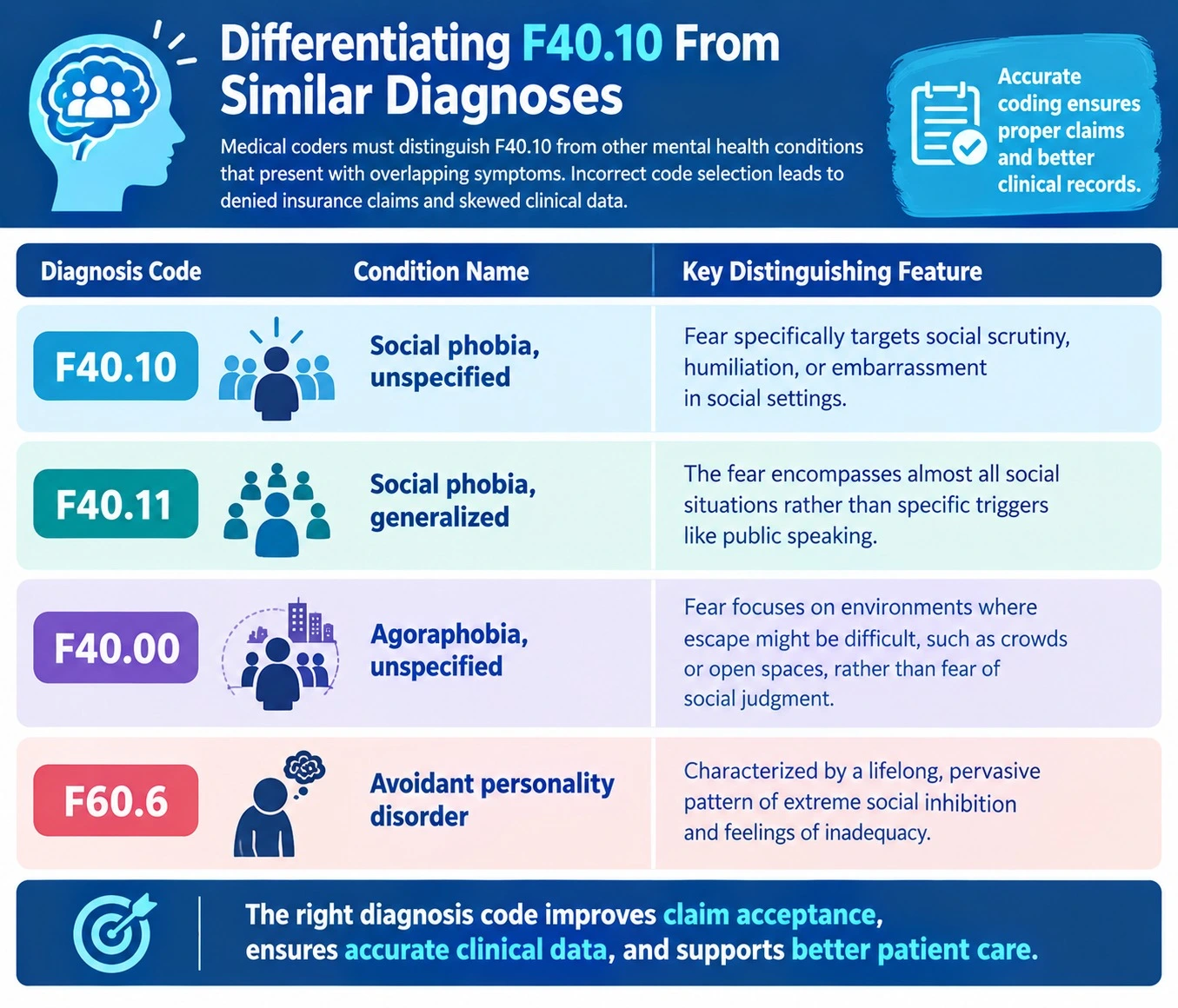
Medical coders must distinguish F40.10 from other mental health conditions that present with overlapping symptoms. Incorrect code selection leads to denied insurance claims and skewed clinical data.
| Diagnosis Code | Condition Name | Key Distinguishing Feature |
|---|---|---|
| F40.10 | Social phobia, unspecified | Fear specifically targets social scrutiny, humiliation, or embarrassment in social settings. |
| F40.11 | Social phobia, generalized | The fear encompasses almost all social situations rather than specific triggers like public speaking. |
| F40.00 | Agoraphobia, unspecified | Fear focuses on environments where escape might be difficult, such as crowds or open spaces, rather than fear of social judgment. |
| F60.6 | Avoidant personality disorder | Characterized by a lifelong, pervasive pattern of extreme social inhibition and feelings of inadequacy. |
Documentation Requirements for F40.10 Claims
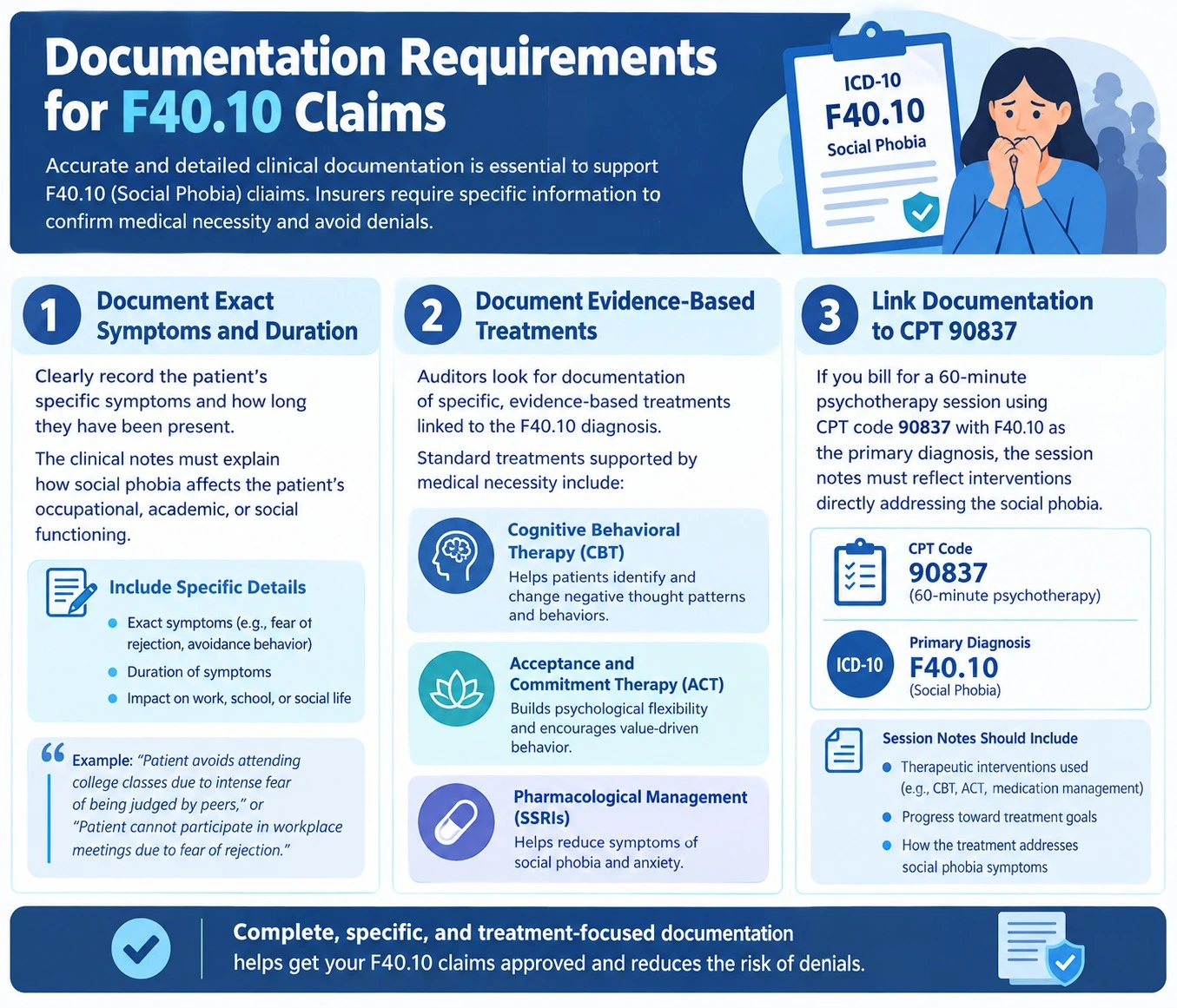
Insurance payers demand highly specific clinical documentation to support the F40.10 diagnosis code. A submitted claim lacking sufficient clinical detail often results in a request for medical records or a denial based on a lack of medical necessity.
Providers must clearly document the patient's exact symptoms and their duration. The clinical notes need to explicitly state how the social phobia impairs the patient's occupational, academic, or social functioning. If a patient avoids attending college classes or cannot participate in workplace meetings due to severe fear of rejection, the provider must write these specific details into the clinical chart.
Auditors look for documentation of specific, evidence-based treatments linked to the diagnosis. Standard treatments supported by medical necessity for F40.10 include cognitive behavioral therapy (CBT), acceptance and commitment therapy (ACT), and pharmacological management using Selective Serotonin Reuptake Inhibitors (SSRIs). If a provider bills for a 60-minute psychotherapy session using Current Procedural Terminology (CPT) code 90837 with F40.10 as the primary diagnosis, the session notes must reflect interventions directly addressing the social phobia.
Managing High Comorbidity Rates in Medical Billing
Patients rarely present with F40.10 in isolation. Up to 90% of individuals with social anxiety disorder have a co-occurring mental health diagnosis. This high comorbidity rate forces coders to carefully sequence diagnoses on the CMS-1500 claim form to accurately reflect the primary reason for the patient encounter.
Frequent comorbid conditions documented alongside social phobia include:
- Major depressive disorder
- Substance abuse disorders
- Bipolar disorder
- Obsessive-compulsive disorder
When a patient seeks treatment primarily for severe depression but also suffers from social phobia, the coder must list the major depressive disorder code as the primary diagnosis. F40.10 becomes the secondary code. Reversing this order when the clinical session primarily focused on depressive symptoms can trigger an insurance audit. Coders must ensure the primary diagnosis code matches the primary focus of the specific clinical encounter billed on that date of service.
Demographic Variances in F40.10 Application
Social anxiety often begins early in life. The World Health Organization noted in a September 2026 fact sheet that anxiety symptoms frequently have their onset during childhood or adolescence. Statistics from the NIMH reinforce this reality. An estimated 9.1% of adolescents aged 13 to 18 have experienced social anxiety disorder, and 1.3% of adolescents experience severe impairment from the condition.
Prevalence rates also differ strictly by biological sex. The NIMH reports that the past-year prevalence of social anxiety disorder is higher among adult females (8.0%) compared to adult males (6.1%).
Clinicians treating pediatric populations use the same F40.10 diagnosis code. The documentation for children, however, looks very different than adult charts. Instead of documenting workplace avoidance, a child's chart might describe a refusal to attend middle school, an inability to speak to teachers, or extreme crying during peer interactions. Coders reviewing pediatric records must ensure these age-specific functional impairments are clearly captured before applying the F40.10 code.
The Global Context of F40.10 and ICD-11 Transitions
Anxiety disorders represent the most common mental health conditions worldwide. A September 2026 WHO report states that anxiety disorders affected 470 million people globally in 2023. Despite this high prevalence, treatment rates remain low. Fewer than five percent of people with social anxiety disorder seek clinical treatment after their first year of experiencing symptoms.
The global medical community relies on accurate ICD-10 data to track public health metrics. Every time a medical biller accurately submits the F40.10 diagnosis code, they feed vital statistics into state and national health registries. This raw data determines government funding for mental health programs and guides academic research into new psychiatric treatments.
While the United States currently utilizes the ICD-10-CM system, other countries have already transitioned to the updated ICD-11 manual. Under the ICD-11, social anxiety disorder is coded as 6B0F. United States medical coders and healthcare billers will eventually need to adapt to this new coding framework. The upcoming system drops the "social phobia" terminology entirely in favor of "social anxiety disorder."
Until the US healthcare system fully implements that transition, mastering the nuances of the F40.10 diagnosis code remains a daily necessity for mental health professionals. Accurate application of this specific code ensures providers receive fair financial reimbursement while maintaining the clinical integrity of the patient's permanent medical history.