



Code 302 Medical: Billing Requirements and Documentation Tips
Medical claim denials can occur even when a healthcare provider delivers medically necessary treatment and submits the correct procedure codes. One administrative problem involves an expired authorization or a missed notification deadline. Insurers communicate this type of payment adjustment through code 302 medical billing, also known as Claim Adjustment Reason Code (CARC) 302.
Code 302 indicates that the time limit associated with precertification, notification, authorization, or pretreatment requirements has expired.
For healthcare practices, understanding this denial requires more than checking whether an authorization number exists. Billing teams must review the approved service dates, payer notification requirements, treatment documentation, and information submitted on the insurance claim.
This guide explains the meaning of medical denial code 302, its billing requirements, common documentation problems, and practical methods for correcting and preventing authorization-related denials.
What is code 302 medical billing?
Code 302 is a Claim Adjustment Reason Code used when a payer determines that a required authorization, notification, precertification, or pretreatment time limit has expired.
The Accredited Standards Committee X12 maintains the standardized Claim Adjustment Reason Code list used in healthcare payment transactions.
Its official description for CARC 302 is:
"Precertification/notification/authorization/pre-treatment time limit has expired."
The code became effective on November 1, 2020.
Healthcare organizations encounter CARC 302 on electronic remittance advice (ERA) or an explanation of benefits (EOB) after an insurer processes a claim.
It is important to distinguish this adjustment code from a CPT procedure code or an ICD-10-CM diagnosis code. CARC 302 describes a payment processing problem rather than a medical condition or service.
It also differs from institutional revenue code 0302, which identifies laboratory immunology services.
What does CO-302 mean?
CO-302 combines two pieces of payment information.
The prefix CO means contractual obligation, while 302 identifies the expired authorization or notification time limit.
According to the Centers for Medicare & Medicaid Services (CMS), claim adjustment group codes identify financial responsibility for adjusted claim amounts.
A CO adjustment generally represents an amount assigned to the provider rather than the patient.
A claim may also contain a different group code, such as PR for patient responsibility. However, patient billing must follow the actual adjudication, applicable insurance contract, and relevant federal or state protections.
Providers should never assume that a code 302 denial automatically permits transferring the unpaid amount to the patient.
Why do medical claims receive denial code 302?
Several administrative circumstances can result in code 302. The underlying problem usually involves a missed deadline or a service date outside the authorization's validity period.
Authorization expired before treatment
Many insurance approvals apply only to a specified period.
For example, an insurer may authorize a diagnostic procedure for dates between August 1 and August 31. If the patient receives the procedure on September 5 without an approved extension or new authorization, the claim may be denied.
The original approval does not necessarily remain valid because the service was previously determined to be medically necessary.
Required notification was submitted late
Some payers require notification before a planned procedure or within a specified period after an inpatient admission.
Missing the applicable notification deadline can cause a payment adjustment even if the medical records support the treatment.
This problem frequently requires coordination between hospital registration, utilization management, and medical billing departments.
Treatment continued beyond the approved period
Extended treatment plans can create authorization problems. A patient receiving physical therapy, rehabilitation, or another recurring service may require renewed approval before continuing treatment beyond the authorized period.
Billing staff must distinguish between expiration of the approved date range and exhaustion of approved visits or units, since insurers may assign different adjustment codes to these situations.
Authorization information was not updated
An insurer might approve a procedure for one date, but the physician subsequently reschedules it. If the practice does not request an applicable authorization update, the new service date may fall outside the existing approval.
A scheduling change therefore needs an authorization review, even when the medical procedure remains unchanged.
Code 302 vs. other medical billing denial codes
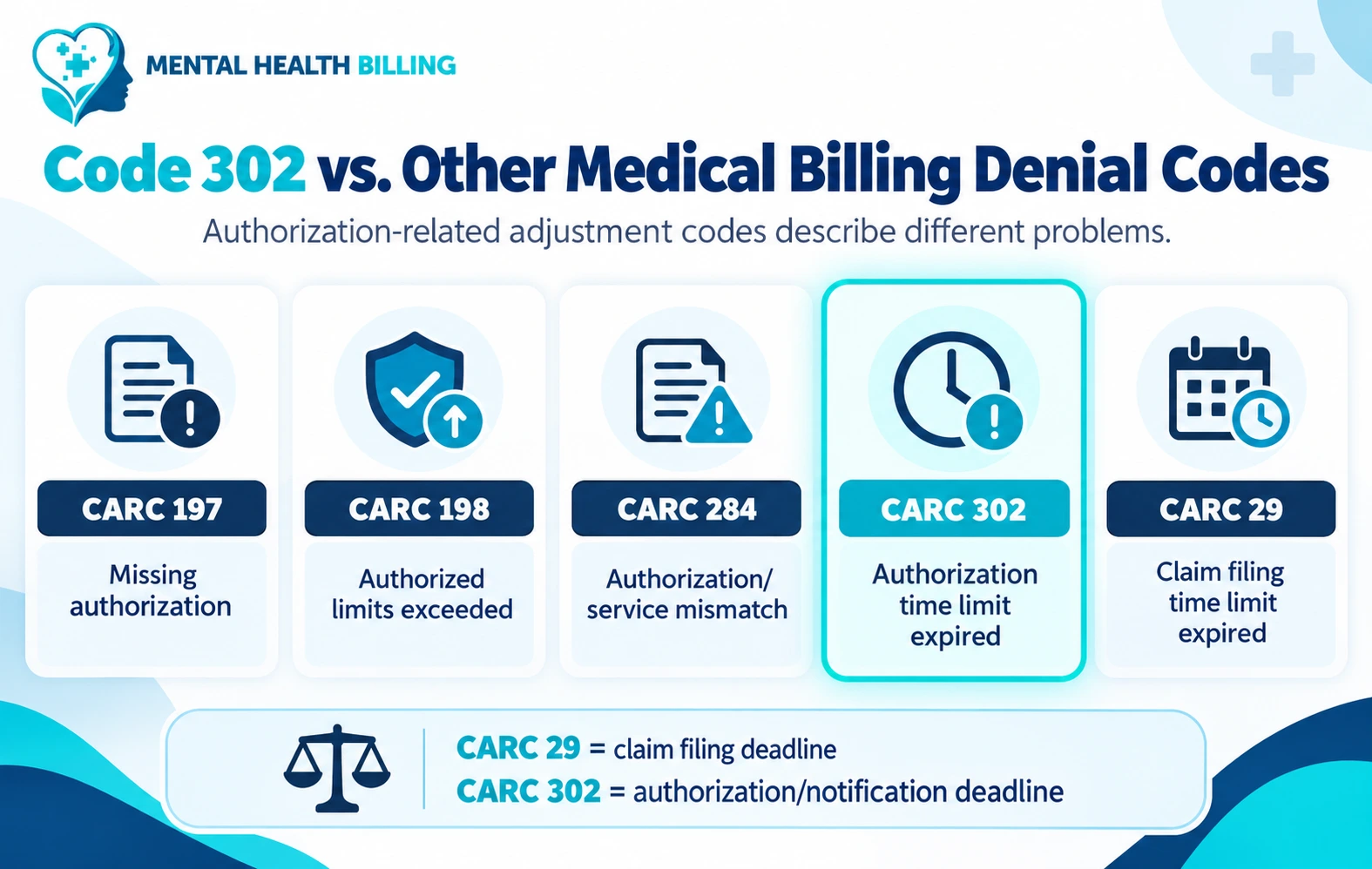
Authorization-related adjustment codes describe different problems. Identifying the correct one prevents unnecessary corrections and appeals.
| Denial code | Meaning | Main issue |
|---|---|---|
| CARC 197 | Precertification, authorization, or notification absent | Required approval or notification is missing |
| CARC 198 | Precertification, authorization, or notification exceeded | Authorized limits were exceeded |
| CARC 284 | Authorization number may be valid but does not apply to the billed services | Authorization and billed service mismatch |
| CARC 302 | Authorization or notification time limit expired | A required time period has expired |
| CARC 29 | Claim filing time limit expired | Insurance claim submitted after the filing deadline |
These descriptions come from the X12 Claim Adjustment Reason Code list.
A common coding mistake is treating CARC 302 as a timely filing denial.
Although both involve deadlines, they address separate requirements. CARC 29 concerns the time allowed to submit a claim, while CARC 302 concerns the time limits associated with authorization or notification.
Medical billing requirements for code 302
Preventing code 302 requires accurate verification before treatment and careful claim preparation afterward.
Verify whether prior authorization is required
Before scheduling a service, billing personnel should verify the patient's insurance benefits and the payer's current authorization requirements.
Requirements may differ according to the member's plan, procedure, servicing provider, and place of service.
A procedure that does not require authorization under one commercial policy may require approval under a different plan administered by the same insurer.
Confirming eligibility alone does not establish whether authorization is necessary.
Confirm the authorized service dates
An approval number does not establish unlimited permission to provide treatment.
Staff should review the authorization's start date, expiration date, service description, approved units, and any conditions attached to the decision.
UnitedHealthcare's 2026 Care Provider Administrative Guide specifies that an advance notification or prior authorization applies to the service date or date range stated in the approval.
For services not yet performed, the guide directs providers to contact the insurer when the approved period has passed to determine whether the dates can be updated or a new submission is necessary.
Match the authorization to the claim
The approved information should match the corresponding insurance claim.
Important elements include the patient's insurance identification, rendering provider, procedure codes, place of service, and treatment dates.
An authorization may be valid but still fail to support payment if it was issued for a different service or provider.
Providers should also remember that prior authorization is generally not a guarantee of reimbursement. Other coverage, coding, and claim processing requirements continue to apply.
Maintain separate deadline controls
Healthcare practices must monitor three separate timelines: the deadline for requesting or notifying the payer, the authorization’s validity period, and the filing deadline for the associated claim. Each can affect reimbursement independently.
Combining these dates into a single scheduling reminder increases the likelihood that a required action will be missed.
Documentation requirements for code 302 medical claims
Accurate medical records are essential when resolving authorization denials. They must support both the medical reason for treatment and the administrative history of the approval.
Authorization records
The billing file should retain the authorization number, payer decision, approved services, authorization dates, and relevant restrictions.
If the payer granted an extension, preserve the revised decision rather than relying on the original approval.
A screenshot or downloadable confirmation from the payer portal can help establish the information available when treatment was scheduled.
Clinical documentation
Medical records should explain why the ordered service was necessary.
Depending on the procedure, useful information may include the patient's diagnosis, symptoms, previous treatment, examination findings, physician orders, and treatment plan.
For services extending over several visits, progress notes should establish the care provided and the clinical basis for continuing treatment.
Clinical documentation alone does not establish that an authorization deadline was met. Both records may be needed to resolve a denial.
Communication and submission records
A strong authorization file also preserves evidence of communication with the payer.
This may include submission dates, electronic acknowledgments, reference numbers, correspondence, requests for additional information, and the payer's final determination.
Telephone conversations should be documented with the date, representative's name or identifier when available, reference number, and explanation provided.
These details can help establish whether a timely request was received or whether an insurer overlooked an approved change.
How to resolve a code 302 medical billing denial
Receiving CARC 302 does not necessarily mean every available correction or appeal option has been exhausted.
The appropriate response depends on the reason for the denial and the payer's requirements.
Step 1: Examine the remittance advice
Review the full ERA or EOB, including the group code, CARC, and any accompanying Remittance Advice Remark Codes.
CMS explains that these codes work together to communicate why payment was adjusted.
Compare the denied claim line with the applicable authorization record. Determine whether the disagreement concerns the service date, notification deadline, approved period, or another administrative requirement.
Step 2: Verify the authorization history
Search the payer portal and the practice's internal records.
Confirm whether approval existed for the actual date of service and whether any extension was granted.
If the claim omitted an existing authorization number or reported incorrect information, ask the payer whether it permits a corrected claim or another administrative correction.
Changing the claim without identifying the actual discrepancy may result in another denial.
Step 3: Contact the insurance payer
When the denial remains unclear, request a specific explanation.
Ask which requirement expired, the date the payer considers applicable, and whether an existing authorization can be reviewed.
Document the response and obtain a reference number.
Some payers permit retrospective authorization reviews in defined circumstances, but such reviews are not universally available and should never be assumed to guarantee reimbursement.
Step 4: Submit a supported appeal
If records indicate that the payer applied an incorrect deadline or overlooked a timely authorization, an appeal may be appropriate.
An effective appeal identifies the denied service, explains the disagreement, and provides the relevant evidence.
Supporting documents may include the approval letter, clinical notes, submission confirmations, authorization updates, and remittance advice.
Appeal deadlines depend on the insurance program. For example, CMS provides a 120-day filing period from receipt of the initial claim determination for first-level redetermination requests under Original Medicare fee-for-service.
This deadline should not be applied automatically to Medicare Advantage or commercial insurance claims.
Step 5: Record the final determination
After the payer responds, update the account with its decision, payment adjustment, and remaining allowable balance.
If the denial is upheld, confirm the applicable financial responsibility before making any patient billing adjustment.
Retain the correspondence for subsequent audits and internal denial analysis.
Example of a code 302 denial
Consider a hypothetical outpatient rehabilitation practice.
The insurer authorizes treatment for the period from June 1 to July 31. During a visit in July, the physician identifies the need for further treatment and schedules an additional session for August 8.
The practice does not obtain an approved extension before the appointment.
After the August claim is submitted, the insurer returns CARC 302 because the existing authorization period ended on July 31.
The billing department reviews the medical record and discovers that the physician documented the need for additional treatment but that no authorization extension was obtained.
The practice should check the payer’s policies on retrospective authorization and appeals to determine whether the request can be reconsidered.
The physician's documentation may support medical necessity, but it does not independently extend the prior authorization.
This example illustrates why clinical and administrative records need separate verification.
Important prior authorization rules for 2026
Medical practices should also understand the federal changes affecting authorization processing.
CMS issued the Interoperability and Prior Authorization Final Rule (CMS-0057-F) on January 17, 2024.
Beginning in 2026, impacted payers, including Medicare Advantage organizations and specified Medicaid and CHIP programs, generally must issue prior authorization decisions for medical items and services within:
- 72 hours for expedited requests.
- Seven calendar days for standard requests.
These requirements do not apply universally to every commercial health plan, and the rule's decision timeframes exclude drug prior authorizations. Certain program-specific exceptions and extensions may apply.
Impacted payers must also provide a specific explanation when denying applicable prior authorization requests.
These federal decision deadlines should not be confused with the validity period of an approved authorization.
A payer's obligation to respond within seven calendar days does not mean the resulting authorization remains valid for seven days. The approved dates and circumstances must be checked separately.
How medical practices can prevent code 302 denials
A reliable prevention process connects scheduling, clinical care, utilization management, and billing.
Before appointments are confirmed, staff should identify procedures requiring authorization and verify that approvals cover the intended treatment dates.
For recurring services, an authorization tracking system can identify approvals approaching expiration. Practices can use advance reminders based on the payer's requirements and expected processing time.
When an appointment changes, the scheduling team should notify the employee responsible for insurance authorization.
Before claim submission, billing personnel should compare the actual date of service with the approved period and check whether the authorization requires an update.
Denial reporting can reveal operational problems that routine claim corrections miss.
For example, repeated CARC 302 adjustments involving the same specialty may indicate that treatment plans are being extended without timely authorization renewal.
Separating authorization expirations from missing authorization, exceeded units, and late claim filing makes that analysis more useful.
Frequently asked questions about code 302 medical billing
Can a provider appeal denial code 302?
Yes, when the payer's appeal procedures permit it and the provider or another eligible party has appeal rights. Evidence of a valid authorization, timely notification, or administrative processing error may support the request. Approval is not guaranteed.
Is CO-302 the same as a missing authorization denial?
No. CARC 302 identifies an expired authorization or notification time limit. CARC 197 identifies absent authorization or notification. The distinction affects the documentation needed to investigate the denial.
Can a patient be billed for CO-302?
A CO adjustment generally assigns responsibility to the provider. Patient billing should be determined from the actual remittance advice, payer agreement, and applicable legal protections. Providers should not automatically bill patients for CO-302 amounts.
Does code 302 indicate that treatment was medically unnecessary?
No. The code specifically identifies an administrative time-limit problem. A separate medical necessity denial may exist, but CARC 302 alone does not establish that the treatment lacked clinical justification.
Can an expired authorization be extended after treatment?
That depends on the insurer's retrospective review rules, applicable law, and circumstances of the service. Providers should contact the payer and obtain a documented determination rather than assuming that an expired approval can be renewed retroactively.
Managing code 302 medical billing accurately
Code 302 medical billing identifies an expired authorization, notification, precertification, or pretreatment time limit. Resolving the adjustment requires comparing the payer's requirements with the actual treatment dates, approved authorization period, and documented submission history.
The most useful safeguards are verifying authorization before treatment, monitoring expiration dates, maintaining complete clinical and administrative records, and reviewing the precise denial reason before correcting or appealing a claim.
Accurate documentation supports reconsideration when an error has occurred. Consistent authorization tracking reduces the risk of preventable code 302 denials before claims reach the payer.