



Aetna incident-to billing for mental health involves an important distinction often overlooked in billing guides: Aetna’s behavioral health supervisory billing policy is separate from Medicare’s incident-to billing requirements. Using the terms interchangeably can cause a practice to apply the wrong requirements.
Does Aetna allow supervised mental health services to be billed under another clinician? Yes, under defined conditions. Aetna’s Provider Education Bulletin, Fall 2024, describes a supervisory billing pathway for qualified license-eligible behavioral health clinicians. That permission should not be interpreted as approval for every provider, insurance product, or treatment setting.
Before submitting a claim, identify the member’s coverage, the treating clinician’s qualifications, and the policy governing the arrangement. Then address claim submission, filing deadlines, and appeals separately.
What Aetna incident-to billing for mental health actually means
Practices often use “incident-to” to describe any service billed under a supervisor. Medicare gives the term a specific meaning: qualifying services furnished by auxiliary personnel as part of an eligible practitioner’s professional treatment.
In its November 1, 2022, Calendar Year 2023 Medicare Physician Fee Schedule Final Rule fact sheet, CMS announced that qualifying behavioral health incident-to services could be furnished under general supervision, effective in 2023. General supervision does not require the supervising practitioner’s physical presence while the service occurs. Other incident-to conditions still apply.
Medicare’s requirements include an established treatment course and the billing practitioner’s continuing involvement. A supervisor’s signature alone does not establish that the service meets those conditions. CMS’s psychological services guidance explains the connection between the treatment plan, practitioner participation, and services furnished by auxiliary personnel.
For an Aetna claim, establish whether the relevant pathway is Aetna supervisory billing, Medicare-based incident-to coverage, or another product-specific arrangement. Ask for the applicable written policy before configuring the billing system.
Who qualifies for Aetna supervisory billing?
Aetna’s Fall 2024 bulletin sets out these requirements:
- The license-eligible clinician has completed the educational requirements for the intended license and is accumulating clinical hours toward independent licensure.
- The clinician receives active supervision appropriate to the caseload.
- The supervisor holds an independent license and maintains active credentials and a contracted provider relationship with Aetna.
- The supervisor and clinician work for the same group or facility.
- The arrangement is in network.
The supervisor need not work at the same service location; virtual supervision is permitted. For qualifying claims, Aetna instructs providers to identify the licensed supervisor as the rendering clinician. Services must fall within the member’s benefits and the applicable Aetna contract.
Before onboarding a clinician, create an internal approval record containing the policy reviewed, credentialing confirmation, employment arrangement, and supervision plan. This gives billing staff a documented basis for selecting the correct claim workflow.
Do not treat “receives supervision” as a sufficient eligibility check. Ask specifically about students still completing educational requirements, independently licensed clinicians awaiting credentialing, and supervisors employed outside the practice.
Verify mental health benefits before discussing payment
An active insurance policy does not answer every coverage question. Aetna explains that the member’s benefit plan determines coverage, and a medical necessity determination does not by itself guarantee payment. Its clinical policy notices also differentiate coverage determinations from benefit exclusions and limitations.
For each proposed arrangement, verify:
- The exact insurance product and behavioral health administrator.
- Whether the intended service is covered.
- The applicable network and provider eligibility requirements.
- Whether authorization or referral requirements apply.
- The patient’s deductible, copayment, and coinsurance.
- Any service-specific conditions affecting the proposed treatment.
Ask a precise question: “Does this member’s plan cover this service when furnished by this clinician under our proposed supervisory arrangement?”
Record the representative’s name, reference number, date, and answer. If the response contradicts a written policy, seek clarification before proceeding based on that guidance. Keep the benefit verification separate from the practice’s credentialing and supervisory approval records.
How to prepare mental health claims
Build a claim review process around the approved billing arrangement. Check the member identifier, service date, procedure code, diagnosis, place of service, provider identifiers, and billing entity before transmission.
The clinical documentation should clearly explain the treatment provided so that a reviewer can understand it. As a practical documentation standard, retain:
- The identity and credentials of the person who furnished treatment.
- The service performed and relevant session time.
- The treatment plan and clinical rationale.
- The supervisory relationship and applicable supervision records.
- Required signatures and dates.
Keep the actual treating clinician identifiable in the record even where the payer directs a different rendering-provider entry on the claim.
Avoid copying a modifier from another insurer’s instructions. Ask Aetna which modifiers, provider fields, and claim format apply to the particular service and product. Save the response with the billing procedure so staff can reproduce the approved setup.
For a new arrangement, review the first submitted claims individually. Review the submitted data against the remittance, resolve any discrepancies, and verify the results before applying the same configuration across the entire caseload.
What is Aetna’s timely filing limit?
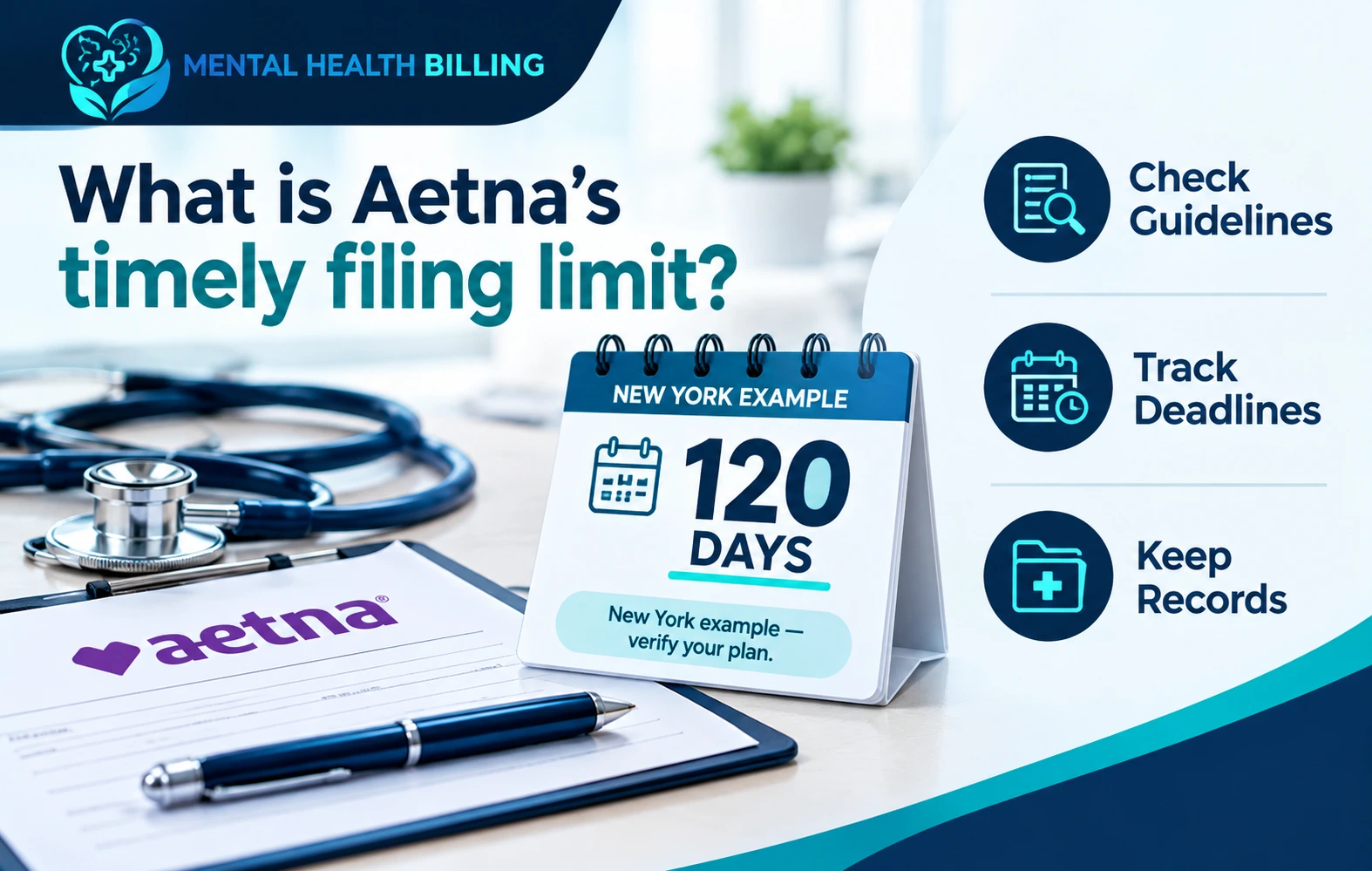
There is no safe universal answer for every Aetna mental health claim. Verify the deadline by reviewing the applicable agreement, product guidelines, and state regulations.
A concrete example appears in Aetna’s Provider Manual State Supplement, available in October 2026: its New York section requires initial submission within 120 days after the service date, unless the parties agreed to a more favorable deadline or a different period is required by law. That state-specific instruction should not become a nationwide default.
| Submission | Deadline to verify |
|---|---|
| Original claim | Initial filing period and triggering date |
| Corrected claim | Correction requirements and applicable submission period |
| Reconsideration or appeal | Dispute deadline measured from the relevant decision |
Aetna’s dispute windows concern decisions already issued. They should not be substituted for the original claim filing deadline.
Retain claim acknowledgments and payer acceptance information. If a claim is rejected, investigate promptly and document the resubmission. For a filing-limit dispute, assemble the original transmission history, acceptance records, claim number, and correspondence.
Which claims mailing address should practices use?
Do not select a mailing address solely because an online article labels it “Aetna mental health claims.”
Aetna’s Provider Manual, available in October 2026, identifies the claims address as information available through the member’s ID card information. It also explains how providers can access member card information through the provider portal. Use that member-specific information and confirm the destination when routing is unclear.
Separate original claims from disputes. Aetna directs providers submitting reconsiderations by mail to use the address on the denial letter or explanation of benefits, or the applicable state-specific address.
For electronic submission, verify the destination with the clearinghouse and payer. Maintain separate routing instructions for original claims, corrected claims, attachments, reconsiderations, and appeals. One address should not populate every workflow automatically.
How to appeal a denied supervisory billing claim
Read the denial before choosing the response. A missing claim field, a provider eligibility dispute, and a medical necessity denial require different supporting evidence.
Aetna’s Provider Disputes & Appeals Overview, accessed October 2026, distinguishes reconsiderations from appeals. Its general instructions provide:
- 180 calendar days from the initial claim decision to request reconsideration.
- 60 calendar days from the reconsideration decision to appeal, subject to exceptions.
- A separate direct-appeal pathway for issues that do not qualify for reconsideration.
State rules and product-specific instructions can change the applicable process. Verify the notice rather than assigning every denial a 180-day deadline.
Organize the submission around the disputed requirement. For provider eligibility, assemble credentialing and supervisory evidence. For medical necessity, supply relevant clinical documentation. For timely filing, supply submission evidence.
Explain exactly what should change: reconsider the provider classification, reprocess the claim under the applicable policy, or review the clinical determination. Avoid a general statement that the practice “followed all rules” without showing which rule addresses the denial.
Does this apply to inpatient mental health services?
Do not transfer an office billing arrangement into inpatient care without checking the setting-specific rules.
Medicare’s office incident-to framework under 42 CFR 410.26 concerns noninstitutional services. CMS addresses hospital services through separate coverage provisions, including its Medicare Benefit Policy Manual, Chapter 6. The presence of a supervising psychiatrist does not establish that an inpatient claim qualifies under office incident-to requirements.
For inpatient treatment, verify the facility agreement, professional billing arrangement, authorization, and clinician eligibility. Review facility and professional claims separately.
What about out-of-network treatment and mental health parity?
The published Aetna supervisory pathway is limited to in-network arrangements. Do not assume that a patient’s out-of-network benefits authorize the same billing method.
Ask separately whether the service is covered outside the network and whether the proposed clinician and billing arrangement qualify.
Mental health parity raises another question: whether a plan applies impermissibly restrictive requirements to mental health or substance use disorder benefits compared with medical and surgical benefits. CMS’s Mental Health Parity and Addiction Equity Act guidance, updated March 13, 2026, explains that nonquantitative treatment limitations include medical management and network-related restrictions.
A denial alone does not establish a parity violation. Request the written restriction and identify the comparable medical or surgical requirement before making that argument. Parity analysis does not itself supply permission to use a particular provider’s identifier.
Establish the billing pathway before the first claim
For Aetna incident-to billing for mental health, document the applicable policy, clinician eligibility, supervision arrangement, benefits, and claim instructions before submission. Keep filing deadlines and dispute procedures in separate workflows. This creates a reviewable explanation of why the practice used that billing arrangement and what evidence supports the claim.