



Medical billing modifiers provide additional information about a healthcare service without changing the basic procedure code. In behavioral health billing, modifier HM indicates that the service was provided by a professional whose qualification level is below a bachelor's degree. Its use can affect how Medicaid programs and other payers process claims, identify service providers, and determine reimbursement.
Modifier HM is particularly relevant to behavioral health organizations employing paraprofessionals, behavior technicians, peer support workers, and other qualified personnel who may not hold a four-year college degree.
However, using modifier HM correctly requires more than identifying a staff member's educational background. Billing teams must also consider provider qualifications, covered services, payer policies, supervision requirements, and documentation standards.
This guide explains the meaning of modifier HM, its applications in medical claims, and the billing requirements healthcare providers should review before submitting claims.
What is modifier HM in medical billing?
Modifier HM is a Healthcare Common Procedure Coding System (HCPCS) Level II modifier with the official description "Less than bachelor degree level."
The American Academy of Professional Coders (AAPC) identifies HM as a modifier commonly associated with behavioral health services performed by personnel whose educational qualifications fall below the bachelor's degree level.
The modifier helps a payer distinguish between services furnished by professionals at different qualification levels when the applicable billing policy uses such distinctions.
For example, a behavioral health agency may employ a licensed clinical psychologist, a master's-level counselor, and a behavior technician. Although these individuals may participate in the same patient's treatment program, their qualifications and permitted responsibilities differ.
A payer may require different modifiers to identify the category of personnel providing a particular service.
Modifier HM communicates the relevant qualification category on the claim. It does not independently establish that the individual is qualified to perform the procedure or that the service qualifies for reimbursement.
What does HM stand for?
The letters HM function as a standardized HCPCS modifier identifier. The official descriptor is Less than bachelor degree level.
The designation should not be interpreted as a professional license, certification, or specific job title.
An individual identified under HM may possess a high school diploma, an associate degree, or another qualification recognized by the applicable program. The exact eligibility rules depend on the service and payer.
A staff member's educational background alone is insufficient to determine whether HM is appropriate. Some Medicaid programs associate modifiers with approved provider roles rather than solely with academic degrees.
When should modifier HM be used?
Modifier HM may be appropriate when a payer requires a claim to identify a qualified service provider working below the bachelor's degree level.
It frequently appears in billing policies for behavioral health and community-based support services.
Common areas where HM may be relevant include behavioral rehabilitation, applied behavior analysis (ABA), psychosocial support, certain substance use disorder services, and community mental health programs.
These services are not automatically eligible for HM billing. The payer must recognize both the underlying service and the applicable provider category.
Modifier HM in behavioral health services
Behavioral health programs often involve professionals with different education, training, and certification requirements.
A community mental health agency, for example, might employ paraprofessional support staff to assist individuals with treatment-plan activities, daily living skills, or community participation.
Where the Medicaid program authorizes those staff to furnish a covered service and assigns modifier HM to their category, the billing department may need to report the modifier alongside the appropriate procedure code.
Florida's Department of Children and Families includes HM-coded services in its FASAMS data code documentation, including an entry associating modifier HM with HCPCS code H2010. This demonstrates that the modifier can appear in state behavioral health coding specifications, although that data specification should not be treated as a universal reimbursement rule.
Modifier HM in ABA therapy billing
Applied behavior analysis is another area where modifier HM may appear.
ABA programs frequently involve behavior technicians working under the direction of qualified professionals. Depending on the payer, modifiers can distinguish technician-delivered services from services delivered by other practitioner categories.
An Optum ABA agency billing guide lists CPT codes 97152, 97153, and 97154 with HN and HM modifier options and describes HM as representing a behavior technician when specified by that guide.
Consider an ABA technician who provides adaptive behavior treatment under an approved treatment protocol.
If the payer requires HM for the technician's category, the claim may use:
CPT 97153-HM
CPT 97153 describes adaptive behavior treatment by protocol, administered by a technician under the direction of a qualified healthcare professional, each 15 minutes.
The procedure code identifies the service, while HM supplies the additional provider-category information required by the payer.
This example depends on the payer’s specific requirements and does not mean that all ABA claims involving a technician must include modifier HM.
Modifier HM requirements for medical claims
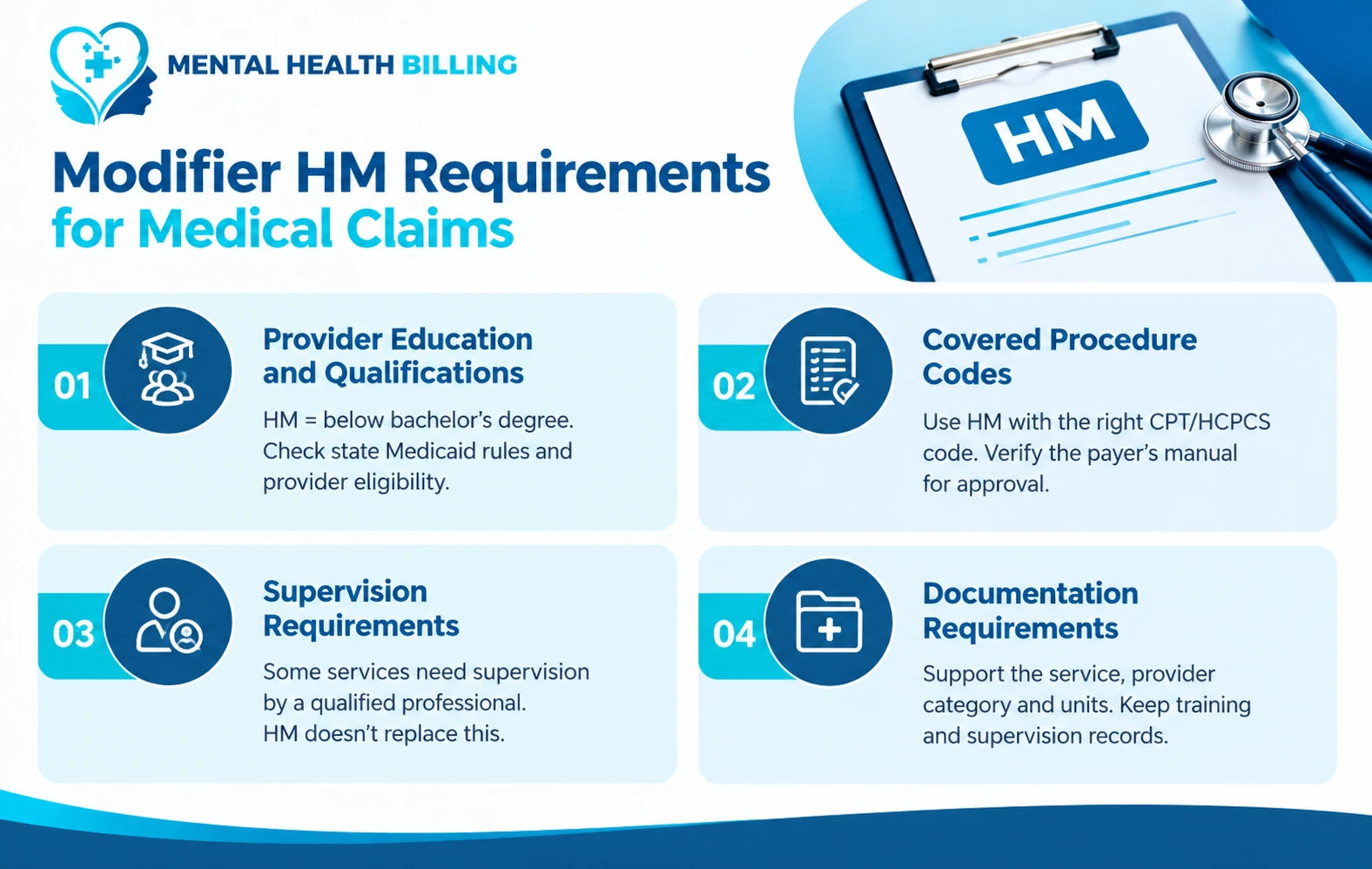
Correct modifier selection begins with verifying the rendering individual's eligibility for the specific service.
1. Provider education and qualifications
The HCPCS definition identifies HM with an education level below a bachelor's degree.
However, Medicaid programs can impose additional qualifications involving training, certification, experience, or approved provider status.
In guidance published June 25, 2024, Medicaid.gov explained that states generally have flexibility in determining eligible providers for covered Medicaid services, subject to applicable federal requirements.
This means a paraprofessional may qualify for reimbursement under one state's Medicaid rules but not under another state's requirements for the same type of service.
Billing staff should examine the applicable provider qualifications rather than assuming that anyone without a bachelor's degree can bill using HM.
2. Covered procedure codes
Modifier HM must accompany an appropriate CPT or HCPCS procedure code.
The underlying code identifies what service was delivered. The modifier provides additional information about the circumstances or personnel involved.
A payer may accept HM with certain behavioral health procedure codes while rejecting the same modifier on unrelated services.
Before submitting the claim, verify whether the current payer billing manual permits, requires, or prohibits HM for the specific procedure.
3. Supervision requirements
Some covered services performed by paraprofessionals require supervision by an appropriately qualified professional.
The required supervision may involve an approved treatment plan, periodic review, documented oversight, or other conditions established by the governing program.
Modifier HM does not replace these obligations.
A claim cannot be made compliant merely by adding HM when the service was performed outside an individual's authorized responsibilities.
4. Documentation requirements
Clinical documentation should support the reported service, provider category, and billed units.
Depending on the program, records may need to establish the rendering staff member's identity, date of service, duration, intervention performed, connection to an approved treatment plan, and required supervisory involvement.
Staff qualification and training records should also be maintained when required by the program or payer.
Documentation requirements vary, but the central billing principle remains consistent: the claim must accurately represent the service that was provided.
Modifier HM vs. HN, HO, and HP: What's the difference?
HCPCS includes several modifiers identifying practitioner education levels. Understanding the distinctions helps billing departments select the appropriate modifier when a payer requires educational-level reporting.
| Modifier | Official description | Qualification category |
|---|---|---|
| HM | Less than bachelor degree level | Below bachelor's degree |
| HN | Bachelor's degree level | Bachelor's degree |
| HO | Master's degree level | Master's degree |
| HP | Doctoral level | Doctoral degree |
| HL | Intern | Intern or trainee category |
These descriptions are established in HCPCS Level II coding references.
The distinction between HM and HN is particularly relevant in ABA billing because organizations may employ technicians with different academic qualifications.
A technician holding a bachelor's degree should not automatically be assigned HN, however. Payer-specific rules may classify personnel according to their authorized treatment role.
Can someone with a bachelor's degree use modifier HM?
In certain programs, yes.
Michigan's Department of Health and Human Services addressed this issue in its fiscal year 2022 code-set technical assistance guidance.
The department explained that, for certain ABA services such as 97153, modifier selection reflected the individual's provider role rather than personal educational attainment. Under that guidance, a behavior technician holding a bachelor's degree could still fall under the technician category associated with HM.
This exception demonstrates why billing departments must consult the applicable state code set rather than applying educational definitions without considering the program's instructions.
Before applying the 2022 clarification to claims in 2026, verify that it aligns with the latest Michigan Medicaid billing policies.
Does Medicare reimburse claims with modifier HM?
Modifier HM does not independently establish Medicare coverage or reimbursement.
Traditional Medicare does not generally use HM as a separate payment designation for paraprofessional behavioral health services. Other Medicare billing pathways have their own eligibility, supervision, and coverage requirements.
Medicaid and certain managed care programs are more common settings for HM reporting.
Providers should not assume that a service reimbursable under Medicaid with modifier HM will also qualify for Medicare payment.
For patients enrolled in both programs, the billing department must review applicable Medicare coverage rules and Medicaid coordination-of-benefits requirements.
Common modifier HM billing errors
Errors involving HM often originate from incorrect provider classification or outdated billing configuration.
One frequent problem involves automatically assigning modifiers according to employee job titles. A practice management system might classify every behavior technician under HM, even when a particular payer requires different coding.
Another problem arises when billing personnel confuse educational qualifications with permission to provide a service.
For example, a high school graduate may meet the academic description associated with HM but still lack the training or program approval required to deliver a specific Medicaid service.
Claim denials may also occur because of:
- Unsupported procedure and modifier combinations.
- Missing or inaccurate rendering-provider information.
- Incorrect service units or insufficient documentation.
- Failure to satisfy payer-specific supervision or enrollment requirements.
- Outdated modifier rules following a state Medicaid policy revision.
Not every denial involving HM indicates that the modifier itself is incorrect. Billing teams must read the actual adjustment and remark codes before determining the cause.
How to correct a denied claim involving modifier HM
When a claim containing HM is denied, begin by reviewing the payer's explanation of benefits or electronic remittance advice.
Identify whether the rejection concerns the modifier, provider qualifications, service eligibility, authorization, or another claim element.
Next, compare the original claim with the policy in effect on the date of service.
A modifier may have been valid when an older claim was submitted but become subject to different requirements after a subsequent policy update.
If the modifier was entered incorrectly, submit a corrected claim according to the payer's procedures.
If HM was appropriate and the service was properly documented, an appeal or reconsideration may be necessary.
Do not remove HM solely to obtain claim acceptance. Doing so may misrepresent the rendering provider category when the payer explicitly requires that modifier.
Frequently asked questions about modifier HM
Is modifier HM used only for mental health billing?
Although modifier HM is commonly used in mental and behavioral health billing, its use depends on the payer’s specific guidelines. It may also apply to certain applied behavior analysis (ABA), substance use disorder treatment, and community support services.
Is modifier HM the same as modifier HN?
No. HM describes a level below a bachelor's degree, while HN identifies the bachelor's degree level. Some programs assign these modifiers according to approved provider roles, so academic qualifications should not be the sole basis for selection.
Can modifier HM affect reimbursement rates?
Yes. When a payer establishes different payment rates by practitioner category, the modifier may help determine which rate applies.
However, HM has no universal reimbursement amount or adjustment percentage. The applicable payment depends on the payer, service, contract, and fee schedule.
Can modifier HM be billed with CPT code 97153?
Yes, under payer policies that authorize this combination. ABA billing guidance from Optum includes HM as an option for technician-delivered services reported using 97153. Providers should verify their current contract and billing instructions.
Does modifier HM require a specific diagnosis?
HM does not identify a diagnosis and does not independently require a particular ICD-10-CM code. Diagnosis requirements arise from the covered service, medical necessity criteria, authorization, and payer policy.
Correct use of modifier HM in medical billing
Modifier HM identifies the less than bachelor's degree level within HCPCS Level II reporting. It is commonly relevant to behavioral health services involving qualified paraprofessional personnel.
Accurate billing requires alignment between the procedure code, rendering provider category, supervision arrangements, documentation, and current payer policies.
The most important practical consideration is that modifier HM should never be selected from educational qualifications alone when the governing program uses role-specific rules. Checking the applicable code set and provider requirements before submission helps prevent avoidable claim corrections and payment disputes.