


SAMHSA’s 2024 National Survey on Drug Use and Health, released on July 28, 2025, estimated that 48.4 million people aged 12 or older (16.8%) had a substance use disorder in the past year. About 10.2 million of the people classified as needing treatment received it. Each of those episodes produces a claim, and substance abuse insurance billing requirements are less uniform than those for most outpatient specialties. A session can be billed correctly to Medicare and rejected by a state Medicaid plan that wants a different code, a different modifier and a different unit of service.
This guide is written for billers, coders and clinic managers. It covers diagnosis coding, procedure codes by payer, level-of-care authorization, parity, and the confidentiality rule that governs who may see SUD records.
Diagnosis coding: one code per substance
Section I.C.5.b of the ICD-10-CM Official Guidelines tells coders what to do when a provider documents use, abuse and dependence of the same substance: assign a single code at the highest level documented. A note that mentions both alcohol abuse and alcohol dependence produces one code from the F10.2 family, not two. Codes for use (F10.9-, F11.9- and so on) are reportable only when the provider ties the use to a substance-related disorder or medical condition, according to a provider tip sheet dated February 18, 2026 from Premera Blue Cross.
Coders cannot upgrade a diagnosis on their own. If the note says only "opioid use" and the clinical picture suggests dependence, the fix is a provider query, not a different code.
Substance abuse insurance billing requirements by payer and setting
No single national code set covers SUD treatment. Medicare, state Medicaid programs and commercial plans each run their own, and one clinic often bills all three.
Medicare screening and office-based treatment
G0396 (15 to 30 minutes) and G0397 (more than 30 minutes) cover structured alcohol and substance misuse assessment with brief intervention. CPT 99408 and 99409 describe the same time bands for payers that follow CPT instead of Medicare’s G-codes. For ongoing care, CMS lets physicians and non-physician practitioners bill monthly bundles: G2086 for the first month (treatment plan, care coordination and at least 70 minutes of services), G2087 for later months (at least 60 minutes), and add-on G2088 for each additional 30 minutes beyond 120. HHS’s telehealth billing guide marks these codes as permanently covered for telehealth, and Section 2001 of the SUPPORT Act removed the geographic and originating-site limits for Medicare telehealth treatment of SUD.
Opioid treatment programs
Medicare pays enrolled opioid treatment programs (OTPs) through weekly bundles, and a week means seven consecutive days. G2067 covers methadone and G2068 covers oral buprenorphine. CMS’s descriptors place dispensing or administration, counseling, individual and group therapy, and toxicology testing (when performed) inside the bundle, so billing those separately duplicates payment. Two add-ons are allowed: G2080 for each additional 30 minutes of counseling, and G2078 for take-home methadone, billable up to three times a month and only for dates that do not overlap the bundle. CMS’s rate file sets the 2026 payment for G2074, the weekly bundle that excludes the drug itself, at $220.34.
A scenario shows how the weekly rule works. If a patient switches from methadone to buprenorphine on a Wednesday, CMS tells OTPs to bill one weekly bundle code for that week, not one for each drug.
Claims go on place of service 58 (non-residential opioid treatment facility) with the program’s organizational NPI as billing provider, per the CMS and HHS OTP fact sheets. Periodic assessments (G2077) may be furnished by audio-video telehealth, and the counseling portions of the bundle plus G2080 may be furnished audio-only when video is not available.
Intensive outpatient adds a separate rule. Under the CY 2024 final rules, an OTP bills G0137 only after delivering at least nine intensive outpatient services in a week, and a physician or practitioner must certify that the patient needs at least nine hours of services weekly. Services are counted, not timed, for the billing threshold, while the certification speaks in hours.
Medicaid and commercial H-codes
State Medicaid agencies and many commercial plans use the H-series. The official descriptor for H0015 defines intensive outpatient as a program that runs at least three hours a day and at least three days a week under an individualized treatment plan. H0020 (methadone) has no Medicare rate, and its descriptor sets no unit of service, so each payer defines one.
Modifiers carry much of the meaning. National HCPCS defines HF as substance abuse program, HG as opioid addiction treatment program and HH as integrated mental health and substance abuse program, but states write their own usage rules. Montana Medicaid’s SUD fee schedule effective October 1, 2022 required HH in the first modifier position to trigger payment, and the modifier added $23.12 to the unit rate. California’s Department of Health Care Services (Information Notice 16-035) assigns HG to narcotic treatment program services, HD to perinatal services and U-modifiers to ASAM levels of care. The same modifier does not carry the same meaning across state lines.
Level of care, authorization and parity
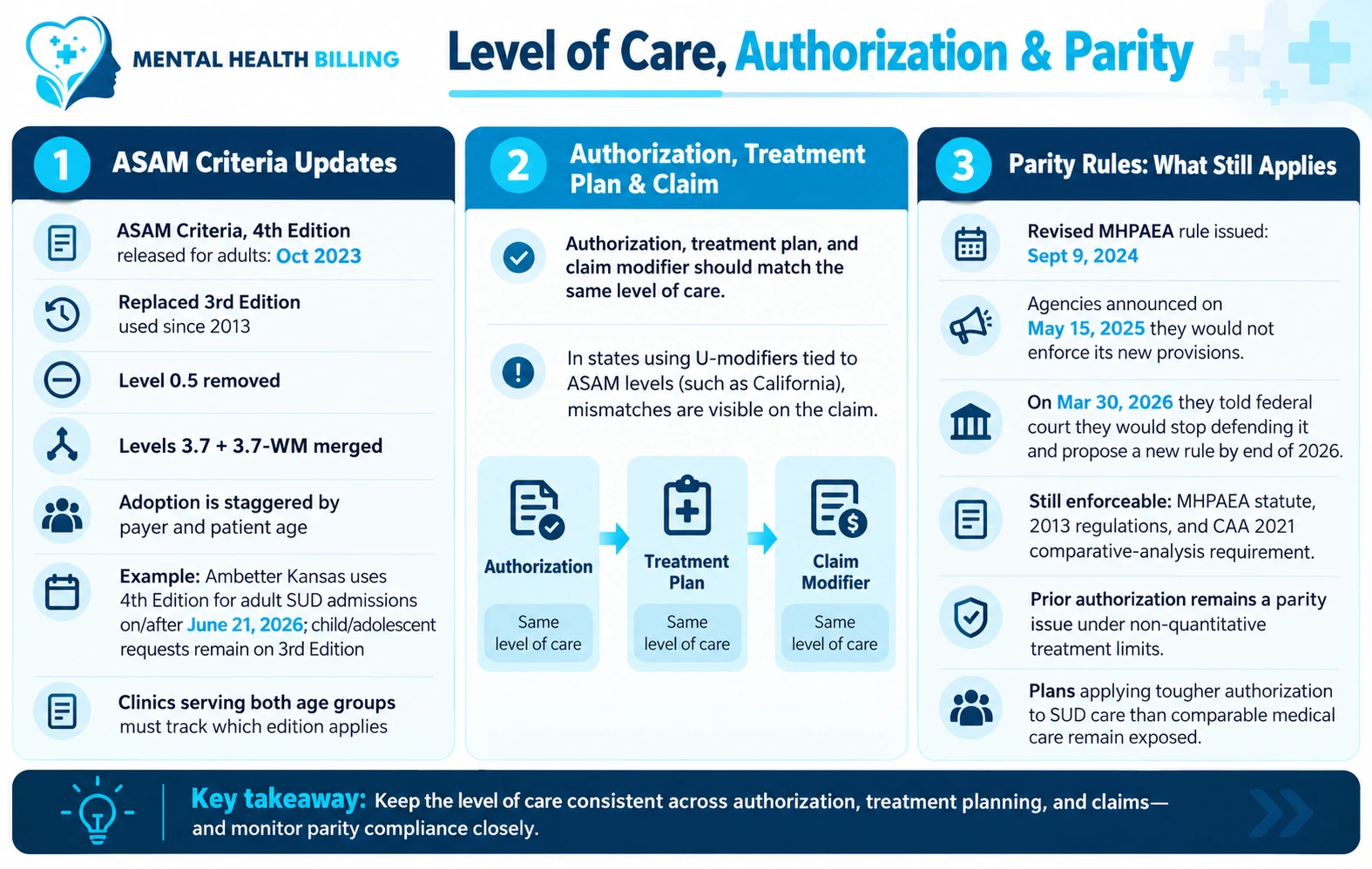
The ASAM Criteria, Fourth Edition, was released for adults in October 2023 and replaced the Third Edition that had been in use since 2013. It removed Level 0.5 (early intervention) and merged Levels 3.7 and 3.7-WM, according to a first-quarter 2026 presentation from California’s DHCS. Adoption is staggered. Ambetter Health’s provider notice for Kansas states that adult SUD admissions on or after June 21, 2026 are reviewed under the Fourth Edition, while child and adolescent requests stay on the Third. A clinic serving both age groups has to track which edition governs each patient.
The authorization, the treatment plan and the claim modifier should name the same level of care. Where U-modifiers map to ASAM levels, as in California, any mismatch is visible on the claim itself.
Parity rules are in flux. The Departments of Labor, HHS and Treasury issued a revised MHPAEA rule on September 9, 2024, announced on May 15, 2025 that they would not enforce its new provisions, and told a federal court on March 30, 2026 that they would stop defending it and issue a new proposed rule by the end of 2026, according to an NFP summary dated April 21, 2026 and an American Psychiatric Association statement dated April 2, 2026. The statute, the 2013 regulations and the comparative-analysis requirement added by the Consolidated Appropriations Act of 2021 remain enforceable. Prior authorization is one of the non-quantitative limits parity covers, so a plan that applies tougher authorization to SUD care than to comparable medical care stays exposed.
42 CFR Part 2 and billing records
42 CFR Part 2 covers federally assisted programs that present themselves as providing substance use disorder (SUD) diagnosis, treatment, or referral services. HHS issued the final rule on February 16, 2024, which took effect on April 16, 2024, with a compliance deadline of February 16, 2026. According to HHS’s fact sheet, patients may now sign one consent covering all future uses and disclosures for treatment, payment and health care operations, which includes billing and claims follow-up. HIPAA covered entities and business associates that receive records under that consent may redisclose them as HIPAA allows, and segregating Part 2 records is no longer required. Separately kept SUD counseling notes are different: they need specific consent and fall outside the broad payment consent.
Billing companies should read their contracts. The rule added business associates to the definition of qualified service organization, according to the law firm Baker Donelson, so vendor agreements need Part 2 language alongside the standard HIPAA terms.
Enforcement is the practical change. On February 13, 2026, HHS announced a civil enforcement program, and the Office for Civil Rights began accepting Part 2 complaints and breach reports on February 16, 2026, according to Quarles & Brady LLP. Part 2 records are now subject to HIPAA-like civil penalties and breach notification requirements. The new right to an accounting of disclosures is deferred until HHS finalizes the matching HIPAA standard at 45 CFR 164.528.
Pre-submission checks for SUD claims
- Identify the payer type first: Medicare G-codes, CPT codes or the state’s H-codes.
- Report one diagnosis code per substance, at the highest documented level.
- Check modifiers and modifier order against the state manual in force on the date of service.
- For OTP claims, verify the seven-day week, place of service 58 and the organizational NPI.
- Match the authorized level of care and ASAM edition to the treatment plan and the claim.
- Confirm a valid Part 2 consent is on file and that the billing vendor’s agreement carries Part 2 terms.
Substance abuse insurance billing requirements in late 2026 rest on four layers: ICD-10-CM hierarchy rules, payer-specific procedure codes and modifiers, ASAM-based authorization, and Part 2 confidentiality. The newest layer, Part 2 enforcement, began on February 16, 2026, and the federal parity rule that shapes plan behavior is expected to receive a proposed replacement before the year ends.