



CPT code 97802 covers the first individual, face-to-face medical nutrition therapy (MNT) visit, where the dietitian performs an initial assessment and starts the intervention. It is billed in 15-minute units. Claims for it usually fail on details rather than the code itself: a missing physician referral, a diagnosis the payer doesn't recognize, or units that don't match the documented time.
This guide covers how 97802 works in practice, how it differs from 97803, what documentation holds up in an audit, and where Medicare and commercial payers diverge.
What Is CPT Code 97802?
CPT 97802 is the code for medical nutrition therapy, initial assessment and intervention, provided individually and face to face with the patient, reported per 15 minutes.
The AMA publishes and copyrights the official descriptor, so check your current CPT book for the exact wording. In practical terms, the code describes a registered dietitian or qualified nutrition professional doing three things during a first encounter:
- Reviewing the patient's medical history, labs, medications, and diet history
- Assessing nutritional status and setting a nutrition diagnosis and care plan
- Delivering the first round of individualized counseling or intervention
It belongs to a small family of MNT codes:
| Code | Service | Unit |
|---|---|---|
| 97802 | Initial assessment and intervention, individual | 15 minutes |
| 97803 | Reassessment and intervention, individual | 15 minutes |
| 97804 | Group MNT (two or more patients) | 30 minutes |
| G0270 | Medicare only: additional individual MNT after a second referral in the same year | 15 minutes |
| G0271 | Medicare only: group MNT following a second referral | 30 minutes |
Many payers also recognize the 97802 family for benefits outside diabetes and kidney disease, including obesity, cardiovascular risk, and certain eating disorder services. Coverage varies widely, which is where most of the billing difficulty comes from.
How CPT 97802 Billing Works
A clean 97802 claim depends on decisions made before the patient walks in. Here is the workflow that produces the fewest denials.
- Verify benefits first. Confirm that the plan covers MNT, whether it needs a referral or prior authorization, how many visits or hours are allowed, and whether a copay or deductible applies. This is the stage that is frequently overlooked. A dedicated eligibility verification process catches most coverage problems before the visit.
- Secure the referral. Medicare requires one from the treating physician. Many commercial plans do too.
- Document the visit with start and stop times, the assessment, the intervention, and the plan.
- Select the code and units. Use 97802 for the initial visit. Count 15-minute units from documented face-to-face time.
- Link diagnoses correctly. Put the payer-recognized diagnosis in the first position and point it to the service line.
- Submit with the right provider details, including the rendering dietitian's NPI and the referring provider's NPI where required.
- Post payments, work the denials, and follow up on aging claims.
Units and Time
Because 97802 is timed, units come from minutes spent with the patient. Many payers apply the CPT midpoint convention, so a unit counts once you've passed the halfway mark of the 15 minutes (8 minutes is the usual shorthand). Some payers set their own rules. Whatever convention you use, apply it the same way every time and make sure the documented minutes support the units billed.
Only face-to-face time counts. Chart review before the visit, phone calls with the referring physician, and writing up the note afterward are not billable minutes.
An Illustrative Scenario
A 58-year-old patient with type 2 diabetes is referred by her primary care physician. The dietitian spends 45 minutes in a face-to-face session covering history, lab review, meal pattern assessment, and initial carbohydrate counseling. That supports three units of 97802, with E11.x as the primary diagnosis and the referring physician's NPI on the claim. If the same patient returns three weeks later for a 30-minute follow-up, that visit moves to 97803.
97802 vs 97803
The difference is about where the patient is in the course of care. It is not about how complex the session is.
| Feature | 97802 | 97803 |
|---|---|---|
| Purpose | Initial assessment and intervention | Reassessment and intervention |
| When used | First MNT encounter for the episode | Follow-up visits after the initial assessment |
| Format | Individual, face to face | Individual, face to face |
| Unit | 15 minutes | 15 minutes |
| Typical visit content | Full history, nutrition diagnosis, care plan, first counseling | Progress review, plan adjustment, further education |
| Typical frequency | Once per patient per episode or benefit period (payer rules vary) | Multiple times, up to the payer's limit |
| Common error | Billed again at every visit | Billed for a first visit |
The mistake that generates the most denials is billing 97802 repeatedly. Most payers treat it as a once-per-patient service, or once per benefit period. A second 97802 for the same patient will usually deny as a duplicate or as an incorrect code for a follow-up.
The opposite error also happens. If a new patient's first visit is billed as 97803, the claim can deny for missing an initial assessment, or it can pay and create audit exposure later.
Most Common Billing Scenarios
New diabetes referral. The standard case: one 97802 visit, then 97803 follow-ups within the allowed hours.
Chronic kidney disease. Medicare covers MNT for non-dialysis kidney disease, and the diagnosis and GFR criteria matter a great deal here (see the Medicare section below).
Weight management or obesity. Coverage is inconsistent across commercial payers. Some cover the 97802 family, some route obesity counseling through other benefits, and some exclude it entirely.
Cardiovascular risk. Hyperlipidemia and hypertension are covered by some commercial plans but not by Medicare under the MNT benefit.
Telehealth visits. Payers vary on whether a video visit can be billed as 97802 and which modifier or place of service applies. Medicare telehealth rules have depended on temporary legislative extensions, so confirm the current status before scheduling.
Returning patient after a long gap. Payers differ on whether a new 97802 is allowed after a year or more without visits. Check the policy rather than assuming.
Documentation Requirements
Auditors read the note to answer one question: does it support the code, the units, and the medical necessity? A good 97802 note stands on its own.
| Element | What to document | Why it matters |
|---|---|---|
| Referral | Referring provider, date, and reason for referral | Medicare requires it, and many commercial plans do |
| Diagnosis | The covered ICD-10 code and clinical basis | Supports medical necessity |
| Relevant clinical data | Labs (such as A1c or GFR), weight, BMI, medications | Shows the need for nutrition intervention |
| Time | Start time, stop time, and total face-to-face minutes | Supports the unit count |
| Assessment | Diet history, nutrition diagnosis, barriers | Distinguishes an initial assessment from a generic conversation |
| Intervention | What was taught and what goals were set | Shows the service was actually delivered |
| Plan | Follow-up timing and monitoring | Supports later 97803 visits |
| Provider credentials | RD credential and signature | Confirms a qualified provider rendered the service |
Two habits cause problems. One is templated notes that read identically across patients, which invites scrutiny. The other is missing time entries. A note that says "counseling provided" without minutes leaves the unit count undefended.
Medical Necessity
Medical necessity means the patient has a condition where nutrition intervention is appropriate and the payer's policy recognizes it. Your documentation should connect the diagnosis, the clinical findings, and the reason for the referral in a way a reviewer can follow in a few seconds.
For example, "type 2 diabetes, A1c elevated above goal, referred for dietary management" is a stronger justification than "dietary counseling requested." The first shows a covered condition and a clear clinical reason. The second gives a reviewer nothing to attach to a coverage policy.
Covered Diagnoses and Payer Rules
What is the covered diagnosis for CPT code 97802? It depends on the payer.
Under Medicare Part B, the MNT benefit applies to:
- Diabetes
- Chronic kidney disease (non-dialysis)
- Kidney transplant, within the period Medicare allows after the transplant
Medicare also sets clinical criteria for these diagnoses, including GFR thresholds for kidney disease. Confirm the current criteria in CMS regulations and your Medicare Administrative Contractor's guidance before you bill.
Commercial payers usually cover a broader or narrower set, depending on the plan. Diagnoses that commonly appear in commercial policies include:
- Diabetes and prediabetes
- Obesity (often with a BMI threshold)
- Hyperlipidemia
- Hypertension
- Certain gastrointestinal, malnutrition, and eating disorder diagnoses
A general code like Z71.3 (dietary counseling and surveillance) is often not sufficient as the sole diagnosis. Payers typically want the underlying condition listed first.
Before billing any of these, pull the specific payer's medical policy. Diagnosis lists change, and two plans from the same insurer can differ.
Medicare Billing Considerations
Medicare's MNT benefit has features that set it apart from most commercial coverage:
- Referral required. The treating physician must refer the patient.
- Limited covered conditions. Diabetes, non-dialysis kidney disease, and post-transplant status.
- Hour limits. Medicare sets an initial-year allotment and a smaller allotment in following years. Additional hours require a new referral in specific circumstances, and that is where G0270 comes in.
- Payment rate. Medicare pays for MNT at a percentage of the physician fee schedule amount, not the full rate. Check the CMS fee schedule lookup for your locality and year.
- Cost sharing. Medicare has generally waived the deductible and coinsurance for MNT. Confirm this for the current year and for the patient's plan type.
- DSMT on the same day. Medicare does not allow diabetes self-management training and MNT to be billed for the same beneficiary on the same date.
- Referring provider on the claim. Include the referring physician's information where the claim form requires it.
- Medicare Advantage. These plans follow their own rules and can add prior authorization or network requirements, so verify each plan separately.
Commercial Insurance Considerations
Commercial coverage is where most practices lose time, because there is no single rulebook. Differences that show up regularly:
- Whether a referral is required at all
- Whether prior authorization is needed for the initial visit or for follow-ups
- Whether visits are limited per year, per lifetime, or per diagnosis
- Whether the plan covers MNT only for certain diagnoses
- Whether registered dietitians can be credentialed and paid directly
- Whether telehealth is reimbursed at parity
Medicare vs. Commercial: Quick Comparison
| Consideration | Medicare | Commercial payers |
|---|---|---|
| Referral | Required from treating physician | Varies by plan |
| Covered conditions | Diabetes, CKD (non-dialysis), post-transplant | Varies; often broader |
| Visit limits | Defined hour allotments | Defined by plan |
| Prior authorization | Not typical in traditional Medicare | Common in some plans |
| Reimbursement basis | Percentage of fee schedule | Contracted rates |
| Best source of rules | CMS and MAC guidance | Payer medical policy and provider manual |
Modifier Usage, If Applicable
97802 does not usually require a modifier, but a few situations can call for one:
- Telehealth modifiers or place-of-service codes. Payers differ on whether they want a telehealth modifier such as 95 or GT, a specific place-of-service code, or both. Follow the individual payer's instruction.
- Modifier 33 (preventive service). Some commercial plans want this on services covered as preventive care under the ACA. Not every plan uses it.
- Non-covered service modifiers. If a Medicare patient does not meet coverage criteria and you plan to bill anyway, the appropriate advance notice process and modifiers apply.
Don't add modifiers by habit. An unnecessary modifier can trigger a denial just as easily as a missing one.
Common Billing Mistakes
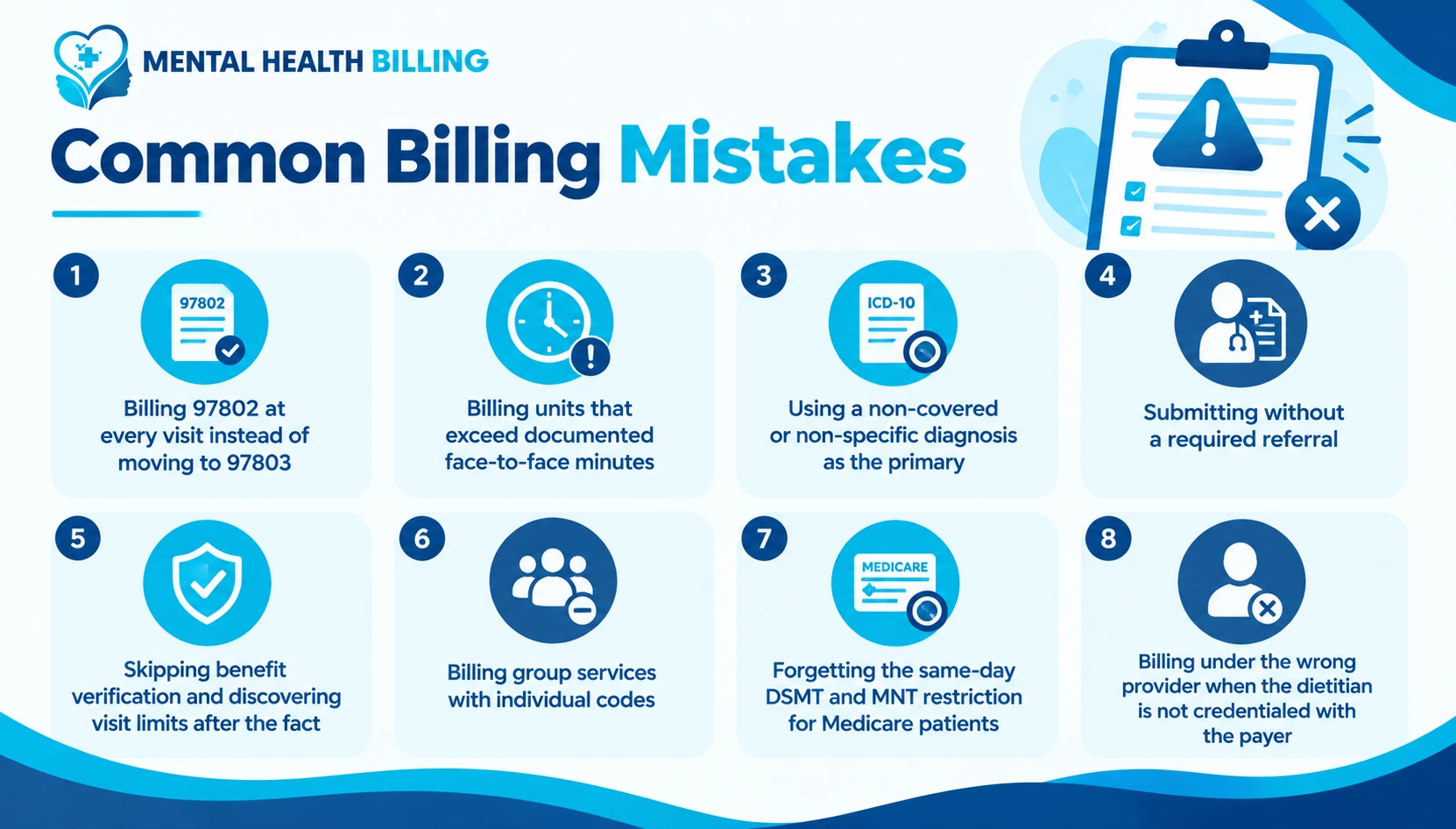
Common Denials
| Denial reason | Likely cause | Prevention |
|---|---|---|
| Diagnosis not covered | Wrong or non-specific primary ICD-10 code | Match diagnosis to payer policy before billing |
| No referral on file | Missing or unlinked physician referral | Collect and store the referral before the visit |
| Duplicate service | 97802 billed more than once | Use 97803 for follow-ups |
| Benefit limit exceeded | Visits or hours used up | Verify remaining benefits at scheduling |
| Provider not eligible | Dietitian not credentialed or enrolled | Confirm enrollment before scheduling |
| Authorization missing | Prior auth not obtained | Check requirements at verification |
| Units not supported | Documentation lacks time | Record start and stop times |
When denials do occur, speed matters. A structured denial management process helps you sort correctable errors (fix and resubmit) from true coverage denials (appeal). Claims that sit unresolved become harder to collect, so a defined A/R follow-up process keeps aging balances from stalling.
Correct Coding Examples
Example 1: Medicare, diabetes. Referral on file, 40 minutes face to face. Bill 97802 × 3 (using the midpoint rule, 40 minutes supports three units), primary diagnosis E11.x, referring physician listed.
Example 2: Commercial, obesity with a BMI-based policy. The plan covers obesity counseling with a BMI threshold. Bill 97802 with the obesity diagnosis and the BMI documented in the note. Some plans also expect a Z68 BMI code as a secondary.
Example 3: Follow-up visit. Same patient returns for 30 minutes. Bill 97803 × 2. Do not use 97802 again.
Example 4: Same-day DSMT and MNT for a Medicare patient. Only one of the two can be billed for that date of service. Schedule them on separate days.
Real Practice Scenarios
The referral gap. A small nutrition practice sees several new patients a week. Their denials cluster around "no referral on file." The fix is a scheduling rule: no initial appointment is confirmed until the referral is uploaded and matched to the patient.
The diagnosis mismatch. A dietitian consistently lists Z71.3 as the only diagnosis on 97802 claims. Two payers deny it as non-specific. Adding the underlying condition and resubmitting resolves most of them, and the intake form is updated to capture the diagnosis at the start.
The credentialing surprise. A new dietitian joins a practice and starts seeing commercial patients before enrollment is complete. Claims are rejected due to an unqualified rendering provider. Building credentialing status into the scheduling system prevents the problem.
These scenarios are illustrative, but the patterns are common across practices.
Coding Tips for Better Reimbursement
- Confirm coverage prior to the initial visit and record the confirmation.
- Record the diagnosis and referral at the time of intake, rather than post-visit.
- Log beginning and ending times in each note.
- Keep a payer-by-payer reference sheet with diagnosis rules, visit limits, and authorization requirements.
- Audit a sample of claims each quarter for unit accuracy and diagnosis linkage.
- Track denial reasons by payer so you can spot patterns.
- Post payments promptly and compare them against expected rates, since underpayments are easy to miss.
For teams that want help with code selection and claim accuracy, medical coding support can add a second layer of review before submission.
Compliance Checklist
- Benefits and eligibility verified and recorded
- Referral obtained and stored
- Rendering provider credentialed and enrolled with the payer
- Note includes assessment, intervention, plan, and provider signature
- Start time, stop time, and total minutes documented
- Units match documented face-to-face time
- Primary diagnosis is payer-recognized and clinically supported
- 97802 billed only for the initial visit
- Payer-specific modifier and place-of-service rules followed
- Prior authorization obtained when required
- Records retained according to payer and legal requirements
How Professional Billing Support Helps
Nutrition practices often run lean. The dietitian is also the scheduler, the biller, and the person chasing referrals. That is manageable at low volume, but it gets harder as payer mix grows.
A billing partner can help with the parts of 97802 that cause the most revenue loss: eligibility checks, claim scrubbing, denial follow-up, and tracking payer rule changes. You can see the full range on the services page, and the about page explains who is behind the work. If you have a specific claim problem, the contact page is the fastest way to reach the team.
Whether you outsource or not, the underlying discipline is the same: verify early, document precisely, and follow up consistently.
2026 Billing Updates and Payer Trends
Some themes are worth watching this year, though you should confirm details with current payer and CMS sources:
- Medicare Physician Fee Schedule changes. Annual updates affect payment levels, and MNT is paid as a percentage of the fee schedule rate, so check the current year's amounts.
- Telehealth policy. Medicare telehealth flexibilities have depended on time-limited legislative action, so confirm what applies to your service dates.
- Prior authorization scrutiny. Many commercial plans continue to tighten authorization requirements and documentation review.
- Growing interest in nutrition-related benefits. Payer attention to diabetes, obesity, and cardiometabolic care keeps MNT relevant, but coverage still varies.
- Code set updates. Review the current-year CPT and HCPCS releases each January for any changes affecting MNT codes.
I have deliberately not listed specific 2026 dollar amounts. Reimbursement rates change by locality and payer, and the CMS fee schedule lookup tool and your payer contracts are the reliable sources.
Key Takeaways
- 97802 is the initial individual MNT code, billed per 15 minutes.
- Follow-up visits belong under 97803, not 97802.
- Medicare covers MNT for diabetes, non-dialysis kidney disease, and post-transplant status, with a physician referral.
- Commercial payers vary, so verify each plan's policy.
- Documented time, a supported diagnosis, and a referral prevent most denials.
- Regular claim audits and denial tracking protect revenue.
Conclusion
CPT 97802 looks simple, but it sits at the point where coding, coverage, and documentation meet. Practices that verify benefits early, keep notes precise, and treat denial patterns as feedback get paid faster and face less audit risk. Those that treat it as a routine code tend to lose money on small, avoidable errors.
Use this guide as a working reference, and confirm specifics against your payers' current policies and CMS guidance before billing.
Frequently Asked Questions
What is the CPT code 97802?
It is the code for the initial individual, face-to-face medical nutrition therapy visit, including assessment and intervention, billed per 15 minutes.
What distinguishes CPT codes 97802 and 97803 from each other?
97802 covers the initial assessment and intervention. 97803 covers reassessment and follow-up intervention on later visits. Both are individual and billed per 15 minutes.
What diagnosis is covered by CPT code 97802?
Medicare covers MNT for diabetes, non-dialysis chronic kidney disease, and kidney transplant status. Commercial coverage varies by plan and may include obesity, hyperlipidemia, hypertension, and other conditions.
Who can bill CPT 97802?
Registered dietitians and other qualified nutrition professionals who meet the payer's requirements and are enrolled or credentialed with that payer.
Is it possible to bill 97802 multiple times for an individual patient?
Usually not within the same episode or benefit period. Payer policies differ on when a new initial visit is allowed.
How many units of 97802 can I bill?
It depends on documented face-to-face time and the payer's unit rules, along with any visit or hour limits on the plan.
Is a referral required to bill 97802?
Medicare requires one from the treating physician. Many commercial plans do as well, but not all.
Does 97802 need prior authorization?
Certain Medicare Advantage and commercial plans mandate it. Traditional Medicare typically does not. Check with each payer.
Can 97802 be billed by telehealth?
Some payers allow it, sometimes with a specific modifier or place of service. Verify the existing regulations for your payment provider and service dates.
Does 97802 require a modifier?
Not usually. Modifiers may apply for telehealth or for plans that use a preventive service indicator.
Can I bill 97802 with Z71.3 alone?
Often not. Many payers want the underlying medical condition as the primary diagnosis.
Can MNT and DSMT be billed on the same day under Medicare?
No. Medicare does not allow both for the same beneficiary on the same date of service.
What is the reimbursement rate for CPT 97802?
It varies by payer, locality, and year. For Medicare, use the CMS fee schedule lookup and remember MNT is paid at a percentage of the fee schedule amount. For commercial plans, refer to your contract.
What are the most common reasons 97802 claims deny?
Non-covered or non-specific diagnoses, missing referrals, duplicate billing, exceeded benefit limits, and providers who are not credentialed with the payer.
What should I do if a 97802 claim is denied?
Identify the denial reason, correct any error, and resubmit if appropriate. If the denial is a true coverage issue, file an appeal with your documentation and the payer's policy in hand.